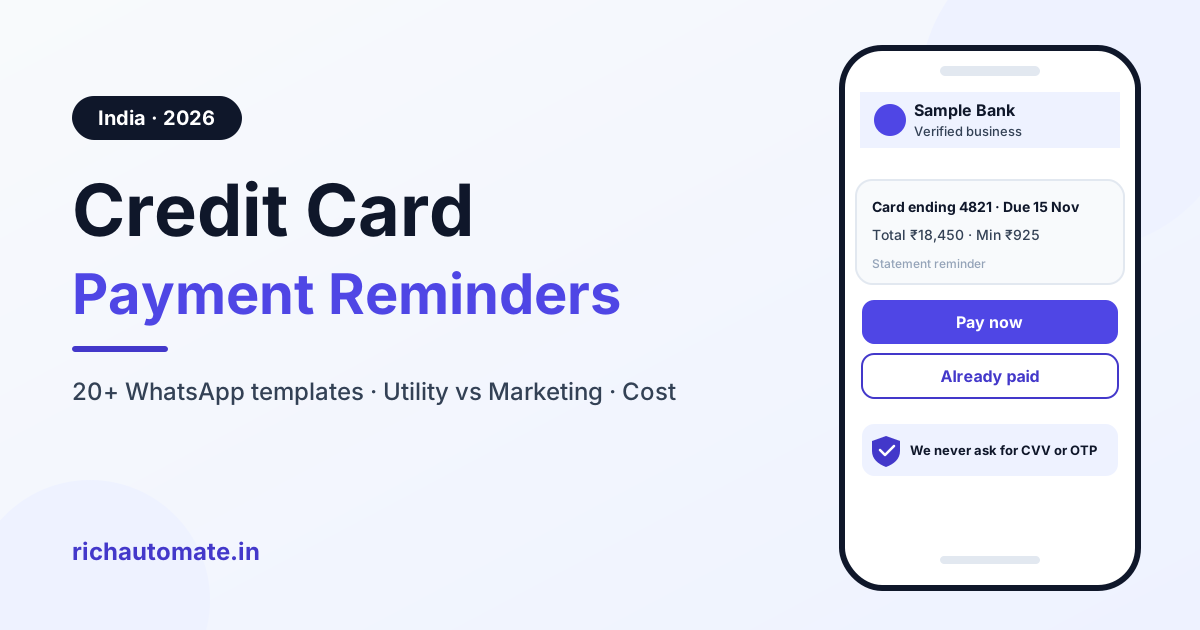
A credit card payment reminder message is a short notice that states the masked card (for example, card ending 4821), the total amount due, the minimum amount due, the due date and one safe way to pay: the official app, netbanking, UPI or a verified payment link. It never asks for the card number, CVV, OTP or PIN. Example: "Your card ending 4821 statement is ready. Total due ₹18,450.00, minimum due ₹925.00, due 15 Nov 2026. Pay in the official app, netbanking or UPI. We never ask for your CVV, OTP or PIN." On WhatsApp, due-date reminders, statement alerts and payment-received confirmations to existing cardholders are Utility templates, at about ₹0.115 per delivered message at Meta's India rate; card upgrades, limit-increase pitches and EMI-conversion offers are Marketing templates, at about ₹0.8631 (BSP-reported; Meta revises rates; confirm the live rate card).
What a credit card payment reminder must contain
A credit card payment reminder should state the masked card, the total and minimum amount due, the due date and one safe way to pay.
Always include:
- Issuer name.
- Masked card: last 4 digits only.
- Statement date, total amount due, minimum amount due and due date.
- Safe ways to pay: official app, netbanking, UPI or your own domain.
- The next step, stated neutrally: "as per your card's terms".
- A help channel, such as a Talk to support button.
- "We never ask for your CVV, OTP or PIN."
Never include the full card number, CVV, OTP or PIN requests, threats, shaming, legal language in early reminders, fake urgency, short links from unknown domains or a staff member's personal number.
For statement timelines, the minimum amount due, late-fee timing, interest and credit reporting, follow the RBI's current credit card directions and your card's most important terms and conditions (MITC); check with your compliance team.
The billing-cycle message map
| Stage | Trigger | Template category | Key variables |
|---|---|---|---|
| Statement generated | Statement run | Utility | Card ending, totals, due date |
| 7 days before due | Due date minus 7 | Utility | Card ending, due date, amounts |
| 3 days before due | Due date minus 3 | Utility | Card ending, due date, minimum due |
| Due today | Due date | Utility | Card ending, amounts |
| Paid in full | Payment posted, balance cleared | Utility | Amount, date, reference |
| Partial or minimum paid | Payment posted, balance left | Utility | Amount paid, balance |
| Auto-debit scheduled | AutoPay active | Utility | Debit date, amount |
| Auto-debit failed | Bank return | Utility | Amount, bank reason |
| Missed, day 1 | No payment posted | Utility | Due date, minimum due |
| Missed, day 7 | Still unpaid | Utility | Overdue amount |
| Missed, day 15 | Still unpaid; firm, respectful | Utility | Overdue amount |
| Help or hardship | Cardholder replies HELP | Free-form reply in the 24-hour window | Request reference |
20 credit card payment reminder templates
No template starts or ends with a variable or puts two side by side, because Meta rejects those.
Statement generated
Hi {{1}}, your statement dated {{2}} for card ending {{3}} is ready. Total due: {{4}}. Minimum due: {{5}}. Due date: {{6}}. View it in the official app. We never ask for your CVV, OTP or PIN.
Key: name, statement date, card ending, total due, minimum due, due date.
Upcoming due (7 days and 3 days)
Hi {{1}}, payment for card ending {{2}} is due on {{3}}. Total due: {{4}}. Minimum due: {{5}}. Pay in the official app, netbanking, UPI or with Pay now. Already paid? Please ignore this.
Key: name, card ending, due date, total due, minimum due.
Hi {{1}}, card ending {{2}} is due in 3 days, on {{3}}. Minimum due: {{4}}. Tap Pay now to pay on our official website, or Already paid if you have paid.
Key: name, card ending, due date, minimum due.
Due today
Hi {{1}}, today is the due date for card ending {{2}}. Total due: {{3}}. Minimum due: {{4}}. Pay in the official app or tap Pay now. Already paid? Tap Already paid.
Key: name, card ending, total due, minimum due.
Minimum due vs total due
Hi {{1}}, on card ending {{2}}, paying the total due of {{3}} clears this statement. The minimum due of {{4}} is the smallest payment needed by {{5}}. Any unpaid balance is handled as set out in your card's MITC. Reply HELP with questions.
Key: name, card ending, total due, minimum due, due date.
AutoPay scheduled
Hi {{1}}, AutoPay for card ending {{2}} will debit {{3}} from your bank account ending {{4}} on {{5}}. Please keep enough balance. To change it, use the official app before the debit date.
Key: name, card ending, amount, bank account ending, debit date. More patterns in UPI AutoPay mandate reminders on WhatsApp.
Auto-debit failed: pay manually
Hi {{1}}, the AutoPay debit of {{2}} for card ending {{3}} could not be completed. Reason from your bank: {{4}}. Please pay by {{5}} in the official app or with Pay now. Already paid? Tap Already paid.
Key: name, amount, card ending, bank reason, due date.
Payment received (full)
Thank you, {{1}}. We received {{2}} for card ending {{3}} on {{4}}. Reference: {{5}}. The total due for this statement is paid, and no action is needed.
Key: name, amount, card ending, date, payment reference.
Partial or minimum payment received
Hi {{1}}, we received {{2}} for card ending {{3}}, which covers the minimum due. The remaining {{4}} carries forward as per your card's terms. You can pay it any time in the official app.
Key: name, amount paid, card ending, remaining balance.
Hi {{1}}, thank you for paying {{2}} on card ending {{3}}. A further {{4}} is needed by {{5}} to cover the minimum due. Tap Pay now, or reply HELP for support.
Key: name, amount paid, card ending, shortfall, due date.
Missed due date (day 1, day 7, day 15)
Hi {{1}}, we have not yet received the payment for card ending {{2}}, due on {{3}}. Minimum due: {{4}}. If you have paid, tap Already paid. Otherwise, please pay in the official app.
Key: name, card ending, due date, minimum due.
Hi {{1}}, the payment for card ending {{2}} is 7 days overdue. Overdue amount: {{3}}. Please pay in the official app or with Pay now, or reply with the date you plan to pay.
Key: name, card ending, overdue amount.
Dear {{1}}, the overdue amount of {{2}} on card ending {{3}} is now 15 days past due. Please clear it soon; next steps follow your card's terms. Facing difficulty? Reply HELP to discuss options.
Key: name, overdue amount, card ending.
Late payment charge applied
Hi {{1}}, a late payment charge of {{2}} has been applied to card ending {{3}} as per your card's schedule of charges. Details are in the official app. Questions? Tap Talk to support.
Key: name, charge amount (from the card system), card ending.
Payment link / UPI
Hi {{1}}, your payment page for card ending {{2}} is ready. Amount due: {{3}}. Tap Pay now to open our official website and pay by UPI or netbanking. We never ask for your CVV, OTP or PIN.
Key: name, card ending, amount due. Pay now is a URL button.
Dispute or help acknowledgement
Hi {{1}}, we have received your request about card ending {{2}}. Reference: {{3}}. We will update you here by {{4}}. Never share your CVV, OTP or PIN with anyone, including our staff.
Key: name, card ending, request reference, update date.
Hi {{1}}, thank you for telling us about difficulty paying card ending {{2}}. Our team will reply here during working hours to discuss options under your card's terms. Your reference is {{3}}. Thank you.
Key: name, card ending, request reference.
Anti-fraud safety reminder
Safety note from {{1}}: messages about card ending {{2}} come only from this verified account and link only to our official website. We never ask for your card number, CVV, OTP or PIN. If anyone asks, tap Talk to support.
Get a 1-minute BSP audit on WhatsApp
Drop your WhatsApp number — we line-item your current invoice against Meta India rates in under 60 seconds. India-hosted, DPDP-compliant.
Key: issuer, card ending.
BNPL / pay-later due
Hi {{1}}, your pay-later bill of {{2}} for account ending {{3}} is due on {{4}}. Pay in the official app or tap Pay now. Already paid? Tap Already paid. We never ask for your OTP or PIN.
Key: name, amount, account ending, due date.
Consumer-durable EMI due
Hi {{1}}, your EMI of {{2}} for the {{3}} on loan ending {{4}} is due on {{5}} and will be debited through your mandate. To pay another way, tap Pay now. Already paid? Please ignore this.
Key: name, EMI amount, product, loan ending, due date.
Template variable map
Fill every variable from a system of record. A missing amount, date or reference should hold the send. A wrong amount in a payment reminder does far more damage than a generic greeting.
| Variable | What it holds | Example value | Source system |
|---|---|---|---|
| Card ending | Last 4 digits only | 4821 | Card management system |
| Total due | Full statement balance | ₹18,450.00 | Card management system |
| Minimum due | Smallest payment due | ₹925.00 | Card management system |
| Due date | Payment due date | 15 Nov 2026 | Card management system |
| Bank reason | Auto-debit return reason | Insufficient balance | Core banking |
| Payment reference | Posted payment ID | CC-REF-20418 | Payment gateway / UPI |
| Overdue amount | Unpaid after due date | ₹925.00 | Collections CRM |
Utility vs Marketing for card messages
On WhatsApp, a due-date reminder to an existing cardholder is a Utility template; a limit-increase or EMI-conversion offer is a Marketing template. Meta classifies by content, not the category you pick.
| Message | Category | Why |
|---|---|---|
| Statement, due-date or auto-debit-failed alert | Utility | Update on an existing account |
| Payment received | Utility | Confirms a completed transaction |
| OTP | Authentication | One-time passwords have their own category |
| Card upgrade or limit increase | Marketing | Sells a new product or more credit |
| Reward-points promo | Marketing | Drives new spending |
| EMI-on-purchase or EMI-conversion offer | Marketing | Promotes a credit product |
| "Pay with card and save" | Marketing | Incentive tied to spending |
| Due alert with "upgrade now" | Marketing risk | Mixed content usually lands in Marketing |
A single promotional line, such as an offer, discount or "upgrade now", can get a template re-categorised as Marketing, which costs about 7.5 times as much. Send offers separately. Marketing messages also face a per-user frequency cap shared across businesses; Utility and Authentication messages are not paced (verify current Meta docs).
Use a Pay now URL button to your official domain plus Already paid and Talk to support quick replies; button text is capped at 25 characters. See WhatsApp message template categories and WhatsApp template rejected reasons and fixes.
Fraud-safe and compliant reminders
A genuine card reminder never asks for your CVV, OTP or PIN. Scams copy issuer alerts, so use a verified profile with a consistent display name and link only to your official domain.
The RBI's Fair Practices Code and recovery-agent rules bind banks and NBFCs: no harassment, no calls before 8am / after 7pm, dignity of borrower, no contacting references. On WhatsApp, block sends outside 8am-7pm and message only the cardholder. Later stages are covered in our guide to compliant WhatsApp debt collection.
Under the DPDP Act, 2023, banks and NBFCs are data fiduciaries and the BSP is a processor. Keep separate consent flags for service and marketing messages, never let a marketing opt-out switch off fraud alerts, and honour STOP. Legitimate use vs consent: confirm with counsel. See the DPDP readiness checklist for banks and NBFCs. No setup can guarantee a number will never be restricted.
This is not legal advice. Check the current RBI directions with your compliance team.
What card reminders cost on WhatsApp
Assumes 90% Utility (₹0.115) and 10% Marketing (₹0.8631) per delivered message, excluding 18% GST.
| Messages | Meta cost | Client Pay (Meta + ₹0.10/msg) | SaaS Pay (₹0.50 utility / ₹1.50 marketing) |
|---|---|---|---|
| 10,000 | 9,000 × ₹0.115 + 1,000 × ₹0.8631 = ₹1,898.10 | ₹1,898.10 + ₹1,000 = ₹2,898.10 | ₹4,500 + ₹1,500 = ₹6,000 |
| 1,00,000 | ₹10,350 + ₹8,631 = ₹18,981 | ₹18,981 + ₹10,000 = ₹28,981 | ₹45,000 + ₹15,000 = ₹60,000 |
| 10,00,000 | ₹1,03,500 + ₹86,310 = ₹1,89,810 | ₹1,89,810 + ₹1,00,000 = ₹2,89,810 | ₹4,50,000 + ₹1,50,000 = ₹6,00,000 |
From 1 October 2026, Meta charges for service messages (free-form replies inside the 24-hour window) and for utility templates sent inside that window, billed per delivered message at the utility rate. BSPs report the first 1,000 service messages per number each month stay free, but that covers free-form replies, not utility templates. Details: October 2026 WhatsApp API price change. RichAutomate's usage-only pricing has ₹0 setup and ₹0 monthly; plans are Starter ₹499/mo, Pro ₹899/mo and White-label ₹1,199/mo. Meta revises rates; confirm the live rate card.
How to automate the billing cycle without code
- A card system event queues the matching Utility template.
- Schedule T-7, T-3, due-day and day 1, 7 and 15 sends by each card's due date, inside permitted hours.
- Check the balance at send time and stop the moment payment posts; dedupe on card ref + cycle + stage.
- Already paid pauses the sequence and triggers reconciliation.
- A failed auto-debit sends a retry notice with Pay now.
- HELP, disputes and hardship go to a person in a shared inbox.
- Log every send for audit.
Mistakes to avoid
- Reminders after the payment has posted.
- Legal threats in early stages.
- Full card numbers.
- Unverified short links.
- Promotional lines in Utility alerts.
- Sends outside permitted hours.
- Messaging references or family.
- Blasting the whole base on one day.
Ready to move card reminders to WhatsApp? Start a 14-day free trial with 100 free credits. Meta reviews every template, so approval is never assured.
Frequently asked questions
How do I write a credit card payment reminder message?
State the issuer, the card's last 4 digits, the total amount due, the minimum amount due, the due date and one safe way to pay, then add "We never ask for your CVV, OTP or PIN." On WhatsApp, save it as a Utility template with numbered variables.
Is a credit card payment reminder a Utility or Marketing template on WhatsApp?
Utility, at about ₹0.115 per delivered message. Upgrade, limit-increase and EMI-conversion offers are Marketing, at about ₹0.8631, and one promotional line can flip a reminder to Marketing. Meta revises rates; confirm the live rate card.
How can a cardholder tell a genuine card reminder from a scam?
A genuine reminder comes from the issuer's verified account, shows only the last 4 digits, links only to the official website and never asks for the card number, CVV, OTP or PIN.
How much does a credit card reminder cost on WhatsApp?
About ₹0.115 per delivered Utility message plus GST at Meta's India rate. On RichAutomate, Client Pay adds ₹0.10 per message; SaaS Pay is ₹0.50 per utility and ₹1.50 per marketing message, with ₹0 setup and ₹0 monthly.
What hours can lenders send overdue card reminders?
The RBI's Fair Practices Code rules out calls before 8am / after 7pm for banks and NBFCs. Apply the same 8am-7pm window to WhatsApp and message only the cardholder. Confirm current RBI directions with your compliance team.