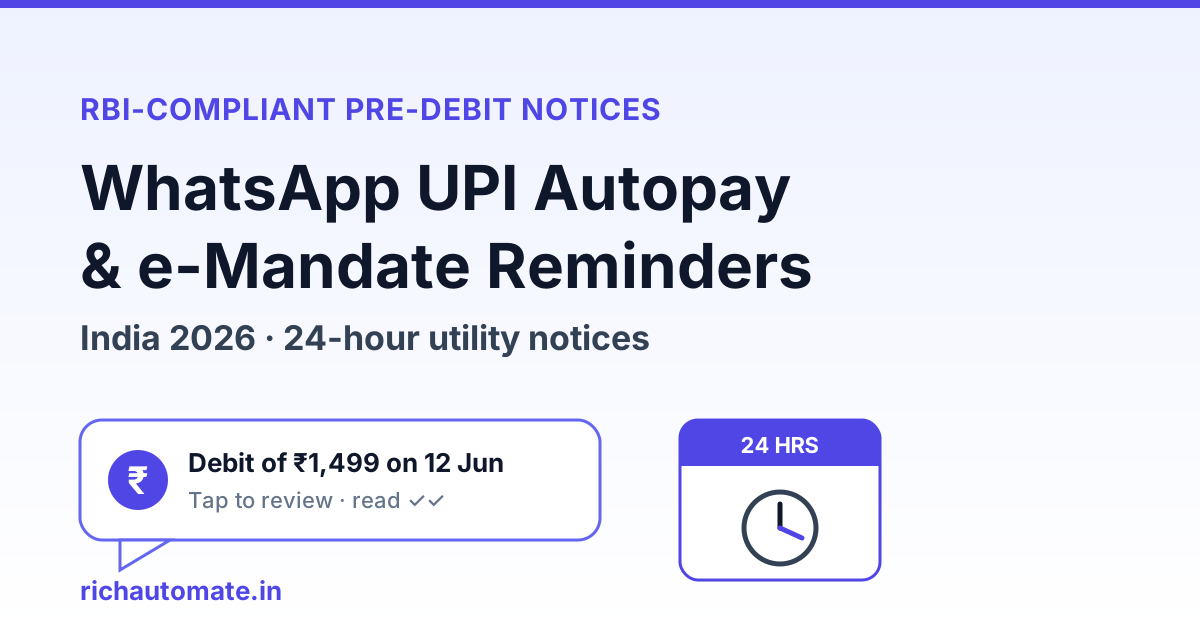
Under the RBI e-mandate framework, every recurring debit — UPI Autopay, eNACH or card-on-file — must be preceded by a pre-debit notification sent to the customer at least 24 hours before the money is pulled. Delivering that notice over the WhatsApp Business API using a utility-category template is the most reliable and lowest-cost way for Indian businesses to stay compliant, cut involuntary churn, and rescue failed mandates before they lapse.
Recurring collections have exploded in India. UPI Autopay now powers a large and fast-growing share of subscription and EMI debits, running alongside older eNACH and card-on-file mandates. But mandates fail quietly — insufficient balance, an expired card, a paused autopay — and industry benchmarks put involuntary churn (revenue lost to failed debits rather than deliberate cancellation) at roughly 8–15% of recurring collections, with NACH bounce rates in some lending books sitting in the 20–30% range on the first presentation. A well-timed WhatsApp nudge before the debit is the single cheapest lever to move both the compliance number and the churn number at once.
What the RBI pre-debit notification rule actually requires
The Reserve Bank of India's framework for processing e-mandates on recurring transactions requires the issuer or the merchant to send a pre-debit notification to the customer at least 24 hours before the actual charge. The notice must clearly state the merchant name, the amount, the date of debit, and a reference to the mandate, and it must give the customer a way to opt out of that particular debit. This applies across UPI Autopay, eNACH/NACH e-mandates, and recurring card payments alike.
The rule is not optional and it is not a one-time consent — it is a per-cycle obligation. A monthly SaaS plan, a 36-month vehicle loan EMI, an annual OTT renewal and a quarterly insurance premium each trigger their own pre-debit notice on their own schedule. That cadence is exactly what breaks manual processes: the moment you have thousands of mandates on different cycles, a spreadsheet and a call centre cannot hit every 24-hour window. Automation is the only way to be provably compliant at scale.
Why WhatsApp beats SMS for the pre-debit notice
SMS was the default pre-debit channel for years, but DLT-registered SMS is a blunt instrument: 160 characters, no rich confirmation, links that trip spam filters, and no read receipt to prove the customer actually saw the notice. WhatsApp utility templates carry the merchant name, the exact rupee amount, the debit date, a PDF of the mandate, and tappable buttons — all inside an opted-in, verified business inbox with delivered and read timestamps you can store as a compliance trail.
| Factor | DLT SMS | WhatsApp utility template |
|---|---|---|
| Proof of receipt | Delivered flag only, often unreliable | Delivered + read timestamps, storable |
| Content | 160 chars, plain text | Amount, date, merchant, PDF mandate, buttons |
| Customer action | None inline | "Pay now", "Update mandate", "Pause" buttons |
| Deliverability | DND blocks, spam folder risk | Opted-in verified inbox, high open rate |
| All-in cost | ~₹0.12–0.20 + DLT overheads | ₹0.30 utility, no setup or monthly fee |
The read receipt matters beyond convenience. When a customer disputes a debit, a timestamped WhatsApp delivery record showing the notice landed and was read 24+ hours before the charge is a far stronger audit artefact than an SMS gateway log. The same reminder mechanics that cut appointment no-shows across Indian clinics and salons apply directly to money owed: a visible, actionable reminder changes behaviour.
The involuntary churn problem, vertical by vertical
Involuntary churn is invisible on a dashboard because it looks like normal attrition. In reality a large slice of it is recoverable: the customer never meant to leave, the debit simply failed. A pre-debit WhatsApp nudge asking the customer to keep sufficient balance, plus an automated retry sequence when a mandate bounces, typically pulls involuntary churn from the 8–15% band down toward 3–6%.
- Lending EMIs: NACH bounces on the 5th or 7th of the month are a top cause of DPD (days-past-due) slippage. A reminder two days before, plus a same-day "your EMI didn't go through, tap to pay" nudge, recovers a meaningful share before it ages into a collections case.
- SaaS subscriptions: failed card-on-file renewals are the classic silent leak. A utility notice before the debit and a dunning sequence after keep MRR intact without a support ticket.
- Insurance premiums: a lapsed premium can void cover entirely. Pre-debit notices paired with grace-period nudges protect both the policy and the renewal. This pairs naturally with efforts to automate insurance premium and policy renewals over WhatsApp.
- OTT and streaming: high-volume, low-ticket renewals where friction kills reactivation. A one-tap update-payment button beats an email nobody opens.
- Gym, edtech and memberships: seasonal balance gaps cause avoidable failures; a nudge preserves the mandate rather than forcing a fresh sign-up.
- Utility bills: recurring auto-pay for electricity, broadband and DTH where a bounced debit means a service cut and an angry call.
How UPI Autopay differs from eNACH and card mandates
All three rails carry the same 24-hour pre-debit obligation, but they behave differently and your reminder copy should reflect that. UPI Autopay mandates are set up through a UPI app and, for higher-value recurring debits, require additional factor authentication (AFA) each cycle above the per-transaction limit NPCI defines for auto-execution; below that threshold the debit runs automatically. That means a UPI Autopay reminder often needs to prompt the customer to approve the mandate execution in their UPI app, not just keep balance ready.
eNACH and NACH mandates, common in lending, pull directly from the bank account on the presentation date, so the failure mode is almost always insufficient balance or a frozen account — here the reminder should push the customer to fund the account a day ahead. Card-on-file mandates, common in SaaS and OTT, fail on expiry, a blocked card or a breached limit, so the reminder should carry an "update card" action. One template engine can serve all three by branching the call-to-action on the mandate type, while keeping the compliant core — merchant, amount, date, opt-out — identical across every rail.
Get the DPDP WhatsApp checklist
A founder-led WhatsApp reply with the DPDP consent + audit-log checklist for WhatsApp Business messaging. India-hosted. No spam.
Getting this branching right matters because a generic "please pay" message underperforms a rail-aware one. A UPI Autopay customer who is told to approve in their app, a lending customer who is told to fund the account, and a SaaS customer who is told to update an expired card each get an instruction they can actually act on within the 24-hour window — which is precisely what converts a reminder into a saved debit.
Template category and cost — utility is the correct, cheap lane
WhatsApp templates are priced by category, and getting the category right is both a compliance and a cost decision. A pre-debit notification is transactional information about an existing agreement, so it is a utility template — the cheaper lane — not a marketing message. Classifying a debit notice as marketing is both more expensive and a category violation risk.
| Message | Category | RichAutomate SaaS Pay | Correct? |
|---|---|---|---|
| Pre-debit notice | Utility | ₹0.30 / msg | Yes |
| Failed-mandate retry | Utility | ₹0.30 / msg | Yes |
| Renewal offer / upsell | Marketing | ₹1.20 / msg | Only for promos |
| Own-WABA send (Client Pay) | Any | ₹0.10 / msg | Pass-through |
RichAutomate charges transparent usage-only pricing: ₹0 setup, ₹0 monthly, Client Pay at ₹0.10 per message on your own WhatsApp number, or SaaS Pay at ₹0.30 per utility message and ₹1.20 per marketing message. For a lender running 50,000 EMI debits a month, pre-debit notices at ₹0.30 cost roughly ₹15,000 — a rounding error against the recovered EMIs and the compliance exposure it removes.
Manual reminders versus an automated engine
The gap between a manual reminder process and an automated one is not cosmetic — it is the difference between sampling your mandates and covering all of them, and between hoping the 24-hour window was hit and being able to prove it.
| Dimension | Manual (call centre / SMS blast) | Automated WhatsApp |
|---|---|---|
| 24-hour timing | Error-prone, missed windows | Scheduled per mandate to the minute |
| Coverage | Sampled, high-value only | 100% of active mandates |
| Retry on bounce | Manual follow-up if any | Automated retry sequence |
| Audit trail | Fragmented logs | Delivered + read per debit |
| Involuntary churn | 8–15% | 3–6% |
Failed-mandate retries and renewal nudges
The pre-debit notice is only half the flow. When a mandate actually bounces — insufficient funds is the dominant reason — the winning pattern is a short, escalating retry sequence: an immediate "your payment of ₹X didn't go through" utility message with a one-tap pay link, a follow-up 24–48 hours later, and a final grace-period notice before the mandate is marked delinquent. Each step is a utility template at ₹0.30, and the whole sequence usually costs less than a single collections call.
Renewal nudges sit slightly apart. A neutral "your annual plan renews on the 12th for ₹X" is utility; a "renew now and get two months free" upgrade is marketing at ₹1.20 and needs a marketing opt-in. Keep the two cleanly separated so your utility deliverability stays clean and your costs stay predictable.
Building it on the WhatsApp Business API
To run this at scale you need a WhatsApp Business API account (not the consumer app), pre-approved utility templates for each notice type, and a scheduler that reads your mandate calendar and fires each notice inside its 24-hour window. RichAutomate handles the template approval workflow, the per-mandate scheduling, delivery-receipt capture, and the retry sequences out of the box, so your billing system only has to emit mandate events.
Volume governance matters here because pre-debit notices are high-frequency and time-critical. New WhatsApp numbers start with lower daily limits and graduate as quality stays high, so you need to climb the messaging tier ladder before a month-end debit spike, and you must keep utility templates landing in the inbox by keeping content clean and opt-outs honoured. A blocked-quality number the day 50,000 EMI notices are due is a compliance and revenue emergency.
The ROI maths for an Indian recurring book
The business case writes itself once you put rupees against it. Take a lender collecting 50,000 EMIs a month at an average ticket of ₹6,000. If involuntary failures sit at 12% and even a third of those are recoverable with timely nudges, that is 2,000 EMIs, or roughly ₹1.2 crore of debits, pulled back into the same month instead of ageing into overdue. The cost to send the pre-debit notice, a failed-mandate alert and one retry to all 50,000 mandates is around ₹45,000 in utility messages at ₹0.30 each. A return of that order against a mid-five-figure spend is why recurring-collection teams treat WhatsApp reminders as infrastructure, not a marketing experiment.
For subscription businesses the arithmetic is about retained MRR rather than rescued principal, but the shape is the same: every renewal saved before it silently fails is margin you keep without spending on reacquisition, which in Indian SaaS and OTT typically costs many times a single utility message. Track three numbers to prove it — notice delivery and read rate, debit success rate before versus after, and recovered value from the retry sequence — and the programme justifies itself inside the first billing cycle.
Compliance guardrails to keep it clean
A few non-negotiables keep the programme on the right side of both RBI and WhatsApp policy. Send the notice at least 24 hours ahead — build in buffer, do not cut it fine. Always include merchant name, amount, debit date and an opt-out path. Store the delivered and read timestamps against the debit record as your audit trail. Keep pre-debit and retry messages in the utility category and never dress a debit notice up as a promo. Honour every pause or opt-out instantly and reflect it in the mandate.
Done right, one utility template engine covers the RBI 24-hour rule, drops involuntary churn by more than half, and gives you a defensible audit trail — all at ₹0.30 a message with no setup or monthly fee.
Get compliant pre-debit reminders live
Stop leaking recoverable revenue to silent mandate failures and stop guessing whether your pre-debit notices hit the 24-hour window. Create your free RichAutomate account to set up compliant UPI Autopay and e-mandate reminders on the WhatsApp Business API — usage-only pricing, no setup fee, live in a day.