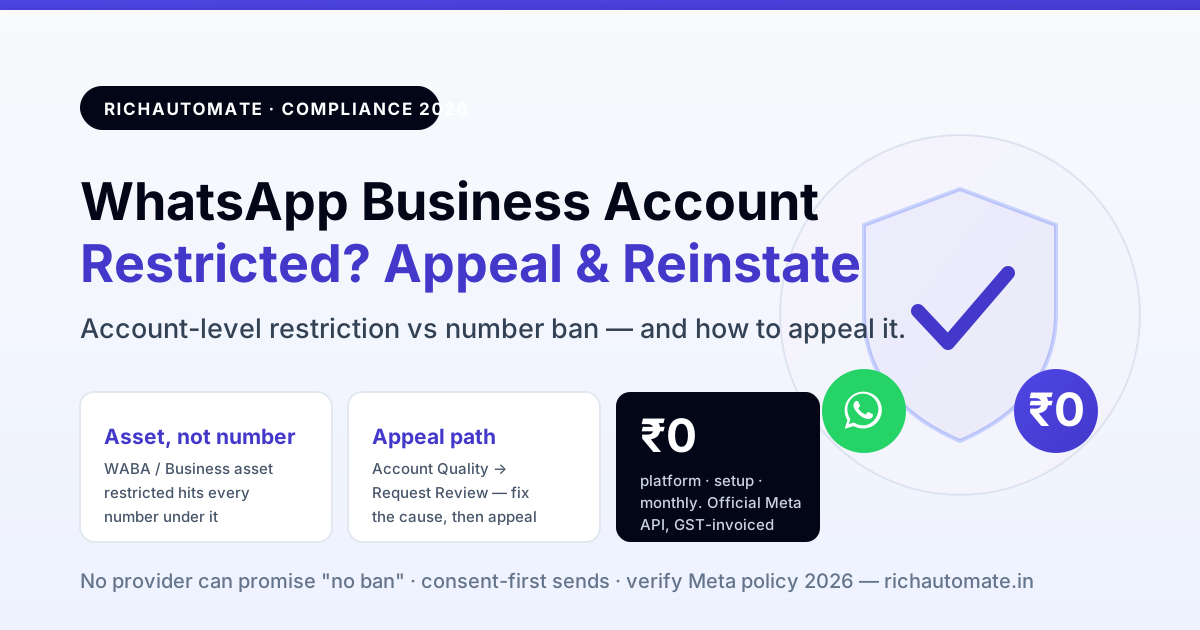
If your WhatsApp Business account is restricted, Meta has flagged the whole business asset — your WhatsApp Business Account (WABA) or the Business Portfolio it sits inside — not just one phone number, so every number under it can lose the ability to send, add templates, or scale messaging at once. The fix is not to spin up a new number; it is to open Account Quality in Business Manager, read the exact restriction reason, fix the underlying cause, and submit a Request Review appeal. Here is how an account-level restriction differs from a single-number ban, why Meta imposes one, and the step-by-step appeal — verify every mechanic against current Meta policy in 2026, because the thresholds and screens change.
Account restriction vs number ban — they are not the same problem
People use "banned" for two very different things, and the fix differs. A number ban hits a single phone number — that number stops sending while the rest of your account keeps working, and you troubleshoot it at the number level (see why a WhatsApp Business number gets banned). An account restriction is bigger: Meta limits the WABA or the whole Business Portfolio, so every number attached to it is affected — you may be blocked from messaging, from creating templates, or from raising your messaging limit until the account is cleared. Knowing which one you have tells you where to look and what to appeal.
| Signal | Number ban | Account (WABA) restriction |
|---|---|---|
| What is affected | One phone number | The whole business asset — all numbers under it |
| Where you see it | Number status in WhatsApp Manager | Account Quality / Business Manager notification |
| Typical trigger | That number's quality or a specific policy hit | Repeated violations, integrity/verification issues, or a portfolio-level flag |
| How you fix it | Number-level: warm up, clean list, wait out | Account Quality → Request Review appeal after fixing the cause |
Why Meta restricts a whole WhatsApp Business account
An account restriction is Meta protecting the platform from a business-level pattern, not a one-off. It usually follows the same root causes as a number ban, but repeated or serious enough to distrust the whole asset. The common triggers:
- Repeated policy violations across numbers. One number getting reported is a number problem; the same pattern on several numbers reads as a business that does not respect the rules.
- Sending to people who did not opt in. Scraped or purchased lists drive blocks and spam reports — the single fastest route to a restriction. Consent is also a DPDP Act obligation in India, not just a Meta rule.
- Business verification or integrity issues. An unverified, incomplete, or mismatched business profile, or a Business Portfolio flagged during an integrity check, can restrict the asset until you resolve it.
- Payment or trust signals. Failed billing, a disputed payment method, or a newly created portfolio behaving like a high-volume sender on day one raises risk.
- Prohibited or restricted-goods content. Messaging around categories WhatsApp does not allow can restrict the account outright.
The restriction ladder — from warning to disabled
Meta rarely jumps straight to a permanent switch-off. There is an escalation, and each rung is a chance to fix the cause before the next. Treat the first notice as the real deadline.
- Low quality / warning: your account or a number drops to a low quality rating and you are flagged — still sending, but this is the moment to act.
- Messaging-limit hold: Meta stops you moving up the tiered messaging limits, or drops you a tier, until quality recovers.
- Restricted: the account is limited — blocked from sending, from adding templates, or both — pending a review you must request.
- Disabled: the end of the ladder. Continued or severe violation disables the asset. Recovery here is hard and not guaranteed; prevention is the only reliable strategy.
The exact tier names, thresholds and durations are set by Meta and change — confirm the current state in your Account Quality view rather than trusting a number you read once. What does not change is the shape: warning, limit hold, restriction, disable.
Get the DPDP WhatsApp checklist
A founder-led WhatsApp reply with the DPDP consent + audit-log checklist for WhatsApp Business messaging. India-hosted. No spam.
How to appeal a restricted WhatsApp Business account
Appealing without fixing the cause just gets the appeal rejected. Do the fix first, then request the review.
- Open Account Quality in Business Manager. Go to WhatsApp Manager → Account Quality (or the Business Manager account-status screen). Read the exact restriction reason Meta states — do not guess.
- Identify the real cause. Was it a policy violation, a consent problem, a verification gap, or a billing issue? The reason text points at one; match your fix to it.
- Fix it before appealing. Strip non-opted-in contacts from every list, correct any mis-categorised templates, complete or correct business verification, and resolve billing. An appeal on an unfixed account fails.
- Submit Request Review. Use the Request Review / appeal button in Account Quality. Where a form allows notes, state plainly what went wrong and the concrete steps you took to fix it — specifics beat a generic "please restore".
- Wait without re-submitting. Reviews take time. Spamming multiple appeals does not speed it up and can hurt. Submit once, wait for the decision.
- If it stays disabled, get help through the right channel. If the asset is fully disabled and the appeal is rejected, escalate through your Business Support / BSP or Meta Business support — not by creating throwaway accounts, which compounds the problem.
Preventing the next account restriction
Every restriction traces back to a handful of preventable habits. Fix these once and the account stays healthy:
- Message only opted-in contacts. People who asked to hear from you do not block or report — that is the whole game, and it is a DPDP Act consent requirement too.
- Complete business verification properly. A verified, accurate business profile and portfolio is table stakes for scaling and for surviving integrity checks.
- Warm new numbers, ramp volume. A brand-new asset blasting a big list on day one is the classic restriction trigger — see number warm-up.
- Match template category to content and keep an easy opt-out. Promotions are marketing; alerts and order updates are utility. Honour unsubscribes fast — a quiet opt-out beats a loud block.
- Watch Account Quality, not just the number rating. Catch the warning rung, not the restriction — the account view is where the business-level signal shows first.
- Keep billing clean. A working, undisputed payment method removes a whole class of trust flags.
What it costs to run this properly on RichAutomate
RichAutomate runs on the official WhatsApp Business API (Meta Cloud API) with ₹0 platform fee, ₹0 setup and ₹0 monthly minimum, so keeping your account in good standing costs nothing extra — it is consent-and-verification discipline, not a paid add-on. You pay per conversation on Meta's category rates: Client Pay at ₹0.10/message plus Meta's per-conversation rate, or SaaS Pay at ₹1.20/marketing and ₹0.30/utility conversation all-in. A 14-day trial with 100 free credits and no card lets you test on a small opted-in segment before you scale. Verify current Meta rates, which change periodically — full breakdown in the WhatsApp Business API cost guide. Going live on the official API in India effectively requires GST for business verification — treat GST as required, not optional.
Bottom line
A restricted WhatsApp Business account is a business-level flag — the whole WABA or portfolio, every number under it — not a single-number ban, so the fix lives in Account Quality, not on one phone number. Read the exact reason, fix the real cause (consent, verification, category, billing) before you touch the appeal, submit one Request Review, and wait. Do not evade with a fresh account. Answer the warning at the first rung and the account recovers; ignore it and the ladder ends in a disable that is hard to reverse. Healthy accounts are a consent-and-verification habit — see the platform on features and pricing.
A restriction appeal is far stronger with records attached — see the WhatsApp audit trail to keep.
An open restriction blocks more than sending. It is a common reason a WhatsApp Flow stays stuck in DRAFT even when the Flow JSON validates cleanly.