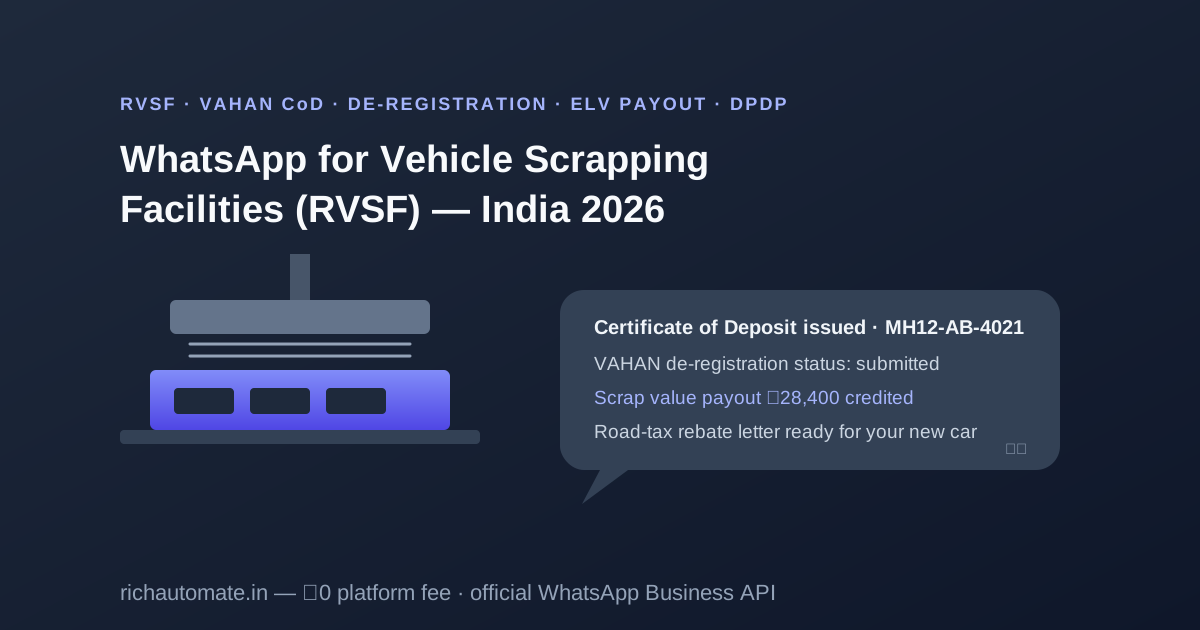
The short answer. A registered vehicle-scrapping facility (RVSF) is the only entity legally allowed to scrap an end-of-life vehicle in India and issue the paperwork - the Certificate of Deposit (CoD) and Certificate of Vehicle Scrapping (CVS) - that a VAHAN de-registration and every scrappage incentive depend on, so the whole business runs on documents, status updates and payouts. WhatsApp on the official Business API is the rail that carries all three: an intake Flow that captures the RC, chassis-number photo and owner KYC in one auditable thread, an instant indicative scrap-value quote plus pickup slot, a document-verification and hypothecation-clearance checklist, then the CoD delivery + VAHAN de-registration status tracker + scrap-value payout confirmation, and finally the new-vehicle road-tax-rebate loop that turns a one-time scrap into a repeat relationship with fleets and dealers. A mid-size RVSF processing ~300 vehicle intakes a month runs the entire loop for roughly ₹1,100-1,800 a month on RichAutomate's ₹0-platform model (illustrative math below). Compliance first: the MoRTH Vehicle Scrapping Policy / V-VMP, the CMVR RVSF registration rules, VAHAN CoD/CVS issuance, CPCB environmentally-sound-dismantling norms, state incentive notifications, and the DPDP Act all govern this trade - verify each with your counsel and the current MoRTH and state circulars before you scrap a single vehicle.
An RVSF is a paperwork business wearing an industrial-yard costume. The scrap steel is the raw material, but the product a customer actually pays for is a clean CoD, a completed VAHAN de-registration and a rebate letter for their next vehicle - and every one of those is a status update that belongs in a WhatsApp thread, not a phone call the owner has to chase.
Why WhatsApp fits registered vehicle scrapping
Scrapping a vehicle is a high-anxiety, document-heavy transaction that most owners do exactly once. A fleet manager retiring ten trucks, or a private owner whose 15-year-old car just failed its fitness test, has the same three questions: what will I get for it, what documents do you need, and how do I know it is really de-registered so I stop being liable for it. That last point is the quiet fear in this trade - an owner who scraps a car but never sees the VAHAN de-registration go through still shows as the registered owner, still on the hook for any misuse of that chassis. A WhatsApp thread that carries the intake checklist, the CoD, the live de-registration status and the payout confirmation answers all three questions in one auditable place. Compared with the reality of most yards today - a WhatsApp personal number, screenshots of RC books, and a ledger nobody can reconstruct six months later - the official API adds intake Flows, approved utility templates, document delivery, a team inbox so no intake dies on one staffer's phone, and a time-stamped record when a de-registration or payout is later disputed.
The WhatsApp template library covers the common message types here if you want a starting point.
| Stage | What happens | WhatsApp job | Category |
|---|---|---|---|
| 1. Scrap enquiry | Owner/fleet wants to scrap; sends vehicle details + condition | Intake Flow: RC, chassis-number photo, make/model/year, fitness/registration status | Utility |
| 2. Indicative quote + pickup | Yard estimates scrap value by weight/category | Written indicative-value quote + pickup or drop-off slot booking | Utility |
| 3. Document verification | RC, owner KYC, NOC/hypothecation-clearance, insurance surrender | Checklist Flow + missing-document nudges + verified confirmation | Utility |
| 4. CoD issuance | Vehicle accepted; Certificate of Deposit generated on VAHAN | CoD PDF delivery + "keep this for your rebate" guidance | Utility |
| 5. De-registration + scrapping | Vehicle dismantled; CVS issued; VAHAN de-registration processed | De-registration status tracker + CVS delivery + payout confirmation | Utility |
| 6. Rebate loop + re-engagement | Owner buys a replacement; fleet plans next batch | Road-tax-rebate letter + new-vehicle dealer handoff + fleet next-batch nudge | Utility + Marketing (opt-in) |
The Certificate of Deposit thread - the money message
The single highest-value automation in this vertical is the document-and-CoD thread. Scrapping stalls on paperwork: a missing hypothecation NOC because the loan was closed years ago but never marked on VAHAN, an RC in a deceased owner's name, an address mismatch, an insurance policy still running. A structured checklist Flow at intake - RC front/back, chassis-number rubbing or photo, owner PAN/Aadhaar for KYC, hypothecation-clearance or bank NOC, and a declaration that the vehicle is not stolen or under legal dispute - lets your back office clear the file in one pass instead of four phone calls over two weeks. Then the CoD itself, delivered as a PDF into the owner's thread the moment it is generated on VAHAN, does two jobs: it is the voucher the owner needs for road-tax rebate and OEM discount on their next vehicle, and it is your proof-of-issuance record. The de-registration status tracker closes the loop on the owner's real fear - a simple "your vehicle is now de-registered on VAHAN; you are no longer the registered keeper" message is the most reassuring thing an RVSF can send, and it is exactly the message yards forget to send today.
Regulator + compliance spine (verify everything)
- MoRTH Vehicle Scrapping Policy / V-VMP - the Voluntary Vehicle-Fleet Modernisation Programme frames the whole regime: mandatory fitness testing at Automated Testing Stations (ATS) for older vehicles (broadly commercial vehicles beyond ~15 years and private vehicles beyond ~20 years - exact ages and enforcement dates differ by category and state), with failed or end-of-life vehicles routed to RVSFs. Verify the current age thresholds, ATS-linkage and enforcement timeline for your state before quoting any owner on eligibility.
- CMVR RVSF registration + operating rules - an RVSF is registered under the Motor Vehicles (Registration and Functions of Vehicle Scrapping Facility) Rules and integrated with the VAHAN scrapping portal; only a registered facility may accept ELVs and issue CoD/CVS. Your registration conditions - site, pollution consent, digital-record obligations - are the licence you operate under; do not let automation imply you can scrap outside them.
- VAHAN CoD + CVS issuance - the Certificate of Deposit (on acceptance) and Certificate of Vehicle Scrapping (after dismantling) are generated on the government portal, and de-registration flows from them. The WhatsApp thread delivers and tracks these documents; it never generates them. Never let a template state a vehicle is de-registered before VAHAN actually confirms it.
- CPCB environmentally-sound dismantling - depollution and dismantling must follow CPCB/SPCB norms (fluid draining, battery and tyre handling, hazardous-waste routing). Owner-facing comms should never promise a timeline that pressures the yard to cut a depollution step; keep the scrapping-completion message tied to actual CVS issuance.
- State incentive notifications - scrappage benefits (road-tax rebate on a new vehicle bought against a CoD - up to ~25% on personal and ~15% on commercial in states that have notified it - plus registration-fee waivers and OEM scrap-discounts) vary sharply by state and change often; as of late 2025 a majority of states/UTs had notified some incentive, but the exact percentage and process differ. State the rebate as "subject to your state's current notification - verify at the RTO", never as a fixed promise.
- DPDP Act 2023 - RC, PAN/Aadhaar, address and bank details for payout are personal data. Collect the minimum needed to process the scrap and payout, state a retention period that satisfies your CMVR digital-record obligation and tax/anti-fraud needs, keep KYC documents out of open team chats, honour deletion requests once statutory retention lapses, and take separate explicit opt-in before any marketing broadcast. See the DPDP compliance checklist.
The carve-out - what the bot must never do
The automation collects documents, delivers a quote a human set, tracks a status VAHAN reports, and confirms a payout finance released. It must never confirm a vehicle is de-registered before VAHAN actually shows it, never generate or fake a CoD/CVS number, never quote a final scrap value that hasn't been set against the weighed vehicle, never promise a specific road-tax rebate percentage as guaranteed, and never accept a vehicle whose documents flag a hypothecation, dispute or possible theft. When an intake smells wrong - chassis number that doesn't match the RC, an owner pushing for cash without KYC, a "lost RC" with no duplicate process started - the correct bot behaviour is to flag a human and pause the file, not to keep the funnel moving. The de-registration and the certificates carry real legal weight; those steps stay with your VAHAN-authorised staff, always.
Get a 1-minute BSP audit on WhatsApp
Drop your WhatsApp number — we line-item your current invoice against Meta India rates in under 60 seconds. India-hosted, DPDP-compliant.
Fleet & bulk-scrap - the B2B pipeline
The volume in this trade is not walk-in private cars; it is fleets. State transport undertakings retiring buses, logistics operators cycling out trucks that failed fitness, government departments scrapping condemned vehicles, and dealers channelling exchange trade-ins that are really end-of-life. A bulk-scrap pipeline on WhatsApp is a different template set: a vehicle-list intake (chassis numbers, RCs, bulk NOC), a batch-status dashboard message ("18 of 40 de-registered, 6 pending hypothecation clearance"), consolidated CoD delivery, and a single reconciled payout statement. For a fleet operator this is the difference between an auditable batch and a nightmare of loose paperwork - and it is exactly the kind of recurring B2B relationship that makes an RVSF's pipeline predictable. The same discipline that a commercial-vehicle fleet operator uses to track live vehicles works in reverse at end-of-life. Used-car and exchange trade-ins that turn out unfit route here too - see how used-car dealerships run their intake.
The new-vehicle rebate loop - re-engagement that pays
Every CoD is a purchase intent. An owner or fleet who just scrapped a vehicle is, by definition, about to buy a replacement - and their CoD unlocks a road-tax rebate and often an OEM scrap-discount on that new vehicle. An RVSF that stops at the payout leaves that intent on the table; one that runs a simple opt-in handoff - "your CoD is valid for a road-tax rebate; want us to connect you to a dealer for the rebate paperwork?" - becomes the useful middle of the owner's next purchase, and a referral partner dealers actually value. Run it as an opt-in message with clear preferences, cap the frequency, and keep the rebate framed as "subject to your state's rules". Fleet-side, a quarterly "you have vehicles approaching fitness expiry - plan the next scrap batch?" nudge keeps supply flowing without buying a single lead. A light CRM tie-in keeps these cohorts clean; the best WhatsApp CRM guide covers the setup.
What it costs - illustrative math on RichAutomate
A mid-size RVSF handling ~300 vehicle intakes a month: intake-Flow confirmations, quotes, document-checklist nudges, CoD and CVS deliveries, de-registration status updates, payout confirmations and rebate-loop handoffs add up to roughly 1,000-1,600 utility messages a month, plus a modest opt-in fleet/rebate broadcast. On Client Pay: ₹0 platform fee + ₹0.10 per message, with Meta's conversation charges billed to you directly by Meta; on SaaS Pay: ₹1.50 per marketing conversation / ₹0.50 per utility conversation, all-in. Monthly cost lands around ₹1,100-1,800 on Client Pay - a rounding error against the value of one clean fleet batch, for the rail that documents every CoD, de-registration and payout. Verify current Meta conversation rates - they change. Full workings in the cost breakdown and the Client Pay vs SaaS Pay guide. Going live on the WhatsApp Business API needs a GST-registered entity - treat GST as effectively required, not optional. 14-day free trial, 100 free credits, ₹0 platform / ₹0 setup / ₹0 monthly.
One-week rollout
- Day 1-2: Official WhatsApp Business API on the yard's business number; build the intake Flow (RC front/back, chassis-number photo, make/model/year, owner KYC basics, hypothecation status).
- Day 3: Indicative-quote, document-checklist and pickup-slot templates submitted for approval; missing-document nudge logic wired.
- Day 4: CoD-delivery, CVS-delivery and de-registration-status templates; payout-confirmation message tied to your finance sign-off; team-inbox routing (private-owner intake vs fleet-batch queue).
- Day 5: Fleet bulk-intake Flow + batch-status dashboard template; opt-in rebate-handoff and fleet next-batch broadcast segments; frequency caps set.
- Day 6-7: Pilot on this week's live intakes, tighten the checklist Flow based on which documents the back office still had to ask for, then switch the yard's number and website enquiry to the WhatsApp intake.
Who fits this / who doesn't
RichAutomate fits the registered vehicle-scrapping facility, ELV-dismantler or fleet-scrap operator that needs the intake, document trail, CoD/de-registration tracking and payout record on a channel that is auditable and team-operable - at ₹0 platform cost, with every CoD, CVS and de-registration staying with VAHAN-authorised staff. An unregistered kabadi yard buying loose scrap doesn't need this - and shouldn't be issuing CoDs at all; a very large multi-site RVSF chain with its own ERP may want deeper custom integration than a WhatsApp-first stack offers out of the box, though the customer-comms layer still fits. Related reading: vehicle service workshops, commercial-vehicle fleet telematics, used-car dealerships, scrap recycling & EPR, and the best WhatsApp CRM guide.
Standing honesty line: no platform - ours included - can promise a ban-proof WhatsApp number, and in this trade the real risk was never a ban; it is an owner who thinks a vehicle is de-registered when VAHAN still shows them as the keeper, or a payout with no paper trail. Keep intake structured, keep the certificates and de-registration with your authorised staff, keep every status in writing. Start the 14-day free trial or see pricing.