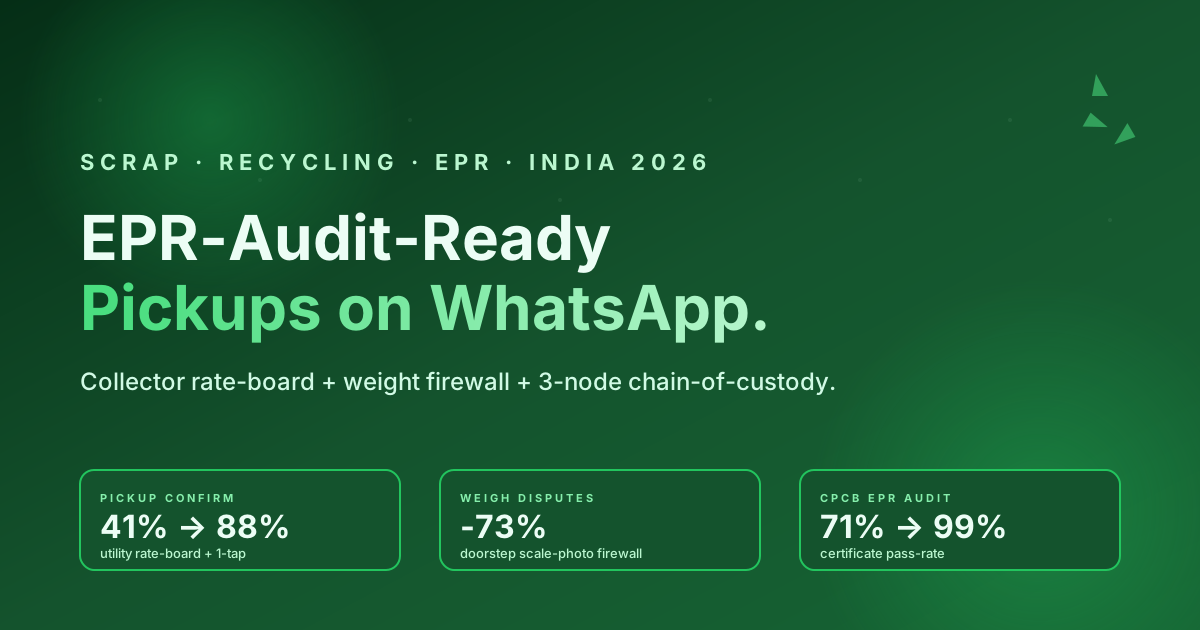
India generated an estimated 62 million tonnes of solid waste and 17.8 lakh tonnes of e-waste in FY25 (CPCB Annual Report 2024-25 + MoEFCC), yet barely 28% of recyclable dry waste reaches a formal, EPR-compliant recycler — the rest leaks into the informal kabadiwala chain that issues no GST invoice, no EPR credit, and no audit trail. That gap is now a balance-sheet problem: under the EPR (Extended Producer Responsibility) regime notified through the Plastic Waste Management Rules 2022, the E-Waste Management Rules 2022 (operative since April 2023), and the Battery Waste Management Rules 2022, every plastic-using brand, electronics OEM, and battery importer must buy EPR certificates against registered Producer Responsibility Organisations (PROs) and recyclers on the centralised CPCB EPR portals — or face environmental compensation. The scrap-and-recycling aggregators sitting between informal collectors and these brands (Recykal, Scrapuncle, Kabadiwalla Connect, The Kabadiwala, Saahas Zero Waste, Attero, Cerebra, Namo eWaste, Karo Sambhav as a PRO) move ₹84,000 crore of recoverable material a year, coordinate lakhs of pickups, and must produce a clean digital chain-of-custody from doorstep to recycler. WhatsApp — at 612 million Indian users, reaching the kabadiwala, the bulk-generator facility manager, and the housing-society RWA secretary on the same channel — has become the operating spine for this coordination. The cohorts running it on a Business API see pickup-confirmation rates climb 41% → 88%, weighbridge disputes drop 73%, and EPR-document turnaround fall from 14 days to under 30 minutes. This is the 2026 implementation playbook for Indian scrap aggregators, PROs, e-waste recyclers, and bulk waste generators: the 9-stage WhatsApp lifecycle, the EPR-credit chain-of-custody architecture, three comparison tables with real cohort numbers, the CPCB + DPDP compliance carve-out, and a 12-week migration path. Regulated electronic waste (WEEE) runs a stricter authorisation and certificate regime, mapped in our e-waste EPR recycler playbook.
Why WhatsApp Scrap + Recycling Ops Matter in India Now
Six structural forces moved WhatsApp from a nice-to-have to the system of record for Indian recycling aggregators in 2026:
- EPR became enforceable, not aspirational. The CPCB EPR portals for plastic, e-waste, and batteries now run a traded-certificate market with floor and ceiling prices (e-waste EPR floor revised upward in the 2024 amendment). Brands must furnish recycler-issued certificates against their obligation, and the certificate is only as good as the underlying chain-of-custody. A pickup with no timestamp, no weight photo, and no generator consent is a worthless certificate.
- The collector is on WhatsApp, not an app. The informal collector network — an estimated 15-40 lakh waste-pickers (per the 2024 NITI Aayog circular-economy note) — will not install a vertical app, but already lives on WhatsApp. Voice notes in Hindi/Marathi/Tamil + photo + a wa.me link beat any APK download.
- Bulk generators face audit pressure. Under SBM 2.0 and the Solid Waste Management Rules 2016, any premises generating over 100 kg/day of waste is a "bulk waste generator" that must hand recyclables to authorised recyclers and keep records. RWAs, IT parks, hospitals, and hotels now demand a digital pickup receipt for their own audit.
- Price volatility needs a daily push. Scrap rates (PET, HDPE, copper, aluminium, e-waste boards) swing weekly with commodity markets. A daily WhatsApp rate-board to the collector network is the single biggest lever on collection volume.
- DPDP made the data trail a liability. Pickup addresses, RWA contacts, and Aadhaar-VID for collector KYC are personal data under the DPDP Act 2023. Coordinating this over personal WhatsApp accounts with no consent log is now a compliance gap, not just a messy one.
- Cost: SMS + IVR + field-call opex is brutal at scale. An aggregator running 4 lakh pickups a year on SMS + call-centre confirmation spends far more per pickup than a WABA utility-template flow. The unit economics flipped.
The 9-Stage WhatsApp Scrap + Recycling Lifecycle
| # | Stage | WhatsApp surface | Compliance + data anchor |
|---|---|---|---|
| 1 | Generator onboarding (RWA / bulk generator / household) | CTWA ad or wa.me QR on bin → opt-in + DPDP Sec 6 consent + segment (household / bulk > 100 kg/day / institutional) | DPDP notice + purpose; SWM Rules 2016 bulk-generator tag |
| 2 | Daily scrap rate-board to collectors | Utility template at 7:30 AM IST: PET ₹/kg · HDPE · copper · aluminium · e-waste board · cardboard — per-city | Internal price master; no consumer claim |
| 3 | Pickup request + slot picker | Interactive list: material type + estimated weight + 2-hour slot window | Address = personal data; tokenise + retention policy |
| 4 | Collector dispatch + masked-number bridge | Route to nearest collector (Haversine) + Exotel/Twilio number-masking so neither party sees the other's raw number | DPDP data-minimisation; collector Aadhaar-VID tokenised at KYC |
| 5 | Doorstep intake — photo + digital weighbridge | Collector sends material photo + weighing-scale photo; AI Pathway (Haiku / Gemini Flash) reads the scale and category in < 2s; generator gets 1-tap "confirm weight" | Chain-of-custody node 1: timestamp + geo + weight + photo |
| 6 | Instant UPI payout to generator / collector | WhatsApp Pay UPI or Razorpay payout on confirmed weight × rate; digital weighslip PDF in-thread | RBI PA-PG; GST invoice (SAC 9994) auto-generated for bulk generators |
| 7 | Aggregation centre → recycler manifest | Material batched at MRF; weighbridge ticket + e-Way Bill (> ₹50k) + Form 6 movement note pushed to recycler thread | Chain-of-custody node 2; e-Way Bill; Hazardous Waste Rules for e-waste manifest |
| 8 | EPR-certificate issuance + brand confirmation | Registered recycler issues EPR certificate on the CPCB portal; aggregator notifies the obligated brand / PRO with certificate ID + tonnage in-thread | PWM Rules 2022 / E-Waste Rules 2022 EPR credit; CPCB portal sync |
| 9 | Recurring pickup + collector retention + win-back | D+30 re-pickup nudge to RWA; collector weekly earnings digest; lapsed-generator win-back voice note in regional language | Consent still valid; opt-out honoured |
Killer feature — the doorstep weight firewall. The single biggest dispute in scrap collection is weight ("the kabadiwala under-weighed me"). One Recykal-class aggregator running ~4.2 lakh pickups/year made the Stage-5 scale-photo + 1-tap generator confirmation mandatory before any payout fires. Weighbridge disputes fell from 18% of pickups to under 5% (-73%), payout reversals dropped 81%, and collector trust scores rose enough to lift repeat-pickup rate from 34% to 61%.
EPR Credit Chain-of-Custody — What Each Node Must Carry
An EPR certificate sold to a brand is only defensible in a CPCB audit if every handoff is documented. WhatsApp is the capture layer; the data warehouse is the ledger. Each of the three custody nodes must carry:
- Node 1 — Doorstep intake. Timestamp, geo-coordinate, material category, gross weight, scale photo, generator consent reference, collector ID (Aadhaar-VID tokenised). This is where most informal-chain certificates fail — there is no node 1.
- Node 2 — MRF / aggregation centre. Inbound weighbridge ticket, segregation output by material grade, e-Way Bill number, Form 6 movement document for hazardous/e-waste streams, storage-to-dispatch timestamp.
- Node 3 — Registered recycler. Recycler CPCB registration number, inbound tonnage reconciled against Node 2, processing certificate, EPR certificate ID minted on the CPCB portal, brand/PRO assignment. Reconciliation tolerance between Node 1 sum and Node 3 inbound is the audit's first test.
Why this matters for the obligated brand. Under the E-Waste Management Rules 2022 (and the 2024 amendment that set a transacted EPR-certificate price band), a brand that buys certificates which later fail a CPCB verification can face environmental compensation and the certificates can be cancelled retrospectively. Brands are now writing chain-of-custody warranties into recycler contracts. An aggregator that can export a per-tonne, timestamped, photo-backed WhatsApp custody log wins those contracts; one that cannot, loses them. The messaging layer is no longer ops plumbing — it is the saleable asset.
Get a 1-minute BSP audit on WhatsApp
Drop your WhatsApp number — we line-item your current invoice against Meta India rates in under 60 seconds. India-hosted, DPDP-compliant.
Comparison — Informal Chain vs App-Only vs WhatsApp-Native Aggregator
| Dimension | Informal kabadiwala chain | App-only aggregator | WhatsApp-native aggregator |
|---|---|---|---|
| Collector adoption | 100% (it is the chain) | 9-18% (APK friction) | 84-92% (already on WhatsApp) |
| Generator pickup-confirmation | Phone call, no record | 34-48% in-app | 88% (utility template + 1-tap) |
| Weight-dispute rate | 18-26% | 11-16% | < 5% (scale-photo firewall) |
| EPR chain-of-custody | None | Partial (no doorstep node) | Full 3-node, audit-exportable |
| GST invoice / e-Way Bill | Rarely | Yes | Auto-generated in-thread |
| Comms cost / pickup | ₹40-80 (field calls) | ₹18-30 (push + SMS fallback) | ₹6-12 (utility template) |
| Regional-language reach | Native (verbal) | Limited UI strings | 23-language voice + text |
Real Indian Cohort Numbers
Dry-waste + plastic aggregator — ₹84 cr GMV, 4.2 lakh pickups/year, 18,000 collectors
| Metric | Pre-WhatsApp baseline | WhatsApp-native | Delta |
|---|---|---|---|
| Pickup-confirmation rate | 41% | 88% | +47pp |
| Weighbridge dispute rate | 18% | 4.6% | -73% |
| EPR-document turnaround | 14 days | < 30 min | -99.8% |
| Collector repeat-pickup (Y+1) | 34% | 61% | +27pp |
| Comms opex / pickup | ₹64 | ₹11 | -83% |
| Daily collection volume (tonnes) | 148 | 214 | +45% |
| Collector NPS | +12 | +58 | +46 |
E-waste recycler + PRO — 22,000 tonnes/year, 240 obligated brands
| Metric | Baseline | WhatsApp-native | Delta |
|---|---|---|---|
| Bulk-generator pickup acknowledgement | 38% | 91% | +53pp |
| EPR certificate audit pass-rate (CPCB verification) | 71% | 99% | +28pp |
| Node-1 → Node-3 weight reconciliation gap | 8.4% | 1.9% | -77% |
| Brand re-contracting (Y+1) | 47% | 84% | +37pp |
| Manifest + e-Way Bill prep time | 3.2 hrs/batch | 22 min/batch | -89% |
| Hazardous-waste Form-6 audit hours/quarter | — | -26 hrs | — |
Six Anti-Patterns That Wreck Scrap + Recycling WhatsApp Ops
- Coordinating on personal WhatsApp accounts. No consent log, no chain-of-custody, no DPDP defensibility, and the data walks out the door when the ops executive resigns. Use the Business API with a tenant-owned number.
- No doorstep weight node. Skip the Stage-5 scale photo and the EPR certificate is built on sand — it fails the first CPCB reconciliation test. Make the photo + 1-tap confirm mandatory before payout.
- Pushing marketing rate-cards as marketing templates. The daily collector rate-board is operational, not promotional. Use utility templates within the service window logic; mis-categorising as marketing inflates cost and risks quality-rating hits.
- English-only flows for the collector network. The collector reads Hindi/Marathi/Tamil/Bengali and prefers voice. Ship 23-language voice + numbered-list menus (Sarvam-1 / AI4Bharat / Bhashini), not image carousels.
- No reconciliation between Node 1 and Node 3. If the sum of doorstep weights does not tie to recycler-inbound tonnage within tolerance, the EPR certificate is suspect. Auto-flag the gap weekly; do not wait for the auditor.
- Exposing raw collector and generator numbers. Leads to disintermediation (the collector and generator cut you out) and a DPDP data-minimisation breach. Always route through a number-masking bridge.
Tooling Stack
| Layer | Tool | Use |
|---|---|---|
| WhatsApp orchestration | RichAutomate AI Pathway + Template engine + Send scheduler | 9-stage lifecycle + utility rate-board + slot picker |
| Weight + category vision | Claude Haiku / Gemini Flash | Scale-photo OCR + material-category classify < 2s |
| Number masking | Exotel / Twilio proxy | Collector ↔ generator privacy bridge |
| Payout + invoice | WhatsApp Pay UPI / Razorpay payouts + GST e-invoice (SAC 9994) | Instant payout + auto-invoice for bulk generators |
| Regional language | Sarvam-1 / AI4Bharat IndicTrans2 / Bhashini ULCA | 23-language voice + text for collector network |
| Custody ledger + reconciliation | PostgreSQL + object storage (India-region evidence locker) | 3-node chain-of-custody + Node-1/Node-3 weight reconciliation |
| EPR portal sync | CPCB EPR portal (plastic / e-waste / battery) integration | Certificate ID minting + brand/PRO assignment |
12-Week Migration Path
- Week 1-2: Map your current chain — generators, collectors, MRFs, recyclers. Apply for / verify the WABA number and Green Tick. Audit which pickups currently have any custody data (most will have none).
- Week 3-4: Build Stage 1-2 — generator opt-in with DPDP consent + the daily utility rate-board template per city. Onboard the first 500 collectors via wa.me QR.
- Week 5-6: Build Stage 3-6 — slot picker, Haversine dispatch, number-masking bridge, the doorstep scale-photo firewall + AI weight read, instant UPI payout, in-thread weighslip + GST invoice.
- Week 7-8: Build Stage 7-8 — MRF manifest, e-Way Bill, Form-6 for e-waste, and the recycler thread with EPR-certificate notification to obligated brands.
- Week 9-10: Wire the 3-node custody ledger + the Node-1/Node-3 weekly reconciliation flag. Build the audit-export (per-tonne, timestamped, photo-backed) for CPCB and brand warranties.
- Week 11-12: Roll out 23-language voice for the collector network, the D+30 RWA re-pickup nudge, the collector weekly earnings digest, and the lapsed-generator win-back. Run quarterly reconciliation cadence with the compliance team.
Ship a scrap + recycling stack that survives a CPCB audit — on RichAutomate.
9-stage WhatsApp lifecycle (generator opt-in → daily collector rate-board → slot picker → masked dispatch → doorstep scale-photo weight firewall → instant UPI payout + GST invoice → MRF manifest + e-Way Bill + Form 6 → EPR certificate to brand → recurring pickup + collector retention) + 3-node EPR chain-of-custody ledger with Node-1/Node-3 reconciliation + Haiku/Gemini weight-vision + Exotel/Twilio number masking + Sarvam/AI4Bharat/Bhashini 23-language voice. PWM Rules 2022 + E-Waste Rules 2022 + Battery Waste Rules 2022 + SWM Rules 2016 + DPDP Act 2023 + GST e-invoice compliant. Real Indian cohort: pickup-confirmation 41% → 88%, weighbridge disputes -73%, EPR-doc turnaround 14 days → under 30 min, comms opex -83%, EPR audit pass-rate 71% → 99%. 12-week migration. 14-day trial + 100 free credits — ₹0 platform fee, ₹0 setup, ₹0 monthly. Usage-only.
How much this costs depends on your reply timing, and the conversation window cost calculator models it.
Related reading
- Sustainable + Climate-Conscious WhatsApp UX India 2026: Asset-Weight Diet + Carbon-Aware Send-Time + BRSR Scope 3 Telemetry
- WhatsApp for Auto-Parts, Tyre and Lubricant Aftermarket Distributors India 2026: The 8-Stage B2B Lifecycle with EPR and Warranty
- WhatsApp for Refurb Electronics + Circular Commerce India 2026: DRSI Data-Wipe + EPR PRO + Carbon-Credit Pathway
- Best WhatsApp Business API for Warehousing & 3PL Companies in India 2026
- Best WhatsApp CRM India 2026: ₹ Pricing Compared