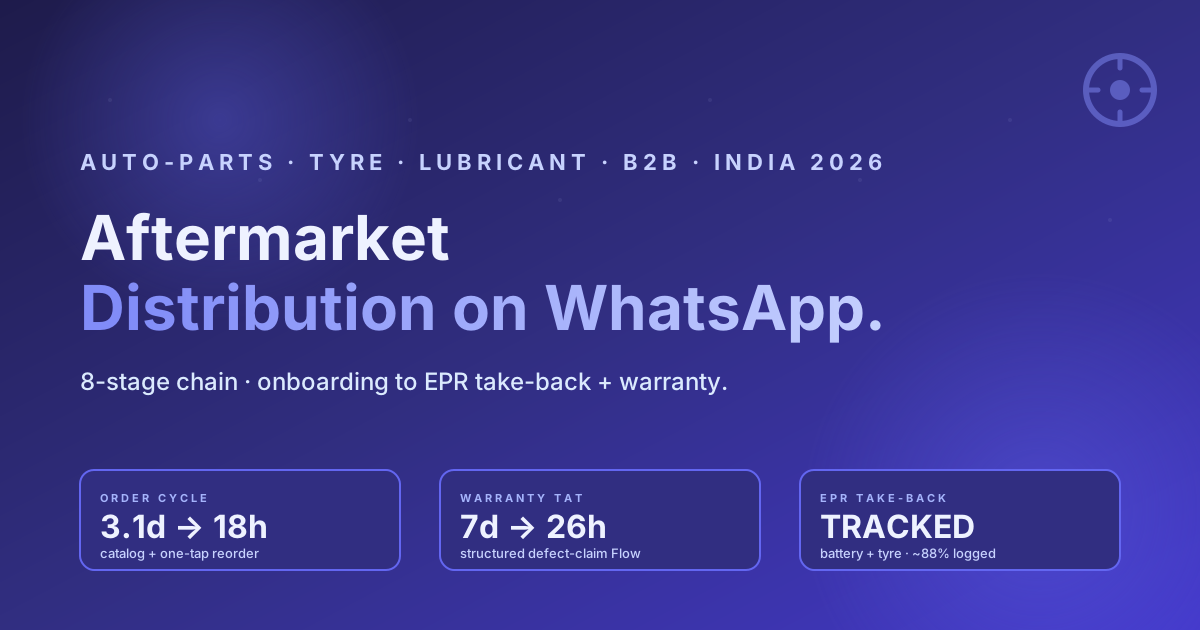
India's auto-components aftermarket is a directional ~₹80,000 cr–₹1 lakh cr business in FY26 (ACMA + industry estimates, treat as approximate), feeding roughly 4–5 lakh independent mechanic garages, multi-brand retailers, and tyre/battery shops through a 3-tier distribution chain: brand/importer → regional distributor → mechanic-or-retailer → vehicle owner. The tyre aftermarket alone is a directional ~₹45,000–55,000 cr slice and lubricants another ~₹30,000 cr (all estimates, verify against ATMA/ACMA latest). Almost every one of those retailers and mechanics already lives on WhatsApp — they place orders, send vehicle photos, and chase warranty claims there today, just over a personal number with zero structure. Meanwhile FY26 layers on real compliance weight: BIS mandatory certification for tyres (IS 15627) and batteries, AIS-142 quality norms, Legal Metrology pack labelling, GST with Section 194Q TDS on purchases above ₹50 lakh, Reverse Charge Mechanism on certain scrap/unregistered buys, e-Way Bill v2, and the freshest hook of all — Extended Producer Responsibility under the Battery Waste Management Rules 2022 and waste-tyre EPR provisions under the Hazardous and Other Wastes Rules 2022/2024, which push producer/importer take-back targets and recycler-certificate trails down the entire chain. This guide is the 2026 implementation playbook for auto-parts, tyre, and lubricant distributors moving the 3-tier chain onto a structured WhatsApp Business stack: an 8-stage lifecycle from retailer onboarding to EPR take-back, three comparison tables, an illustrative distributor cohort (1 distributor / 600 retailers), the counterfeit-parts and warranty-claim mechanics that make this vertical distinct, and the regulator-by-regulator carve-out you must build into templates and Flows.
Why WhatsApp Wins the Auto-Parts Aftermarket Chain in 2026
Five structural reasons the tyre/lubricant/auto-parts distributor moved WhatsApp from a personal-number afterthought to the operating spine of the business this year:
- The buyers are mechanics and small retailers, not procurement desks. A garage owner does not log into a DMS portal or wait for a sales-agent visit every fortnight. He sends a part number or a photo of a worn part on WhatsApp at 9pm and expects a price and stock answer. The channel already matches the buyer.
- Order cycles are short and consumption-driven. Fast-moving SKUs (oil filters, brake pads, common-size tyres, batteries) reorder on a consumption cadence, not a calendar. WhatsApp catalog plus one-tap reorder collapses the order-to-dispatch loop from days to hours.
- Counterfeit and warranty are trust battlegrounds. Spurious auto parts are a large, well-documented India problem. A genuine-part distributor who can push a verifiable batch/holographic check and run a structured warranty-claim thread wins loyalty that price alone cannot buy.
- EPR is now a chain-wide obligation, not a producer-only one. Battery Waste Rules 2022 and waste-tyre EPR provisions create take-back targets, recycler certificates, and traceability that flow down to the retailer/mechanic who physically collects the used battery or scrap tyre. WhatsApp is where that take-back gets logged at the counter.
- Credit terms and DSO live or die on cadence. Most retailer sales run on credit. Polite, automated, dignified payment nudges over WhatsApp recover days of DSO that phone-chasing never touches.
The 8-Stage WhatsApp Lifecycle for an Auto-Parts Distributor
Map the entire distributor-to-retailer relationship to eight WhatsApp-native stages. Each stage names the automation surface (template, Flow, or AI Pathway) and the KPI it moves.
Stage 1 — Mechanic / retailer onboarding
New garage or retailer onboards via a WhatsApp Flow: shop name, GSTIN (or composition/unregistered flag — this decides RCM and 194Q treatment later), vehicle-segment focus (2W / PV / CV / tractor), preferred brands, and credit-reference details. Capture the GSTIN once and validate it; it drives e-invoicing, e-Way Bill, and TDS logic for every order that follows. Output: a clean retailer master record, not a name scribbled in a diary.
Stage 2 — Catalog + stock / MOQ check
Retailer browses the WhatsApp product catalog by part number, vehicle make-model, or category. A Flow or AI Pathway answers live stock, minimum-order-quantity (MOQ), pack size, and BIS-cert status for regulated lines (tyres IS 15627, batteries). A photo of a worn part can route to a human or an AI part-matcher. Output: fewer wrong-part orders, faster quote-to-cart.
Stage 3 — Scheme-slab / quantity-discount push
Distributor schemes in this trade are slab-based: buy 4 tyres get X, cross ₹Y of lubricant this month for a free-goods slab, battery exchange bonus. A targeted template broadcast (utility or marketing, classified correctly) pushes the live scheme with the retailer's current slab position (“you are 6 litres from the next free-goods tier”). Output: higher scheme uptake and basket size.
Stage 4 — Order + credit terms
Retailer confirms the cart in-thread. The system applies the agreed credit terms (net-7 / net-15 / net-30), checks the outstanding-vs-limit guardrail, and returns a proforma. If the retailer is unregistered or composition, the RCM/194Q flags set here. Output: orders booked against a credit policy, not on trust alone.
Stage 5 — e-Way Bill + RCM dispatch
On dispatch, the GST e-invoice and e-Way Bill (v2 portal) generate against the validated GSTIN; the e-Way Bill number and a photo of the loaded consignment go to the retailer on WhatsApp. Where Reverse Charge applies (e.g. certain scrap/unregistered procurement on the inbound side), the document trail is attached. Output: paperwork that travels with the goods and lands in the retailer's chat, not a lost paper challan.
Stage 6 — Photo-POD delivery
Delivery rider or transporter captures a photo proof-of-delivery (POD) — cartons at the shop, retailer signature or OTP — back into the same thread via a Flow. Disputes (“2 cartons short”) resolve against a timestamped photo instead of a phone argument a week later. Output: dispute rate down, DSO clock starts clean.
Stage 7 — Warranty / defect-claim thread
This is the stage that separates a genuine-parts distributor from a box-mover. A defective battery, a tyre with a manufacturing fault, a failed part — the retailer opens a warranty claim through a structured Flow: invoice reference, batch/serial, vehicle reading (km/months for pro-rata), and photos/video of the defect. The thread routes to the brand's warranty desk with a claim ID, and the retailer gets status updates. Consumer-Protection-Act warranty obligations and the brand's pro-rata policy both live in this flow. Output: warranty-claim TAT collapses, retailer trust compounds.
Stage 8 — Tyre / battery EPR take-back + reorder by consumption cycle
When the retailer sells a new battery or tyre against an exchange, the used unit is collected. A WhatsApp Flow logs the EPR take-back: old-unit type, quantity, and a photo, generating a take-back record that rolls up to the producer/importer's EPR target and the recycler-certificate trail. The same consumption signal triggers a reorder nudge (“you have moved 18 of the 20 batteries from last month”). Output: EPR compliance evidence plus a consumption-timed reorder in one motion.
Regulators and Legal Carve-Outs You Must Build In
This vertical sits under an unusually dense regulatory stack. Build each into template copy, Flow validation, and document logic — do not bolt it on later. Where exact thresholds or clause numbers are cited below, treat them as directional and verify against the current notification before relying on them.
- BIS mandatory certification. Tyres carry mandatory BIS certification under IS 15627; automotive batteries are also under BIS scope. Catalog entries for these lines should surface cert/ISI-mark status, and warranty flows should reference it. Do not let a non-certified SKU pass as certified in any template.
- AIS-142 and automotive standards. AIS norms govern quality for various components; reference them where a part claims conformance, and avoid efficacy/performance claims you cannot substantiate (ASCI green/performance-claim risk).
- Legal Metrology (Packaged Commodities). Pack labelling — MRP, net quantity, importer/manufacturer details — is mandated. Catalog images and copy must not contradict the declared pack.
- GST + Section 194Q TDS. A buyer whose purchases from a seller cross ₹50 lakh in a financial year must deduct TDS at the prescribed rate under 194Q (verify rate and interplay with 206C(1H) TCS). The retailer master must hold PAN/GSTIN to compute this correctly.
- Reverse Charge Mechanism (RCM). Certain inbound procurement (e.g. scrap, or supplies from unregistered persons under applicable notifications) attracts RCM. Flag retailer/vendor registration status at onboarding so the document logic is right at dispatch. Verify the exact RCM-notified categories that apply to your scrap/used-part flows.
- e-Way Bill v2. Movement of goods above the threshold needs an e-Way Bill; the v2 portal is the current rails. Generate against the validated GSTIN and push the EWB number into the chat.
- EPR — Battery Waste Management Rules 2022. Producers/importers carry collection and recycling targets, with a registration and certificate regime. The chain must support take-back of used batteries and the data trail that proves it. (Exact target percentages and timelines — verify against the latest CPCB notification.)
- EPR — waste-tyre obligations under the Hazardous and Other Wastes (Management and Transboundary Movement) Rules, as amended 2022/2024. Producers/importers/recyclers of tyres face EPR obligations, recycler registration, and certificate trading. This is the fresh 2026 regulatory hook for the tyre side of the chain — verify current target years and per-category obligations before quoting them.
- Counterfeit parts + IPR. Spurious auto parts are a major India problem with safety and brand-IPR consequences. A genuine-parts distributor should support batch/holographic/QR verification in-thread and never imply a part is genuine OEM if it is not.
- Consumer-Protection-Act warranty. Warranty claims and pro-rata settlements fall under consumer-protection obligations; the claim flow should capture evidence and timelines that stand up if escalated.
- DPDP Act 2023. Retailer/mechanic PII, credit references, and vehicle data need lawful consent and purpose-limitation. Keep marketing opt-in distinct from transactional necessity.
Why the EPR hook matters in 2026. Battery Waste Rules 2022 and the waste-tyre EPR provisions shift used-unit take-back from a vague goodwill gesture to a measurable, certificate-backed producer obligation that auditors and the producer's own EPR registration depend on. The retailer or mechanic at the counter is the physical collection point. If your take-back is logged on paper (or not at all), the producer cannot evidence its target and the recycler-certificate trail breaks. Logging the take-back on WhatsApp — type, quantity, photo, timestamp, retailer ID — turns the counter into a compliant data node. Verify the exact target percentages and deadlines against the current CPCB notification, but build the take-back capture now.
Get a 1-minute BSP audit on WhatsApp
Drop your WhatsApp number — we line-item your current invoice against Meta India rates in under 60 seconds. India-hosted, DPDP-compliant.
Worth knowing the scale of the risk, and the DPDP penalty calculator estimates it from your own numbers.
WhatsApp-Native Distributor Ops vs the Old Channels
| Dimension | Phone / WhatsApp-personal-number | DMS portal + sales-agent visit | WhatsApp Business stack (RichAutomate) |
|---|---|---|---|
| Order placement | Call/text, manually keyed, error-prone | Portal login or fortnightly agent visit | Catalog + one-tap reorder in-thread, auto-booked |
| Stock / MOQ check | “Let me check and call back” | Visible in portal if retailer logs in | Live stock + MOQ answer in seconds via Flow/Pathway |
| Scheme communication | Word of mouth, missed slabs | Printed scheme sheet, agent-explained | Personalised slab-position push, “6 L to next tier” |
| Dispatch docs | Paper challan, often lost | Generated in DMS, emailed | e-invoice + e-Way Bill number + load photo in chat |
| Proof of delivery | Verbal, disputed later | Signed challan filed at depot | Photo POD + OTP into the same thread |
| Warranty claim | Phone chase, paper to brand | Portal ticket, slow | Structured Flow → brand desk + claim ID + status |
| EPR take-back | Untracked or on paper | Rarely captured digitally | Logged Flow record → producer EPR + recycler trail |
| Payment / DSO | Manual chasing, awkward | Statement in portal | Automated dignified nudge cadence, faster DSO |
Genuine vs Counterfeit — and the Warranty-Claim Channel
| Aspect | Counterfeit / grey-market path | Genuine-parts path on WhatsApp |
|---|---|---|
| Verification | No traceable batch; lookalike holograms | Batch/serial + QR/hologram check in-thread before sale |
| BIS / AIS cert | Often absent or faked | Cert status surfaced in catalog for IS 15627 lines |
| Warranty validity | Effectively none; retailer eats the loss | Structured claim with invoice + batch + reading → brand pro-rata |
| Claim TAT | Indefinite, phone-dependent | Claim ID + status updates, measured TAT |
| EPR linkage | Used unit dumped, no trail | Take-back logged against producer EPR target |
| Retailer trust / repeat | Race to the bottom on price | Trust + verifiable warranty compounds loyalty |
Per-Stage Automation Surface and KPI
| Stage | Primary surface | KPI it moves |
|---|---|---|
| 1. Onboarding | WhatsApp Flow (GSTIN, segment, credit ref) | Clean retailer master %, time-to-activate |
| 2. Catalog + stock/MOQ | Catalog + Flow / AI Pathway | Wrong-part rate, quote-to-cart time |
| 3. Scheme-slab push | Template broadcast (correctly classified) | Scheme uptake %, average basket |
| 4. Order + credit | Flow + credit-limit guardrail | Orders within credit policy %, order cycle time |
| 5. e-Way Bill + RCM | Utility template + document attach | Doc-with-goods %, EWB error rate |
| 6. Photo-POD | Delivery Flow (photo + OTP) | Delivery-dispute rate, DSO clock accuracy |
| 7. Warranty claim | Structured Flow → brand desk | Warranty-claim TAT, claim-closure rate |
| 8. EPR take-back + reorder | Take-back Flow + consumption nudge | EPR take-back capture %, reorder rate |
Illustrative Distributor Cohort — 1 Distributor / 600 Retailers
The numbers below are illustrative — a directional model of what a mid-size tyre-plus-lubricant-plus-battery distributor serving ~600 mechanics and retailers can expect when the 8-stage stack is fully live. They are not a guarantee; your mix, brands, and credit policy will move them.
| Metric (illustrative) | Before (phone / paper) | After (WhatsApp stack) | Delta |
|---|---|---|---|
| Order-to-dispatch cycle | 3.1 days | 18 hours | ~−76% |
| Scheme-slab uptake | 31% of eligible retailers | 54% of eligible retailers | +23 pp |
| Warranty-claim TAT | 7 days | 26 hours | ~−85% |
| Wrong-part / return rate | 9.4% | 3.6% | ~−62% |
| Delivery-dispute rate | 6.1% | 1.8% | ~−70% |
| EPR take-back capture (battery/tyre exchange) | ~20% logged | ~88% logged | +68 pp |
| DSO (days sales outstanding) | 47 days | 38 days | −9 days |
| Repeat / consumption-timed reorder rate | 34% | 61% | +27 pp |
The EPR + warranty combination is the durable moat. Any distributor can cut an order cycle with a catalog. What competitors cannot easily copy is the trust loop: a retailer who knows that a defective battery means a 26-hour structured warranty claim (not a 7-day phone fight) and that every exchanged unit is logged into a compliant EPR trail will keep buying genuine parts from you even when a grey-market box is ₹40 cheaper. The illustrative jump in take-back capture from ~20% to ~88% is not just compliance — it is the data spine that lets the producer hit its Battery/Tyre EPR targets and lets you prove it on audit.
Six Anti-Patterns That Wreck an Auto-Parts WhatsApp Rollout
- Onboarding without capturing GSTIN/registration status. If you do not flag unregistered/composition retailers at stage 1, your RCM and 194Q logic is wrong at dispatch and your e-invoicing breaks. Capture and validate up front.
- Implying genuine/OEM when it is not. Counterfeit is a legal and safety minefield. Never let a template or catalog entry suggest BIS-cert or OEM status a SKU does not have. Surface real cert status only.
- Treating warranty as a phone afterthought. Warranty is the trust battleground. An unstructured claim (no invoice ref, no batch, no reading, no photo) cannot be settled pro-rata and erodes the retailer relationship. Make stage 7 a real Flow.
- Skipping EPR take-back capture. “We collect the old battery but do not log it” means the producer cannot evidence its EPR target. Log type, quantity, photo, timestamp every time.
- Blasting schemes as marketing without classification. Mis-classifying a scheme push (marketing vs utility) risks template rejection and quality hits. Classify correctly and respect DPDP marketing opt-in.
- No credit-limit guardrail in the order Flow. Booking orders without checking outstanding-vs-limit pushes DSO up and turns WhatsApp convenience into a receivables problem. Wire the guardrail into stage 4.
12-Week Rollout Path
- Week 1–2: Retailer master + onboarding Flow. Capture GSTIN/registration, segment, brands, credit terms. Validate GSTINs. Set RCM/194Q flags.
- Week 3–4: Catalog + stock/MOQ. Wire product catalog by part number and vehicle make-model; surface BIS-cert status on IS 15627 lines; build the photo-to-part-match route.
- Week 5–6: Order + credit + scheme. Cart confirm Flow, credit-limit guardrail, proforma; slab-position scheme templates (classified correctly).
- Week 7–8: Dispatch + POD. e-invoice + e-Way Bill v2 generation into chat; delivery photo-POD Flow with OTP.
- Week 9–10: Warranty claim Flow. Invoice + batch/serial + reading + photo capture; routing to brand warranty desk; claim-ID status updates.
- Week 11–12: EPR take-back + reorder. Take-back capture Flow (type/qty/photo) wired to the producer EPR/recycler trail; consumption-timed reorder nudges; DSO and KPI dashboards.
Internal Resources
If you also run a general-trade FMCG-style book alongside auto parts, the order-taking and scheme mechanics in the B2B FMCG distribution guide map closely. For collecting retailer advances and clearing credit faster, see native WhatsApp UPI payments. To keep the whole retailer master, order history, and claim threads in one place, the best WhatsApp CRM comparison covers the options. Full plan and pricing on the pricing page.
Run your auto-parts aftermarket chain on RichAutomate.
Onboard mechanics and retailers (GSTIN + credit terms + segment) + catalog with live stock/MOQ and BIS-cert status + slab-position scheme push + order with credit-limit guardrail + e-invoice and e-Way Bill v2 into the chat + photo-POD delivery + structured warranty-claim Flow to the brand desk + tyre/battery EPR take-back capture wired to the producer/recycler trail + consumption-timed reorder. Illustrative distributor cohort (1 distributor / 600 retailers): order cycle 3.1d → 18h, warranty-claim TAT 7d → 26h, EPR take-back ~20% → ~88% logged, DSO −9 days. ₹0 platform fee, ₹0 monthly. Client Pay ₹0.10/msg + Meta direct, or SaaS Pay ₹1.50 marketing / ₹0.50 utility-auth. 14-day trial + 100 free credits.
Start free → · WhatsApp 918160311319 · Book a 30-min demo