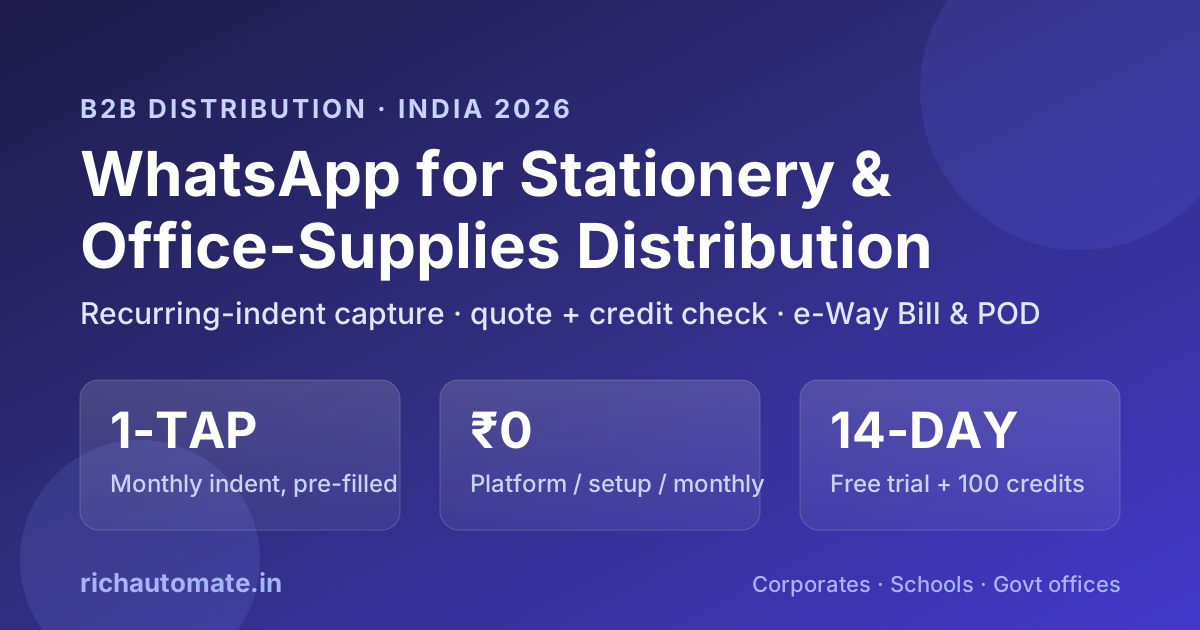
If you distribute stationery and office supplies — A4 reams and notebooks, pens and files, toner and printer ribbons, housekeeping consumables and pantry stock — to corporates, schools, colleges, government offices and retail counters, your business does not live or die on a single big order. It lives on the recurring monthly indent: the same purchase officer, the same admin head, the same school store-keeper raising more-or-less the same list, month after month, against a credit limit, to be quoted, dispatched, delivered with proof, statemented and chased. Most of that cadence today runs on phone calls, loose WhatsApp messages, a salesperson's memory and a pile of email PDFs — which is exactly why orders slip, the wrong SKU ships, credit limits get breached, and payments age past 60 days. This guide maps the full B2B stationery and office-supplies distribution lifecycle onto a structured WhatsApp Business API layer — corporate and school account onboarding, catalogue share, monthly indent capture, quote and credit-limit check, dispatch with e-Way Bill and proof-of-delivery, monthly statements with payment reminders, and re-order nudges plus back-to-school and FY-start campaigns. The killer move for this trade is recurring-indent capture: turning a predictable monthly buy into a one-tap WhatsApp form. Regulatory touch-points (GST, e-invoicing thresholds, e-Way Bill, Legal Metrology, BIS on select goods) are flagged where they bite — every specific hedged "verify with your CA and the official portal as of 2026," because thresholds and rules change. This is general operational guidance, not tax, legal or compliance advice.
Why stationery distribution is a recurring-indent business
Office and institutional consumption is steady and repetitive by nature. A 200-seat office reorders A4 paper, pens, files, sticky notes, toner and pantry stock on a rhythm; a school replenishes registers, chalk, lab consumables and worksheets each term; a government office raises an indent against a sanctioned budget head every month. The buyer is rarely shopping — they are replenishing, often from last month's list with small edits. That predictability is the opportunity most distributors leave on the table: instead of waiting for the admin head to remember to call, you can prompt the indent, pre-fill it from history, quote it instantly and lock the dispatch — all inside WhatsApp, the one app every purchase officer already keeps open. The economics resemble any high-frequency B2B distribution trade; the discipline that powers a B2B FMCG distribution workflow on WhatsApp maps almost one-to-one onto stationery, with catalogues and credit limits in place of beats and schemes.
The hook in one line: the customer who reorders the same ream-and-toner list every month should not have to phone you, wait for a quote, and re-explain their delivery dock. A WhatsApp indent form pre-filled from their last order — tapped, quoted, credit-checked and dispatched in minutes — is the single highest-leverage thing a stationery distributor can automate. Everything else in this guide hangs off that one capability.
The light regulatory frame — verify each line as of 2026
Stationery distribution is a lightly regulated trade compared with pharma or food, but a handful of touch-points still matter, and the specifics move — so treat the list below as the shape of what to confirm with your CA and the relevant portal, not as advice:
- GST and e-invoicing. Your tax invoices, HSN codes and GST rates run through GST; above a turnover threshold, e-invoicing (IRN/QR) is mandatory and the threshold has been progressively lowered over the years. Verify your current e-invoicing applicability and the live threshold with your CA and on the GST portal as of 2026.
- e-Way Bill. Goods movement above a consignment-value threshold typically requires an e-Way Bill, with state-level variations on intra-state limits. Verify the current e-Way Bill threshold and your state's rules as of 2026.
- Legal Metrology. Pre-packaged commodities carry declaration requirements (quantity, MRP, manufacturer, etc.) under Legal Metrology rules; some stationery sold as packaged goods is in scope. Verify which of your SKUs are covered and the current declaration requirements as of 2026.
- BIS on select products. A subset of products — certain electrical or safety-relevant items that creep into an office-supplies catalogue — may carry BIS standards/marking requirements. Most plain stationery does not, but verify per SKU. Confirm BIS applicability for any non-stationery line you carry as of 2026.
None of this is heavy, but a clean WhatsApp paper-trail of invoices, e-Way Bills and delivery proof makes the compliance posture easier to defend if questioned. The platform organises the evidence; your CA and the official portals govern the obligation. The reconciliation discipline behind a clean GST position is itself a workflow — the same structure that powers a GST invoice-reconciliation flow keeps your distribution invoices matched and audit-ready.
The distribution lifecycle on WhatsApp — stage by stage
The whole trade is a repeating loop, and WhatsApp can carry every stage of it. Here is the lifecycle as a sequence:
| Stage | What happens | What WhatsApp does |
|---|---|---|
| 1. Account onboarding | Corporate/school account set up with GSTIN, credit terms, delivery point | Structured onboarding form captures KYC, GSTIN, ship-to, contact |
| 2. Catalogue share | Buyer needs the current SKU list, packs and rates | Catalogue/PDF + product list shared in-thread, always current |
| 3. Monthly indent capture | Buyer raises the recurring purchase list | WhatsApp Flow / order form, pre-filled from last indent |
| 4. Quote + credit-limit check | Price the indent; confirm it fits the credit limit | Quote sent in-thread; credit-limit flag before confirmation |
| 5. Dispatch + e-Way Bill + POD | Pick, pack, generate invoice/e-Way Bill, deliver | Dispatch alert, e-Way Bill doc, proof-of-delivery photo captured |
| 6. Monthly statement + reminder | Statement of account; collect ageing payments | Statement PDF + scheduled, polite payment reminders |
| 7. Re-order nudge + campaigns | Prompt next indent; seasonal pushes | Re-order nudge on cadence; back-to-school / FY-start campaigns |
Each stage that today depends on a phone call or a salesperson remembering becomes a structured, timestamped, searchable step. The buyer experiences less friction; you experience fewer slipped orders and faster collections.
Account onboarding and catalogue share
A corporate or institutional account is more than a phone number — it carries a GSTIN, agreed credit terms, a delivery dock, a contact hierarchy (who can indent, who approves) and often a price list specific to that account. A WhatsApp onboarding form captures all of it in one structured submission instead of a string of back-and-forth messages, and the record becomes the spine every later stage references. Once the account is live, the buyer can pull the current catalogue on demand: a clean product list or a PDF shared in-thread, always the latest version, so nobody indents against a stale rate card. School and college accounts have their own rhythm — terms, fee cycles, store-keeper roles — and the institutional-communication patterns that work for a K-12 school on WhatsApp translate directly to the school-supplies side of the desk. Keep the catalogue and price list account-aware so the quote at stage four is right the first time.
If you message outside India, the WhatsApp pricing calculator by country has the per-country rates.
Get the India 2026 WhatsApp BSP price comparison
Wati vs AiSensy vs Interakt vs RichAutomate: Meta rates, platform fees and hidden costs, side by side. We send it to your WhatsApp in a minute.
Monthly indent capture — the recurring engine
This is the stage that pays for the whole system. A monthly indent is highly predictable: most of the list repeats, with small quantity edits and the occasional new SKU. A WhatsApp Flow (or a structured order form) lets the buyer raise it in a couple of taps — and the smartest version pre-fills the form from the buyer's last indent, so they confirm and adjust rather than retype. The buyer never leaves WhatsApp, never waits on hold, and never has to remember to call; you receive a clean, structured order with SKUs, quantities and the ship-to already attached. Run a scheduled re-order nudge on each account's cadence — "Time for this month's indent? Tap to review your usual list" — and you convert a passive replenishment into a prompted, captured one. This recurring-indent capture is the difference between hoping the order comes and reliably collecting it.
Why pre-fill matters: a buyer asked to build a 30-line indent from scratch each month will delay it, batch it, or split it across vendors. A buyer shown last month's list and asked to confirm-and-edit completes it in under a minute — and completes it with you, because you asked first. Pre-filled recurring-indent capture is both a retention moat and a share-of-wallet lever: you become the default vendor simply by being the easy one.
Quote, credit-limit check, dispatch, e-Way Bill and POD
Once the indent lands, two things happen fast on WhatsApp. First, the quote: priced against the account's rate card and sent in-thread for confirmation — no email round-trip, no "did you get my PDF?" Second, the credit-limit check: before the order is confirmed, the system can flag whether this indent plus the buyer's outstanding balance breaches their agreed limit, so you collect or hold rather than over-extend and discover the problem at month-end. On confirmation, dispatch kicks in: a dispatch alert to the buyer, the tax invoice and e-Way Bill document shared in-thread (e-Way Bill applicability and thresholds verified as of 2026), and — critically — a proof-of-delivery photo captured at the dock and logged against the order. That POD trail closes the classic dispute: "we never received the toner" is answered with a timestamped photo, not an argument. The same dispatch-and-POD rigour that disciplines an auto-parts aftermarket distribution operation applies line-for-line to stationery cartons.
| Aspect | Phone + loose chat (typical) | WhatsApp-structured distribution |
|---|---|---|
| Indent capture | Buyer calls or types a freehand list | Pre-filled Flow form, structured SKUs and quantities |
| Quoting | Emailed PDF, chased for confirmation | In-thread quote, one-tap confirm |
| Credit control | Discovered at month-end, too late | Limit flagged before order is confirmed |
| Delivery proof | Signed challan in a file, or nothing | Timestamped POD photo against the order |
| Statements | Emailed, often ignored | Statement PDF in-thread + scheduled reminders |
| Re-order | Wait for the buyer to remember | Cadence nudge prompts the next indent |
Monthly statements and payment reminders
B2B stationery runs on credit, and credit runs on collections. A WhatsApp statement-of-account — a clean PDF of open invoices, ageing and the running balance — delivered into the same thread the buyer already uses beats an emailed statement that sits unread. Layer scheduled, polite payment reminders on top: a gentle nudge as an invoice approaches its due date, a firmer one as it ages, each utility-category and account-specific. Tie the reminder cadence back to the credit-limit check at order time, and you close the loop: orders that would push an account over its limit are flagged up front, and ageing invoices are chased before they harden into bad debt. Keep the tone professional and the cadence respectful — these are long-term institutional relationships, and the goal is steady collection, not pressure. The wholesale-trade collection discipline that keeps a fabric and textile wholesale book healthy is the same playbook here: statement, remind, reconcile, repeat.
Re-order nudges and seasonal campaigns
Two motions drive growth on top of the recurring base. The first is the re-order nudge: a scheduled, per-account prompt timed to each buyer's replenishment cadence, surfacing their usual list so the next indent is one tap away. The second is seasonal campaigns — the two biggest demand spikes in this trade are back-to-school (school and college supplies as terms begin) and financial-year start (corporate and government budget refresh in Q1 of the new FY, when registers, files and consumables get bulk-ordered). A WhatsApp broadcast (marketing-category, to opted-in accounts) timed to these windows — with a tap-through to a pre-built indent — converts a known seasonal surge into captured orders rather than scattered phone enquiries. Always send seasonal pushes to accounts that have opted in, keep them genuinely useful, and let buyers opt out cleanly; the same broadcast hygiene that underpins all good WhatsApp marketing in India protects your sender quality and your relationships. Before you scale these sends across hundreds of accounts and quarterly cycles, model the volume on the WABA cost calculator so you size the spend first.
What it costs on RichAutomate
RichAutomate is the WhatsApp Business API layer that carries the whole distribution loop — account onboarding forms, account-aware catalogue share, pre-filled monthly indent capture, in-thread quotes with credit-limit flags, dispatch alerts with e-Way Bill documents and proof-of-delivery photos, monthly statements with scheduled payment reminders, and re-order nudges plus back-to-school and FY-start campaigns. Pricing is flat: ₹0 platform fee, ₹0 setup, ₹0 monthly. On Client Pay, ₹0.10 per message with Meta's conversation charges billed to you directly by Meta at Meta's rates. On SaaS Pay, an all-in ₹1.50 per marketing conversation and ₹0.50 per utility conversation — and most distribution traffic (indent confirmations, dispatch alerts, statements, reminders, re-order nudges) is utility, the cheaper category; only the seasonal broadcasts are marketing. There is a 14-day free trial with 100 credits to wire one account's full monthly cycle — onboard, indent, quote, dispatch, statement — before you commit. See the full card at richautomate.in/pricing. Meta's conversation-category pricing changes; verify current rates as of 2026. RichAutomate is a messaging platform, not a tax, accounting or compliance service — engage your CA for GST, e-invoicing, e-Way Bill, Legal Metrology and BIS obligations and verify each as of 2026.
Turn the monthly indent into a one-tap habit
From corporate and school account onboarding to the next financial year's bulk refresh, the win is a structured WhatsApp distribution layer that prompts the recurring indent, pre-fills it from history, quotes it instantly with a credit-limit check, dispatches it with an e-Way Bill and a proof-of-delivery photo, statements it cleanly and chases payment politely — then nudges the next cycle and rides the back-to-school and FY-start spikes. The killer capability is recurring-indent capture: you become the default vendor by being the easy one. Flat pricing, no surprises: ₹0 platform fee, ₹0 setup, ₹0 monthly — Client Pay at ₹0.10 per message with Meta conversation charges billed direct by Meta, or SaaS Pay at ₹1.50 marketing / ₹0.50 utility all-in. Start the 14-day free trial with 100 credits, WhatsApp us at 918160311319, or book a 30-minute walkthrough at https://richautomate.in/book/demo. (RichAutomate is a messaging platform — engage your CA and verify all GST, e-invoicing, e-Way Bill, Legal Metrology and BIS requirements as of 2026.)
Start your 14-day free trial → · See full pricing · Run the WABA cost calculator