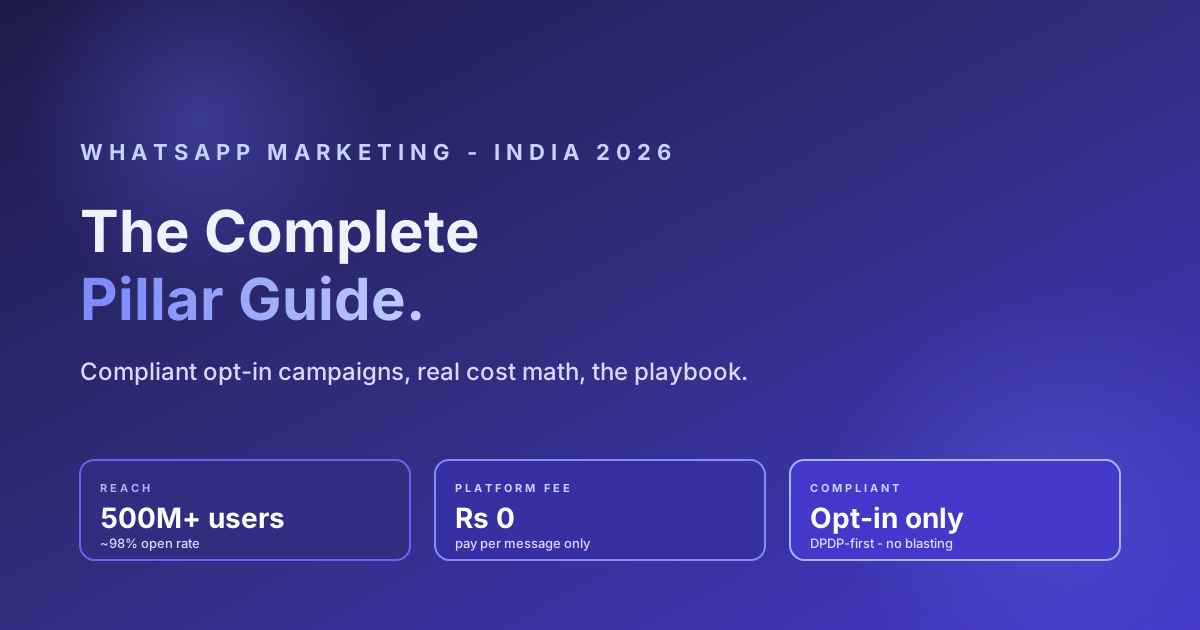
WhatsApp marketing is the practice of reaching opted-in customers on WhatsApp with broadcasts, automated journeys and conversational selling, run through the official Meta WhatsApp Business API — not through banned bulk-blasting tools. In India it works because WhatsApp reaches over 500 million users with roughly 98% message open rates, but it only works legally and sustainably when every contact has consented and every promotional send uses a Meta-approved template. This guide is the complete 2026 playbook: what it is, why India, how to stay compliant, the campaign types that convert, the real per-message cost math, a step-by-step launch plan, ROI measurement, industry examples and the mistakes that get numbers banned.
Most WhatsApp marketing content online either sells you software or quietly encourages illegal blasting. This is neither. It is a practical, India-specific reference for doing WhatsApp marketing the compliant way — the only way that survives the DPDP Act and Meta quality enforcement in 2026.
What is WhatsApp marketing, and why India?
WhatsApp marketing means using WhatsApp as a permission-based channel to acquire, convert, retain and re-engage customers. Practically, that is three things: broadcasting approved promotional templates to opted-in audiences, automating lifecycle journeys (welcome, cart recovery, re-order, win-back), and selling conversationally inside the chat with catalogs and payments.
India is the channel's single largest market. WhatsApp reaches an estimated 500 million-plus Indian users (verify current figure), and because it is where customers already are, marketing open rates routinely sit near 98% with click rates far above email or SMS (verify benchmark). For an Indian SMB or D2C brand, that combination — universal reach plus near-perfect open rates — is why WhatsApp has quietly become the highest-ROI owned channel.
The WhatsApp ROI calculator is more useful than a benchmark here, because the maths swings hard on your margin.
The catch: this reach is only legally accessible through the official WhatsApp Business API. The old "bulk WhatsApp sender" tools that scrape numbers and blast unsolicited messages are against WhatsApp policy and, since the DPDP Act, exposed under Indian data law. Sustainable WhatsApp marketing in 2026 is built on consent, not volume.
Legal, compliant bulk sending in India (not illegal blasting)
There is a crucial distinction Indian businesses must internalise. Compliant WhatsApp marketing reaches a large audience through the official API using opt-in contacts and Meta-approved templates. Illegal blasting uses grey-market tools to message people who never consented — and it gets numbers banned and businesses exposed to penalties.
| Dimension | Compliant API marketing | Illegal bulk blasting |
|---|---|---|
| Channel | Official Meta WhatsApp Business API | Grey-market "WhatsApp sender" tools |
| Audience | Verifiable opt-in only | Scraped or purchased number lists |
| Message format | Meta-approved templates outside 24h window | Free-text spam |
| Opt-out | One-tap unsubscribe honoured | None |
| Outcome | Sustainable, scalable, brand-safe | Number banned, DPDP exposure |
Three rules keep you on the right side. First, get genuine opt-in: a website checkbox, a keyword reply, a Click-to-WhatsApp ad tap, or a checkout consent box all count — buying a database does not. Second, use approved templates: outside the 24-hour customer-service window, every promotional message must be a pre-approved marketing template in the correct category. Third, honour the DPDP Act 2023 and its 2026 Rules: keep consent records, provide easy opt-out, and process data lawfully. Unlike SMS, WhatsApp marketing does not require DLT registration — but it absolutely requires real consent. For the full audit, see our DPDP compliance checklist.
Meta template categories — the rules that shape every campaign
Every WhatsApp message you send programmatically falls into a category, and the category decides both what you are allowed to say and what you pay. Get the category wrong and Meta re-classifies the message or rejects the template.
| Category | What it is for | Relative cost |
|---|---|---|
| Marketing | Promotions, offers, launches, re-engagement, newsletters | Highest |
| Utility | Order updates, shipping, appointment reminders, payment receipts | Lower (often 50-70% less, verify) |
| Authentication | OTPs and login codes | Low |
| Service | Free-form replies inside the 24h customer-initiated window | Often free in-window (verify) |
The single most expensive mistake here: slipping a promotional element into a utility template. If your "order shipped" message also says "and here is 10% off your next order", Meta bills it as marketing, not utility. Keep utility purely transactional and run promotion through dedicated marketing templates.
The campaign types that actually convert
WhatsApp marketing is not one tactic — it is a portfolio. Each campaign type maps to a different goal in the customer lifecycle.
| Campaign type | Primary goal | Template category |
|---|---|---|
| Broadcast / promotional blast (to opt-in list) | Acquisition, sale launch, announcement | Marketing |
| Welcome / onboarding drip | Activation of new opt-ins | Marketing + Utility |
| Abandoned-cart recovery | Recover lost checkout revenue | Marketing (or Utility if order-tied) |
| Re-engagement / win-back | Revive lapsed customers | Marketing |
| Click-to-WhatsApp (CTWA) ads | Paid lead generation into chat | Free entry-point window |
| Post-purchase / re-order | Retention, repeat revenue, reviews | Utility + Marketing |
The highest-ROI starting point for most Indian brands is abandoned-cart recovery (low audience, high intent) and CTWA ads, which drop a lead straight into a free-messaging entry-point window. For the lead-magnet funnel that pairs with CTWA, see click-to-subscribe lead funnels.
The real cost math — what WhatsApp marketing actually costs in India
Confusion about cost is the biggest blocker for Indian businesses, so here is the honest structure. There are two layers: what Meta charges, and what your provider charges on top.
Meta's charge. As of 2026 Meta bills per message by category, with marketing the costliest and utility/authentication cheaper; service messages inside the 24-hour window cost about ₹0.115 each since 1 October 2026 (after a reported 1,000 free per number each month), and there are free entry-point conversations from ads and Page CTAs (verify the current India rate card and free allowance, as Meta updates them periodically). India marketing rates are among the lowest globally.
The provider charge. Most platforms add a monthly platform fee or per-message markup on top. RichAutomate does not. The platform fee is Rupee 0 — no setup, no monthly floor, no commitment — and you choose how you pay:
Get the India 2026 WhatsApp BSP price comparison
Wati vs AiSensy vs Interakt vs RichAutomate: Meta rates, platform fees and hidden costs, side by side. We send it to your WhatsApp in a minute.
- Client Pay: Rupee 0.10 per message, with Meta's per-conversation charge billed to you directly and transparently.
- SaaS Pay: a blended Rupee 1.50 per marketing message / Rupee 0.50 per utility-authentication message, with Meta charges already bundled in.
Every new account starts on a 14-day trial with 100 free credits. Because there is no platform floor, a quiet month costs almost nothing and a busy month scales linearly. To model your own all-in number against a platform-plan BSP, run it through the WABA cost calculator, and for the full breakdown of the two billing modes read Client Pay vs SaaS Pay decoded.
A step-by-step WhatsApp marketing campaign playbook
- Get on the official API. Connect a clean phone number (not already on WhatsApp), a Facebook Business Manager, and complete business verification. On RichAutomate this is largely same-day.
- Build a consented list. Add opt-in checkboxes at checkout, run a Click-to-WhatsApp ad, or use a keyword opt-in. Log every consent with timestamp and source.
- Segment. Split by lifecycle (new, repeat, VIP, lapsed) and by language preference — Hindi and regional-language variants lift CTR materially in tier-2/3.
- Get templates approved early. Submit marketing templates in the correct category ahead of any sale. Approval can take 24 hours or longer in peak season.
- Warm the number. Ramp volume gradually so a sudden spike does not trip Meta anti-spam and drop your quality rating.
- Send at the right time. For India, daytime 10:00-13:00 and afternoon 13:00-17:00 IST generally outperform late-night sends; avoid very early morning and family-time evenings on festival days.
- Automate the follow-up. Use the 24-hour service window and free entry-point windows to nurture conversationally at no extra message cost.
- Measure, then iterate. Track delivery, read, click and conversion per template, and retire under-performers.
Measuring ROI — the metrics that matter
WhatsApp marketing is measurable end to end, which is what makes it accountable. Track: delivery rate (sent vs delivered — a proxy for list hygiene), read rate (typically very high on WhatsApp), click-through rate on template buttons, conversion rate and revenue attributed, and cost per conversation / cost per conversion using the real per-message math above. Watch your WABA quality rating (GREEN / YELLOW / RED) as a leading indicator — a slide to YELLOW means recipients are blocking or reporting, and revenue follows quality down. ROI is simply attributed revenue divided by total send cost; because India per-message costs are low and open rates are high, well-run WhatsApp campaigns commonly outperform email and SMS on return per rupee. For the full metric set, see the best WhatsApp CRM in India 2026.
Six industry examples
- D2C and e-commerce: abandoned-cart recovery, new-drop broadcasts, and post-purchase re-order nudges — the classic high-ROI trio.
- Retail and FMCG: store-wide sale announcements to opt-in loyalty members plus catalog browsing in chat.
- Real estate: site-visit reminders, EMI nudges and RERA-compliant project updates to interested leads.
- Healthcare and clinics: appointment reminders and recall campaigns (mostly utility) with promotional health-camp broadcasts to opt-in patients.
- Education and EdTech: course-launch broadcasts, batch reminders and parent-student dual-thread nurture.
- Restaurants and QSR: reservation confirmations, festival offers and loyalty re-engagement to repeat diners.
The pattern across verticals is identical: utility templates carry transactional trust, marketing templates carry promotion, and the highest returns come from segmented, lifecycle-timed sends rather than one-size-fits-all blasts.
Common WhatsApp marketing mistakes
- Buying number lists and blasting. The fastest way to a permanent ban and DPDP exposure. Always build consented lists.
- Mixing promotion into utility templates. Meta re-bills it as marketing and may reject the template.
- Over-sending. More than one marketing message per recipient per day erodes quality rating and trains people to block you.
- Ignoring the quality rating. A YELLOW transition is a warning; auto-pause campaigns on RED.
- English-only creative. In tier-2/3 India, Hindi and regional-language variants convert markedly better.
- Submitting templates late. Peak-season approval queues are slow — submit weeks ahead of any big campaign.
For the seasonal ramp that avoids these traps, see the WhatsApp marketing calendar for India 2026 and the Diwali 2026 playbook.
The bottom line
WhatsApp marketing in India is the rare channel where reach, open rate and cost-efficiency all point the same way — but only on the compliant, opt-in, API-based path. Build a consented list, respect template categories, watch quality, and measure per-rupee ROI. Do that and WhatsApp becomes the highest-return owned channel most Indian businesses have. Skip consent and you are one report away from a banned number. For pricing details see the RichAutomate pricing page.
Start WhatsApp marketing free — Rupee 0 platform fee.
No setup fee, no monthly floor, no commitment. Pay only per message: Client Pay Rupee 0.10/msg + Meta direct, or SaaS Pay Rupee 1.50 marketing / Rupee 0.50 utility-auth. Official Meta Cloud API, green-tick eligible, DPDP-first, visual flow builder, broadcasts, drip journeys and CTWA. 14-day trial + 100 free credits. Talk to us on WhatsApp at 918160311319 or book a 30-minute call.
Related guides in this cluster
- WhatsApp marketing calendar: 47 festival & campaign dates
- Diwali 2026 WhatsApp marketing playbook
- Click-to-subscribe + lead-magnet funnels
- Click-to-WhatsApp Ads ROI playbook
- DPDP Act WhatsApp compliance checklist
- 30 WhatsApp campaign ideas (swipe file)
- WhatsApp abandoned-cart recovery playbook
- Best time to send WhatsApp campaigns (hour-by-hour)
Related reading: Best WhatsApp Marketing Software India 2026: Top 11 Ranked walks through the same WhatsApp setup for a neighbouring use case.