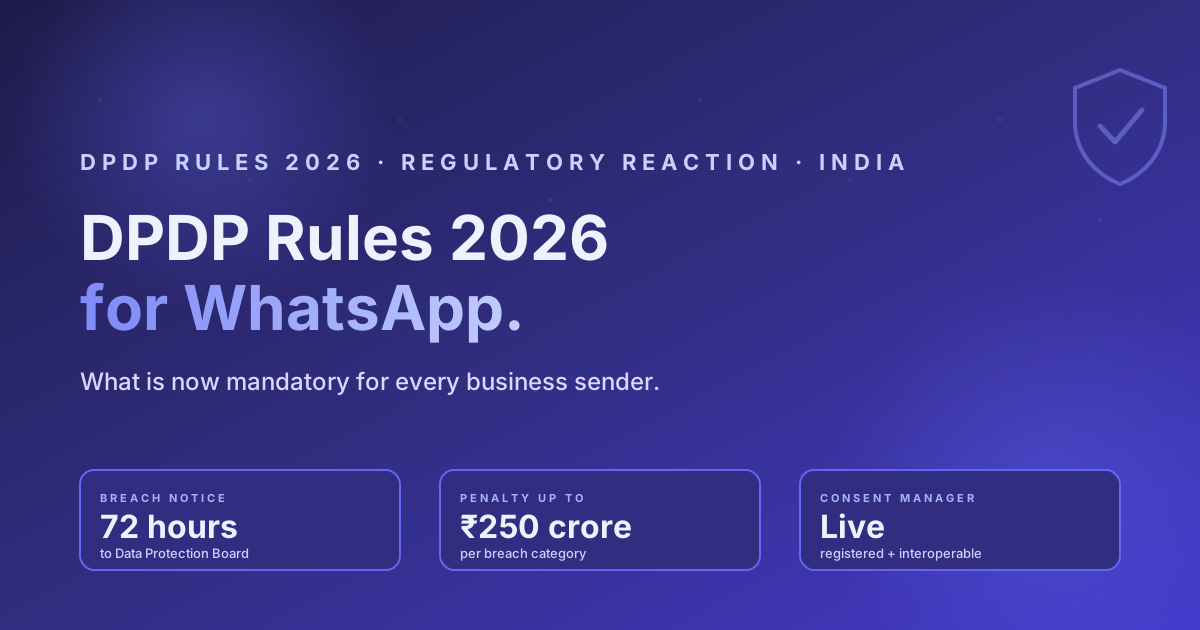
The Digital Personal Data Protection Act became law in 2023, but for nearly three years it sat without the operational rulebook that gives a statute teeth. That changed when the Government finalized the DPDP Rules 2026 — the subordinate legislation under MeitY that converts the Act’s principles into concrete, dated, auditable obligations. For a business that reaches customers on WhatsApp, this is the moment the compliance theory becomes a checklist with deadlines, prescribed formats, and a live regulator (the Data Protection Board of India) that can impose monetary penalties running to ₹250 crore per breach category. This guide is a clause-by-clause reaction: for each finalized Rule, what is now newly mandatory, and exactly how it changes the WhatsApp lifecycle a business already runs — opt-in capture, template content, retention of chat logs, breach handling, and consent withdrawal. The Act is 2023; the Rules are 2026 — and the Rules are where the operational work lives. Where an exact clause number or threshold is still being read against the final gazette text, we describe the obligation functionally and flag it — per the finalized DPDP Rules 2026, verify exact clause — so you act on the substance without over-claiming a citation. Consent UX is only half the risk — our companion piece on WhatsApp dark patterns and CCPA compliance covers the design traps regulators now penalise.
The one-line framing. The 2023 Act told you that consent, notice, breach reporting, children’s data, and erasure matter. The 2026 Rules tell you the format of the notice, the mechanism for consent (a registered Consent Manager), the clock on breach reporting, the method of verifiable parental consent, and the timelines for retention and erasure. If your WhatsApp opt-in form, your retention policy, and your incident runbook have not changed since 2025, they are now out of date.
The FY26 Context: Why This Is Not a Drill
Three structural facts make the DPDP Rules 2026 different from the long parade of draft consultations that preceded them:
- A funded, operational regulator. The Data Protection Board of India (DPB) is constituted as a digital-first adjudicatory body. It receives breach intimations, handles data-principal complaints, and adjudicates penalties. Unlike a self-certification regime, there is now a body whose job is to act on what lands in its inbox.
- Penalty ceilings that change the risk math. The Act sets penalty ceilings up to ₹250 crore for the most serious categories (failure to prevent a breach, failure to notify), with a graded schedule for lesser failures. For a mid-market brand, even a fraction of the top ceiling dwarfs the cost of compliance tooling.
- Universal scope. Almost every business that sends a WhatsApp message to an Indian customer is a Data Fiduciary processing personal data (at minimum a phone number, usually a name, often order and location data). There is no small-business carve-out from the core obligations — only proportionality in how heavy the controls must be. India has tens of thousands of organizations running WhatsApp Business at scale, and the Rules reach all of them.
What Actually Changed: Act 2023 vs Rules 2026
The cleanest way to absorb the shift is to put the principle (from the Act) next to the operational requirement (from the Rules) and the concrete WhatsApp change it forces.
If you are unsure where you stand, the WhatsApp compliance self-audit covers the checks in order.
| Area | Act 2023 (principle) | Rules 2026 (operational requirement) | WhatsApp lifecycle change |
|---|---|---|---|
| Notice | Notice must accompany or precede consent. | Prescribes the content and format of the notice — itemized purposes, plain language, withdrawal route, grievance contact. (verify exact clause) | Opt-in screens, website widgets, and the first WhatsApp template that captures consent must carry a structured, itemized notice — not a one-line "we may message you." |
| Consent | Consent must be free, specific, informed, unconditional, unambiguous. | Introduces the Consent Manager — a registered, interoperable entity through which a data principal can give, manage, review, and withdraw consent. | Consent records must be machine-readable and portable; opt-in capture should log purpose-scoped consent you can later prove and honor a withdrawal against. |
| Breach | Fiduciary must notify the Board and affected principals of a personal data breach. | Sets the mechanics and timeline — intimation to the Board and to affected principals, with a tight window (widely understood as 72 hours for the Board after becoming aware). (verify exact clause and timing) | Your incident runbook must treat a leak of WhatsApp contact lists or chat exports as a reportable breach with a running clock. |
| Children | Verifiable parental consent required for under-18 data. | Prescribes verifiable consent methods and limits on tracking / behavioral monitoring / targeted advertising to children. | If any WhatsApp audience may include minors, you need an age-gate and a parental-consent step before messaging, plus no behavioral targeting of that cohort. |
| Significant Data Fiduciary | Board may designate SDFs with extra duties. | Defines additional obligations — DPIA, periodic audit, appointment of a Data Protection Officer based in India. (thresholds per final notification, verify) | High-volume senders may cross the SDF line; budget for a named DPO, an annual audit, and a DPIA on the WhatsApp processing. |
| Retention & erasure | Retain only as long as necessary for the purpose. | Specifies retention and erasure timelines and erasure-on-withdrawal duties. (category-specific periods, verify) | Chat logs, opt-in proofs, and media stored in your platform need a retention clock and an automated erasure path on withdrawal or purpose-end. |
| Cross-border transfer | Transfer permitted except to restricted territories. | Clarifies the transfer regime and any restricted-territory list the Government may notify. | If your BSP, CRM, or analytics stack stores WhatsApp data outside India, confirm the destination is not restricted and that contracts reflect the regime. |
Clause 1 — Notice: Your Opt-In Copy Is Now Regulated
Under the Act, notice was a duty stated in the abstract. The Rules give it shape: a notice must be in clear and plain language and must let the data principal understand what personal data is collected, why (itemized by purpose), how to withdraw consent as easily as it was given, and how to complain — to you and to the Board. (per the finalized DPDP Rules 2026, verify exact clause.)
For WhatsApp senders the practical consequence is concrete. The point of consent is usually one of three surfaces: a website widget, a landing-page form, or the very first WhatsApp template that asks the customer to opt in. Each of those surfaces must now carry a structured notice rather than a throwaway "by continuing you agree to receive messages." A compliant pattern looks like: a short purpose list ("order updates · delivery alerts · occasional offers — each separately togglable"), a one-tap withdrawal instruction ("reply STOP anytime"), and a link to a privacy notice that names your grievance officer.
WhatsApp-specific tip. Marketing and utility template content does not itself replace the notice, but it must stay consistent with the consented purpose. If the customer opted in for "order updates," a promotional broadcast to that scope is a purpose-limitation problem, not just a deliverability one. Keep purpose-scoped consent and route templates to the audiences whose consent actually covers them.
Clause 2 — Consent Manager: Consent Becomes Portable Infrastructure
The headline novelty of the Rules is the Consent Manager: a registered entity, accountable to the Board, through which data principals can give and — crucially — review, manage, and withdraw consent across fiduciaries in an interoperable way. Registration and interoperability requirements are set out in the Rules. (verify registration thresholds and technical standard.)
You do not have to become a Consent Manager. But you do have to make your own consent records compatible with this world: purpose-scoped, time-stamped, and capable of honoring a withdrawal that may arrive through a Consent Manager rather than directly from the customer. In WhatsApp terms, that means your opt-in capture should write a structured record (who, when, which purposes, which channel) and your system must be able to act on a withdrawal signal by stopping the relevant template categories — not just dropping a flag in a spreadsheet.
| Consent event | What to capture | WhatsApp system behavior |
|---|---|---|
| Opt-in | Identifier, timestamp, itemized purposes, source surface, notice version shown | Enable only the consented template categories for that contact |
| Review | A way for the principal (or Consent Manager) to see current consents | Expose consent state on request; keep it accurate, not stale |
| Withdrawal | Timestamp, which purposes withdrawn, channel of request | Stop the affected categories immediately; never harder to withdraw than to opt in |
| Purpose end | Trigger when the purpose is fulfilled (order closed, subscription ended) | Move data toward the retention clock and scheduled erasure |
Clause 3 — Breach Notification: A 72-Hour Clock Starts
The Rules convert "notify the Board" into a procedure with a clock. On becoming aware of a personal data breach, a fiduciary must intimate the Data Protection Board and the affected data principals, within a tight window understood to be 72 hours for the Board (with an initial intimation possibly required even sooner and fuller details to follow). (per the finalized DPDP Rules 2026, verify exact timing and content of each intimation.)
Get the DPDP WhatsApp checklist
A founder-led WhatsApp reply with the DPDP consent + audit-log checklist for WhatsApp Business messaging. India-hosted. No spam.
The breaches that matter for a WhatsApp business are not exotic. They are: an exported contact list emailed to the wrong recipient; a CRM or BSP account compromised; a chat-history export leaked; an agent device lost while logged into the inbox. Each of those is a personal data breach with a running clock the moment you become aware. Your runbook needs four things ready before an incident, not during one:
- Detection and triage. Who decides "this is a breach," and how fast — because awareness starts the clock.
- Board intimation template. Pre-drafted content: nature, scope, likely consequences, mitigation. Fill-in-the-blanks under time pressure.
- Principal notification path. How you tell affected customers — and yes, a WhatsApp utility template is a legitimate channel to reach them, if pre-approved.
- Evidence trail. Logs proving when you became aware and when you notified, because the timeline is the thing the Board will scrutinize.
Clause 4 — Children: Age-Gating Before You Message
The Rules give operational shape to the Act’s protection of minors: verifiable parental consent before processing a child’s personal data, and a bar on tracking, behavioral monitoring, and targeted advertising directed at children. (verify the prescribed verification method and any exemptions for specified purposes such as health or education.)
If your WhatsApp audience could plausibly contain under-18 users — EdTech, coaching, gaming, kids’ products, some D2C — you cannot simply collect a number and broadcast. You need an age declaration at opt-in, a verifiable parental-consent step for minors, and a rule that the minor cohort never receives behaviorally targeted promotional templates. For most senders the cleanest answer is to design the funnel so minors are either excluded or routed through a parent-consent gate, and to keep the proof of that consent alongside the contact record.
Clause 5 — Significant Data Fiduciaries: When Volume Triggers Extra Duties
The Board may designate high-impact processors as Significant Data Fiduciaries, who then carry additional duties: a Data Protection Impact Assessment, periodic independent audits, and appointment of an India-based Data Protection Officer who is the point of contact for the Board and for grievances. (designation thresholds — volume and sensitivity of processing — per the final notification, verify.)
A business sending tens of millions of WhatsApp messages a month, or handling sensitive cohorts, should plan as if SDF status is plausible. Practically: budget for a named DPO whose contact appears in your notice and templates, run a DPIA specifically on the WhatsApp processing chain (capture → BSP → Meta → storage → erasure), and schedule the periodic audit rather than scrambling when designation lands.
| Obligation | Deadline / cadence | WhatsApp impact |
|---|---|---|
| Publish structured notice | Before/at point of consent (now) | Rewrite opt-in widgets + first-contact template |
| Consent-record interoperability | Align to Consent Manager regime | Purpose-scoped, machine-readable consent logs |
| Breach intimation | ~72h to Board on awareness (verify) | Incident runbook + pre-approved notify template |
| Verifiable parental consent | Before processing minor data | Age-gate + parent-consent step in funnel |
| DPIA + audit + DPO (if SDF) | On designation / periodic | DPIA on WhatsApp chain + named India DPO |
| Erasure on withdrawal / purpose-end | Within prescribed timelines (verify) | Automated retention clock + erasure job |
Clause 6 — Retention & Erasure: Chat Logs Get a Clock
The Act said keep data only as long as necessary. The Rules make that operational with retention and erasure timelines and an explicit duty to erase on withdrawal of consent or once the purpose is served. (category-specific periods per the finalized DPDP Rules 2026, verify.)
For WhatsApp this lands hardest on the data you accumulate almost by accident: months of chat history, media files customers sent, opt-in proofs, and the engagement logs in your CRM. Each needs a defined retention period tied to a purpose, and an erasure path that fires on withdrawal or purpose-end. The compliant posture is: store the minimum for the consented purpose, keep a documented retention schedule, and automate deletion rather than relying on a quarterly manual cleanup. "We keep everything forever just in case" is now a finding, not a strategy.
Clause 7 — Cross-Border Transfer: Know Where Your WhatsApp Data Lives
The Rules clarify the transfer regime: transfers are broadly permitted except to territories the Government restricts by notification. (verify the current restricted list, if any.) The WhatsApp angle is that your data often leaves India without you thinking about it — a US-hosted CRM, an analytics tool, a BSP with overseas infrastructure, Meta’s own processing. The action is an inventory: list every system that touches WhatsApp personal data, note where it stores and processes, confirm none sit in a restricted territory, and ensure your data-processing contracts reflect the regime. This is a one-time mapping exercise with an annual refresh, not a continuous burden.
The Before / After Sender Checklist
| Lifecycle stage | Before (pre-Rules habit) | After (DPDP Rules 2026) |
|---|---|---|
| Opt-in capture | One-line "you agree to messages" | Itemized, purpose-scoped notice + clear withdrawal route |
| Consent storage | Boolean flag on contact | Machine-readable, time-stamped, purpose-scoped, withdrawal-aware record |
| Template routing | Broadcast to whole list | Route to audiences whose consent purpose actually covers the template |
| Withdrawal handling | Manual unsubscribe, eventually | Immediate stop of affected categories; as easy as opt-in was |
| Breach | Quiet internal cleanup | Board + principal intimation on a ~72h clock (verify) with evidence trail |
| Minors | No age check | Age-gate + verifiable parental consent + no behavioral targeting |
| Retention | Keep everything forever | Retention schedule + automated erasure on withdrawal / purpose-end |
| Cross-border | Unmapped vendor stack | Data-location inventory + restricted-territory check + contracts |
An Illustrative Compliance-Readiness Cohort
Consider a hypothetical mid-market D2C brand running about 900,000 WhatsApp conversations a month across order updates, delivery alerts, and promotions, with a contact base of 1.8 million opt-ins accumulated over three years. Running the DPDP Rules 2026 gap assessment, an illustrative readiness profile looks like this:
| Control | Pre-Rules baseline | Post-remediation target |
|---|---|---|
| Opt-ins with itemized purpose record | ~12% (legacy boolean flags) | 100% on new capture; legacy re-consent campaign for the rest |
| Withdrawal honored within 24h | ~3 days, manual | Immediate, automated category stop |
| Breach runbook with Board template | None | Documented, tested, ~72h-ready (verify) |
| Minor cohort age-gated | 0% | Age-gate live; minors excluded or parent-consented |
| Retention schedule + erasure job | Keep-forever | Purpose-tied retention + automated erasure |
| Cross-border vendor map | Unmapped | Full inventory + restricted-territory check annually |
The pattern is consistent across senders we model: the heavy lift is not new technology but re-consent of the legacy base, automating withdrawal and erasure, and writing a breach runbook before it is needed. A platform that captures purpose-scoped consent at opt-in and enforces it on send turns most of this from a project into a default.
How RichAutomate Maps to the Rules
The DPDP Rules 2026 reward businesses whose messaging stack treats consent, purpose, and erasure as first-class. On RichAutomate that means opt-in capture that records itemized purpose and timestamp, template routing that respects the consented scope, one-tap withdrawal that immediately stops the affected categories, and retention controls so chat logs do not become a keep-forever liability. Pricing stays transparent through all of it: ₹0 platform fee, and you choose Client Pay at ₹0.10/message (you pay Meta directly) or SaaS Pay at ₹1.50 marketing / ₹0.50 utility-auth. Every plan includes a 14-day trial with 100 free credits so you can stand up a compliant opt-in flow before you commit.
Make your WhatsApp stack DPDP Rules 2026-ready.
Purpose-scoped opt-in capture · itemized notice on the first template · one-tap withdrawal that stops the right categories instantly · retention + erasure controls on chat logs · a breach-notify utility template ready to fire. ₹0 platform fee. Client Pay ₹0.10/message (pay Meta directly) or SaaS Pay ₹1.50 marketing / ₹0.50 utility-auth. 14-day trial with 100 free credits. Talk to us on WhatsApp at +91 81603 11319 or book a walkthrough at richautomate.in/book/demo. This guide is operational, not legal advice — verify exact clauses against the final gazette and your counsel.
Related reading: the DPDP Act 2023 WhatsApp compliance checklist (the 47-point audit), the Consent Manager deadline guide, and the best WhatsApp CRM for India. See transparent costs on the pricing page.
For the operational side of these rules — what to keep, how long, and what a deletion request has to reach — see WhatsApp chat data retention in India.