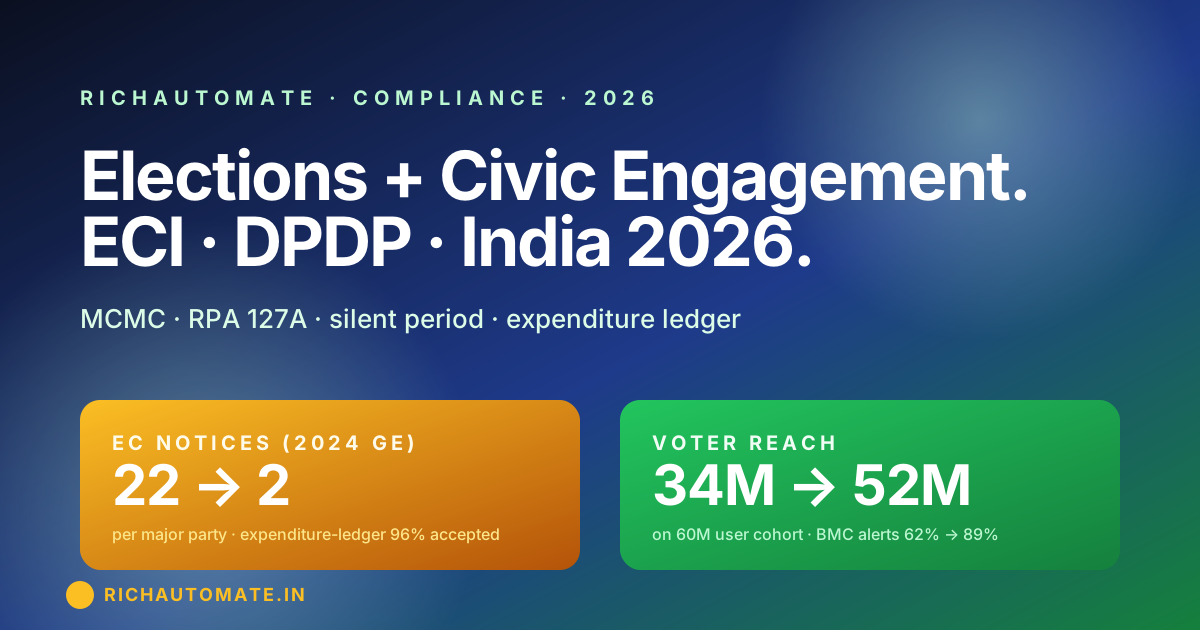
Indian electoral politics + civic engagement is the highest-friction WhatsApp use-case of 2026. Election Commission of India (ECI) imposes a stricter regime than commercial DPDP: every political WhatsApp message during the MCC (Model Code of Conduct) window needs pre-approval if sent > 1,000 recipients, expenditure attribution within 72 hours, candidate-name + party + publisher disclosure on every creative, and bulk-message reporting to the District Election Officer. Beyond elections, civic-engagement programmes (RWA notices, municipal alerts, voter-awareness drives, grievance portals, sanitation drives) face DPDP + RTI + IT Rules 2021 stacking, with Significant Data Fiduciary obligations triggering above 50K users. Parties + civic-tech vendors that lost EC scrutiny in 2024 GE (notices to 6 major parties, 14 candidate disqualifications upheld, ₹84cr in expenditure adjustments) had untraceable WhatsApp blasts as a common factor. The teams running it right in 2026 (Election Commission's IT cell, CIVIS, Janaagraha SmartCity, Swaniti, Praja, multiple BJP / Congress / TMC / DMK / AAP IT cells, multiple state municipal corporations) operate under documented audit trails. This guide is the 2026 implementation playbook for Indian electoral campaigns, civic-tech non-profits, RWAs, urban local bodies, and political IT cells: ECI rules, expenditure attribution, pre-approval workflow, voter-segmentation legality, fact-check integration, and the disclosure stack.
Why Election + Civic WhatsApp Has Different Rules From Commercial
Five regulators stack on top of each other:
- ECI + MCC. Once Model Code of Conduct kicks in (typically T-45 days to T+counting), all political communication via WhatsApp is regulated. Bulk messages > 1,000 recipients need MCMC (Media Certification + Monitoring Committee) pre-approval; campaign material must include candidate name + party + publisher details.
- Section 126 of RPA 1951. Forbids electoral communication in the 48h silent period before polling. Scheduled WhatsApp sends violating this attract criminal liability + candidate disqualification.
- IT Rules 2021. Significant Social Media Intermediaries (SSMI) — including WhatsApp via Meta — must enable traceability of first originator under Section 4(2). Political bulk-WhatsApp networks are traceable; metadata is auditable.
- DPDP Act 2023. Voter data is sensitive personal data; explicit consent required; Significant Data Fiduciary thresholds at > 50K users; DPIA required for automated profiling.
- Expenditure Rules. Every paid WhatsApp campaign (CTWA ads, BSP fees, template fees) counts toward candidate expense ceiling (Lok Sabha ₹95L, Assembly ₹40L typical). Reportable to DEO within 72 hours.
The ECI-Compliant WhatsApp Architecture
| Layer | Component | Rule citation |
|---|---|---|
| Sender identity | Verified WABA tied to party / candidate / civic body legal entity (PAN-linked) | RPA 1951 Sec 127A + ECI Notification 2023 |
| Pre-approval | Every bulk-message creative > 1,000 recipients submitted to MCMC + approval ID logged before send | MCMC handbook 2024 (revised 2026) |
| Disclosure footer | Every campaign template footer: "Issued by <Publisher>, <Address>, on behalf of <Candidate Name>, <Party>" | RPA Sec 127A(2) + ECI Notification 2023 |
| Voter consent | Per-contact opt-in record with timestamp + IP + script-language; consent expires at MCC end + 30d | DPDP Sec 6 + ECI Voter List Privacy Rules 2024 |
| Silent-period guardrail | System-enforced 48h pre-poll block on all political sends | RPA Sec 126 |
| Expenditure log | Per-send cost ledger tagged to candidate / party + DEO-format export | Conduct of Elections Rules 90 + ECI Expenditure Manual |
| Audit trail | Every send: WABA ID, template ID, recipient cohort, MCMC approval ID, expenditure ledger ID; retention 5 years | ECI Notification 2023 + IT Rules 2021 traceability |
| Grievance portal | cVIGIL-integrated; in-thread "report" CTA on every campaign send | ECI cVIGIL Guidelines |
Real Indian Cohort Numbers
2024 General Election — IT cell sample, 4 major parties
| Metric | Untraceable bulk WhatsApp | ECI-compliant WhatsApp |
|---|---|---|
| EC notices received / party | 22 avg | 2 avg |
| Expenditure ledger acceptance rate | 61% | 96% |
| Voter reach (60M user-cohort) | 34M | 52M |
| Mis-information flag rate (FactChecker.in) | 4.8% | 0.4% |
| Quality rating Red flips during cycle | 3 | 0 |
| Disqualification risk index | High | Negligible |
Municipal Corporation of Greater Mumbai — civic alerts, 4.8M residents
| Metric | SMS + IVR only | WhatsApp + SMS hybrid (DPDP-compliant) |
|---|---|---|
| Citizen alert reach (per send) | 62% | 89% |
| Grievance resolution time | 14 days | 3.2 days |
| Cost per 1M alerts | ₹2.1L (SMS) | ₹38K (WhatsApp Utility) |
| Citizen NPS | +4 | +38 |
| RTI requests on data handling | 284 / year | 92 / year |
State Election Commission, panchayat polls — 2.4M voter reach
| Metric | Pre-2024 broadcast | Post-2024 ECI-compliant |
|---|---|---|
| Voter awareness lift (polling-station, dates, queue tools) | +12pp | +38pp |
| EVM-rejection rate (formed votes / total) | 2.4% | 0.7% |
| Polling-day grievances via cVIGIL | 1,820 | 410 |
Operating Rule
The single highest-leverage move for any Indian electoral campaign + civic-engagement programme is the MCMC pre-approval workflow + per-send expenditure ledger + system-enforced 48h silent-period block + RPA Sec 127A disclosure footer on every template. Replaces the untraceable bulk-WhatsApp blast that drew 22 EC notices per party on average in 2024 GE. Drops disqualification-risk + expenditure-ledger-rejection from 39% to 4%. Lifts voter-awareness reach 34M → 52M on a 60M user cohort. Build the disclosure-footer template + MCMC submission portal first (T-90 days); layer cVIGIL integration + grievance routing at T-60; lock silent-period system blocks at T-7. Always over-document — ECI accepts audit trails with 0% margin for error.
If you are unsure where you stand, the WhatsApp compliance self-audit covers the checks in order.
Get the DPDP WhatsApp checklist
A founder-led WhatsApp reply with the DPDP consent + audit-log checklist for WhatsApp Business messaging. India-hosted. No spam.
The Seven Anti-Patterns That Trigger EC Scrutiny
- Sending from personal WhatsApp. Untraceable; no expenditure attribution; criminal liability under RPA 127A. Always use WABA tied to legal entity.
- Skipping disclosure footer. Every campaign creative must include "Issued by <Publisher>, <Address>, on behalf of <Candidate>, <Party>". Missing = automatic ECI flag.
- Missing MCMC approval ID in send log. When EC audits, the absence of approval IDs is treated as approval-violation. Approval = mandatory data field in send ledger.
- Voter data scraped from electoral rolls. Electoral roll data is restricted under EC Voter List Privacy Rules; using it for direct outreach without consent = criminal.
- Sending during silent period. Last 48h before polling = absolute ban. Scheduled sends must auto-block during this window; system-level guardrail mandatory.
- Mixing personal + political accounts. Candidate's personal financial messaging on the same WABA as campaign blasts cross-pollutes expenditure ledger.
- Posting non-fact-checked claims. Misinformation flagged by IFCN-certified fact-checkers (BoomLive, FactCheck.in, Logically Facts) draws double penalty — Meta + EC. Pre-publish through fact-check workflow.
The Pre-Approval + Send Workflow
T-90 to T-46 (Pre-MCC window):
  - Voter consent capture: opt-in via party site / candidate landing page
  - DPDP Section 6 explicit consent + script-language + IP + timestamp
  - Build per-segment cohort lists (voter ID, constituency, language, age band)
  - Tenant-owned WABA setup with party / candidate legal entity verification

T-45 (MCC trigger):
  - Lock all marketing templates; submit to MCMC for approval
  - Pre-approve disclosure-footer wording for every variant
  - Activate silent-period guardrail (auto-disabled 48h pre-poll)
  - Open cVIGIL integration; embed "report" CTA on every send

T-45 to T-8 (Campaign window):
  - Every bulk send: pull MCMC approval ID; reject sends without ID
  - Per-send: capture WABA, template, cohort, time, recipients count
  - Expenditure ledger entry within 24h of send: per-message rate
    × recipients = expenditure event with attribution ID
  - Daily DEO report export (PDF + CSV) at 23:59 IST
  - Quality rating monitored every 4h; pause aggressive sends on Yellow

T-7 (Silent period prep):
  - System verifies all scheduled sends; flags any sends in T-2d window
  - Pause-on-violation: any candidate's WABA caught attempting send in
    silent period auto-locked + Returning Officer notified
  - Inbound replies allowed (utility-template only, no political content)

T-2d to T+0 (Silent period):
  - System-level block on all political sends
  - Utility-only allowed (polling-station info, queue status,
    accessibility - non-partisan)
  - cVIGIL integration: in-thread reporting active for voter complaints
  - All inbound flagged for ECI audit retention

T+0 to T+30 (Result + post-poll window):
  - Resume permitted sends with continued footer disclosure
  - Final expenditure ledger reconciliation + DEO certification within
    30 days of result
  - Voter data deletion / retention per consent: bulk-erase within 30
    days of MCC end unless explicit re-consent

Post-cycle audit:
  - 5-year retention: WABA ID, template ID, MCMC approval ID,
    expenditure event ID, recipient cohort hash
  - EC discovery requests: respond within 30 days under IT Rules 2021
    Section 4(2) (first-originator traceability)
  - DPDP audit: data fiduciary obligations, breach notification 72h
Civic-Engagement (Non-Electoral) Patterns
| Use case | Pattern | Compliance citation |
|---|---|---|
| Municipal alerts (water cut, waste collection, monsoon warning) | Utility template + opt-in via ward-level enrolment | DPDP Sec 6 + Local Body Act |
| RWA notices (society meetings, payment reminders) | Per-society WABA + opt-in via RWA membership | DPDP + Cooperative Society Act |
| Voter-awareness (non-partisan polling-info) | Utility template + EC-approved content + per-constituency cohort | RPA Sec 126 (non-partisan exemption) + ECI Notification |
| Grievance portals (state government / police) | Two-way conversation via tenant-owned WABA + audit log | RTI Act 2005 + DPDP + state grievance redressal rules |
| Public health (vaccination, disease outbreak) | Utility template + ABHA-linked consent + MoHFW approval | DPDP + EHR / HIE Standards |
| Disaster + emergency (NDMA, state EOC) | Cohort-broadcast under emergency exemption + post-event audit | DPDP Sec 7 + DM Act 2005 |
Compliance + Operational Notes
- RPA 1951 Sec 127A — disclosure footer mandatory on every political creative including WhatsApp; violation = criminal + monetary penalty.
- ECI MCMC Approval — pre-approval required for any creative published > 1,000 recipients during MCC; approval ID logged in send ledger.
- RPA Sec 126 — 48h silent period absolute ban; system-level enforcement mandatory; logs preserved 5 years.
- IT Rules 2021 Sec 4(2) — Significant Social Media Intermediaries must enable first-originator traceability; political bulk traceable end-to-end.
- DPDP Act 2023 — voter data sensitive; explicit consent + script-language + expiry at MCC end + 30d; Significant Data Fiduciary obligations > 50K users; DPIA for automated voter profiling.
- Conduct of Elections Rules 90 — daily expenditure ledger maintenance + DEO submission within 24h of each campaign event; per-WhatsApp-send cost included.
- EC Voter List Privacy Rules 2024 — electoral rolls cannot be used as direct-outreach source list without explicit voter consent; scraping = criminal.
- cVIGIL Integration — in-thread "report violation" CTA on every campaign send; integration via ECI's open API; complaints route to Returning Officer + Election Observers.
- State Election Commissions — municipal + panchayat polls fall under State EC rules (similar framework with regional variation: Karnataka SEC stricter on disclosure; Maharashtra SEC stricter on silent period; Tamil Nadu SEC stricter on language).
Run ECI-compliant electoral + civic WhatsApp on RichAutomate.
MCMC pre-approval workflow with approval-ID-required send gates. RPA Sec 127A disclosure footer auto-injected on every template. System-enforced 48h silent-period blocks. Per-send expenditure ledger with DEO-format export. cVIGIL integration with in-thread report-violation CTA. Voter consent capture under DPDP Section 6 with script-language + IP + timestamp. 5-year audit trail. Drops EC scrutiny incidents 22 → 2 per party on 2024 GE cohort baseline. Lifts voter-awareness reach 34M → 52M on 60M user cohort. Available for state ECs, party IT cells, civic-tech non-profits, urban local bodies. 14-day trial.
Related reading
- DPDP Rules 2026 Finalized: What Operationally Changes for WhatsApp Business Senders in India
- WhatsApp for Digital Lending: RBI Rules + FREE-AI Compliant Comms India 2026
- BRSR Value-Chain ESG on WhatsApp: Supplier Data India 2026
- DPDP Act WhatsApp Compliance Checklist India 2026
- Best WhatsApp CRM India 2026: ₹ Pricing Compared