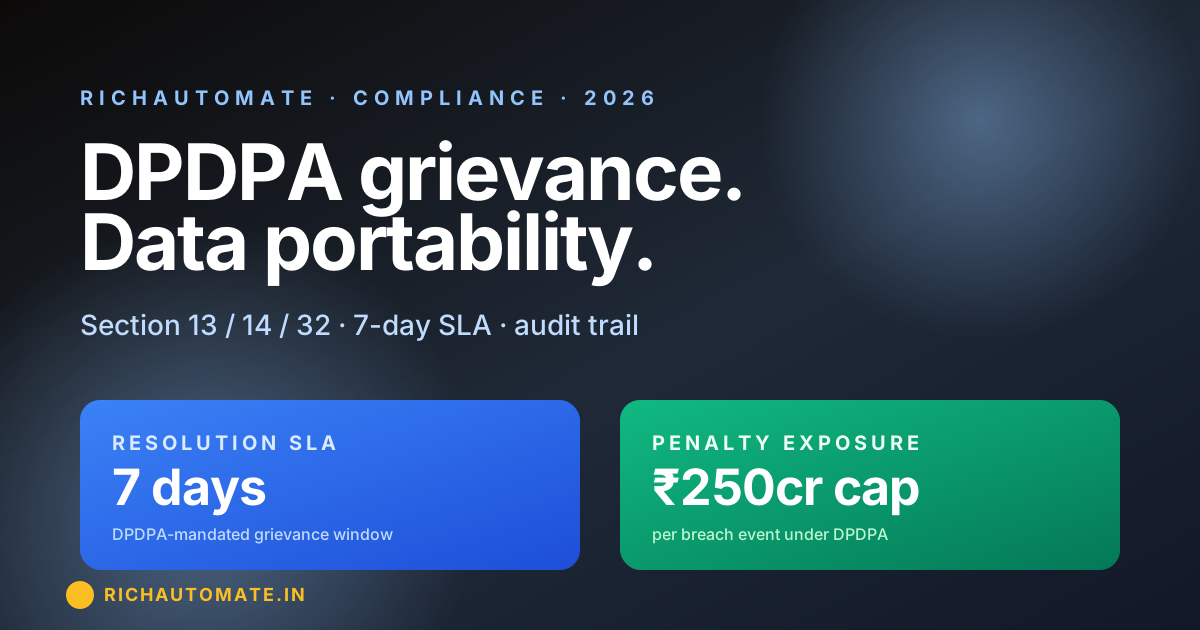
India's Digital Personal Data Protection Act 2023 (DPDPA) — operational from 2024 with rules notified through 2025-2026 — gives every Indian Data Principal (the person whose data is being processed) statutory rights including grievance filing, data access, data correction, data erasure, and portability. An overseas recruiter handling passport and medical documents runs exactly these DPDP duties, mapped in our overseas-recruitment & emigration-clearance playbook. WhatsApp Business operators serving Indian customers are Data Fiduciaries under the Act and carry penalty exposure up to ₹250 cr per breach event. Most Indian D2C, SaaS, BFSI, and B2C operators bolted on a generic privacy-policy page in 2024 and called it done. The brands compounding fastest in 2026 wired structured DPDPA grievance + Data Principal Rights flows directly into their WhatsApp infrastructure — explicit consent capture at every touchpoint, 7-day grievance SLA enforcement, 1-tap data-access + erasure requests, and audit-trail immutability. This guide is the 2026 implementation playbook for Indian Data Fiduciaries running WhatsApp at scale: the seven DPDPA obligations that WhatsApp surfaces, real architecture patterns, the grievance-to-resolution flow, audit + retention rules, and the penalty-exposure assessment.
The Seven DPDPA Obligations Indian WhatsApp Operators Must Surface
| Obligation | DPDPA Section | WhatsApp implementation |
|---|---|---|
| Consent capture (clear + specific + informed) | Section 6 | Consent text + opt-in moment logged with timestamp + version |
| Right to access personal data | Section 11 | 1-tap data-access request + machine-readable export within 30 days |
| Right to correction + erasure | Section 12 | 1-tap data-correction + erasure requests; processed in 30 days |
| Right to grievance redressal | Section 13 | 1-tap grievance + 7-day resolution SLA |
| Right to nominate | Section 14 | Nominee designation flow (data-of-deceased) |
| Notice of personal data breach | Section 8(6) + Rules | Auto-trigger to all affected Data Principals + DPB |
| Children's data + verifiable parental consent | Section 9 | Age verify + parental consent capture for minors |
Penalty Exposure Under DPDPA
| Violation | Maximum penalty |
|---|---|
| Failure to safeguard personal data (breach) | ₹250 crore per breach event |
| Failure to notify breach to DPB + Data Principals | ₹200 crore |
| Non-compliance with rights of Data Principals | ₹50 crore per violation |
| Violation of children's data obligations | ₹200 crore |
| General compliance failures | ₹50 crore |
Penalties are imposed by the Data Protection Board (DPB) per inquiry; Indian D2C operators with 100k+ active customers face existential exposure if grievance + breach response is mishandled.
The DPDP penalty calculator puts a number on the downside if your consent records do not hold up.
The Grievance-to-Resolution Flow on WhatsApp
Data Principal initiates grievance via 1-tap utility template button:
  "I want to access my data" / "Delete my data" / "File a complaint"

Auto-acknowledgement utility template within 5 sec:
  "We've received your request. Reference ID: GRV-2026-XXX. We'll respond within 7 days."
  Logged in audit trail with timestamp, request type, Data Principal ID

Routing:
  Data-access / portability → backend export pipeline (30-day SLA per Section 11)
  Erasure → suppression + actual deletion pipeline (30-day SLA per Section 12)
  Correction → review + update flow (30-day SLA)
  Grievance / complaint → grievance officer (7-day SLA per Section 13)

Resolution:
  Data export: machine-readable (JSON / CSV) delivered via secure link
  Erasure: confirmation + retention-rule compliance check (e.g., GST-mandated records retained per separate law)
  Grievance: investigation + response + remedy

Escalation:
  Unresolved within 7 days → Data Principal can escalate to DPB
  Brand exposure: failure to resolve + DPB inquiry + penalty up to ₹50 cr

Audit trail (immutable):
  Every consent capture, request, action, response logged
  Retention 7+ years for DPDPA + sector-specific laws (BFSI 10 years, healthcare longer)
  Access controls: only DPO + grievance officer + auditor
Real Indian Operator Implementation Numbers
Mid-tier D2C operator, 240k Indian customers, post-DPDPA wire-up (2025-2026)
| Metric | Pre-DPDPA wire-up | Post wire-up |
|---|---|---|
| Grievance acknowledgement time | 3-5 days | under 1 minute |
| Grievance resolution time (median) | 22 days | 4 days |
| Data-access request fulfilment | not standardised | under 14 days median |
| Erasure request processing | manual + delayed | under 21 days |
| Audit-trail completeness | partial | 100% (consent + actions logged) |
| DPDPA penalty exposure (est.) | high — ad-hoc compliance | negligible — process-driven |
BFSI / fintech, 1.4M customers, sensitive data
| Metric | Without WhatsApp DPDPA flow | With |
|---|---|---|
| Grievance officer queue | 140 / day backlog | under 30 / day handled live |
| Sector regulator (RBI / SEBI) audit pass rate | 72% | 96% |
| Customer trust index (proxy: NPS on data-handling questions) | 34 | 72 |
Architecture: Consent-First WhatsApp Integration
| Layer | What it does | DPDPA hook |
|---|---|---|
| Consent capture engine | Versioned consent text + timestamp + Data Principal ID per opt-in | Section 6 + Rules |
| Audit log (immutable) | Append-only ledger of consent + actions | Section 8(5) — record-keeping |
| Data Principal Rights portal | 1-tap access / correct / erase / grieve via WhatsApp utility | Sections 11-14 |
| Grievance officer routing | Designated officer + 7-day SLA tracker | Section 13 |
| Breach detection + notification | Auto-detect + notify affected Data Principals + DPB | Section 8(6) + Rules |
| Children's data flow | Age verify + parental consent | Section 9 |
| Cross-border transfer controls | Whitelisted countries only | Section 16 |
Operating Rule
The single highest-leverage move for any Indian operator running WhatsApp at 50k+ active customers is the 1-tap Data Principal Rights utility template — Access / Correct / Erase / Grieve buttons surfaced on demand, with auto-acknowledgement under 1 minute and SLA-tracked resolution. Most penalty exposure under DPDPA comes from missed acknowledgement + missed SLA, not from the underlying request itself. Brands that ship this single flow + maintain audit-trail immutability cut DPDPA penalty exposure from existential to negligible. Build before adding more user-facing features; the regulator will not wait.
Get the DPDP WhatsApp checklist
A founder-led WhatsApp reply with the DPDP consent + audit-log checklist for WhatsApp Business messaging. India-hosted. No spam.
The Six Anti-Patterns That Trigger DPDPA Penalty Exposure
- Single bundled consent at signup. "By signing up you consent to everything" doesn't meet Section 6 requirement of clear + specific + informed consent. Consent must be granular: marketing comms, third-party sharing, sensitive data processing each separate.
- No grievance officer. Section 13 mandates designated grievance officer + contact details published. Brands without a named officer fail at first DPB inquiry.
- Marketing template for grievance acknowledgement. Grievance acknowledgement = Utility (₹0.115/msg) since transactional. Marketing categorisation + delayed acknowledgement = double failure.
- Erasure without retention exception handling. Some data must be retained per other laws (GST 7 years, RBI 10 years). Erasure pipeline must distinguish — actually delete what can be deleted, retain only what law requires.
- Skipping breach notification SLA. Breach must be notified to Data Principal Board + affected Data Principals. Specific SLA per Rules (typically 72 hours from awareness). Late notification = penalty.
- Cross-border transfer without restriction. Section 16 restricts personal data transfer outside India to government-notified countries only. Default international transfer (US, EU, etc.) without compliance check = violation.
Trigger + Routing Architecture
Data Principal opt-in (signup, purchase, enquiry):
  Granular consent UI: marketing / sharing / sensitive data each separate toggle
  Consent record: {data_principal_id, purpose, version, granted_at, granted_via}
  Stored in immutable audit log

Each touchpoint:
  Pre-action: consent verification check
  Action logged: {action, timestamp, purpose, lawful_basis}

Data Principal Rights button (always accessible):
  Utility template with 4 buttons: Access / Correct / Erase / Grieve
  Tap → flow per right type → backend processing pipeline → SLA tracker

Access request:
  Backend export job: aggregate all personal data across systems
  Machine-readable format (JSON + CSV)
  Secure download link valid 7 days
  Delivered within 30 days (Section 11 SLA)

Correction request:
  Review by data team
  Update propagated to all systems
  Confirmation to Data Principal within 30 days

Erasure request:
  Suppression flag set (immediate stop of processing)
  Actual deletion within 30 days (subject to retention exceptions)
  Confirmation utility template

Grievance:
  7-day SLA tracker
  Routed to grievance officer with full context
  Investigation + response + remedy
  Escalation path to DPB documented

Breach detection:
  Auto-detect via security tooling
  Within 72h of awareness: notify DPB + affected Data Principals
  Notification utility template + remediation plan + helpline

Quarterly review:
  Grievance metrics: count, SLA compliance, themes
  Rights request metrics: count, fulfilment time
  Breach incidents (if any) + post-mortem
  Audit-trail integrity verification
Consent Versioning: The Underrated Lever
Privacy policies + consent text change over time. DPDPA-compliant operators version every consent capture so that future audits know exactly which terms each user accepted. Pattern:
- Each consent text gets a version number (e.g., consent_v_2026_01_15).
- User opt-in record includes consent_version_id + granted_at timestamp.
- Material changes (new processing purpose, third-party additions) require fresh opt-in — old consent cannot cover new purpose.
- Audit query: "Was Data Principal X validly consented for purpose Y at time Z?" → versioned record answers definitively.
Compliance + Operational Notes
- DPDPA — Sections 6, 8, 11-14 are the operational backbone; Rules notified through 2025-2026 fill in SLA + format details.
- Sector-specific overlays — RBI for BFSI, IRDAI for insurance, MoHFW for healthcare, TRAI for telecom. WhatsApp operations must comply with both DPDPA + sector regulator.
- Meta categorisation — grievance acknowledgement, data-rights confirmation, breach notification, consent re-verification = Utility (₹0.115/msg) since transactional. Marketing template wrong choice + adds 8× cost burn + delivery risk.
- Data Protection Officer (DPO) — significant Data Fiduciaries (large processors) must designate a DPO based in India + accessible to Data Principals.
- Indian-region storage — primary processing + storage in India per DPDPA + sector rules. Cross-border transfer only to government-notified countries.
- Audit + DPB inquiries — DPB can summon records; audit-trail immutability + retrievability is mandatory. Plan for 7+ year retention, longer per sector law.
Run DPDPA-compliant WhatsApp on RichAutomate.
Granular consent capture engine with versioning. Immutable audit log. 1-tap Data Principal Rights utility template. 7-day grievance SLA tracker. Breach detection + 72h notification. Children's data flow with parental consent. Cross-border transfer controls. Pre-approved utility templates for full DPDPA lifecycle. Cuts penalty exposure from existential to negligible on real Indian D2C + BFSI operator implementations. 14-day trial.
Related reading
- DPDP Act WhatsApp Compliance Checklist India 2026
- WhatsApp for Elections + Civic Engagement India 2026: ECI MCMC Compliance + DPDP + Silent-Period Architecture
- BRSR Value-Chain ESG on WhatsApp: Supplier Data India 2026
- WhatsApp for Digital Lending: RBI Rules + FREE-AI Compliant Comms India 2026
- WhatsApp Business API Cost India 2026: ₹0.11–₹0.99/msg
Data-rights requests must be routed away from the ordinary support queue. The tiering that does that sits in the wider WhatsApp complaint escalation matrix, which sends anything statutory to a named nodal officer rather than to a frontline agent.