India’s digital lending engine disbursed an estimated ₹3.5–4.5 lakh crore in FY26 across consumer + MSME + BNPL + personal-loan rails (estimated, triangulated from FACE / industry FY25 trajectories — verify exact figures), routed through a network of several hundred RBI-registered NBFCs and many more Lending Service Providers (LSPs) operating Digital Lending Apps (DLAs). And almost every one of those borrowers is reachable on WhatsApp — 600 million-plus Indian users — the single highest-open-rate channel a lender owns. But the regulatory floor under that channel was re-poured. The RBI Digital Lending Directions 2025/2026 (consolidating the 2022 guidelines plus the FREE-AI framework, the Default Loss Guarantee cap, the Key Fact Statement mandate, and tightened recovery-conduct rules) make borrower communication a compliance surface, not a growth hack. Send a loan offer without a Key Fact Statement, hide the LSP behind the brand, place a recovery call at 9pm, or let an AI agent improvise a repayment threat — each is now a documented violation that the RBI ombudsman + the borrower-grievance machinery can act on. This guide maps each major rule (as per RBI Digital Lending Directions 2025/2026, verify exact clause) to compliant WhatsApp comms across the full lending lifecycle: origination consent → KFS delivery → disbursal confirmation → EMI reminder pathway → conduct-limited recovery → grievance / RBI-ombudsman. It is written for product, compliance, collections, and growth teams at NBFCs, fintech LSPs, and bank digital-lending units who need the channel to scale and survive an inspection. For a different RBI-adjacent savings-and-collections model, see WhatsApp for registered chit funds.
Why RBI Digital Lending Rules Reshape Every Borrower Message in 2026
The 2022 Digital Lending Guidelines were the first shock. The 2025/2026 consolidation is the second — and it is the one that moves communication from marketing’s desk to compliance’s. Five forces converge:
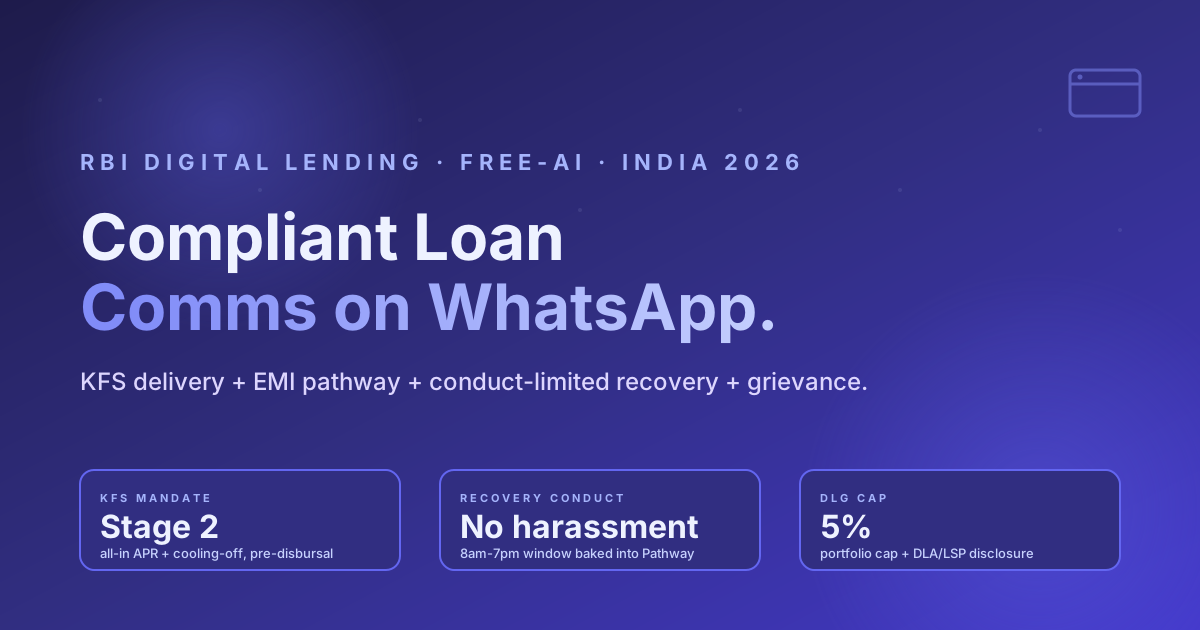
- KFS is non-negotiable and pre-disbursal. Every digital loan must carry a Key Fact Statement showing the all-in Annual Percentage Rate, fees, and the cooling-off / look-up period — delivered before the borrower is bound. A WhatsApp offer that omits it is a defective disclosure (as per RBI Digital Lending Directions 2025/2026, verify exact clause).
- DLG cap reshapes who can promise what. The Default Loss Guarantee a LSP can offer a regulated lender is capped at roughly 5% of the loan portfolio (verify exact percentage and computation basis). This changes risk-sharing economics — and means LSP-branded comms cannot imply the LSP is the actual lender.
- Recovery conduct is rule-bound. Recovery contact is restricted to a defined window (commonly cited as 8am–7pm — verify against the latest RBI / Fair Practices Code), with explicit prohibition on harassment, repeated calls, public shaming, or contacting references. A WhatsApp collections sequence must encode the window and the tone, not just the schedule.
- DLA / LSP disclosure + data localization. Borrowers must know which entity is the regulated lender, which is the LSP, and that their data is stored in India with consent-bound, purpose-limited usage. WhatsApp footers and consent flows carry this.
- FREE-AI framework raises the bar on automation. The RBI FREE-AI (Framework for Responsible and Ethical Enablement of AI) guidance pushes lenders toward fair, accountable, explainable, and human-overseen AI — which directly governs any AI-driven WhatsApp agent that nudges, negotiates, or answers a borrower.
Rule × What Changed × WhatsApp Impact
| RBI rule / instrument | What changed (2025/2026) | WhatsApp comms impact |
|---|---|---|
| Key Fact Statement (KFS) | Mandatory all-in APR + fee + cooling-off disclosure, standardised format, pre-disbursal | KFS must be delivered as a structured template / document before any acceptance step; cannot bury it post-disbursal |
| Default Loss Guarantee (DLG) cap | LSP guarantee capped (~5% of portfolio, verify); invocation + accounting tightened | LSP-branded WhatsApp cannot imply lending; lender identity disclosed in every credit message |
| Recovery conduct rules | Defined contact window + explicit anti-harassment + no third-party / reference contact | Collections pathway must hard-gate send-time window + tone + frequency caps |
| DLA / LSP disclosure | Borrower must see regulated-lender + LSP identity + grievance officer up front | Footer + welcome consent must name lender, LSP, and grievance / ombudsman route |
| Data localization + consent | India-stored, purpose-limited, revocable consent (aligns with DPDP) | Opt-in capture + revocation handling + no data sharing beyond stated purpose |
| FREE-AI framework | Fair, accountable, explainable, human-in-loop AI in finance | AI WhatsApp agent needs guardrails, escalation to human, audit log of every nudge |
| No dark patterns | No pre-ticked consent, no coerced upsell, no misleading urgency | Consent + offer messages must be plain, non-coercive, with clear decline path |
The Compliant Lending Lifecycle on WhatsApp
Map the rules to the journey, stage by stage. Each stage pairs an automation with the guardrail that keeps it inside the Directions.
Before you submit, run the copy through the WhatsApp template approval checker to catch the rejection triggers Meta flags most often.
Stage 1 — Origination & consent
Capture explicit, logged opt-in before any credit message. The first WhatsApp interaction names the regulated lender and the LSP, states the purpose, and offers a plain decline. No pre-ticked boxes, no coerced “reply YES to continue” that hides terms. Consent is timestamped, revocable, and stored in India under DPDP-aligned purpose limitation.
Stage 2 — KFS delivery
Before the borrower accepts, deliver the Key Fact Statement — all-in APR, every fee, the cooling-off / look-up period, and the recovery + grievance contacts — as a structured WhatsApp template plus an attached KFS document. Acceptance is a separate, deliberate step after the borrower has seen the KFS, never bundled into the offer message.
Stage 3 — Disbursal confirmation
On disbursal, send a confirmation naming the regulated lender, the sanctioned amount, the first EMI date, and the link to the borrower’s loan account + grievance route. This is a utility-class message and doubles as the borrower’s record.
Stage 4 — EMI reminder pathway (D-7 / D-3 / D-0 / D+3)
A conduct-safe reminder cadence keeps borrowers informed without tipping into harassment:
- D-7: Gentle upcoming-EMI heads-up with amount + date + one-tap pay link.
- D-3: Reminder + the option to flag hardship and request restructuring (routes to human).
- D-0: Due-today nudge with pay link; single message, no repeated pings.
- D+3: Missed-payment notice in plain, non-threatening language + grievance + hardship route — the bridge into conduct-limited recovery, never a threat.
Stage 5 — Conduct-limited recovery
Recovery messaging is gated by the RBI contact window, frequency caps, and a hard ban on harassment, public shaming, or contacting references / third parties. The pathway enforces the time window at the send layer, caps total touches, and escalates only to compliant human agents — never an AI improvising pressure.
Stage 6 — Grievance / RBI-ombudsman
Every message footer and the grievance flow surface the named grievance redressal officer, the resolution SLA, and the escalation path to the RBI Integrated Ombudsman Scheme. A borrower can raise a complaint from inside WhatsApp and get a tracked ticket.
Get the DPDP WhatsApp checklist
A founder-led WhatsApp reply with the DPDP consent + audit-log checklist for WhatsApp Business messaging. India-hosted. No spam.
Compliant vs Non-Compliant Recovery Comms
| Dimension | Non-compliant (violation risk) | Compliant (RBI-aligned) |
|---|---|---|
| Contact time | Calls / pings at 9pm or 6am | Hard-gated to the permitted window (e.g. 8am–7pm, verify) |
| Frequency | Repeated daily pings, multiple per day | Frequency-capped, spaced, logged |
| Tone | Threats, shaming, coercive urgency | Plain, factual, hardship + grievance route offered |
| Third parties | Contacting references / family / employer | Borrower-only contact; no reference outreach |
| Identity | LSP poses as lender; agent unnamed | Regulated lender named; agent + grievance officer disclosed |
| AI behaviour | AI agent improvises pressure off-script | FREE-AI guardrails + human escalation + audit log |
Per-Stage Automation & Guardrail
| Stage | WhatsApp automation | Built-in guardrail |
|---|---|---|
| Origination | Consent-capture welcome template | No pre-tick + logged timestamp + revocable + lender/LSP named |
| KFS delivery | KFS template + attached document | Pre-disbursal gate; acceptance is a separate step |
| Disbursal | Utility confirmation message | Lender identity + account + grievance link |
| EMI reminder | D-7 / D-3 / D-0 / D+3 pathway | Single message per stage; hardship + pay link, no spam |
| Recovery | Conduct-limited collections sequence | Send-window gate + frequency cap + no-harassment copy + human escalation |
| Grievance | In-thread grievance flow | Named officer + SLA + RBI-ombudsman escalation route |
The recovery-conduct + harassment guardrails, baked into the Pathway. The single biggest WhatsApp compliance failure for digital lenders is recovery tone + timing. A compliant RichAutomate collections pathway enforces three things at the engine level, not as a policy memo: (1) a send-time gate so no recovery message can leave outside the RBI-permitted contact window (e.g. 8am–7pm, verify against current Fair Practices Code); (2) a frequency cap + spacing so no borrower is pinged into harassment; (3) approved, non-threatening copy with a hardship + grievance route on every message, and escalation only to a named, compliant human agent — never an AI improvising pressure. Harassment, public shaming, and contacting references / family are blocked by design.
FREE-AI: Governing the AI WhatsApp Agent
If an AI agent answers borrowers, nudges EMIs, or negotiates, the RBI FREE-AI framework (Framework for Responsible and Ethical Enablement of AI — verify scope and applicability) sets the expectation: fairness (no discriminatory treatment), accountability (a named owner for the agent’s actions), explainability (the borrower can understand why a message was sent), and human oversight (escalation to a person for anything sensitive — hardship, disputes, recovery). Practically, that means the agent runs on approved templates, logs every outbound nudge, refuses to threaten or improvise terms, and hands off to a human the moment a borrower flags distress or dispute.
Illustrative Lender Cohort (Illustrative — Not a Guarantee)
The numbers below are illustrative of the direction compliant comms tend to move, not a promise of results. They model a mid-size NBFC / LSP cohort that moved EMI + recovery onto a guard-railed WhatsApp pathway.
| Metric (illustrative) | Before (call + SMS heavy) | After (guard-railed WhatsApp) | Direction |
|---|---|---|---|
| EMI on-time rate | baseline | +12 pp | up (illustrative) |
| Recovery-conduct complaints | baseline | -60% | down (illustrative) |
| KFS disclosure coverage | partial | 100% pre-disbursal | up |
| Cost per reminder vs voice call | baseline | materially lower | down (illustrative) |
| Grievance resolution time | baseline | faster (in-thread ticketing) | down (illustrative) |
Why this lowers complaint risk. Conduct complaints to the RBI ombudsman are overwhelmingly about recovery tone, timing, and third-party contact — the exact failures a send-window gate + frequency cap + approved non-threatening copy + borrower-only contact eliminate by design. Moving recovery from improvised calls to a logged, guard-railed WhatsApp pathway turns the riskiest stage of the lifecycle into the most auditable one.
Data Localization, Consent & DPDP Alignment
The Directions require borrower data to be stored in India, used only for the disclosed purpose, and held under revocable consent — which dovetails with the DPDP Act’s notice + consent + purpose-limitation duties. On WhatsApp that means: a clear opt-in at origination, a plain-language purpose, no sharing beyond the lender / LSP chain, an honoured revocation, and no dark patterns in any consent ask. Footers carry the lender identity, the grievance officer, and the data-handling statement.
Implementation Checklist for Digital Lenders
- Name the regulated lender + LSP in the welcome message and every credit communication.
- Gate the KFS as a pre-disbursal template + attached document; make acceptance a separate step.
- Build the D-7 / D-3 / D-0 / D+3 EMI pathway with single-message-per-stage discipline.
- Hard-code the recovery send-time window + frequency cap at the engine level.
- Use only approved, non-threatening recovery copy; block reference / third-party contact.
- Put a hardship + grievance + RBI-ombudsman route on every collections message.
- Wrap any AI agent in FREE-AI guardrails: approved templates, audit log, human escalation.
- Capture revocable, India-stored consent with no dark patterns; honour opt-out instantly.
For vertical-specific playbooks, see our deep-dives on gold-loan NBFC WhatsApp comms, the microfinance / SHG loan lifecycle, and how a WhatsApp CRM ties consent, EMI, and grievance together. Pricing and trial details are on the pricing page.
Ship RBI-compliant lending comms on RichAutomate.
Origination consent (logged, revocable, lender + LSP named, no dark patterns) + KFS delivery (pre-disbursal template + document) + disbursal confirmation + EMI pathway (D-7 / D-3 / D-0 / D+3) + conduct-limited recovery (send-window gate + frequency cap + no-harassment copy + human escalation) + grievance / RBI-ombudsman route. FREE-AI guardrails on every AI nudge. Data-localised, DPDP-aligned consent. ₹0 platform fee · Client Pay ₹0.10/message · SaaS Pay ₹1.50 marketing / ₹0.50 utility · 14-day trial + 100 free credits. (Compliance specifics: verify against the current RBI Digital Lending Directions and Fair Practices Code.)
RBI rules are half the picture: pair them with the DPDP Act checklist for banks and lenders for consent, retention and breach reporting.
Need the actual wording? Copy these loan approval message templates that carry the amount, APR, tenure and Key Fact Statement link in one Utility message.
Related: WhatsApp for Loan DSA & Mortgage Brokers in India 2026 — the enquiry-to-disbursal workflow a channel partner runs on WhatsApp: consent capture, eligibility pre-qual, KYC document collection and sanction-status updates, inside RBI digital-lending guardrails.