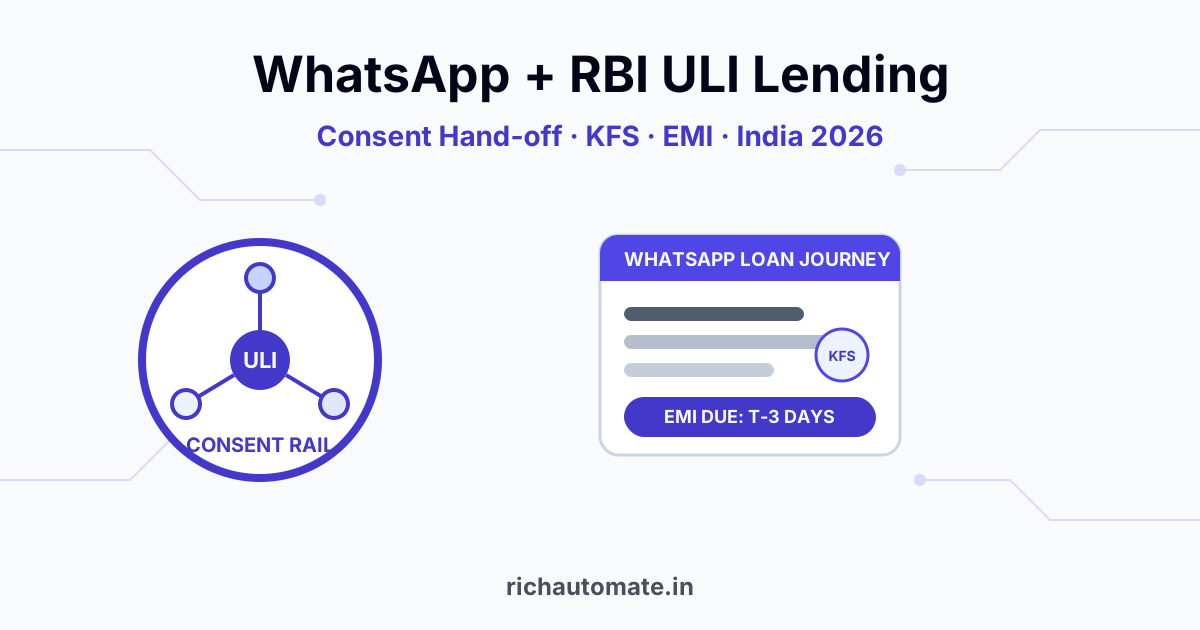
The RBI's Unified Lending Interface (ULI) is a public digital-credit rail that lets a borrower consent to share verified data — land records, Aadhaar/PAN, GST and account-aggregator feeds — so a lender can underwrite in minutes instead of weeks. In a ULI-native journey WhatsApp does not replace ULI; it wraps it — handling lead capture, the consent hand-off, Key Fact Statement (KFS) delivery, and disbursal-and-collection comms, while the regulated data pull and credit decision happen on the ULI/lender rails, never inside a chat thread. This guide maps where WhatsApp legitimately sits for an NBFC, bank or Lending Service Provider (LSP) getting ULI-ready in 2026, what data must never transit WhatsApp, and the ₹ costs — with every regulatory point hedged "verify current RBI status", because ULI is still scaling from pilot.
What ULI is (and what stage it is at)
ULI is an RBI-conceived, RBI-Innovation-Hub-built platform that standardises how lenders access a borrower's financial and non-financial data through a common, consent-based set of APIs — the "UPI moment" for credit. Instead of every lender integrating separately with each land-registry, GSTN, Aadhaar or account-aggregator source, ULI offers a plug-and-play layer: with the borrower's explicit consent, the lender pulls exactly the data fields it needs, cutting turnaround and the paperwork drag on small-ticket and rural credit. Verify the current rollout stage at the RBI before you build — ULI moved from a 2024 pilot toward wider availability, and the live scope of participating lenders and data providers changes with each RBI update. Treat this as a readiness playbook, not an integration manual: the point is to position your WhatsApp lending stack so that when your institution goes live on ULI, the borrower-facing layer is already compliant and ready.
ULI does not sit alone. It rides on the same consent philosophy as the account-aggregator consent journey and operates alongside the RBI's Digital Lending Directions, whose DLG, KFS and LSP-conduct rules govern everything the borrower actually sees — including your WhatsApp messages.
Where WhatsApp fits in a ULI-native lending journey — and where it must not
The single most important design decision is the boundary. A ULI journey has a regulated core (identity, consent-artefact exchange, data pull, underwriting, disbursal) and a communications shell (find the borrower, explain, remind, collect). WhatsApp is the shell, never the core.
- WhatsApp DOES: capture the lead and intent, deep-link the borrower into the lender's or LSP's ULI-integrated app/consent screen, deliver the KFS document, send approval/disbursal confirmations, and run EMI-reminder and collection comms — all transactional utility messaging.
- WhatsApp does NOT: collect Aadhaar numbers, OTPs, full bank statements, card/CVV or credit decisions in the chat. The consent artefact and the data pull happen on the ULI rails and the lender's secure environment; the borrower authenticates there, not in a message. A chat thread is not a consent-management system and must not become a store of regulated financial data.
Get this boundary right and WhatsApp becomes the highest-reach, lowest-friction on-ramp to a ULI loan without inheriting the compliance weight of the regulated core.
The 5-stage WhatsApp lifecycle for a ULI-ready lender
Stage 1 — lead capture + eligibility intake (WhatsApp Flow)
Replace the leaky web form with a WhatsApp Flow that captures name, loan purpose, rough ticket size and city, plus a soft-eligibility self-declaration (income band, entity type). No KYC identifiers here — just enough to qualify and route. The Flow response drops a structured lead into your loan-origination system (LOS) so a ULI-integrated underwriting queue picks it up. This mirrors the top-of-funnel intake in our gold-loan NBFC onboarding playbook, minus any collateral-photo step.
Stage 2 — consent hand-off to the ULI rail (deep-link, not in-chat)
When the borrower is ready, WhatsApp sends a single deep-link into the lender/LSP app or ULI consent screen where the borrower authenticates and grants purpose-scoped, time-bound consent for the specific data pull. The consent artefact — what was shared, with whom, for how long — is created and stored on the regulated rail, not in WhatsApp. Your chat simply confirms "consent recorded, we're checking your eligibility now." Keeping the consent step off WhatsApp is what keeps the whole journey inside the RBI's digital-lending and DPDP consent architecture.
Stage 3 — KFS + sanction delivery (document message)
The Digital Lending Directions make the Key Fact Statement mandatory — APR, all-in cost, fees, cooling-off period and recovery mechanism in a standard format — before the borrower commits. Deliver the KFS as a WhatsApp document into the borrower's thread: searchable, forwardable, timestamped, and impossible to "lose in the app." On sanction, send the sanction letter and repayment schedule the same way. This is a genuine compliance win — the borrower demonstrably received the KFS, and you have the delivery record.
Stage 4 — disbursal confirmation + onboarding
On disbursal, a utility template confirms the amount credited, the first EMI date and the repayment channel, and links the borrower to a self-service statement. Because DLG and no-pass-through-of-fees rules govern what you can say, the message stays factual — amount, date, EMI — with no cross-sell riders bolted onto a regulated disbursal notice.
Get a 1-minute BSP audit on WhatsApp
Drop your WhatsApp number — we line-item your current invoice against Meta India rates in under 60 seconds. India-hosted, DPDP-compliant.
Stage 5 — EMI reminders + collection comms (the recurring spine)
Load every EMI due date into a scheduler and fire utility reminders at T-3 days, a due-day nudge and a compliant overdue follow-up with a payment link. Collection messaging must follow the RBI's fair-practices and recovery-conduct norms — no harassment, reasonable hours, clear identification — which a templated, logged WhatsApp cadence enforces far better than ad-hoc agent calls. The same T-3/due-day/overdue mechanic drives our microfinance and SHG loan-lifecycle playbook.
The automation stack you actually need
- WhatsApp Flows for lead capture and eligibility intake — structured, no KYC identifiers in-chat.
- Deep-links to the lender/LSP ULI consent screen for the regulated authentication and data pull.
- Document messages for the KFS, sanction letter and repayment schedule.
- Utility templates for disbursal confirmation and every EMI reminder — the cheapest, highest-deliverability category.
- A due-date scheduler keyed to each EMI — the recovery-conduct spine.
- A multi-agent shared inbox for borrower queries, with a clean audit log of every message.
What data must never transit WhatsApp — the readiness checklist
- No Aadhaar numbers, OTPs, or authentication secrets in chat — authentication belongs on the ULI/lender rail.
- No full bank statements, card numbers or CVV — the account-aggregator/ULI pull handles financial data under consent.
- No credit decision or scoring logic exposed in the thread — the underwriting happens in the lender's secure environment.
- Consent artefacts stored on the regulated rail, not reconstructed from message history.
- Data minimisation — WhatsApp holds only what it needs to communicate: name, loan reference, EMI status. Everything regulated stays upstream.
What it costs: the RichAutomate pricing
The WhatsApp platform layer on RichAutomate is ₹0 setup, ₹0 monthly, ₹0 platform fee. You choose how the per-message cost works:
- Client Pay: ₹0.10 per message, with Meta's conversation charges billed directly to you at cost. KFS delivery, disbursal notices and EMI reminders are utility-category — the cheap end of Meta's card — so a full lending book of transactional comms runs at a rounding-error cost.
- SaaS Pay: all-inclusive ₹1.50 marketing / ₹0.50 utility per message on one INR GST invoice, tiered down with volume — no separate Meta bill to reconcile. GST registration is effectively required to run a live WhatsApp Business API sender in India.
- 14-day free trial + 100 free credits to wire your eligibility Flow and test the EMI reminder engine before committing.
For how these per-message numbers stack against platform and BSP fees, see the WhatsApp Business API pricing breakdown.
DPDP + digital-lending carve-out
A ULI-ready WhatsApp stack sits at the intersection of the RBI Digital Lending Directions and the Digital Personal Data Protection Act, 2023 — and both push the same way:
- Consent on the rail, not in the chat. Purpose-scoped, time-bound consent is captured and stored on the regulated ULI/AA layer; WhatsApp only confirms status.
- Purpose limitation. Borrower contact and loan-reference data used for servicing is not repurposed into unrelated marketing.
- Recovery conduct. Collection messaging follows fair-practice norms — identification, reasonable hours, no harassment — enforced by templated, logged cadences.
- Retention. Keep KFS-delivery and reminder logs for your statutory record window; honour opt-out of non-essential messages while continuing genuinely transactional notices.
7-day ULI-readiness rollout
- Day 1: Connect your WhatsApp Business API number and map your current lending journey to the regulated-core vs communications-shell boundary.
- Day 2: Build the lead-capture + eligibility Flow (no KYC identifiers) and wire responses into your LOS.
- Day 3: Set up the deep-link hand-off to your ULI/LSP consent screen; confirm no regulated data touches the chat.
- Day 4: Create the KFS, sanction and disbursal document/utility templates in compliant, factual wording.
- Day 5: Configure the EMI due-date scheduler with the T-3/due-day/overdue reminder sequence and payment links.
- Day 6: Run a compliance check against the Digital Lending Directions and DPDP — data minimisation, recovery conduct, retention windows.
- Day 7: Fire a test batch against a sample cohort and verify KFS delivery and reminder receipts end-to-end.
Get your WhatsApp lending layer ULI-ready
RichAutomate gives NBFCs, banks and LSPs the borrower-facing WhatsApp stack for a ULI-native journey — eligibility Flows, consent deep-links, KFS document delivery, and an automated EMI reminder engine — at ₹0 setup, ₹0 monthly, ₹0 platform fee. Client Pay is ₹0.10/message plus Meta's rates billed direct at cost; SaaS Pay is ₹1.50 marketing / ₹0.50 utility all-inclusive. The regulated core stays on the ULI rail; WhatsApp handles the reach. Start with a 14-day free trial and 100 free credits, or book a 30-minute walkthrough. Verify current ULI availability with the RBI before go-live.
The customer LTV calculator shows what a retained customer is worth before you set the spend.
Start your 14-day free trial → · Book a 30-min walkthrough · See the cost breakdown