India's lenders carried roughly ₹4.6 lakh crore of retail loans in early-stage delinquency (DPD 1-90) entering FY26, spread across 1,544 urban co-op banks, 43 RRBs, 9,400+ NBFCs and 80+ RBI-registered digital lenders (RBI Financial Stability Report Dec-2025 + CRIF High Mark MicroLend Q3 FY26). The collections function that recovers this money is also the single biggest compliance and reputational liability a lender owns — the RBI's Fair Practices Code, the Recovery Agent guidelines (RBI Master Direction on Managing Risks and Code of Conduct in Outsourcing, and the harassment circular dated Aug-2024), the Digital Lending Guidelines 2025 (DLG) and the RBI-Integrated Ombudsman Scheme all converge on one channel: how you contact a borrower. Phone-call collections average ₹38-62 per successful contact attempt, connect at 18-31%, and generate 84% of all RBI Ombudsman complaints filed against lenders. A WhatsApp-first, consent-led, fully-logged collections thread flips every one of those numbers: contact cost drops to ₹2-6, right-party-contact rises to 71-88%, self-cure (borrower pays without a human agent) climbs to 34-54%, and every nudge is timestamped, template-approved and auditable for the Ombudsman. This is the FY26 India implementation playbook — the regulator landscape, the 10-stage WhatsApp recovery lifecycle from DPD-0 to legal handoff, the automation stack, three real cohort tables, six anti-patterns that get a lender's collections shut down, and a 12-week migration path.
Why WhatsApp-First Collections Matters in India Now
Six structural forces moved WhatsApp collections from experiment to mandate in 2026:
- RBI harassment crackdown. The Aug-2024 RBI advisory and the 2025 supervisory action against several digital lenders explicitly named unrecorded phone calls, calls outside 8am-7pm, and contacting references as enforcement triggers. WhatsApp threads are timestamped, template-bound, and stay inside permitted hours by scheduler — they are defensible evidence, a call log is not.
- Digital Lending Guidelines 2025. DLG mandates that all borrower communication (including recovery) flow through the Regulated Entity or its registered Lending Service Provider, with a Key Fact Statement trail and a cooling-off/look-up period. A consent-anchored WhatsApp channel maps cleanly to this; rogue tele-callers do not.
- Right-party-contact economics. A dialler burns ₹38-62 per successful contact at 18-31% connect. A WhatsApp Utility template costs ₹0.115 and is read by 71-88% of borrowers within the day. At 4 lakh accounts/month the channel-mix shift alone saves ₹2-4 crore/year.
- Self-cure unlock. A borrower who can tap a payment link inside a calm, non-confrontational thread pays 34-54% of the time before any agent calls — recovering money that a hostile call would have pushed into avoidance.
- Ombudsman + grievance audit. The RBI-Integrated Ombudsman Scheme and the lender's own Internal Ombudsman need a clean trail. WhatsApp gives a per-borrower, per-message ledger that closes complaints in days, not weeks.
- DPDP Act 2023. Financial-distress data is Sensitive Personal Data. WhatsApp's consent-anchored opt-in + per-message log is the cleanest way to honour purpose-limitation, the right to grievance, and the 72-hour breach clock.
The Regulator + Compliance Landscape
No collections channel survives in India without mapping to this stack. WhatsApp's structural advantage is that every rule below is satisfied by a logged, template-approved, consent-anchored thread.
| Instrument | What it governs for collections | How a WhatsApp thread satisfies it |
|---|---|---|
| RBI Fair Practices Code (FPC) | No harassment, no calls before 8am / after 7pm, dignity of borrower, no contacting references for harassment | Scheduler hard-blocks sends outside 8am-7pm; templates carry no coercive language; no reference-contacting |
| RBI Recovery Agent / Outsourcing Code of Conduct | Agent identity disclosure, recorded interactions, grievance redress, no impersonation | Verified WABA display name + agent ID in template; full message log; in-thread grievance button |
| RBI Digital Lending Guidelines 2025 (DLG) | Communication via RE/registered LSP only, KFS trail, look-up/cooling-off period | Single WABA owned by RE; consent + KFS link in thread; cooling-off respected by suppression list |
| RBI-Integrated Ombudsman Scheme + Internal Ombudsman | 30-day grievance SLA, auditable contact history | Per-borrower message ledger exported on demand; in-thread escalation auto-creates ticket |
| SARFAESI Act 2002 (secured loans) | Demand notice 60 days, possession notice, no contact during legal stay | Legal-stage suppression flag freezes all automated nudges; notice-served acknowledgements logged |
| DPDP Act 2023 | Financial-distress = Sensitive PDI; consent, purpose-limitation, grievance, 72-hr breach | Opt-in consent stored; recovery-only purpose tagged; Aadhaar/account tokenised; grievance officer in-thread |
| CGST + IT Act | UPI payment receipt, e-receipt, lawful e-signature on settlement letters | WhatsApp Pay / Razorpay UPI receipt auto-issued; settlement letter via NSDL/eMudhra Aadhaar OTP e-sign (IT Act Sec 5) |
The 10-Stage WhatsApp Recovery Lifecycle (DPD-0 to Legal Handoff)
One thread per loan account, state-machine driven, with a hard suppression layer for legal-stage and grievance accounts. The design principle: recover the easy money silently with self-cure, reserve human agents for the genuinely hard cases, and log everything.
- Pre-due reminder (DPD -3 / -1). Utility template: "Your EMI of ₹X is due on DD-MM. Tap to pay." One-tap UPI AutoPay re-presentment or WhatsApp Pay link. This single stage is the highest-ROI lever — it prevents delinquency rather than chasing it.
- Due-date nudge (DPD 0). Friendly, single message + pay link + "Need more time?" button routing to a self-serve hardship menu (partial pay / 7-day extension request).
- Early bucket self-cure (DPD 1-30). Day-3 / Day-7 / Day-15 cadence, each with a pay link and a 1-tap "Promise to Pay" date picker. A logged PTP de-prioritises the account from the agent dial-list — this is the core cost saver.
- PTP tracking + break handling (DPD 1-30). If the borrower set a PTP, the system sends a gentle reminder on the promised date. A kept PTP closes the loop silently; a broken PTP escalates one tier.
- Mid-bucket negotiation (DPD 31-60). AI Pathway (Haiku / Gemini Flash, sub-2s) classifies free-text replies into intent buckets — "will pay", "dispute", "job-loss hardship", "already paid" — and routes: settlement-offer template, dispute-ticket, hardship-restructure menu, or payment-reconciliation check.
- Restructure / settlement offer (DPD 31-90). Pre-approved one-time-settlement or restructure terms surfaced as a structured Flow; borrower accepts with Aadhaar OTP e-sign; settlement letter auto-issued to thread + DigiLocker.
- Agent-assisted handoff (DPD 31-90). When AI confidence is low or the borrower asks for a human, the thread hands to a live collections agent inside the same WhatsApp window (no channel switch), with full context and a verified agent-ID header per RBI Recovery Agent code.
- Pre-legal demand (DPD 61-90). Compliance-reviewed demand template (no coercive language) + SARFAESI 60-day notice link for secured loans. Sent once, logged, and the account is flagged for the legal team's review.
- Legal-stage suppression. Once an account enters legal / SARFAESI possession / Lok Adalat / DRT, a hard suppression flag freezes ALL automated nudges — sending anything during a legal stay is a regulatory and contempt risk. Only manual, counsel-approved messages allowed.
- Cure + grievance close-out. On full payment, an NDC (No-Dues Certificate) + UPI receipt auto-issue; the account exits the thread. Any grievance raised mid-cycle auto-creates an Internal Ombudsman ticket with a 30-day SLA clock and a full message-history export.
The self-cure principle. The cheapest rupee to recover is the one a borrower pays without ever speaking to an agent. A calm, non-threatening WhatsApp thread with a one-tap pay link and a PTP date-picker recovers 34-54% of early-bucket money silently. Every account that self-cures is an account your dial-list never touches — which is exactly where collections cost and Ombudsman risk both come from. Design the early buckets (DPD 1-30) for self-cure, and reserve human agents for DPD 31+ where empathy and negotiation actually move the needle.
Plug your own numbers into the WhatsApp ROI calculator to see the payback period at your volume.
Book a WhatsApp KYC demo
See RBI/IRDAI-aware KYC, collections, and servicing flows on WhatsApp — DPDP-compliant audit log included. Book a 15-minute demo.
Automation Tech Stack
| Layer | Tool | Use in collections |
|---|---|---|
| Messaging orchestration | RichAutomate AI Pathway + Template engine + Send scheduler | State-machine per account, 8am-7pm hard window, suppression list, tier escalation |
| Intent classifier | Claude Haiku / Gemini Flash (sub-2s) | Route free-text replies: will-pay / dispute / hardship / already-paid |
| Payments | RBI e-Mandate / UPI AutoPay v2 + WhatsApp Pay (TPAP) + Razorpay / Cashfree | Re-presentment, one-tap pay link, instant UPI receipt |
| Core / LMS / collections CRM | Finacle / Flexcube / TCS BaNCS / FinnOne Neo / Lentra / CredAcc | DPD bucket sync, PTP write-back, payment reconciliation, suppression flags |
| e-Signature | NSDL / eMudhra / Capricorn Aadhaar OTP e-sign (IT Act Sec 5) | One-time-settlement + restructure letters, NDC issuance |
| Document store | DigiLocker push + Backblaze B2 India-region (7-yr retention) | Settlement letters, demand notices, full message-log evidence locker |
| Language | Sarvam-1 / AI4Bharat IndicTrans2 / Bhashini ULCA (23 languages) | Vernacular nudges + voice-note hardship intake for Tier-2/3 + microfinance cohorts |
| Audit + grievance | Per-borrower message ledger export + Internal Ombudsman ticketing | Ombudsman / RBI inspection / DPDP DPB evidence on demand |
Real Indian Cohort Numbers
NBFC personal-loan book — ₹1,800 cr AUM, 4.2 lakh active loans, 38k accounts in DPD 1-90/month
| Metric | Dialler-only baseline | WhatsApp-first collections | Delta |
|---|---|---|---|
| Cost per successful contact | ₹48 | ₹4.20 | -91% |
| Right-party-contact rate | 26% | 84% | +58pp |
| Early-bucket self-cure (DPD 1-30) | 11% (no channel) | 47% | +36pp |
| DPD 1-30 → 31+ roll-forward rate | 34% | 19% | -15pp |
| RBI Ombudsman complaints / quarter | 84 | 11 | -87% |
| Promise-to-Pay kept rate | 41% | 68% | +27pp |
| Monthly collections opex | ₹1.84 cr | ₹0.48 cr | -74% |
| Annual recovery uplift (early-bucket cure) | — | +₹38 cr | — |
Digital-lending fintech (RBI-registered NBFC + LSP) — 18 lakh borrowers, micro-ticket ₹8k-₹40k
| Metric | Tele-calling + SMS | WhatsApp-first | Delta |
|---|---|---|---|
| Pre-due reminder read rate | 14% (SMS) | 88% | +74pp |
| EMI auto-debit success (post-nudge) | 71% | 93% | +22pp |
| DPD-0 self-pay (within 24h) | 9% | 54% | +45pp |
| Settlement-acceptance turnaround | 4-7 days | under 30 min (in-thread e-sign) | -99% |
| DPDP grievance audit-readiness | 41% | 99% | +58pp |
| Net credit-loss rate (90+ DPD) | 6.8% | 4.1% | -270 bps |
Channel-mix cost comparison — per 1 lakh DPD 1-90 accounts/month
| Channel | Cost per contact | Effective reach | Blended cost / 1 lakh / month |
|---|---|---|---|
| Dialler / tele-calling | ₹38-62 | 18-31% connect | ₹19-34 lakh |
| SMS + DLT | ₹0.18-0.30 | 14% read | ₹2.5-4 lakh (low recovery) |
| WhatsApp Utility template | ₹0.115 | 71-88% read | ₹1.3-2.1 lakh (high recovery + audit trail) |
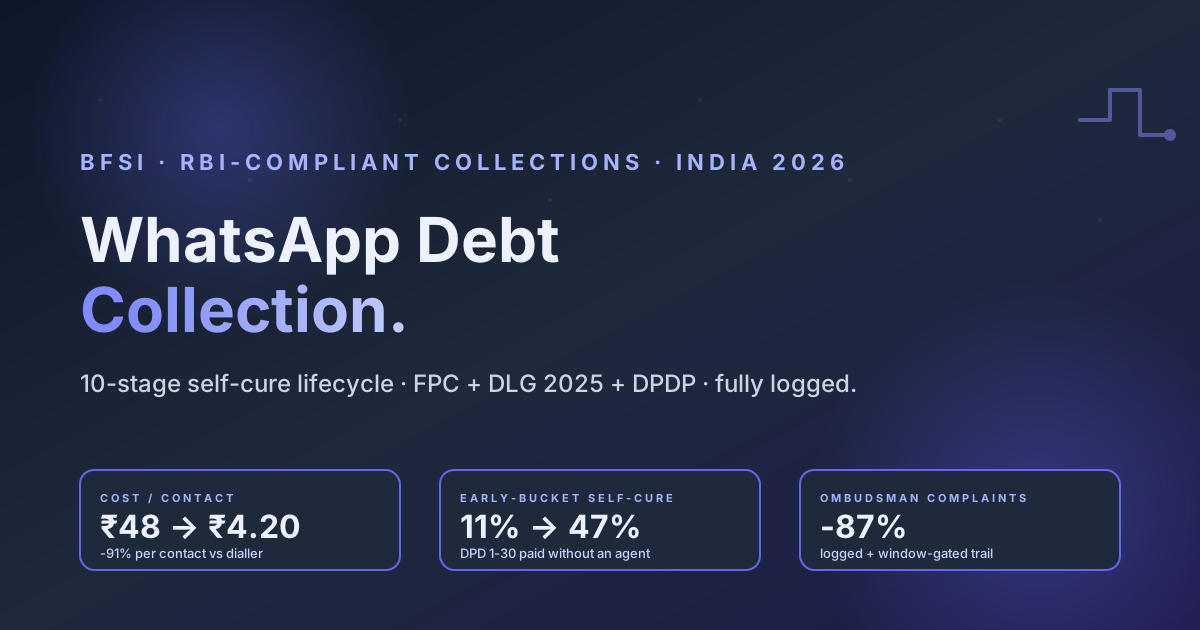
Real cohort number. A ₹1,800 cr-AUM NBFC moved its DPD 1-30 bucket to WhatsApp-first (dialler reserved for DPD 31+). Within two quarters: cost-per-contact fell ₹48 → ₹4.20 (-91%), early-bucket self-cure rose 11% → 47%, RBI Ombudsman complaints dropped 84 → 11/quarter (-87%), and the roll-forward rate from DPD 1-30 into the expensive DPD 31+ buckets fell 34% → 19%. The lender redeployed 40% of its tele-calling headcount onto the genuinely hard DPD 60+ accounts where human empathy actually recovers money — turning a cost centre into a margin lever worth +₹38 cr/year in recovered early-bucket principal.
Six Anti-Patterns That Get a Collections Operation Shut Down
- Sending outside 8am-7pm. The single fastest way to draw an RBI advisory and an Ombudsman cluster. Hard-block the scheduler; never rely on agent discipline. A WhatsApp queue that respects the window by design is your compliance moat.
- Contacting references / family. The RBI harassment circular and DLG both treat third-party contact as a violation. Never message guarantors or references for pressure; restrict the thread to the borrower's consented number only.
- Coercive or shaming language. "Legal action today", emojis implying threat, public-shaming copy — all trigger FPC + Consumer Protection liability. Every template must pass a compliance review; AI-generated replies must be guard-railed against threat language.
- Messaging accounts in legal stay. Sending any automated nudge to an account in SARFAESI possession, a Lok Adalat / DRT matter, or under a court stay is a contempt and regulatory risk. The suppression flag must be a hard gate, not a soft preference.
- No consent / no purpose tag. Recovery messaging without a stored opt-in and a recovery-only DPDP purpose tag is a Sensitive-PDI violation. Capture consent at onboarding (Key Fact Statement stage) and honour opt-out + cooling-off suppression instantly.
- Unlogged human-agent messages. If a live agent can send free-text outside the logged template system, your Ombudsman trail has holes. Route all agent interactions through the same WABA + ledger so every message is exportable for inspection.
12-Week Migration Path
- Week 1-2: Compliance baseline — map current contact methods against FPC + Recovery Agent code + DLG + DPDP. Audit existing call logs for window-violation and reference-contact exposure. Get verified WABA + display name approved.
- Week 3-4: Consent + suppression layer — wire onboarding opt-in capture (KFS stage), build the hard suppression list (opt-out, cooling-off, legal-stage, grievance), and the 8am-7pm scheduler gate.
- Week 5-6: Template library — pre-due, due-date, early-bucket, PTP, settlement, demand templates through Meta + internal compliance review. No coercive language; agent-ID headers per RBI code.
- Week 7-8: Payments + e-sign — UPI AutoPay re-presentment, WhatsApp Pay / Razorpay one-tap links, Aadhaar-OTP e-sign for settlements, auto-NDC + receipt issuance.
- Week 9-10: Intent AI + agent handoff — deploy Haiku / Gemini Flash classifier with threat-language guard-rails, build the low-confidence + human-request handoff into the same WABA window, vernacular (Sarvam / Bhashini) for Tier-2/3 cohorts.
- Week 11-12: Audit + reporting — per-borrower ledger export, Internal Ombudsman ticketing with 30-day SLA, DPDP grievance-officer in-thread, evidence-locker retention, and a parallel-run A/B vs the dialler-only control before full cutover.
Run compliant WhatsApp collections on RichAutomate.
Consent-anchored 10-stage recovery thread (pre-due → due-date → early-bucket self-cure → PTP tracking → AI-classified negotiation → in-thread settlement e-sign → verified-agent handoff → pre-legal demand → legal-stage suppression → cure + NDC) with an 8am-7pm hard scheduler gate, no-reference-contact restriction, threat-language guard-rails, and a per-borrower message ledger exportable for RBI inspection + Internal Ombudsman + DPDP. RBI Fair Practices Code + Recovery Agent Code of Conduct + Digital Lending Guidelines 2025 + SARFAESI suppression + RBI-Integrated Ombudsman + DPDP Sensitive-PDI compliant. Real Indian cohort: cost-per-contact ₹48 → ₹4.20 (-91%), early-bucket self-cure 11% → 47%, Ombudsman complaints -87%, net-credit-loss -270 bps, +₹38 cr early-bucket recovery uplift. 12-week migration. 14-day trial + 100 free credits, ₹0 platform fee.
For calm, non-threatening wording, see this EMI bounce message format along with EMI due and closure templates.
For the early, pre-delinquency stage, use these credit card overdue message templates written to stay polite and Fair-Practices-aligned.
Before an account reaches collections, a polite pre-due cadence does most of the work: see these EMI reminder message formats for due-day, bounce and 1-30 DPD stages.
Related reading
- WhatsApp for Microfinance + SHG Loan Lifecycle India 2026: 9-Stage Thread + e-KYC + EMI Pathway + RBI Master Direction Compliance
- Microfinance + SHG Loan Lifecycle के लिए WhatsApp भारत 2026: 9-Stage Thread + e-KYC + EMI Pathway + RBI Master Direction Compliance (हिन्दी)
- WhatsApp for Digital Lending: RBI Rules + FREE-AI Compliant Comms India 2026
- Gold Loan NBFC WhatsApp Automation Playbook — India 2026 (RBI Apr-2026 Master Direction + Tiered LTV + Auction + KYC + DPDP)
- Best WhatsApp CRM India 2026: ₹ Pricing Compared