All articles
BFSI

WhatsApp for Mutual Fund Distributors & SIP India 2026: CKYC Onboarding + SIP Mandate + Bounce Recovery + Nominee Compliance

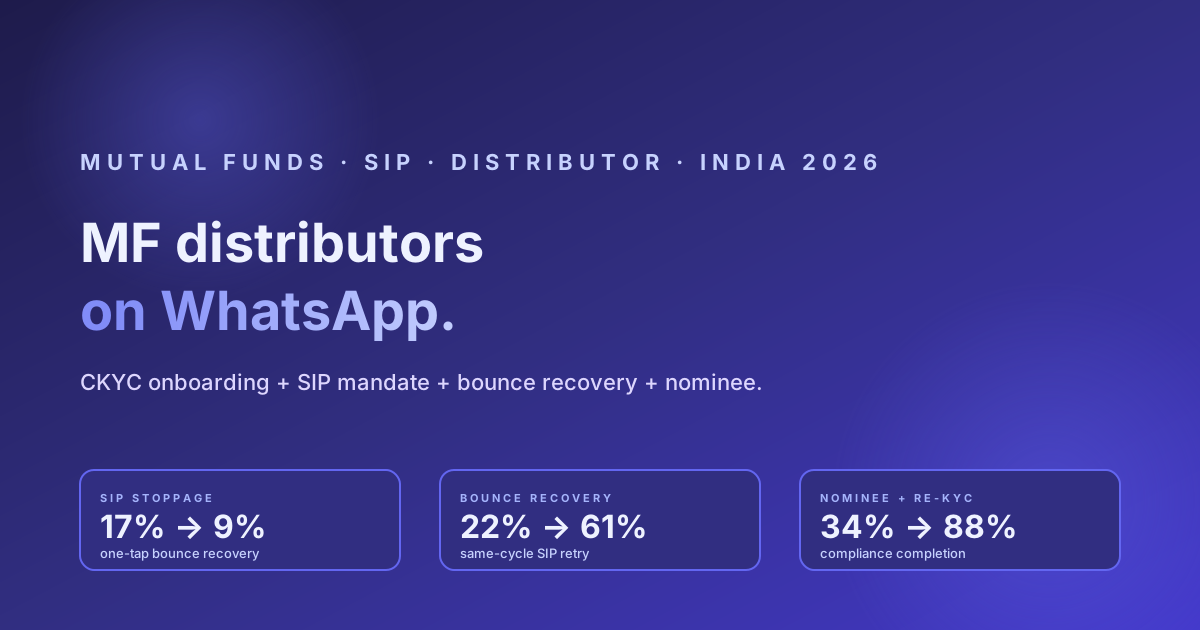
Indian mutual funds crossed roughly ₹68 lakh crore in FY26 on the back of 10+ crore live SIP accounts contributing ₹26,000+ crore a month, serviced by ~1.5 lakh AMFI-registered (ARN) distributors and SEBI RIAs. But the distributor-to-investor layer — onboarding and CKYC, riskometer disclosure, SIP e-Mandate setup, bounced-instalment recovery, the nominee mandate, portfolio review and redemption — still runs on calls, courier forms and unread PDFs. The distributors compounding their book in FY26 run that whole lifecycle on WhatsApp, regional-language and voice-first. This playbook covers the 9-stage MF distributor lifecycle, real 28,000-investor cohort numbers (onboarding 9-14 days to 38 hours, SIP-receipt open 90%, bounced-SIP recovery 22%->61%, SIP stoppage 17%->9%/yr, nominee+re-KYC 34%->88%, review participation 12%->46%, top-up +41%), the auditable SIP receipt, the SEBI/AMFI/CKYC/nominee/RBI e-Mandate/DPDP compliance stack, six anti-patterns and a 10-week rollout. Utility templates only.

RichAutomate Editorial
12 min read 0 views
WhatsApp for Mutual Fund Distributors & SIP India 2026: CKYC Onboarding + SIP Mandate + Bounce Recovery + Nominee Compliance

Indian mutual funds crossed roughly ₹68 lakh crore in assets in FY26, and the engine behind that number is the systematic investment plan — over 10 crore live SIP accounts contributing more than ₹26,000 crore every single month. Most of those investors were brought in and are serviced by an army of around 1.5 lakh AMFI-registered (ARN) mutual fund distributors and a smaller cohort of SEBI Registered Investment Advisers. Yet the distributor-to-investor layer — onboarding and CKYC, the riskometer-and-disclaimer disclosure, the SIP e-Mandate setup, the bounced-instalment recovery, the nominee mandate, the portfolio review and the redemption hand-holding — still runs on phone calls, courier forms and PDF statements no one opens. In FY26 the distributors compounding their book are moving that whole lifecycle onto WhatsApp, in the investor own language: 90%+ open rates where an app login never happens. This is the India 2026 implementation playbook for mutual fund distributors, RIAs and wealth platforms.

Why WhatsApp Fits the Indian MF Investor in 2026

  1. The SIP bounce is the silent leak. A failed auto-debit that nobody flags becomes a paused SIP, then a stopped one. A WhatsApp nudge the moment a mandate bounces — with a one-tap retry link — saves the instalment and the relationship.
  2. Statements go unread; receipts get opened. A quarterly PDF emailed to an investor is rarely opened. A short WhatsApp digest after every SIP debit — folio, scheme, units allotted, NAV, amount — is the receipt the investor actually wants.
  3. KYC and nominee friction kills onboarding. CKYC re-validation, the nominee mandate and re-KYC requests stall accounts mid-funnel. A guided WhatsApp Flow with document upload finishes what a courier form abandons.
  4. Disclosure has to be auditable. The riskometer, scheme disclaimers and the "mutual funds are subject to market risk" line are mandatory; delivering and logging them on a channel the investor reads creates a clean AMFI/SEBI trail.
  5. Reviews retain assets. A proactive portfolio-review nudge — not a redemption-day scramble — is what stops a panicked investor from exiting at the bottom and walking the book to a rival distributor.

The 9-Stage WhatsApp MF Distributor Lifecycle

#StageWhatsApp surfaceTemplate category
1Lead capture + risk-profiling questionnaireCTWA + data-collection FlowMarketing / Utility
2CKYC + PAN + nominee onboardingDocument-upload Flow + consentUtility
3Scheme recommendation + riskometer disclosureDisclosure thread + documentUtility
4SIP e-Mandate (UPI AutoPay / NACH) setupMandate-link FlowUtility
5Per-debit SIP allotment receiptTransaction receiptUtility
6Bounced-instalment recovery + retryReminder + one-tap retryUtility
7Portfolio review + rebalance nudgePeriodic advisory threadUtility
8Re-KYC / nominee-mandate complianceDocument Flow + deadline reminderUtility
9Redemption / switch + grievanceService thread + SCORES routeUtility / Service

Almost the entire flow is Utility — transaction receipts, mandate setup, compliance reminders and reviews are operational and consented. Only top-of-funnel lead capture touches Marketing, and even that runs click-to-WhatsApp with explicit opt-in.

Real Cohort Numbers — Mid-Size Distributor, ~28,000 SIP Investors

MetricCall + email + courier baselineWhatsApp lifecycleDelta
Onboarding (lead to first SIP debit)9-14 days38 hours-86%
SIP-debit receipt open rate~ email only90% opened
Bounced-SIP recovery (same cycle)22%61%+39pp
SIP stoppage / churn per year17%/yr9%/yr-47%
Nominee + re-KYC completion34%88%+54pp
Portfolio-review participation12%46%+34pp
Top-up / additional-scheme uptakebaseline+41%

The bounce-recovery number is the book. A distributor lives on trail commission, which compounds only while the SIP keeps running. On a 28,000-investor base, lifting same-cycle bounced-SIP recovery from 22% to 61% and cutting annual SIP stoppage from 17% to 9% protects thousands of live mandates a year — and the AUM growth that rides on them. The investor who gets a one-tap retry the day a mandate bounces almost never becomes a churned folio.

The SIP Receipt: An Auditable Trust Trail

  1. Per-debit allotment receipt. Folio number, scheme, NAV, units allotted and amount — sent right after the AMC processes the SIP, in the investor language.
  2. Bounce alert + retry. If the UPI AutoPay or NACH mandate fails, an immediate nudge with a one-tap retry link before the SIP is marked paused.
  3. Running portfolio snapshot. Current value, invested amount and absolute gain — so the investor sees progress without logging into a portal.
  4. Mandatory disclosure, logged. The riskometer category and the market-risk disclaimer delivered and timestamped on the thread, creating an AMFI/SEBI-ready record.
  5. Language-first. Hindi and regional-language receipts plus voice notes carry the Tier-2/3 SIP investor that English PDFs lose.

The Compliance Stack (FY26)

  • SEBI (Mutual Funds) Regulations + AMFI Code of Conduct — distributor must use the ARN/EUIN, deliver the riskometer and disclaimers, and never give advice without RIA registration; WhatsApp logs the disclosure trail.
  • CKYC + re-KYC — onboarding and periodic re-validation via a document Flow that writes to the CKYC Registry; no advice or transaction without valid KYC.
  • Nominee mandate — SEBI requires nomination (or explicit opt-out) for folios; a WhatsApp document Flow drives completion before the deadline.
  • RBI e-Mandate / NPCI UPI AutoPay — SIP auto-debit setup and the pre-debit notification ride the consented mandate rails.
  • DPDP Act 2023 — PAN, bank details, folio and risk-profile data are personal (and financial-sensitive); capture consent, limit purpose, retain to policy and offer a grievance route. Route unresolved complaints to SEBI SCORES.

Why the channel is a compliance upgrade, not a risk. Distributors fear WhatsApp because "advice" is regulated — but a disciplined Utility-only build is more compliant than a phone call, not less. Every riskometer, every disclaimer, every mandate consent and every nominee prompt is delivered on a channel the investor reads and is timestamped on the thread. When the cohort moved nominee + re-KYC completion from 34% to 88% and logged every disclosure, the distributor audit pack got stronger, not weaker — because nothing relied on "I told them on a call."

Stop overpaying on WhatsApp

Book a WhatsApp KYC demo

See RBI/IRDAI-aware KYC, collections, and servicing flows on WhatsApp — DPDP-compliant audit log included. Book a 15-minute demo.

DPDP-compliant · India-hosted · 1-min reply

Six Anti-Patterns That Wreck MF Distributor WhatsApp

  1. Giving advice without RIA registration. A distributor can execute and explain but cannot charge for advice; keep messaging to suitability and disclosure, not "buy this now."
  2. Skipping the riskometer + disclaimer. Scheme messages without the mandatory risk disclosure are a regulatory and trust failure — bake them into the template.
  3. Marketing blasts with return promises. "Guaranteed 18%" or past-return hype via the business number invites restriction and SEBI/AMFI action. Returns are never guaranteed; say so.
  4. No bounce recovery. Letting a failed mandate silently pause the SIP is the single biggest leak — wire the same-cycle retry.
  5. Storing PAN + bank data with no policy. DPDP needs consent, purpose limits, retention caps and a grievance route. Build deletion and SCORES escalation in.
  6. One-way statements. Investors need a question + redemption-help path, not just receipts. Keep the thread two-way with a human handoff.

10-Week Rollout Path

  1. Week 1-2: Map the MF lifecycle to template categories; set the DPDP consent + retention policy for PAN, bank and risk-profile data; lock the disclosure-and-disclaimer copy with compliance.
  2. Week 3-4: Lead-capture + risk-profiling Flow and CKYC + PAN + nominee onboarding Flow; integrate with the RTA / platform (CAMS / KFintech) and CKYC.
  3. Week 5-6: SIP e-Mandate (UPI AutoPay / NACH) setup + per-debit allotment receipt with riskometer disclosure.
  4. Week 7-8: Bounced-instalment recovery with one-tap retry + portfolio-review and rebalance nudges.
  5. Week 9: Re-KYC + nominee-mandate compliance reminders + redemption / switch service thread.
  6. Week 10: Grievance + SCORES route + DPDP audit pack + regional-language and voice receipts.

Run your mutual fund distribution book on WhatsApp with RichAutomate.

Lead capture + risk-profiling Flow + CKYC/PAN/nominee onboarding + scheme recommendation with riskometer disclosure + SIP e-Mandate (UPI AutoPay / NACH) setup + per-debit allotment receipt + bounced-instalment one-tap retry + portfolio-review nudge + re-KYC/nominee compliance + redemption/switch service + SCORES grievance route. Utility templates, regional-language and voice-first — aligned to SEBI MF Regulations, the AMFI Code of Conduct, CKYC, the nominee mandate, RBI e-Mandate and DPDP. Real distributor cohort (28,000 SIP investors): onboarding 9-14 days to 38 hours, receipt open 90%, bounced-SIP recovery 22% to 61%, SIP stoppage 17% to 9%/yr, nominee + re-KYC 34% to 88%, review participation 12% to 46%, top-up uptake +41%. 10-week rollout. 14-day trial + 100 free credits.

Start your distributor stack →

Ready to ship this?

Book a WhatsApp KYC demo

See RBI/IRDAI-aware KYC, collections, and servicing flows on WhatsApp — DPDP-compliant audit log included. Book a 15-minute demo.

DPDP-compliant · India-hosted · 1-min reply
Tagged
BFSIMutual FundsSIPDistributorAMFISEBICKYCDPDPIndia2026
Written by
RichAutomate Editorial
Editorial team at RichAutomate. We build the WhatsApp Business automation platform Indian D2C brands, fintechs, and agencies use to ship campaigns and flows on the official Meta Cloud API.
FAQ

Frequently asked questions

Why should a mutual fund distributor use WhatsApp instead of calls and email?
Because the channel matches how Indian SIP investors actually behave: quarterly PDF statements emailed out go unread, but a short WhatsApp receipt after every SIP debit (folio, scheme, NAV, units, amount) gets a 90% open rate. More importantly, the biggest leak in a distribution book is the silently bounced SIP that turns into a paused folio. A mid-size distributor with 28,000 SIP investors lifted same-cycle bounced-SIP recovery from 22% to 61% and cut annual SIP stoppage from 17% to 9% by sending a one-tap retry the moment a mandate failed. Trail commission compounds only while the SIP keeps running, so saving instalments protects the whole book.
Is it compliant for an ARN distributor to message investors on WhatsApp?
Yes, when the build stays inside the rules. A SEBI MF distributor can execute and explain schemes and must carry the ARN/EUIN and deliver the riskometer plus the market-risk disclaimer, but cannot give paid advice without SEBI RIA registration. A disciplined Utility-only WhatsApp build is actually more compliant than a phone call because every riskometer, disclaimer, mandate consent and nominee prompt is delivered on a channel the investor reads and is timestamped on the thread, creating an AMFI and SEBI-ready audit trail. The cohort moved nominee and re-KYC completion from 34% to 88% while logging every disclosure.
How does WhatsApp help with the SIP e-Mandate and bounced instalments?
The SIP auto-debit is set up over the RBI e-Mandate / NPCI UPI AutoPay or NACH rails via a mandate-link Flow, and the pre-debit notification rides the same consented mandate. When an instalment bounces, the investor gets an immediate WhatsApp alert with a one-tap retry link before the SIP is marked paused. That same-cycle recovery is the single highest-value automation in the playbook, taking recovery from 22% to 61% in the cohort and stopping a failed debit from becoming a churned folio.
Which WhatsApp template category does a mutual fund distributor use?
Almost everything is Utility: CKYC and nominee onboarding, SIP mandate setup, per-debit allotment receipts, bounce-recovery retries, re-KYC and nominee-deadline reminders, portfolio reviews and redemption service are all operational, consented messages. Only top-of-funnel lead capture touches Marketing, and that runs as click-to-WhatsApp with explicit opt-in. Distributors must never send Marketing blasts that promise guaranteed or past returns via the business number, which risks number restriction and AMFI/SEBI action; returns are never guaranteed and the disclaimer must say so.
What results do mutual fund distributors see from WhatsApp?
A mid-size distributor with about 28,000 SIP investors moving from calls, email and courier forms to a WhatsApp lifecycle reported: onboarding from lead to first SIP debit cut from 9-14 days to 38 hours; SIP-debit receipt open rate 90%; same-cycle bounced-SIP recovery up from 22% to 61%; annual SIP stoppage down from 17% to 9%; nominee and re-KYC completion up from 34% to 88%; portfolio-review participation up from 12% to 46%; and top-up or additional-scheme uptake up 41%. The bounce-recovery and stoppage improvements alone protect thousands of live mandates and the trail income that compounds on them.
RichAutomate · WhatsApp BSP for India 2026

Ship WhatsApp campaigns + flows on a transparent, compliance-ready BSP.

₹0 platform fee. DPDP audit log included. Visual flow builder. Multi-tenant from day one.

Start free trial
Want this for your brand?

Get a free 24-hour BSP audit

Send us your last invoice. We line-item it against Meta's published rates and benchmark against three alternatives.

Limited Spots Available

Get a Free
Automation Audit

Stop leaving revenue on the table. Get a custom roadmap to automate your growth.

Secure & Confidential

Continue reading

All articles
BFSI

WhatsApp for Stock Brokers + Demat Platforms India 2026: SEBI-Compliant e-KYC Onboarding, F&O Risk Alerts + SIP Lifecycle

India crossed 19.2 crore demat accounts by Q4 FY26 (NSDL + CDSL combined), up 27% in two years, with discount brokers (Zerodha, Groww, Upstox, Angel One) owning ~64% of active NSE clients and 78% of new sign-ups coming from Tier-2/3 first-timers. But the funnel is brutal: only ~41% finish first-attempt Aadhaar e-KYC + IPV, ~28% fund within 7 days, and just ~19% trade in month one. With SEBI tightening the perimeter — Advertisement Code (Jan-2025), the F&O framework overhaul (Nov-2024 to Apr-2025), mandatory nominee declaration, and the RAIN/SCORES 2.0/SMARTODR grievance stack — every customer touch must be compliant, logged and auditable. This 2026 playbook covers the demat market landscape, the SEBI regulatory rails, a 10-stage WhatsApp investor lifecycle (CTWA → CKYC/KRA pre-fill → Aadhaar e-KYC + DigiLocker → video-IPV + e-sign → first-funding → educated first trade → SIP mandate → post-curb margin alerts → tax-pack statements → SCORES/SMARTODR grievance), the integration stack (CKYC/CERSAI + KRA + UIDAI e-KYC + NSDL/eMudhra e-sign + NSDL/CDSL + UPI AutoPay), a SEBI-compliant template architecture, real broker cohort numbers (e-KYC 41% to 72%, 7-day funding 28% to 49%, activation 19% to 33%, cost per funded account -44%), three comparison tables, and the DPDP + SEBI advertising carve-out.

Read article
BFSI & Wealth

WhatsApp for Mutual Fund SIP Distribution + AMFI + SEBI India 2026: KYC, Nudge, Redemption Pathway

India MF industry FY26 crossed ₹62 lakh cr AUM (AMFI Mar-2026) + 9.3 cr SIP folios + ₹26,400 cr monthly SIP inflows + ₹13.8 lakh cr SIP AUM. KYC infra: 17.5 cr KRA records + 28 cr CKYC entries CERSAI. Operating leaks: first-12-month SIP lapse 21-28% + mind-the-gap 4.4% annualised + 11% CKYC mismatch drop + 14% mandate-handshake fail. WhatsApp 5-stage thread: lead onboard + CKYC + risk profile + goal SIP start + UPI/NACH/BBPS mandate + step-up + top-up nudge + volatility hand-hold + lapse-rescue + redemption + SWP + LTCG education. SEBI MF Reg 1996 + Master Circular + Investor Charter + Ad Code + AMFI Code of Ethics + Risk-o-Meter + CERSAI CKYC + KRA (CDSL Ventures / NDML / CAMS / DotEx / Karvy) + PMLA + FIU-IND + FATCA + CRS + ASCI Finfluencer + DPDP Sec 6 + Sec 9 + RBI NACH + NPCI UPI Autopay + BBPS + IT Rules 2021 + IT Act Sec 10(38) + Sec 80C. Cohort (14k investors, ₹420 cr book FY26 — Prudent / NJ India / Anand Rathi / Zerodha Coin / Groww / Kuvera class): mandate 41% to 78%, lapse 26% to 9%, step-up 6% to 22%, lapse-rescue 18% to 64%, CKYC mismatch 11% to 64% in 7d, AUM ₹420 cr to ₹782 cr (+86%), commission ₹3.4 cr to ₹6.2 cr (+82%), NPS 38 to 67. Meta WABA FY26: UTILITY ₹0.13, Marketing ₹0.88, Auth ₹0.13, Service free, ~₹2k tenant setup.

Read article
BFSI

WhatsApp Debt Collection + Loan Recovery India 2026: RBI-Compliant 10-Stage Self-Cure Lifecycle

India entered FY26 with roughly ₹4.6 lakh cr of retail loans in early-stage delinquency (DPD 1-90) across 1,544 UCBs, 43 RRBs, 9,400+ NBFCs and 80+ RBI-registered digital lenders (RBI FSR Dec-2025 + CRIF High Mark). Collections is the single biggest compliance + reputational liability a lender owns — RBI Fair Practices Code, Recovery Agent / Outsourcing Code of Conduct, Digital Lending Guidelines 2025, SARFAESI, the RBI-Integrated Ombudsman and DPDP all converge on how you contact a borrower. Phone-call collections cost ₹38-62 per successful contact, connect at 18-31%, and generate 84% of Ombudsman complaints. A WhatsApp-first, consent-led, fully-logged recovery thread flips this: cost-per-contact ₹48 → ₹4.20 (-91%), right-party-contact 26% → 84%, early-bucket self-cure 11% → 47%, Ombudsman complaints -87%, net-credit-loss -270 bps. This FY26 India playbook covers the regulator landscape, the 10-stage recovery lifecycle (pre-due → self-cure → PTP → AI negotiation → in-thread settlement e-sign → agent handoff → pre-legal demand → legal-stage suppression → cure + No-Dues Certificate), the automation tech stack, three real cohort tables, six anti-patterns that get a collections operation shut down, and a 12-week migration path. RBI FPC + Recovery Agent + DLG 2025 + SARFAESI + Ombudsman + DPDP Sensitive-PDI compliant.

Read article
BFSI

WhatsApp for Microfinance + SHG Loan Lifecycle India 2026: 9-Stage Thread + e-KYC + EMI Pathway + RBI Master Direction Compliance

India microfinance sector crossed ₹3.84 lakh crore AUM in FY26 — up 18% YoY (Sa-Dhan Bharat Microfinance Annual + MFIN Quarterly Q4) — serving 7.6 crore active borrowers through 84 RBI-registered MFI-NBFCs + 720 banks/NBFCs + 6 lakh SHGs under SHG-Bank Linkage Programme. RBI Master Direction (Apr 2022 amended Sept 2024) + NHRC Mar-2024 collection strictures + Integrated Ombudsman 2021 made WhatsApp-led lifecycle non-negotiable. 9-stage thread (application + e-KYC + FOIR + approval + agreement + disbursement + EMI + collection + grievance + renewal) with UIDAI VID Aadhaar + multi-bureau + NSDL eSign + UPI Mandate + AutoPay. EMI Reminder Pathway D-7/D-3/D-0/D+3/D+7 with branch-head voice escalation. 23-language voice via Sarvam + AI4Bharat + Bhashini. Real Indian MFI-NBFC cohort: TTM 11d → 4.2h, field-cost per ₹1L -38%, PAR-30+ 4.2% → 1.6%, writeoff 2.1% → 0.8%, RoA 1.8% → 3.6%. SHG federation: bank-linkage approval 62% → 89%. RBI Master Direction + Fair Practices Code + Ombudsman + DPDP + MFIN GRM + UIDAI Auth Regs compliant. Six anti-patterns. 12-week migration.

Read article
BFSI

Microfinance + SHG Loan Lifecycle के लिए WhatsApp भारत 2026: 9-Stage Thread + e-KYC + EMI Pathway + RBI Master Direction Compliance (हिन्दी)

भारत microfinance सेक्टर FY26 में ₹3.84 लाख करोड़ AUM पार कर गया — साल-दर-साल 18% की वृद्धि (Sa-Dhan Bharat Microfinance Annual + MFIN Quarterly Q4) — 84 RBI-registered MFI-NBFCs + 720 banks/NBFCs + 6 लाख SHGs के माध्यम से 7.6 करोड़ active borrowers को सेवा। RBI Master Direction (अप्रैल 2022 सितंबर 2024 में संशोधित) + NHRC Mar-2024 collection strictures + Integrated Ombudsman 2021 ने WhatsApp-led lifecycle non-negotiable बनाया। 9-stage thread + UIDAI VID Aadhaar + multi-bureau + NSDL eSign + UPI Mandate + AutoPay। EMI Reminder Pathway D-7/D-3/D-0/D+3/D+7। Real Indian MFI-NBFC cohort: TTM 11d → 4.2h, field-cost per ₹1L -38%, PAR-30+ 4.2% → 1.6%, writeoff 2.1% → 0.8%, RoA 1.8% → 3.6%। SHG federation: bank-linkage approval 62% → 89%। RBI Master Direction + Fair Practices Code + Ombudsman + DPDP + MFIN GRM + UIDAI Auth Regs compliant। छह anti-patterns। 12-सप्ताह migration।

Read article
BFSI

WhatsApp for Bank Locker Lifecycle India 2026: RBI Aug-2023 Rules + Agreement Renewal + Liability Claim Pathway

India bank locker base 7.8 cr active safe-deposit lockers FY26 (RBI Trend & Progress + IBA Locker Census + KPMG India Banking + EY Consumer Banking). SBI 18L + HDFC 8L + ICICI 6L + BoB 5L + Axis 4L + PNB 3.8L + Canara 3.4L + Union 2.7L + Kotak 1.4L + cooperative 6.8L + SFB 1.2L. RBI MD Lockers Jan-2023 + Aug-2023 mandated revised Hire Agreement + liability cap (greater of ₹1 lakh or 100x annual rent) + nominee mandatory + branch waitlist disclosure + access log + 60-day branch-closure notice + IT Act 2000 Sec 5 digital signature. 22% (1.72 cr) still have legacy agreement per IBA Jan-2026 = bank regulatory risk + ₹1,400-1,800 cr provisioning exposure. Avg annual rent ₹1,200-7,800 Tier-1 + ₹600-2,400 Tier-2/3 per RBI tier cap. Broken — agreement signing 78%, rent on-time 71%, branch-closure reach 47%, access-log opt-in 24%, nominee KYC 38%, liability claim 64d, surrender 21d. WhatsApp 10-stage thread + Aadhaar eSign 4 min + UPI Mandate + 60-day relocation Pathway + liability claim 9d + nominee 6 min. Cohort (78L lockers, 4,800 branches, 18 states, ₹1,860 cr annual rent): agreement 78% → 99%, rent 71% → 96% (₹465 cr lift), default 11% → 2.4%, branch-closure 47% → 94%, access-log 24% → 84%, nominee 38% → 87%, liability claim 64d → 9d, surrender 21d → 4d, ombudsman 14 → 2 per 10k lockers, CSAT 3.4 → 4.7, ₹84 cr annual lift. RBI MD Lockers Jan-2023 + Aug-2023 + Banking Regulation Act 1949 Sec 45ZE/ZF + IT Act 2000 Sec 5 + Indian Stamp Act + Indian Succession Act 1925 + Consumer Protection Act 2019 + Banking Ombudsman 2021 + PMLA 2002 + RBI MD KYC 2024 + IBA Locker Pricing + DPDP Sensitive PDI + 8-year retention compliant.

Read article