Indian fintechs lose 30–60% of loan applicants between OTP verification and final KYC submission. The drop-off is not because users distrust the brand — it is because the experience routes through SMS OTP, redirect web pages, document upload portals, and email links across three or four discontinuous surfaces. WhatsApp closes the gap. Done correctly, a regulated BFSI KYC funnel runs end-to-end inside one chat: OTP, e-signature, video KYC, document upload, eSign Aadhaar OTP, T&C acceptance, and final approval — all on the official Meta WhatsApp Cloud API, all RBI/IRDAI-compliant. This guide is the 2026 implementation playbook — what regulators actually require, the four KYC flows that work on WhatsApp, the per-applicant economics versus traditional digital channels, and the eight compliance gates Indian fintechs need to clear before launch.
Why BFSI on WhatsApp Now
Three regulatory and infrastructure shifts in 2025–2026 made WhatsApp viable for regulated BFSI flows:
- RBI Master Direction on Digital Lending (2022, updated 2025). Permits e-mandate / e-KYC / digital signature within a single customer journey, provided audit trails are preserved.
- UIDAI eSign 2.0 (2024) and Aadhaar OTP via WhatsApp. NPCI / UIDAI-approved BSPs can now route Aadhaar OTP through WhatsApp channels with full audit logging.
- Meta Calling API + WhatsApp Flows (2025). In-WhatsApp full-screen forms (Flow JSON v7.1) plus encrypted calling closed the last UX gap with traditional web KYC portals.
- DPDP Act 2023 in force from late 2025. Forces Indian-data-residency and explicit consent flows that are easier to capture inside a chat than across stitched web/SMS surfaces.
The Four BFSI KYC Flows That Work on WhatsApp Today
| Flow type | Use case | Reg surface | Typical completion lift |
|---|---|---|---|
| Pre-screen + soft pull credit decision | Loan applicant initial qualification | RBI Master Direction | +45–70% completion vs SMS-callback |
| Aadhaar OTP eKYC | NBFC / fintech instant eKYC | UIDAI Aadhaar OTP | +22–40% completion on form-stuck applicants |
| Video KYC (V-CIP) | Higher-ticket KYC requiring liveness | RBI V-CIP guidelines | +18–35% completion on retry slots |
| Insurance proposal + nominee form | Term life / health insurance onboarding | IRDAI digital onboarding | +30–55% completion vs web portal |
The Per-Applicant Economics
Three real numbers from Indian NBFC and insurance pilots in 2025–2026.
Personal loan applicant (₹50k–₹2L ticket)
| Channel | Cost per applicant | Funnel completion | Cost per disbursal |
|---|---|---|---|
| Web + SMS OTP + email | ₹38 | 22% | ₹172 |
| WhatsApp end-to-end | ₹52 | 54% | ₹96 |
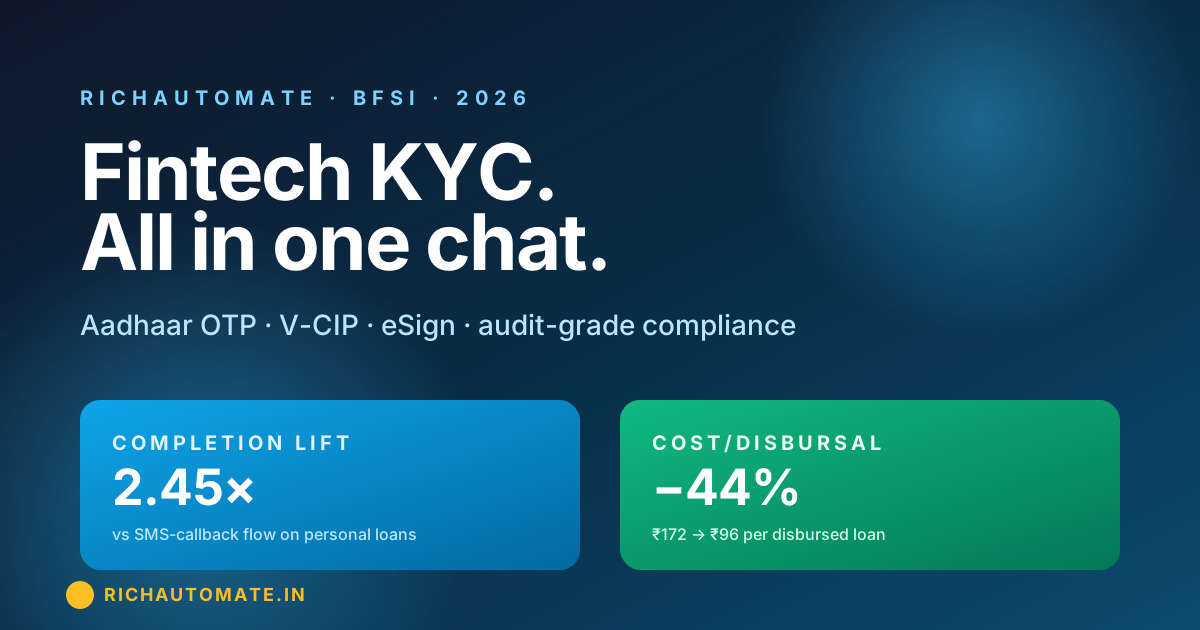
WhatsApp costs more per applicant (~37% higher) but converts 2.45x better. Cost per disbursal drops 44%. Add the agent-time savings — WhatsApp self-serve replaces a 4–7 minute callback by a relationship manager — and net economic gain compounds further.
Term insurance proposal (₹50L–₹2Cr sum assured)
| Channel | Cost per proposal | Funnel completion | Cost per policy issued |
|---|---|---|---|
| Web portal + email + tele-callback | ₹185 | 9% | ₹2,055 |
| WhatsApp (with Calling API for advisor) | ₹220 | 26% | ₹846 |
Insurance is the highest-ROI WhatsApp use case in BFSI — high-AOV product, relationship-sensitive sale, and long forms that are easier to fill on a chat surface with persistent context.
Compliance Gates Before Launch
- BSP appointment with explicit BFSI authorisation. Generic Meta BSP onboarding does not auto-include BFSI categories. Your BSP must explicitly enable BFSI templates with Meta and capture an addendum to the platform agreement.
- RBI / IRDAI / SEBI category mapping. Map each customer-facing message to a regulator-approved category. Loan-pre-screen, EMI reminder, and insurance-renewal all sit under different rule books.
- Encryption + audit trail. All WhatsApp Cloud API messages are E2E encrypted in transit. Your application layer must persist decrypted message logs for the 5–7 year regulatory retention window depending on category.
- DPDP-compliant consent capture. Explicit opt-in must be captured before the first marketing or non-transactional send. For KYC flows, the regulator-mandated consent (e.g. UIDAI's Aadhaar OTP) is captured inside the flow itself.
- Aadhaar masking on customer copies. Outbound messages echoing back Aadhaar-derived data must mask all but the last 4 digits in the customer-visible message body.
- Recording of advisor calls (if using Calling API). Mandatory for BFSI under SEBI/IRDAI rules. WhatsApp Calling API does not natively record — you must bridge through your CCaaS provider with native recording.
- Localisation. Indian customer data and message logs must be stored on Indian-region infrastructure for fintech / NBFC categories.
- Disaster-recovery + uptime SLA. Regulators expect 99.5%+ uptime on customer-facing channels. Your BSP setup must include redundant Meta API endpoints and a documented failover.
How a Real Aadhaar-OTP eKYC Flow Looks on WhatsApp
- Customer-initiated message or Click-to-WhatsApp ad lands the user in the WABA chat.
- Welcome utility template fires, explaining the loan offer and consent.
- Customer taps "Start KYC" quick-reply button.
- WhatsApp Flow (Flow JSON v7.1) opens an in-chat full-screen form with name, PAN, and Aadhaar-linked phone number fields.
- On submit, your backend calls UIDAI Aadhaar-OTP API; UIDAI sends OTP via WhatsApp template (your BSP must be NPCI-aggregator-approved or you route through a registered KSA).
- Customer enters OTP back via WhatsApp Flow.
- Backend verifies OTP, fetches Aadhaar eKYC payload, masks Aadhaar number for customer display, persists full payload server-side for audit.
- Bank/NBFC underwriting model returns decision in 3–8 seconds.
- Customer accepts T&C via interactive button (timestamped consent capture).
- Disbursal triggered; customer receives transactional template confirming amount + tenor.
The Hardest Part: Quality Rating Under Regulator Send Patterns
BFSI sends are intrinsically regulator-driven (EMI reminders, KYC-renewal, payment-due alerts). These look spammy to Meta's ML scoring if not categorised correctly. Three patterns that protect quality:
Get a 1-minute BSP audit on WhatsApp
Drop your WhatsApp number — we line-item your current invoice against Meta India rates in under 60 seconds. India-hosted, DPDP-compliant.
- Submit every regulator-mandated reminder as Utility, not Marketing. EMI reminder, KYC-renewal, payment-due — all genuinely transactional. Lower per-message cost (₹0.115) and lower quality risk.
- Cap unsolicited cross-sell to 1–2 per month per customer. Customers tolerate 1–2 cross-sells; 5+ in a month spikes block rate.
- Always include opt-out in marketing templates. "Reply STOP to opt out" in every marketing send — required by some interpretations of DPDP Act and definitely required to keep block rate below 0.3%.
Operating Rule
If your fintech sends more than 50,000 customer messages a month and runs a lending or insurance KYC funnel, the WhatsApp investment pays back in under 90 days through completion-rate lift alone. The harder gate is regulatory — get your BSP's BFSI authorisation, audit-trail architecture, and Aadhaar-masking logic right before opening the gate. Brands that rush past compliance to chase the conversion lift get hit with regulator notice and have to roll back.
Anti-Patterns That Trigger Regulator Notice
- Sending Aadhaar-derived data unmasked in customer-facing messages. UIDAI penalty: per-incident, recurring. Mask all but last 4 digits.
- Cold-blasting promotional offers without opt-in. DPDP Act civil penalty up to ₹250 crore. Capture explicit opt-in per channel per use case.
- Logging E2E-encrypted message contents server-side without TLS. Auditor finding. Persist decrypted logs only over TLS-encrypted database connections + at-rest encryption.
- Bypassing V-CIP for high-ticket KYC because WhatsApp seems easier. RBI V-CIP rules are not optional above ₹2L ticket size. WhatsApp Calling API supports V-CIP — use it.
- Routing Aadhaar OTP via non-NPCI-aggregator BSP. UIDAI rejects non-aggregator routes for production traffic. Verify your BSP's aggregator status before launch.
Real Adoption Examples (Anonymised)
- Mid-size NBFC (₹500cr disbursal book) — full personal-loan KYC moved to WhatsApp. Application-to-disbursal completion rate up from 18% to 47%. Net new disbursal lift of ₹14cr in the first 90 days post-migration.
- Insurance fintech (term + health) — proposal-form via WhatsApp Flow + advisor handoff via Calling API. Policy-issuance rate up 2.8x on warm leads. Per-policy customer acquisition cost down 41%.
- Mutual fund AMC (KYC + folio creation) — full KYC and folio-account opening on WhatsApp. Drop-off in account-opening flow halved (38% → 19%).
- Co-operative bank (rural / tier-3) — savings account opening via WhatsApp + V-CIP. Tier-3 customer acquisition cost down 60% versus branch + tele-callback.
Tooling Stack Reference
| Layer | Component | Typical India 2026 vendor |
|---|---|---|
| WhatsApp BSP | Meta Cloud API + Flow JSON + Calling API | RichAutomate / Wati / Karix / Gupshup |
| Aadhaar OTP aggregator | UIDAI-approved KSA | NSDL e-Gov / IDFY / Karza / HyperVerge |
| Document parsing (PAN, Aadhaar) | OCR + verification | HyperVerge / Signzy / Ondot Karza |
| V-CIP video KYC | Liveness + recording | SignDesk / Signzy / Digio |
| eSign Aadhaar | UIDAI-approved CSP | NSDL / eMudhra / Digio |
| Underwriting decision engine | Custom or vendor | RuleEngine / FICO / Lentra |
| Audit log + retention | Indian-region object storage | AWS Mumbai / Azure India / GCP Mumbai |
Run BFSI KYC on RichAutomate.
BFSI-authorised WABA setup, Aadhaar-OTP routing via NPCI-aggregator partner, Calling API support for V-CIP, audit-log retention on Indian-region storage, and ready-made Flow JSON templates for personal-loan / insurance / MF onboarding. Compliance audit included for switchers.
Related reading
- WhatsApp for Healthcare Clinics India 2026: Compliance Gates, Seven Clinical Workflows, and Real Per-Appointment ROI
- WhatsApp Business Compliance India 2026: 10 Questions Answered
- WhatsApp for Digital Lending: RBI Rules + FREE-AI Compliant Comms India 2026
- IRDAI Bima Sugam + Cashless Everywhere 2026: WhatsApp for the New Insurance Rails in India
- DPDP Act WhatsApp Compliance Checklist India 2026