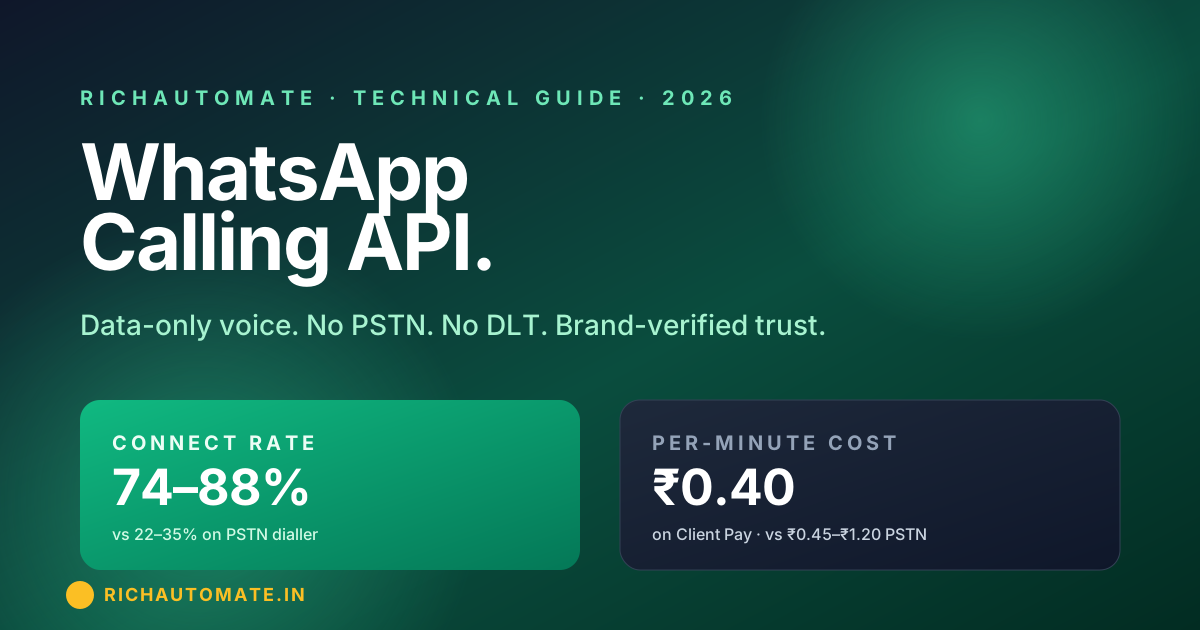
Meta opened the WhatsApp Business Calling API to general availability in late 2025, and Indian D2C brands have been quietly testing it through Q1 2026. Unlike outbound calls from your support number, the Calling API lets a customer tap a button in a WhatsApp message and connect to your agent — over data, encrypted end-to-end, with no PSTN charges, no DLT registration, and no IVR DTMF mess. This guide is the complete 2026 implementation playbook — what the API actually does, the four use cases that move revenue, the per-minute economics versus PSTN-grade alternatives, the WABA quality-rating implications, and the five anti-patterns that get your calling permissions throttled by Meta within a week.
What Is The WhatsApp Business Calling API, Exactly?
The Calling API is a Meta Cloud API extension that lets a brand-side agent receive or initiate a WhatsApp voice call with a customer who has opted in. It is not a regular phone call. Three properties matter:
- Data-channel only. The call routes over the customer's WhatsApp connection (Wi-Fi or mobile data). No PSTN involvement. No call charges to either side.
- End-to-end encrypted. Same E2E encryption as standard WhatsApp calls. Recordings are not natively available; you implement that on your side via the SIP-bridge endpoint Meta exposes to your CCaaS / softphone provider.
- Initiated only after consent. Either the customer taps a Call button in a WABA-approved template, or your agent sends a Call Permission Request that the customer accepts. You cannot cold-call. Period.
Four Use Cases That Actually Move Revenue (and One That Does Not)
| Use case | Trigger pattern | Why it works | Typical impact |
|---|---|---|---|
| High-AOV cart recovery | Customer abandons cart over ₹15,000 → call-back template offering 5-min advisor | High-intent buyer, premium product, voice clears doubt faster than chat | +18–32% recovery on premium SKUs |
| BFSI / fintech KYC verification | Loan / insurance applicant pauses in mid-form → assisted call with KYC officer | Voice + visual ID submission in same window beats SMS+OTP+IVR drop-offs | +22–40% completion rate on KYC drop-offs |
| D2C complaint resolution | Negative-sentiment chat detected → escalation button: tap to call manager | Live human voice de-escalates faster than email; chat history visible to agent | NPS lift of 15–25 points on resolved tickets |
| EdTech demo / counsellor call | Free-trial signup → counsellor button in welcome flow | Lead-to-conversation latency drops from 24h SMS callback to 30s tap | +45–80% conversion lift on demo bookings |
| Avoid: Cold outbound marketing calls | Mass-blast Call Permission Requests | Meta throttles within hours; customer report rate spikes | WABA quality crash, calling permission revoked |
How Calling API Compares to PSTN, IVR, and Regular WhatsApp Chat
| Dimension | WhatsApp Calling API | PSTN outbound (cloud telephony) | IVR / dialler | WhatsApp chat only |
|---|---|---|---|---|
| Per-call cost (India) | ₹0 (data-only) | ₹0.45–₹1.20 / min | ₹0.15–₹0.40 / min + DLT setup | Per-message rates apply |
| DLT registration | Not required | Required | Required | Not for calling, but template approval needed |
| Connection rate (answered calls) | 74–88% (opted-in audience) | 22–35% | 15–28% | n/a |
| Call quality | HD voice over data | Variable, depends on operator | Variable | n/a |
| Recording / compliance | Customer-side via your SIP bridge | Native | Native | Chat history natively retained |
| Customer trust signal | Brand name + verified tick visible | Unknown number, often spam-flagged | Unknown number | Brand name + tick |
| Best for | High-intent assisted resolution | Mass outbound, transactional confirmation | Bulk surveys, IVR menus | Async low-friction conversations |
How Much Does It Actually Cost?
The call itself is free over data. The cost stack is:
- BSP per-minute calling fee. RichAutomate charges ₹0.40/minute on Client Pay (pass-through Meta surcharge, currently ₹0) plus our agent-bridge SIP fee. SaaS Pay inclusive at ₹0.60/minute.
- SIP bridge / softphone provider. If you route the agent leg through Twilio / Plivo / Exotel, expect ₹0.10–₹0.30/minute. Self-hosted Asterisk eliminates this.
- Storage for recordings. ~₹0.0008 per minute on object storage (1MB/min compressed Opus). Trivial.
- Agent labour. The actual cost driver. ₹4–₹12/minute on a salaried Indian support agent. This dominates.
Total all-in cost: ~₹5–₹13 per minute of agent time, of which the platform layer is ₹0.50–₹0.90. The ROI math always favours connection rate × ticket value over per-minute cost minimisation.
Quality Rating — Calling Has Its Own
Meta tracks Call Quality Score separately from your Messaging Quality Score. Three signals matter:
- Answer rate. Below 50% answer means too many cold or unwanted calls. Drop quality.
- Block / report rate post-call. Above 0.8% within 30 min after a call ends signals bad-fit calling. Drop quality.
- Average call duration. Calls under 10 seconds repeatedly (drop-and-redial pattern) flag spam-like behaviour.
If Call Quality drops to RED, Meta caps your daily call attempts at 1,000 — regardless of WABA messaging tier. Recovery takes 30 days of clean calling history.
The Permission Model (Read This Before You Code)
- Template-embedded Call button. A pre-approved utility or marketing template includes a Call action. The customer taps; Meta pings your endpoint; your agent picks up. Permission is implicit through the tap.
- Call Permission Request. An interactive message prompts the customer with a Yes / No to be called now. If they accept, Meta opens the call channel. Valid for ~1 hour.
- Inbound only on existing 24h window. If the customer is in an open service window, you can call without a separate permission. Useful for support escalation.
You cannot, under any circumstances, initiate an outbound call without one of these three permissions. Meta enforces this server-side; the API will reject the request with an error code 4005 (Permission Required).
Get a 1-minute BSP audit on WhatsApp
Drop your WhatsApp number — we line-item your current invoice against Meta India rates in under 60 seconds. India-hosted, DPDP-compliant.
The conversation window cost calculator shows how the 24-hour window changes your per-conversation spend.
Webhook + Endpoint Architecture
The Calling API uses two webhook event types your backend must handle:
- call.connect — fired when a customer taps the Call button or accepts a Permission Request. Payload includes the customer's phone number, the WABA conversation context, and a SIP URI for your agent leg to connect to.
- call.terminate — fired when either party hangs up or the call ends abnormally (network loss, timeout). Payload includes duration, hangup cause, and quality metrics.
Your backend then bridges the SIP URI to an available agent via your CCaaS provider (FreeSWITCH, Asterisk, Twilio Voice, or RichAutomate's built-in agent-routing if you use SaaS Pay).
POST https://yourbackend.com/webhooks/whatsapp/call.connect
{
  "object": "whatsapp_business_calling",
  "entry": [{
    "id": "PHONE_NUMBER_ID",
    "changes": [{
      "value": {
        "messaging_product": "whatsapp",
        "metadata": { "display_phone_number": "+919999XXXXXX" },
        "calls": [{
          "id": "CALL_SID_FROM_META",
          "from": "+919876543210",
          "timestamp": "1714719300",
          "type": "audio",
          "sip": "sip:agent-bridge.richautomate.in;transport=tls",
          "permission_source": "template_button"
        }]
      },
      "field": "calls"
    }]
  }]
}
How Indian D2C Brands Are Using It Today
- Premium D2C jewellery brand — abandon-cart for orders over ₹50k triggers a SMS-style WhatsApp template offering a 5-minute advisor call. Connection rate 81%, recovery rate 27%, average ₹37,000 saved order.
- Health insurance startup — KYC-stuck applicants get a Call Permission Request from a licensed advisor. KYC-completion lift of 38% versus their old SMS-callback flow.
- EdTech bootcamp — free-trial signup triggers immediate counsellor call. Demo-to-paid conversion lift 62% versus the previous T+24h dialler workflow.
- Consumer electronics brand — warranty escalation chat with sentiment > -0.4 routes to a Call escalation button. NPS lift +19 on resolved tickets.
Five Anti-Patterns That Crash Your Calling Permissions
- Mass-blasting Call Permission Requests to cold lists. Block / report rates spike within hours. Meta throttles you the same day.
- Auto-redialling drop-outs. If a customer hangs up within 5 seconds, do not auto-call back. Wait for human-initiated retry from your end.
- Calling outside business hours. 9 PM–9 AM IST calls have 3× higher block rates. Restrict by IST time at the orchestration layer.
- No agent ready for inbound. Customer taps Call → 30 second hold → drops. This pattern destroys your answer rate. Pre-warm agents before sending the call-button template.
- Mixing PSTN dialler with WhatsApp Calling API on the same WABA. Customers get confused; they think a regular telemarketer call came from your verified WhatsApp brand. Trust collapses.
Operating Rule
Treat the Calling API as a high-trust, low-volume channel. Reserve it for moments where voice genuinely clears more friction than chat — high-AOV abandon-carts, KYC drop-offs, escalation tickets, and lead counsellor follow-ups. Do not use it as another marketing dialler. Brands that respect this scarcity see 70%+ answer rates indefinitely.
Approval and Onboarding
The Calling API is not auto-enabled when you create a WABA. You request access through your BSP. Approval typically takes 7–14 days and Meta reviews:
- Your existing WABA quality rating (must be GREEN for the past 30 days).
- Your messaging volume (Tier 2 or higher, i.e. 10,000+ unique contacts already messaged).
- Your stated use case in the access request — generic "customer support" gets rejected; specific assisted-resolution use cases get approved.
- Your PSTN-channel history if you operate a parallel call centre — heavy DLT-flagged outbound history hurts approval odds.
What This Means For Indian D2C In 2026
The Calling API closes the last gap between WhatsApp and a full assisted-sales channel. Brands that previously had to choose between asynchronous chat (low friction, slow resolution) and PSTN dialler (high friction, low connection) now have a third option: data-only voice on the customer's preferred surface, with brand-verified trust signals, at near-zero variable cost. Early adopters in BFSI, EdTech, and premium D2C are seeing 2–4x ROI versus the workflows they replaced. The brands that wait until Q3 2026 will be playing catch-up against competitors who already trained their agents on this surface.
Ship Calling API on RichAutomate.
Built-in agent routing for Calling-API-enabled WABAs, SIP bridge included on SaaS Pay, full webhook handling, and template-embedded Call button support. Free migration of your existing WABA to Calling-API-eligible status. 14-day trial.
Related reading
- WhatsApp for EdTech India 2026: The Eight-Stage Onboarding Funnel, Dual-Thread Parent Architecture, and Real CAC Numbers
- Best WhatsApp Chatbot Builder India 2026: Pricing + No-Code Guide
- WhatsApp Voice / Calling API Hybrid India 2026: 78% Connect Rate, 84% First-Call Resolution, When to Call vs Text
- WhatsApp Message Template Categories India 2026: Marketing vs Utility vs Authentication (Pricing + Approval Guide)
- Client Pay vs SaaS Pay: How RichAutomate's Dual WhatsApp Billing Saves Indian D2C ₹21 Lakh/Year