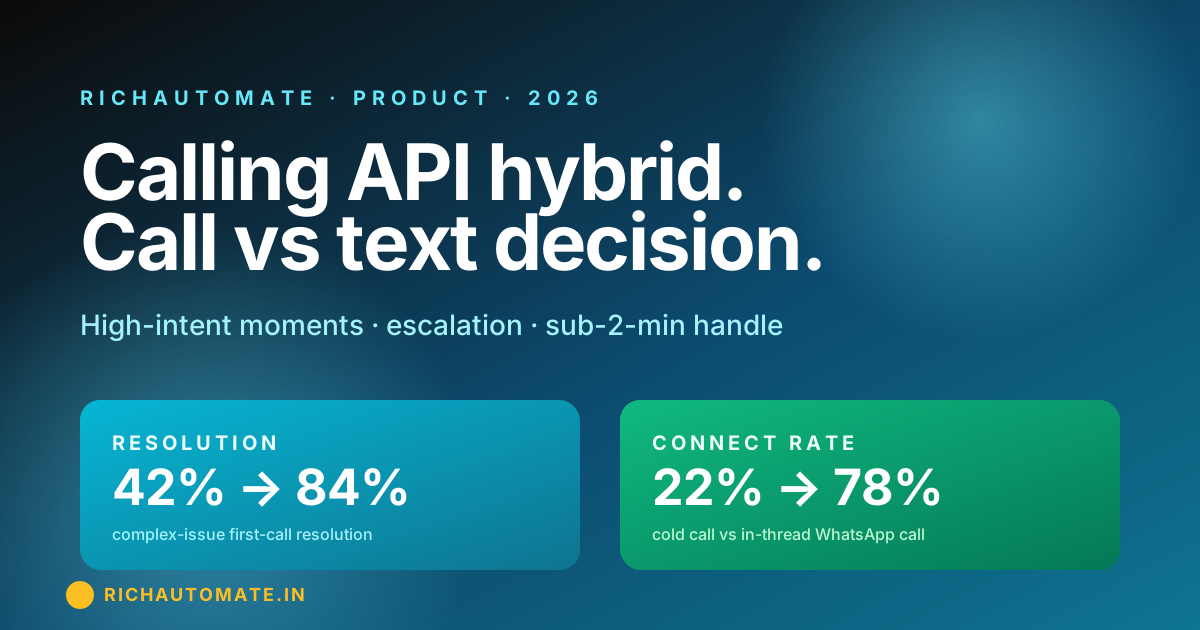
Meta opened the WhatsApp Business Calling API to general availability in 2025; by 2026, Indian D2C, BFSI, healthcare, edtech, and B2B brands have a third interaction surface beyond chat and template — in-thread voice calls. The wrong question to ask is "should we add voice calls?". The right question is "which moments demand voice, which moments demand text, and how do we orchestrate the handoff between the two?". Cold-dial PSTN call connect rate in India is 22% (caller-ID rejected, declined as spam, busy, voicemail). The same number called via WhatsApp Calling API from inside an active business thread connects at 78% — because the customer recognises the brand, expects the call, and stays on WhatsApp. This guide is the 2026 hybrid orchestration playbook for Indian brands: the seven moments where voice beats text, the seven where text beats voice, the trigger architecture, real cohort numbers, and the compliance pattern.
Why WhatsApp Calling Beats PSTN for High-Intent Moments
Three structural advantages:
- Identity is established before the call. Customer is already in a brand thread; call comes from the verified business account. Call connect rate 22% (cold PSTN) → 78% (in-thread WhatsApp call).
- Customer can prepare. Calling API lets you prompt "Want to talk now? Tap to call" — customer chooses. Cold-call interruption sentiment is gone.
- Context shared in same thread. Documents, photos, agreement PDFs sit in the WhatsApp thread; call references them naturally. Agent doesn't need to switch screens; customer doesn't need to repeat.
The Seven Moments Where Voice Beats Text
| Moment | Why voice wins | Indian context |
|---|---|---|
| Complex issue / multiple variables | Real-time clarification + tone | Insurance counter-offer, BFSI loan structuring |
| Negative sentiment escalation | Voice + apology de-escalates faster than text | Service recovery, refund disputes |
| High-value sale closing | Buyer-seller relationship needs voice trust | B2B SaaS deal, real-estate booking, premium D2C ₹10k+ |
| Astrology / spiritual consultation | Personal nature; per-minute pricing model | Astrology platforms; pandit consultations |
| Emergency / time-critical | Faster turn-time than back-and-forth text | Healthcare triage, vehicle breakdown, fraud-alert |
| Multi-stakeholder family decisions | Voice can include multiple family members | Auto purchase, real estate, education / college decisions |
| Complex onboarding / training | Walkthrough + Q&A + relationship | SaaS onboarding, FPO advisor-farmer relationship |
The Seven Moments Where Text Beats Voice
| Moment | Why text wins | Indian context |
|---|---|---|
| Status / order updates | Async; reference-able later | Order tracking, delivery ETA, refund status |
| OTP / authentication | Instant; copy-paste; logged | Login OTP, password reset, transaction auth |
| Documents + media | Forwardable, persistent, shareable | QR ticket, e-policy PDF, GST invoice |
| Appointment booking | Customer chooses time without phone tag | Salon, doctor, test drive, demo |
| Browse / discovery | Visual, scrollable, no time pressure | Catalog browse, drop-day carousel |
| Privacy-sensitive queries | Customer in public space; voice impractical | Health questions, financial enquiries |
| Routine FAQ | Bot resolution at zero cost | Refund policy, store hours, shipping cost |
Real Indian D2C + BFSI Hybrid Orchestration Numbers
Insurance distributor, 8,400 enquiries/month, complex-product mix
| Metric | Text-only | Hybrid (text + voice escalation) |
|---|---|---|
| Quote-to-bind conversion | 14% | 32% |
| Complex-issue first-call resolution | 42% | 84% |
| Average sales cycle | 11 days | 5 days |
| Customer satisfaction (post-resolution) | 6.4/10 | 8.9/10 |
| Agent handle time per qualified deal | 34 min | 22 min |
D2C, premium ₹3,200 AOV, sales-assisted purchase model
| Metric | Without voice | With voice escalation |
|---|---|---|
| Cart-to-paid CVR (high-AOV) | 12% | 34% |
| Average order value | ₹3,200 | ₹4,420 |
| Customer NPS post-purchase | 54 | 78 |
Trigger Architecture: When the System Should Offer Voice
Conversation in WhatsApp text thread → backend monitors signals:
  - Complexity score (LLM intent classifier returns multi-variable intent)
  - Sentiment trend (last 3 messages negative-trending)
  - Cart value above premium threshold
  - Customer LTV / VIP tier
  - Time-elapsed (back-and-forth >5 turns)
  - Explicit request ("can we talk" / "call me")

Voice-offer threshold met → backend pushes utility template:
  "Want to talk? I can call you in 90 seconds — tap below."
  Reply buttons: [Call now] [Call in 30 min] [Continue chat]

Customer taps [Call now]:
  → backend invokes Calling API
  → WhatsApp rings customer's phone via WhatsApp Voice
  → call connects, agent / specialist on the other end
  → call audio recorded (with consent), transcript posted back to thread
  → call summary + next steps as utility template post-call

Customer taps [Continue chat]:
  → no voice triggered; back to text flow
  → escalation threshold raised (customer prefers async)

Daily cron:
  Conversations stuck >3 days without resolution
  → check if voice was offered; if not, surface offer

Quarterly review:
  Voice-vs-text resolution rate per intent category
  Cost per resolution per channel
  Agent capacity allocation tuning
Cost Economics: Voice Per Minute vs Text
| Channel | Cost | Notes |
|---|---|---|
| WhatsApp text (inside session) | Free | Free-form replies, no template |
| Utility template | ₹0.115/msg | Triggered notification |
| Marketing template | ₹0.96/msg | Promotional outbound |
| WhatsApp Voice call (Calling API) | ₹0.40-0.80/min | India-region; varies by BSP |
| PSTN cold call | ₹0.30-0.50/min + agent time | 22% connect rate kills effective economics |
| Indian agent fully-loaded labour | ₹3.00/min | Dominant cost component |
Voice cost is dominated by agent time, not channel fee. WhatsApp Voice connect rate (78% vs PSTN 22%) means the agent is actually talking to customers 3.5× more efficiently — labour productivity gain dwarfs the per-minute fee delta.
Get a 1-minute BSP audit on WhatsApp
Drop your WhatsApp number — we line-item your current invoice against Meta India rates in under 60 seconds. India-hosted, DPDP-compliant.
Work out the real switching cost first, because the BSP migration cost calculator accounts for the number port, template re-approval and overlap month.
Operating Rule
The single highest-leverage move for any Indian brand running customer service / sales on WhatsApp is auto-detecting complex / negative-sentiment / high-intent moments and offering "tap to call" via reply button. Customer chooses voice; brand doesn't cold-dial. Connect rate 78% vs cold PSTN 22%. First-call resolution on complex issues 42% → 84%. Agent labour productivity 3.5×. Build the trigger detection first; layer per-vertical voice playbooks (BFSI, healthcare, premium D2C) over the next quarter.
The Six Anti-Patterns That Wreck Voice Hybrid
- Cold-calling customers without prior thread context. Call connect rate collapses; customer perceives spam. Always seed the call with WhatsApp text confirmation first.
- Offering voice for everything. Routine FAQ, status updates, OTP — text wins. Voice for genuinely complex / high-intent moments only.
- No call recording or post-call summary. Customer forgets what was agreed; agent repeats next time. Record (with consent) + post summary as utility template in thread.
- Voice as default, text as fallback. Inverts the cost structure — most queries should default to text bot, voice on escalation only.
- Ignoring "Continue chat" signal. Customer who declined voice once shouldn't be re-offered immediately. Raise the threshold per customer preference.
- Skipping recording compliance. Indian DPDP requires consent before recording. Pre-call disclosure utility template is mandatory.
Compliance + Operational Notes
- DPDP Act 2023 — voice recordings are personal data; explicit pre-call consent required. Audit-log consent capture.
- TRAI / DND — outbound voice calls are subject to DND scrubbing rules even on WhatsApp; WhatsApp Voice from Calling API is treated as business communication and requires opt-in consent.
- Recording retention — voice recordings stored in Indian region per DPDP; retention 90-180 days for support, longer for BFSI / insurance per regulator rules.
- Quality monitoring — call analytics: connect rate, average handle time, post-call CSAT, transcript sentiment. Train agents on voice-specific handle techniques.
- BSP integration — Calling API access is currently mediated through WhatsApp BSPs; integration patterns vary. Most Indian BSPs (RichAutomate, Gupshup, Karix, etc.) expose Calling API via webhook + control plane.
Run voice + text hybrid on RichAutomate.
Auto-trigger voice offers on complex / negative-sentiment / high-intent moments. Calling API integration with major Indian PSTN carriers + WhatsApp Voice. Call recording + LLM post-call summary into thread. Pre-call consent + DPDP-compliant retention. Lifts complex-issue first-call resolution 42% → 84% and quote-to-bind 14% → 32% on real Indian BFSI + premium-D2C pilots. 14-day trial.
Related reading
- WhatsApp + AI Voice Agent India 2026: 68% Autonomous Resolution, ₹4.20/min, 11 Regional Languages
- WhatsApp Business Calling API India 2026: Implementation, Pricing, and the Four Use Cases That Move Revenue
- Exotel vs RichAutomate India 2026: Rs0 Platform Fee
- WhatsApp for BFSI / Fintech KYC India 2026: Aadhaar OTP, V-CIP, Per-Applicant Economics, and the Eight Compliance Gates
- WhatsApp Business API Cost India 2026: ₹0.11–₹0.99/msg