Indian D2C brands obsess over CAC and ignore the math that decides whether the business compounds — cohort retention. A 5% lift in 90-day retention is worth more than a 30% drop in CAC for any brand operating above ₹5cr ARR. WhatsApp is the only channel with the open-rate, persistent-thread continuity, and cost structure to actually move the retention number. Email-driven lifecycle programmes lift retention 1-3 points; WhatsApp-driven programmes lift it 8-14 points on the same cohort. This guide is the 2026 implementation playbook for Indian D2C — the cohort framework, the six lifecycle messages that move the curve, and the per-cohort economics from real Indian brands.
The Cohort Framework
Three numbers anchor every retention conversation:
- Day-1 retention — % of new customers who return for a second action (purchase, log-in, app-open) within 24 hours. Indian D2C benchmark: 22-38% across categories.
- Day-30 retention — % active 30 days post-first-purchase. Benchmark: 14-28%.
- Day-90 retention — % active 90 days in. Benchmark: 8-18%. The number that decides LTV.
WhatsApp lifecycle programmes typically lift each band by absolute 6-14 points. The gain compounds: Day-90 retention up 10 points = LTV up 25-40%.
The Six Lifecycle Messages That Move the Curve
| Stage | Trigger | WhatsApp message | Lift target |
|---|---|---|---|
| D-0 onboarding | First purchase confirmed | Welcome + product-specific quick-start tutorial | +8-14% Day-1 retention |
| D-3 first-use nudge | Customer hasn't opened app / used product | "Here's the 1-tap shortcut to your first [outcome]" | +6-12% Day-7 retention |
| D-14 milestone celebration | Customer hits a usage milestone | "You did X — here's the next thing many customers love" | +4-8% Day-30 retention |
| D-30 win-back | 30 days since last action | Personalised re-engagement based on consumed category | +5-10% Day-60 retention |
| D-60 loyalty | Customer returned post D-30 nudge | Loyalty program enrolment offer | +8-15% Day-90 retention |
| D-90 referral | Engaged customer at D-90 | 1-tap referral with reward visible | Indirect — drives next-cohort growth |
Per-Cohort Economics: Real Indian D2C Numbers
D2C wellness brand (₹980 AOV, 6,000 first-purchasers/month)
| Cohort metric | Email-only lifecycle | WhatsApp-driven lifecycle |
|---|---|---|
| Day-1 retention | 28% | 41% |
| Day-30 retention | 14% | 26% |
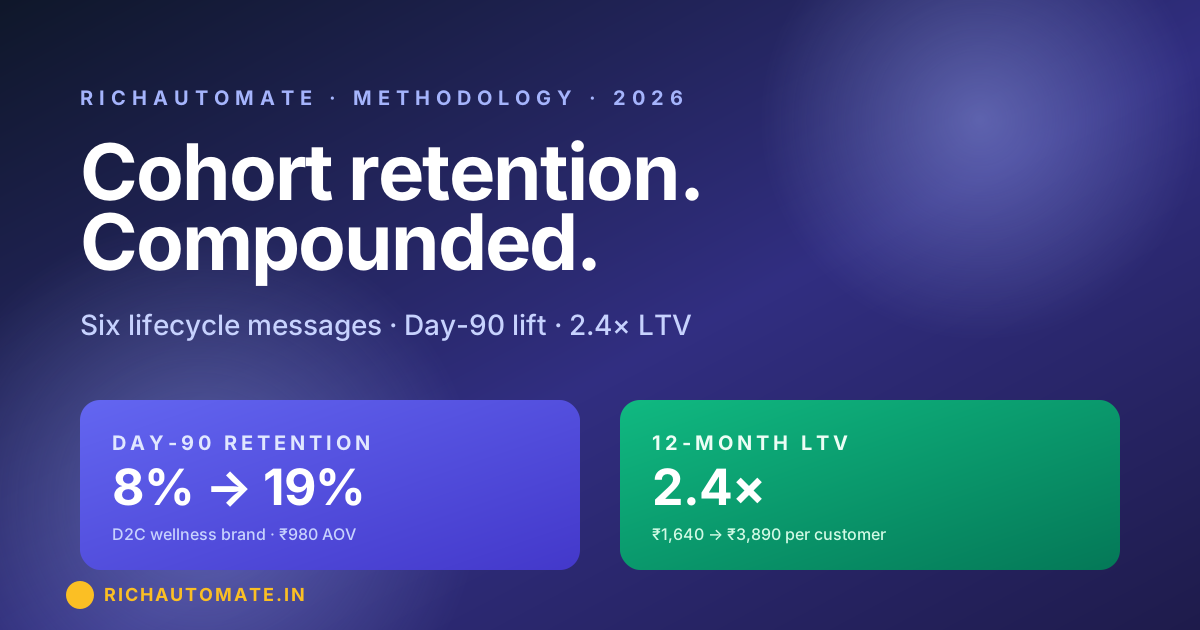
| Day-90 retention | 8% | 19% |
| 12-month LTV per customer | ₹1,640 | ₹3,890 |
| Effective payback period at ₹420 CAC | 3.1 months | 1.3 months |
D2C beauty subscription (₹1,400 AOV recurring)
| Metric | Without WhatsApp lifecycle | With |
|---|---|---|
| Day-30 active subscriber rate | 67% | 84% |
| Average active months | 4.1 | 7.8 |
| Subscriber LTV | ₹5,740 | ₹10,920 |
Trigger Architecture
Order.created → backend stores customer_id + first_purchase_at
Cron daily 9 AM IST scans:
  - First-purchase customers (D+0)        → onboarding template
  - 3 days since first purchase, no usage → first-use nudge
  - 14 days post-first-purchase           → milestone celebration
  - 30 days inactive                      → win-back
  - 60 days post-first + still active     → loyalty offer
  - 90 days post-first + engaged          → referral nudge

All templates approved as Utility (transactional, customer-context).
Quality rating preserved by sticking to behaviour-triggered, not bulk-blast.
Operating Rule
The single highest-leverage retention investment for Indian D2C above ₹5cr ARR is the D+3 first-use nudge for customers who haven't consumed the product yet. Day-1 → Day-7 is where 60-70% of retention falls off; brands that send a contextual WhatsApp utility template in that window halve the early-churn cliff. Build this first; layer the rest of the cadence over the next 60 days.
Get a 1-minute BSP audit on WhatsApp
Drop your WhatsApp number — we line-item your current invoice against Meta India rates in under 60 seconds. India-hosted, DPDP-compliant.
Plug your own numbers into the WhatsApp ROI calculator to see the payback period at your volume.
The Five Anti-Patterns That Wreck Lifecycle Retention
- Same template for all cohorts. A new D2C buyer gets a generic discount blast same as a 6-month loyal customer. Both annoyed. Segment + personalise per cohort age.
- D+30 win-back as discount-only. Discounts retain price-sensitive customers; alienate brand-loyal ones. Mix of discount + content + community access works better.
- No suppression on recently-purchased. Customer just bought yesterday gets a "come back!" message tomorrow — feels stalker-ish. Suppress lifecycle messages for 14 days post-purchase.
- Skipping referral nudge at D-90. Engaged D-90 customers are warm referrers. Brands that don't ask leave 22-40% of next-cohort growth on the table.
- Using marketing templates instead of utility. Behaviour-triggered lifecycle messages with customer context qualify as utility (₹0.115 vs ₹0.96). Categorising as marketing burns 8x cost + lower deliverability.
Compliance Notes
- DPDP Act 2023 — explicit opt-in at first purchase for lifecycle WhatsApp updates.
- Lifecycle templates qualify as Utility under Meta categorisation when behaviour-triggered with customer context. Utility rate ₹0.115/msg.
- Customer opt-out ("Reply STOP") suppresses all lifecycle sends. Audit-log opt-out timestamp.
- Indian-region storage of customer behaviour data per DPDP Act.
Run lifecycle retention on RichAutomate.
Behaviour-triggered template scheduling. Cohort segmentation by first-purchase date + product category + LTV tier. Suppression rules built in. Reorder + win-back + loyalty templates pre-approved. 14-day trial.
Related reading
- WhatsApp Churn Prediction ML + Intervention India 2026: 47% Save Rate, AUC 0.84, Real Cohort Numbers
- WhatsApp + GenAI / LLM Agent India 2026: 78% Resolution, ₹0.42 per Conversation, RAG Over Catalog
- WhatsApp for BFSI / Fintech KYC India 2026: Aadhaar OTP, V-CIP, Per-Applicant Economics, and the Eight Compliance Gates
- WhatsApp Template A/B Testing Methodology India 2026: Sample Sizes, Variant Design, Quality Rating Safeguards
- DPDP Act WhatsApp Compliance Checklist India 2026