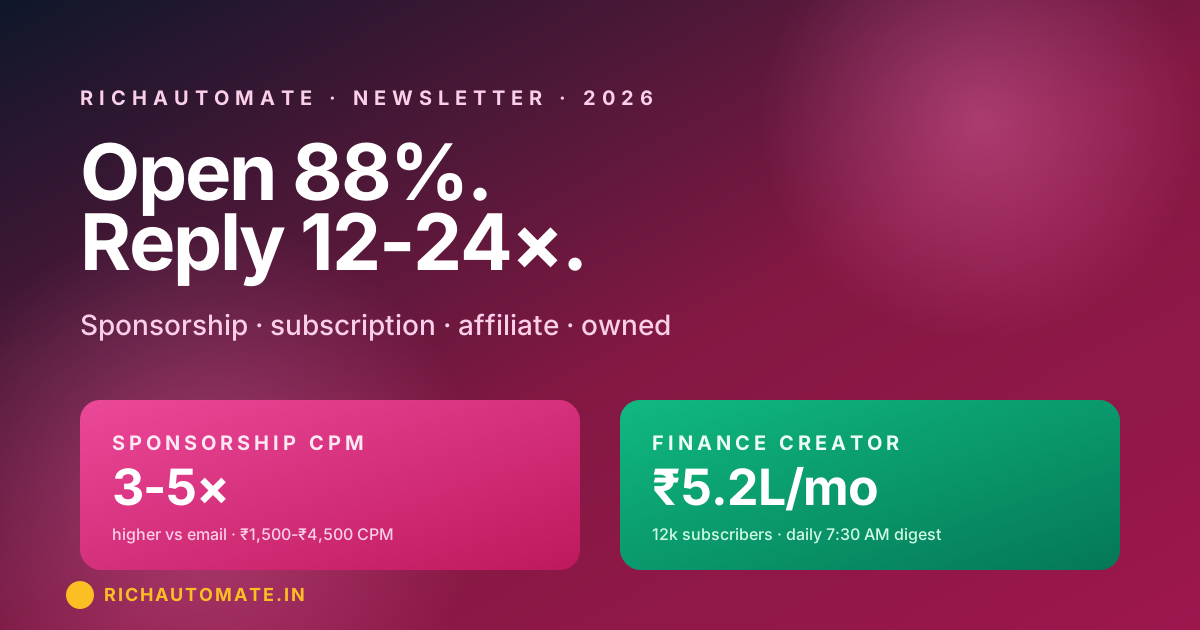
Indian creators and brands sitting on email newsletter lists with 25% open rates are leaving 60–70% of attention on the table. The same audience reads WhatsApp at 88–92% open rates and replies 12–24× more frequently. The shift from email-only to WhatsApp-first newsletters is the biggest distribution arbitrage in Indian content marketing 2026 — and it is barely being exploited. This guide is the implementation playbook for paid + free WhatsApp newsletters — the four newsletter formats that work, audience-growth math via Click-to-WhatsApp ads, monetisation models (subscription, sponsorship, programmatic), and the five anti-patterns that crash your subscriber list within a week.
Email vs WhatsApp Newsletter Economics
| Metric | Email newsletter (India 2026) | WhatsApp newsletter |
|---|---|---|
| Open rate | 22–28% | 88–92% |
| Click-through rate | 2–4% | 12–22% |
| Reply rate | 0.3–0.8% | 4–9% |
| Cost per send (1,000 subscribers, 4 sends/mo) | ~₹1,200 (Mailchimp / ConvertKit India) | ~₹3,840 (utility template at ₹0.96/msg × 4,000) |
| Per-engaged-reader cost | ~₹6.00 | ~₹2.13 |
| Sponsorship CPM (sellable) | ₹400–₹1,200 | ₹1,500–₹4,500 (3-5× higher per impression) |
| Subscriber LTV (12-month) | ₹85–₹240 | ₹340–₹1,200 |
Per-engaged-reader cost is ~3× lower on WhatsApp despite the higher per-message rate. Sponsorship CPM is 3–5× higher. Subscriber LTV climbs 4–5×. Net economics favour WhatsApp at any list size above ~200 active subscribers.
The Four Newsletter Formats That Work on WhatsApp
- Daily / weekly digest. 3–5 curated stories or insights per send. Best for news, finance, sports, tech-trends audiences. Read time 60–90 sec inside chat.
- Single-topic deep-dive. One long-form essay (~600–1,200 words) per week or fortnight. Ideal for substack-style audiences. Inline + linked-out hybrid (preview in chat, full read on web).
- Audio-first newsletter. 3–7 minute voice note per send. Personal, high-trust. Works for creator-led brands, founders, opinion writers. Cheaper to produce than text + higher emotional bond.
- Interactive newsletter. Embedded poll, quick-reply CTAs, micro-Flow forms collecting reader preferences. Doubles as audience research. Highest engagement format; hardest to scale on volume.
Subscription Mechanics — How To Get People In
- Click-to-WhatsApp ad → consent prompt. Meta CTWA ad routes user to WhatsApp; opening template asks "Reply YES to subscribe to [name] newsletter — get [frequency] updates." Captures explicit opt-in. CPL ₹8–₹35 in India 2026 depending on niche.
- Web embed → QR code → WhatsApp prefilled message. Site visitor scans QR or clicks button → opens WhatsApp with prefilled message "SUBSCRIBE NEWSLETTER" → backend captures + confirms. Lower-cost than paid ad.
- Cross-promote from email list. Existing email subscribers receive a one-time email with WhatsApp CTA. Migration rate 18–34% on engaged email cohorts. Migrate strongest readers first; keep email as fallback for non-WhatsApp audiences.
- Referral viral loop. Each subscriber gets one-tap share button. India social-graph is dense; referrals drive 22–40% of growth on niche newsletters.
Real Indian Newsletter Numbers
Finance creator newsletter (12,000 WhatsApp subscribers)
| Metric | Email-only (prior) | WhatsApp-first (current) |
|---|---|---|
| List size | 32,000 emails | 12,000 WhatsApp + 18,000 email |
| Average reads per send | 7,200 | 10,800 WhatsApp + 4,200 email |
| Sponsorship slots filled per month | 2 of 4 (₹40k each) | 4 of 4 (₹1.2L WhatsApp slot, ₹40k email slot) |
| Monthly newsletter revenue | ₹80,000 | ₹5.2L |
D2C lifestyle brand owned newsletter (8,500 subscribers)
| Metric | ||
|---|---|---|
| Newsletter-to-product-page CTR | 2.4% | 18.6% |
| Newsletter-attributed monthly revenue | ₹1.4L | ₹14.8L |
| Cost to send 4× per month | ₹3,400 platform fee | ~₹32,640 (utility templates) |
| Net ROI (revenue ÷ cost) | 41× | 45× |
Per-message cost is higher on WhatsApp; per-rupee newsletter ROI is roughly the same or slightly higher because the conversion lift compounds.
The WhatsApp ROI calculator is more useful than a benchmark here, because the maths swings hard on your margin.
Monetisation Models
| Model | Best for | How it works on WhatsApp |
|---|---|---|
| Sponsorship | Curators, news, niche analyst newsletters | 1 sponsor per send. Sponsored intro line + native link in template body. CPM ₹1,500–₹4,500. |
| Paid subscription | Premium analysis, finance, B2B research | Razorpay subscription mandate + access via gated WhatsApp utility template. ₹99–₹699/month typical. |
| Affiliate | Reviews, recommendations, deal aggregators | Tracked-link templates with retailer-id. ~12–22% click-to-purchase conversion. |
| Owned-product | D2C brands, founders selling courses | Newsletter-to-product-page templates. 18%+ CTR drives direct revenue. |
| Programmatic | High-volume publishers | Not yet mature on WhatsApp. Ad-server integrations exist for tier-1 publishers. |
The Send Schedule That Maximises Open Rate
Indian audience telemetry from 2026 newsletter pilots:
Get a 1-minute BSP audit on WhatsApp
Drop your WhatsApp number — we line-item your current invoice against Meta India rates in under 60 seconds. India-hosted, DPDP-compliant.
- Daily digest: 7:30–8:30 AM IST (commute + first-coffee window). Read rate peaks at 92%.
- Weekly long-form: Sunday 9:00–10:30 AM IST. Reading time + relaxed attention.
- Audio newsletter: Sunday 7:00–9:00 PM IST (post-dinner audio consumption window).
- Interactive: Wednesday 11:00 AM–12:00 PM (mid-week reply intent peaks).
Avoid Monday morning mass sends (highest competing-message volume) and Friday evening (reader fatigue). Don't send between 11 PM–6 AM ever — quality rating risk + reader irritation.
Operating Rule
Indian creators sitting on 5,000+ engaged email subscribers can typically grow WhatsApp newsletter list to 1,500–3,000 subscribers within 60 days via cross-promotion alone, no paid acquisition. The compounding effect: WhatsApp's 88% open rate amplifies the existing brand voice 3–4× without changing content. Migrate the most-engaged 30% of your email list first; let the rest stay on email as a fallback for non-WhatsApp audiences.
The Five Anti-Patterns That Crash Newsletter Subscriber Lists
- Treating WhatsApp like email broadcast. Long subject-line-style headers, multiple CTAs, footer disclaimers — none translate to chat. Newsletter copy must be conversational, single-CTA, scannable in 60 sec.
- Sending 5+ times per week. WhatsApp tolerance for newsletter cadence is lower than email — anything above 3/week feels intrusive. Twice weekly is the sweet spot for digest format; weekly for long-form.
- Skipping the unsubscribe path. Every newsletter template must include "Reply STOP to unsubscribe" (DPDP-compliant + Meta-policy required). Skipping it spikes block + report rates.
- Mass-broadcasting promotional content as newsletter. Newsletter is editorial. Bury "Buy our product" messages and you lose trust. Sponsorships should be clearly marked; owned-product mentions should be 1 per 4 sends max.
- Forwarding the whole essay in chat. WhatsApp message bodies above 1,024 chars truncate awkwardly + read poorly. Use a 3–4 line teaser inside chat + link out to full content. Best of both — chat for attention, web for depth.
Compliance + Consent Specifics
- DPDP Act 2023 explicit opt-in. Capture "Yes I agree to receive [Name] newsletter via WhatsApp" before first send. Audit-log timestamp + message ID.
- Opt-out path on every send. "Reply STOP to unsubscribe" visible in every newsletter template body.
- Marketing template categorisation. Newsletter content is "marketing" under Meta classification. Submit each newsletter as a marketing template; cannot use utility templates for editorial content.
- Spam-rule isolation. Keep newsletter WABA separate from transactional messaging WABA. Quality-rating issues on the newsletter side don't cascade to your transactional template performance.
- Indian-region storage of subscriber data. If you collect email + name + phone, the data must be stored on Indian-region infrastructure per DPDP Act.
Tooling Stack Reference
| Layer | Component | Cost |
|---|---|---|
| WhatsApp BSP | Cloud API + newsletter delivery | ₹0.96 per marketing message (Client Pay) |
| List management + segmentation | BSP CRM or external CRM | Often included |
| Subscription billing | Razorpay / Cashfree | 2% per transaction |
| Sponsor matching | Manual or marketplace | Marketplace 10–20% take |
| Web preview / archive | Static site generator (Hugo / Astro / Next.js) | Free |
| Cross-promote | Click-to-WhatsApp ads via Meta | CPL ₹8–₹35 |
Three Real Indian Newsletter Examples (Anonymised)
- Finance creator (Mumbai-based, 12k WhatsApp subscribers). Daily 7:30 AM digest. Sponsorship-funded ₹5.2L/month revenue. 100% growth from email-list cross-promotion + organic referral.
- SaaS founder weekly (Bengaluru, 4k subscribers). Single-topic deep-dive Sundays 9 AM. Premium tier ₹299/month, 18% conversion from free → paid. Total monthly revenue ₹2.1L.
- Indian classical music curator (audio-first newsletter, 6.8k subscribers). Sunday 7 PM voice note + 2 song recommendations. Sponsorship ₹40k per send, 4 sends/month = ₹1.6L revenue. Subscriber NPS 87.
Run your newsletter on RichAutomate.
Send marketing templates at scale to thousands of subscribers. Built-in segmentation by engagement / sponsorship-tier / preference. Razorpay subscription billing for paid newsletters. Web archive auto-generation. CTWA-ad integration for paid acquisition. 14-day trial.
Related reading
- WhatsApp for D2C Subscription Brands India 2026: Recurring Billing, UPI Mandate Recovery, and the Seven Workflows That Protect MRR
- WhatsApp for B2B SaaS Lead Nurture India 2026: Buyer-Role Personas, Per-Funnel-Stage Channel Matrix, and Real Demo-to-Close Numbers
- WhatsApp for Print + News Media Daily-Edition Distribution India 2026: 9-Stage Subscriber Thread + Cohort Fan-Out + Post-Privacy Ad-Attribution + PRB Compliance
- WhatsApp for Laundry & Dry-Cleaning India 2026: Pickup-to-Delivery Lifecycle + Franchise Routing + UPI AutoPay Subscriptions
- Client Pay vs SaaS Pay: How RichAutomate's Dual WhatsApp Billing Saves Indian D2C ₹21 Lakh/Year