Indian D2C support teams running customer service on WhatsApp without an SLA framework leak revenue at three points: high first-response times that customers interpret as ghosting, agent overload that breaks at 50+ open conversations per agent, and unmeasured handover quality that turns escalations into refund requests. The brands that win run a tight SLA grid — first-response within 4 minutes, full resolution within 4 hours for 80% of tickets, CSAT ≥4.5/5 — and the WhatsApp infrastructure that surfaces every breach in real time. This guide is the 2026 implementation playbook — the seven SLA metrics that matter, agent-load thresholds before quality crashes, the auto-routing patterns that hold the SLA at scale, and the five anti-patterns that wreck service team economics.
The Seven Customer Service SLA Metrics That Matter
| Metric | Best-in-class target (Indian D2C 2026) | What it controls |
|---|---|---|
| First Response Time (FRT) | under 4 min p50, under 12 min p95 | Customer perception of effort + churn risk |
| Time to Resolution (TTR) | 4 hours p50, 24 hours p95 | Revenue protection + escalation rate |
| One-Touch Resolution Rate | ≥ 62% | Agent productivity + customer effort |
| Open Conversations Per Agent | under 35 simultaneously | Quality crash threshold |
| Escalation Rate | under 12% | L1-agent skill + tooling adequacy |
| CSAT post-resolution | ≥ 4.5/5 average, ≥ 95% surveyed | Loyalty + repeat purchase |
| Reopen Rate (resolved → reopened in 7d) | under 8% | Resolution quality vs cosmetic close |
Per-Agent Economics: Where the Quality Cliff Is
| Open conversations / agent | FRT p50 | CSAT | Reopen rate | Verdict |
|---|---|---|---|---|
| 15 | 1.8 min | 4.7 | 4% | Under-utilised — costs more than needed |
| 25 | 2.4 min | 4.6 | 5% | Sweet spot for high-quality teams |
| 35 | 4.1 min | 4.5 | 7% | Operational maximum at scale |
| 50 | 9.8 min | 4.1 | 14% | Quality cliff — reopen rate doubles |
| 70+ | 22+ min | 3.6 | 26% | Crisis state — agent burnout + churn risk |
The 35-conversation-per-agent threshold is the single most important number in WhatsApp service ops. Brands that auto-cap routing at 35 keep CSAT above 4.5 indefinitely. Brands that let it drift to 50+ during peak see CSAT collapse + reopen rate double inside 30 days.
Auto-Routing Patterns That Hold the SLA
- Skill-based round-robin with load cap. New conversation enters → router picks the available agent with lowest open-count under the 35 cap, matching the skill (orders / refunds / general). If all agents at cap → queue with FRT clock paused.
- VIP fast-lane. Customer with LTV above ₹X bypasses the queue, routed to senior agent with cap of 25. Detect via CRM lookup at conversation entry.
- Sentiment escalation. NLP detects negative sentiment in incoming message → flag for senior agent or supervisor. Beats letting an angry customer wait the full FRT clock.
- Time-zone awareness. Outside business hours → AI agent handles with explicit "human available at 9 AM" disclosure. Track AI-resolved vs human-resolved separately.
- Conversation tagging at close. Mandatory tag from a controlled vocabulary at resolution (refund / shipping / product-defect / billing / how-to / other). Powers root-cause analytics, not vanity metrics.
- Reopen handoff. If a customer returns within 7 days on same issue, route to the same agent who closed it (memory continuity). If unavailable, supervisor.
- Bulk-incident clustering. If 20+ conversations arrive in 60 min mentioning the same product / SKU / shipping route → auto-create incident ticket + send a brand-side announcement template instead of handling 20 individually.
Real Indian D2C Service-Team Numbers
Mid-size D2C brand (₹1,500 AOV, 8,000 monthly tickets)
| Metric | Email + phone (legacy) | WhatsApp + SLA framework |
|---|---|---|
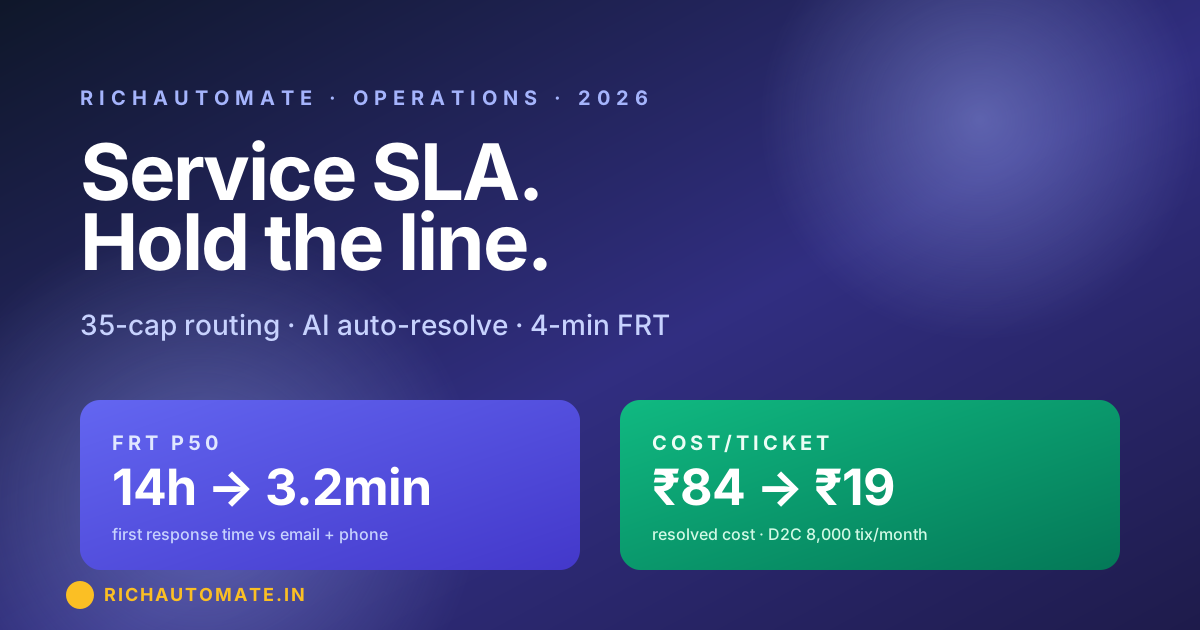
| FRT p50 | 14 hours | 3.2 min |
| TTR p50 | 2.8 days | 3.7 hours |
| One-touch resolution | 34% | 68% |
| Tickets per agent / day | 22 | 58 |
| CSAT | 3.9 | 4.6 |
| Cost per resolved ticket | ₹84 | ₹19 |
Mid-size insurance fintech (24/7, AI + human hybrid)
| Metric | Phone + email | WhatsApp + AI-assist |
|---|---|---|
| Tickets self-resolved by AI (no human touch) | 0% | 41% |
| Average ticket cost | ₹118 | ₹38 |
| CSAT on AI-resolved | n/a | 4.4 |
| CSAT on human-resolved | 4.0 | 4.7 |
| 24/7 coverage cost | ₹2.4L/mo (3 night agents) | ₹0.4L/mo (AI overnight + 1 night agent) |
The 24-hour Service Window Math
Meta's WhatsApp Cloud API rules: if a customer messages first, you have a 24-hour service window where outbound replies are free (no per-message fee). Outside the window, you must use a paid template. Service operations that don't respect this window quietly burn budget — every reply outside 24h costs ₹0.115 (utility) or ₹0.96 (marketing). At 8,000 monthly tickets with 30% replied outside the window, that's ~₹2,300/month leaked to template fees that should have been free.
How much this costs depends on your reply timing, and the conversation window cost calculator models it.
Get a 1-minute BSP audit on WhatsApp
Drop your WhatsApp number — we line-item your current invoice against Meta India rates in under 60 seconds. India-hosted, DPDP-compliant.
Fix: triage incoming WhatsApp messages on arrival; if customer-initiated and within 24h, route to free service-message track; if outside 24h, surface a template-fee-prompt to the agent so they consciously decide to use a paid template.
Sentiment Detection That Doesn't Crash WABA Quality
Three approaches, ordered by accuracy + latency:
- Keyword + regex. "refund" / "cancel" / "not received" / "worst" / "legal" → escalate. ~75% accuracy, < 50ms latency. Good baseline.
- Local LLM (small model in-cluster). Run a fine-tuned multilingual sentiment classifier on every incoming. Catches Hindi-English code-switch + sarcasm. ~88% accuracy, ~200ms latency.
- Frontier LLM via API (OpenAI / Anthropic / Gemini). Best accuracy ~94% on Indian D2C ticket corpus, but adds 1–3 sec latency + per-call cost. Reserve for high-AOV / high-LTV escalations where latency is OK.
Best-in-class teams blend (1) for fast triage + (3) on flagged edge cases.
The Agent Console — What It Must Show in Real Time
Per agent:
- Current open count vs 35 cap.
- Oldest waiting customer + their wait time (drives FRT discipline).
- Customer's LTV + last 3 orders + open returns + active subscription state — all visible without leaving WhatsApp thread.
- Inline GenAI suggestion (e.g. OpenAI / Gemini) on every incoming message — agent reviews + edits + sends in one click.
- Sentiment flag visible inline on every message.
- Tag picker pre-populated with last-used tag and ML suggestion.
- One-click escalation to supervisor with note.
Operating Rule
The single most-impactful service-ops investment for an Indian D2C brand running WhatsApp at 5,000+ tickets/month is capping agent load at 35 open conversations and surfacing the cap in the routing layer. Most brands intuitively over-load agents during peaks; the result is a CSAT collapse that doesn't surface until reopens spike 2-3 weeks later. Auto-cap + queue with FRT-paused is non-negotiable above 5,000 monthly tickets.
The Five Anti-Patterns That Wreck Service Team Economics
- Single shared inbox without ticket-state. Agents step on each other's replies, customers get duplicate or contradicting answers. Always run a per-conversation owner state.
- Treating every conversation as a ticket. Many WhatsApp interactions are quick FAQ — order status, return policy. Auto-resolve via AI without creating a human ticket. Reduces queue noise 30–50%.
- Closing tickets prematurely. Agent marks resolved but customer hasn't confirmed. Reopen rate spikes. Always wait for customer acknowledgement OR auto-close with explicit "please reply if anything else" nudge.
- Surveying CSAT inside the same agent thread. Customer feels social pressure to give 5/5. Survey via separate utility template after 30 min — gives honest signal.
- Sending broadcast announcements through service window only. Many brands try to use the customer-initiated 24h window to push promo content. Customers report it. Quality crash inside 7 days. Service window is for service, not marketing.
Tooling Stack Reference for Indian D2C 2026
| Layer | Component | Recommendation |
|---|---|---|
| WhatsApp BSP | Cloud API + agent inbox + routing | RichAutomate (built-in routing, 35-cap, sentiment) / equivalent |
| AI agent | L1 auto-resolve + agent suggestion | OpenAI GPT-4o-mini for cost / Anthropic Claude Sonnet for quality |
| CRM context lookup | LTV, orders, subscriptions | Shopify / Zoho / HubSpot via webhook on conversation open |
| Sentiment | Real-time classifier | Local fine-tuned model (sub-200ms) + GPT fallback for edge cases |
| Analytics | SLA dashboards, cohort analysis | Built-in BSP analytics + Metabase / Superset for deep-dive |
| Survey + CSAT | Post-resolution template | Single-question 1-5 quick-reply, 30 min after close |
What This Means For Indian D2C Service Teams in 2026
The brands that are quietly winning customer-service economics in Indian D2C aren't cutting agent count or outsourcing — they're running tighter SLA discipline on WhatsApp + investing 20–40% of the ticket volume into AI auto-resolve. Net effect: same headcount handles 2.5× more tickets, CSAT climbs 0.5–0.8 points, cost per resolved ticket drops 60%+. The brands that wait until Q3 2026 to instrument their service ops will be paying premium per-ticket cost while their competitors deliver faster + cheaper service to the same customers.
Run service ops on RichAutomate.
Built-in agent routing with 35-cap by default. Inline AI agent suggestion (OpenAI + Gemini compatible). Real-time SLA dashboards (FRT, TTR, CSAT, reopens). 24-hour service-window detection with template-fee prompt. Sentiment escalation. CRM context lookup on conversation open. 14-day trial.
Related reading
- WhatsApp Bot-to-Human Handoff India 2026: 8.6 CSAT, 6-Minute Resolution, Context Handover Schema
- WhatsApp for Healthcare Clinics India 2026: Compliance Gates, Seven Clinical Workflows, and Real Per-Appointment ROI
- WhatsApp Business Calling API India 2026: Implementation, Pricing, and the Four Use Cases That Move Revenue
- WhatsApp for Beauty + Cosmetics D2C India 2026: Seven Moments, 38% Repeat Rate, Real Category Numbers
- Best WhatsApp CRM India 2026: ₹ Pricing Compared