Indian outpatient clinics and diagnostic chains lose 22–35% of booked appointments to no-shows, and another 14% of revenue to delayed lab-report delivery cycles that drag follow-up consultations by weeks. SMS reminders at 5–8% read rate cannot fix this. WhatsApp, used right, collapses the gap — appointment confirmations, intake forms, lab reports, prescription refills, and follow-up reminders all in one persistent chat thread that the patient actually opens. This guide is the 2026 implementation playbook for Indian healthcare practices — from solo OPDs to multi-city diagnostic chains. Covers the seven clinical workflows that work on WhatsApp, the DPDP + clinical-data compliance gates, real per-appointment ROI numbers from Indian pilots, and the five anti-patterns that risk regulator notice or patient harm. If you are still choosing a vendor, our comparison of the best WhatsApp API for healthcare in India weighs compliance, data residency, and per-message cost side by side.
Why Healthcare on WhatsApp Now
| Driver | Healthcare-specific impact |
|---|---|
| SMS read rate collapse (2024–2026) | Appointment SMS reminders read at 5–8%. No-show rate compounds. |
| DPDP Act 2023 in force (late 2025) | Health-data category requires explicit consent + Indian residency. WhatsApp consent flows easier than fragmented web/SMS. |
| NMC / NDHM ABHA integration mature | ABHA-linked patient records can be referenced inside WhatsApp utility templates with proper masking. |
| Patient WhatsApp adoption near saturation | 92%+ of urban Indian outpatients have WhatsApp on the same number their clinic captured. |
| Meta utility-rate cut (2026) | ₹0.115 per utility message — appointment reminders are essentially free at clinic scale. |
| WhatsApp Native Flows + Calling API GA | Intake forms inside WhatsApp + tap-to-call for tele-consult escalation. |
The Seven Clinical Workflows That Work on WhatsApp
- Appointment booking + confirmation. Web/Practo/walk-in booking → WhatsApp confirmation utility template within 30 seconds. Includes doctor name, slot, address, parking note, intake form link.
- Pre-appointment intake. 24h before slot, WhatsApp Flow opens an in-chat form for symptoms / current-meds / allergies / insurance. Submitted data lands in EMR before patient walks in.
- Same-day reminders. T-3h reminder with one-tap reschedule via Flow time-picker. Cuts no-show by 40–60%.
- Lab report delivery. Report ready → utility template with one-tap download (signed URL, 24h expiry). Patient sees the report 5–8 days faster than waiting for paper / email.
- Prescription refill reminders. Long-term meds (BP, diabetes, thyroid) auto-reminder T-3 days before refill. Patient replies "Yes" to trigger doctor's e-script.
- Tele-consult escalation via Calling API. Lab result abnormal → utility template with Call Doctor button → routed to on-call physician via WhatsApp Calling API + recording bridge.
- Post-visit feedback + outcome tracking. 48h after visit, single-question CSAT + 7-day follow-up symptom check. Drives clinical quality + repeat-visit revenue.
Per-Appointment Economics: Real Indian Clinic Numbers
Multi-doctor outpatient clinic (450 appointments / week)
| Metric | SMS + phone-callback | WhatsApp end-to-end |
|---|---|---|
| Reminder read rate | ~8% | ~88% |
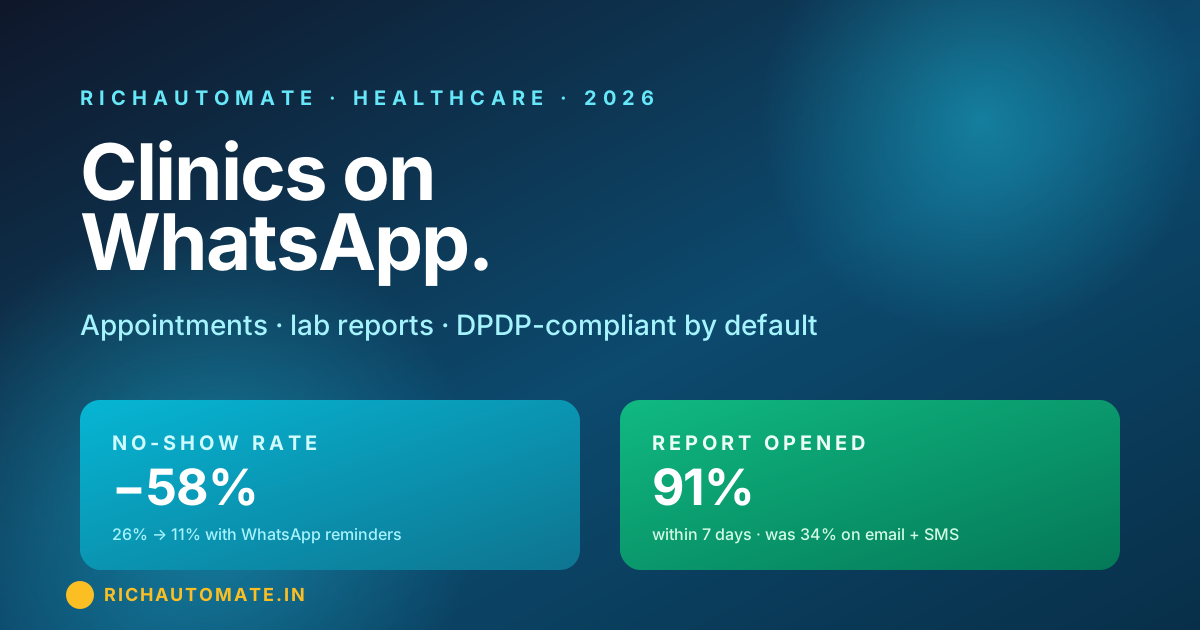
| Same-day no-show rate | 26% | 11% |
| Reception time per booking (intake collection) | ~6 min | ~1 min (pre-filled via Flow) |
| Lab-report-to-patient lag | 4–7 days | same-day push |
| Per-appointment cost (messaging + agent time) | ~₹38 | ~₹14 |
| Annual saving on a 450-appt/week clinic | ~₹5.6L in messaging + ~210 reception hours/year reclaimed | |
Diagnostic lab chain (4,000 tests / week, 12 collection centres)
| Metric | Email + SMS link | WhatsApp lab-report delivery |
|---|---|---|
| Report opened by patient (within 7 days) | 34% | 91% |
| Repeat-visit-rate within 90 days | 22% | 38% |
| Support tickets "where is my report?" | ~620 / month | ~80 / month |
| NPS lift | baseline | +19 points |
Compliance Gates Before You Send a Single Message
- DPDP-compliant consent. Health data falls under sensitive personal data. Capture explicit opt-in at booking — checkbox on the booking form + a one-time WhatsApp utility message asking the patient to reply YES to confirm consent for health-related WhatsApp updates. Audit log the reply with timestamp + WhatsApp message ID.
- Patient-data masking on outbound. Never send full Aadhaar / ABHA ID / detailed lab values in the message body. Use one-tap signed-URL links. The patient authenticates on landing (OTP or ABHA login) to view the report.
- NMC + clinical-records retention. Outbound message logs must be retained 5–7 years per NMC's Indian Medical Council Regulations 2002 (as amended 2024) on professional records. Indian-region storage with at-rest encryption.
- Practitioner identification. Marketing-style sends not allowed for private practitioners under NMC code. Stick to utility-only templates: appointment, report, prescription, follow-up. No promotional broadcasts.
- BSP healthcare authorisation. Generic Meta BSP onboarding does not auto-include healthcare. Your BSP must enable healthcare templates with Meta and capture an addendum acknowledging clinical-data handling.
- HIPAA-style isolation for international patients. If your clinic serves NRIs / international medical tourism, isolate that patient cohort in a separate WABA — Indian DPDP rules apply for Indian residents; HIPAA-equivalent controls for the international cohort.
- Doctor-side privacy. Tele-consult Calling-API records: patient consent for recording is mandatory before call connects. Recording stored with same retention + masking as written records.
The DPDP-Compliant Appointment Confirmation Template
What an actual approved healthcare utility template looks like in 2026:
Get a 1-minute BSP audit on WhatsApp
Drop your WhatsApp number — we line-item your current invoice against Meta India rates in under 60 seconds. India-hosted, DPDP-compliant.
Hello {{patient_first_name}},

Your appointment with {{doctor_name}} at {{clinic_name}}
is confirmed for {{date}} at {{time_slot}}.

Address: {{clinic_short_address}}
Slot ID: {{slot_id_last_4}}

Please complete your intake form before arrival:
{{intake_form_short_link}}

Reply RESCHEDULE to change the slot.
Reply CANCEL to cancel free of charge before {{free_cancel_deadline}}.

This message is from a healthcare provider you booked with.
Reply STOP to opt out of WhatsApp updates.
Key compliance elements: no patient ID number unmasked, doctor + clinic identified, opt-out mentioned, intake form is a short signed-URL (not raw form data in body), reschedule + cancel mechanics inline.
The Five Anti-Patterns That Risk Regulator Notice or Patient Harm
- Sending full lab values in the message body. "HbA1c: 9.4%" in plain WhatsApp = sensitive data leakage if the phone is shared / lost / forwarded. Always link to authenticated viewer.
- Promotional broadcasts to patient lists. "15% off your next health checkup!" is non-compliant with NMC code for private practitioners and triggers DPDP marketing-consent rules separately. Stick to utility-only.
- Forgetting to isolate test-environment patients. Pilot WABA mistakenly catching real production patient numbers — sends mock messages to people who didn't consent. DPDP penalty + clinical-trust collapse.
- No opt-out path on every message. Even utility messages should include "Reply STOP to opt out". Required by DPDP + Meta utility-template guidelines.
- Tele-consult Calling API without recording disclosure. Patient must hear / read "This call may be recorded for medical records" before connecting. Missing disclosure = clinical-record evidentiary problems.
Operating Rule
If your clinic or diagnostic chain books more than 200 appointments a week and uses SMS or phone-callback for reminders, the WhatsApp migration ROI pays back in under 60 days through no-show reduction alone. Compliance is the hard gate, not the technology — DPDP consent capture, BSP healthcare authorisation, masking on outbound, NMC retention. Brands that nail compliance first scale to multi-city without regulator notice. Brands that rush past it get hit with a single complaint and roll the entire programme back.
Multi-Specialty Hospital vs Solo OPD: Different Patterns
| Practice type | Volume | Best WhatsApp pattern | Compliance scope |
|---|---|---|---|
| Solo OPD / dental clinic | 30–80 appts/wk | Booking + confirmation + reminder + follow-up. No Flow forms initially. | DPDP consent + retention only |
| Multi-doctor OPD (5–15 docs) | 200–600 appts/wk | Add intake Flow + lab-report delivery + prescription refill | DPDP + masking + BSP healthcare auth |
| Diagnostic lab chain (multi-centre) | 2,000–10,000 tests/wk | Full automation: report delivery + repeat-test reminders + collection-centre slot booking | Full set + Indian-region storage + 7-year retention |
| Multi-specialty hospital | 1,000+ daily appts | All of above + Calling API for tele-consult escalation + ABHA-linked records | Full set + HIPAA-equivalent for international cohort + NABH audit-trail |
The Lab-Report-Delivery Workflow That Works
- Lab tech finalises report in LIS (Laboratory Information System).
- LIS webhook fires to BSP / RichAutomate with patient ID + signed URL to PDF.
- Outbound utility template fires with patient first name + test-name + tap-to-view link.
- Patient taps link, lands on a tokenised page that requires either OTP (sent to same WhatsApp number) or ABHA login.
- Authenticated, patient sees the report in-browser. Optionally downloads PDF.
- If abnormal flagged in LIS: a follow-up template offers a Calling API Call Doctor button. Tapping connects patient to on-call physician.
- Audit log: send timestamp, view timestamp, download timestamp, doctor-call timestamp — all retained 7 years per NMC.
Three Real Indian Healthcare Pilots (Anonymised)
- Mumbai dental chain (8 centres, 1,200 appts/wk). WhatsApp reminders + intake Flow. No-show rate dropped 27% → 11%. Reception team hours reclaimed: ~280/year. Annual saving: ₹14.5L.
- Bengaluru diagnostic lab (multi-city, 4,500 tests/wk). Lab-report delivery moved to WhatsApp. Report-opened-within-7-days rate climbed from 34% to 91%. Repeat-visit rate within 90 days: 22% → 38%. Net new revenue: ~₹62L/year.
- Delhi multi-specialty hospital (110 doctors, 1,400 daily appts). Full WhatsApp programme — booking confirmation, intake, lab delivery, prescription refill, post-visit feedback, tele-consult escalation. Patient NPS lift +24. Tele-consult adoption +180%. ROI within 47 days.
What to Build First (Migration Sequence)
- Week 1. BSP setup with healthcare authorisation. Single confirmation template approved.
- Week 2–3. DPDP consent campaign — re-permission existing patient list. Audit log built.
- Week 4–5. Same-day reminder + reschedule Flow. Cuts no-show first.
- Week 6–8. Lab-report delivery with signed-URL viewer + OTP gate.
- Week 9–11. Pre-appointment intake Flow + EMR write-back integration.
- Week 12+. Tele-consult Calling API + recording bridge. Outcome-tracking follow-ups.
Further reading
Run healthcare WhatsApp on RichAutomate.
BSP healthcare authorisation pre-cleared. DPDP consent flows + audit log built in. Indian-region storage with 7-year retention defaults. ABHA-aware templates for clinics already on NDHM. Tele-consult Calling API + recording bridge included on SaaS Pay. Free compliance audit for switchers.
Related: WhatsApp for dermatology & skin clinics in India (2026) — appointment booking, no-show reminders, treatment-package quotes, pre/post-care aftercare, recall follow-ups and before/after consent in one thread.