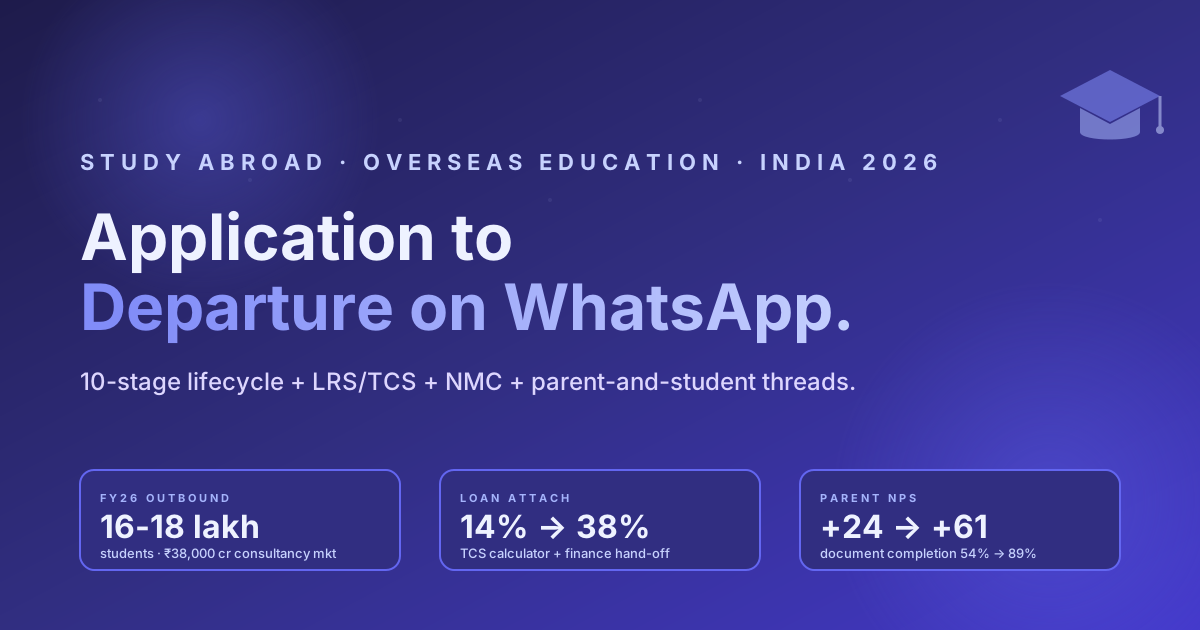
India sent an estimated 13.6 lakh students abroad for higher education in 2024, and the FY26 outbound cohort is tracking toward 16-18 lakh as Canada-and-Australia visa tightening reroutes demand into Germany, Ireland, the UAE, France and a resurgent UK Graduate Route (Ministry of External Affairs Lok Sabha data + RBI LRS bulletins + Bureau of Immigration). The overseas-education consultancy market — the agents, counsellors and ed-finance brokers sitting between the student and the university — is now a ₹38,000 crore-plus services economy spread across roughly 8,500 active agencies, from listed players (IDP Education India, Leverage Edu, Yocket, ApplyBoard India) down to single-counsellor Tier-2 shops in Kota, Hyderabad, Ludhiana and Kochi. The problem: the application-to-departure journey is an 11-to-14-month, document-heavy, anxiety-soaked marathon — SOP drafts, transcripts, IELTS/PTE/Duolingo scores, financial proof under RBI's Liberalised Remittance Scheme, an education-loan sanction, a visa interview, a tuition wire, and a pre-departure briefing — and most of it is run on a chaos of phone calls, email threads the parent never opens, and Google Sheets only the counsellor can see. WhatsApp, at 612 million Indian users and the default channel for both the 18-24 student and the 45-55 fee-paying parent, is where the entire lifecycle is migrating. This guide is the 2026 implementation playbook for Indian study-abroad consultancies: market sizing, the FEMA/RBI/ED regulatory landscape, a 10-stage WhatsApp lifecycle, the automation tech stack, the DPDP minor-and-financial-data carve-out, real cohort numbers, comparison tables, and five anti-patterns that lose families and trigger compliance flags.
India's Outbound Student Market FY26 — The Numbers
The outbound boom is real but the destination mix has churned violently. Canada's January 2024 study-permit cap and Australia's higher financial-capacity and English thresholds collapsed two of the three biggest corridors; the slack flowed to continental Europe, the UK Graduate Route, and Gulf branch campuses. A consultancy that built its 2022 pipeline entirely on Canada SDS is, in FY26, rebuilding its counselling scripts from scratch.
| Destination | FY26 Indian student estimate | YoY trend | Dominant funnel |
|---|---|---|---|
| USA | 3.3-3.6 lakh | Flat / mild decline (visa backlog + F-1 scrutiny) | STEM masters + OPT |
| UK | 1.7-2.0 lakh | Recovering (Graduate Route retained) | 1-yr masters + post-study work |
| Canada | 1.0-1.3 lakh | Down ~40% (PAL/study-permit cap) | PG diploma → PR |
| Germany | 0.5-0.7 lakh | Up sharply (zero/low tuition + Blue Card) | Public-university MS + Opportunity Card |
| Australia | 0.9-1.1 lakh | Down (financial + English tightening) | Masters + skilled migration |
| Ireland / France / UAE / others | 1.4-1.8 lakh | Up (branch campuses + Schengen study) | Mixed UG/PG + work-pathway |
Two structural facts drive everything below. First, the parent is the payer: 71% of the fee and remittance decisions are taken or co-signed by a parent who is not on email and lives on WhatsApp. Second, the money is regulated: every rupee that crosses the border for tuition or living expenses flows through the RBI Liberalised Remittance Scheme and now carries a Tax Collected at Source liability — which means the consultancy is unavoidably in a financial-advisory adjacency whether it likes it or not.
The Regulatory Landscape — FEMA, LRS, TCS, NMC, AIU
Study-abroad consultancies operate in a denser compliance mesh than most verticals realise. The five regulators that shape every WhatsApp message you send:
- RBI / FEMA — Liberalised Remittance Scheme. A resident individual can remit up to USD 2,50,000 per financial year. Education remittances (tuition + living) sit inside this cap. Wires go through an Authorised Dealer (AD-I bank) against a Form A2 + LRS declaration. Your WhatsApp flow must never "advise" on structuring remittances to dodge the cap — that is a FEMA contravention.
- Income Tax — TCS on LRS (Section 206C(1G)). From the FY24 regime: education remittances funded by a loan from a notified financial institution attract 0.5% TCS above ₹7 lakh; self-funded education remittances attract 5% above ₹7 lakh. This single fact reshapes the financing conversation — the loan-vs-self-fund TCS gap is now a headline counselling input, and your bot must surface it accurately, not invent rates.
- NMC — Foreign Medical Graduate route. For MBBS-abroad aspirants, the National Medical Commission's Foreign Medical Graduate Licentiate (FMGL) Regulations 2021 mandate a 54-month course + 12-month internship in the same country + FMGE/NExT clearance. Mis-selling a non-compliant college is a consumer-protection and reputational landmine; the bot must gate medical-college recommendations against the NMC framework.
- AIU — degree equivalence. The Association of Indian Universities issues equivalence certificates that determine whether a foreign degree is recognised for Indian government jobs and PhD admissions. Counselling that ignores AIU equivalence sets students up for a nasty surprise on return.
- DPDP Act 2023 + GST. You are processing minors' data (UG aspirants under 18), financial data (loan + bank statements), and passport/Aadhaar identity. Verifiable parental consent under Section 9 and sensitive-data handling under Section 8 are mandatory. Consultancy service fees attract 18% GST; a foreign university's commission to you is an export of service with its own LUT/zero-rating treatment.
Why this matters operationally. A consultancy that pipes TCS, LRS cap, NMC eligibility and AIU equivalence into its WhatsApp counselling as structured, sourced facts — not counsellor folklore — wins trust with parents instantly and insulates itself from the mis-selling complaints that sink agencies on consumer forums. Build the regulator data as a single source of truth your AI Pathway reads from; never let it improvise rates.
The 10-Stage WhatsApp Lifecycle
The entire application-to-departure journey maps to ten WhatsApp stages, each with a defined trigger, owner, and template surface. This is the spine of the automation.
| # | Stage | WhatsApp surface | Owner |
|---|---|---|---|
| 1 | Lead capture (Click-to-WhatsApp ad / website widget) | CTWA entry + opt-in + profile quiz (country, course, budget, intake) | Bot |
| 2 | Eligibility + shortlist | AI Pathway: GPA → score → budget → 6-college shortlist card | Bot → Counsellor |
| 3 | Document collection | Checklist Flow: transcripts, passport, test score, SOP draft, LOR | Bot (OCR) + Counsellor |
| 4 | Application submission | Per-university sub-thread + status pulses (submitted / under review) | Counsellor |
| 5 | Offer / conditional offer | Offer-letter delivery + accept/decline button + deposit nudge | Bot |
| 6 | Education loan + LRS planning | Loan-vs-self-fund TCS calculator + lender hand-off + sanction tracking | Bot → Finance partner |
| 7 | Visa preparation | Visa checklist Flow + interview-slot reminder + mock-interview booking | Counsellor |
| 8 | Tuition wire + acceptance | AD-bank Form A2 reminder + remittance-done confirmation + GIC/blocked-account | Bot → Finance partner |
| 9 | Pre-departure | Accommodation + SIM + forex + insurance + airport pickup checklist Flow | Bot |
| 10 | Post-arrival + alumni | D+7 settle-in check, D+90 satisfaction NPS, referral + sibling cross-sell | Bot |
The genius of running this on WhatsApp is that the parent and student share one thread tree: the counsellor opens a parent sub-thread for fee/loan/remittance messages and a student sub-thread for SOP/test/visa messages, but both roll up to one family record. No more "did you forward that to your father?" — the parent gets the deposit nudge directly, in the language they actually read.
The Automation Tech Stack
A modern study-abroad consultancy runs roughly this stack on top of a WhatsApp Business API platform:
Get a 1-minute BSP audit on WhatsApp
Drop your WhatsApp number — we line-item your current invoice against Meta India rates in under 60 seconds. India-hosted, DPDP-compliant.
| Layer | Tool / pattern | Job |
|---|---|---|
| Lead capture | Click-to-WhatsApp ads (Meta) + website widget + ctwa_clid stitching | Attribute every lead to the ad/keyword that produced it |
| Eligibility engine | AI Pathway (Claude Haiku / Gemini Flash) reading a course-and-college dataset | GPA + test-score + budget → ranked shortlist in under 2s |
| Document OCR | Vision model on transcript / passport / score-card uploads | Auto-extract GPA, passport number, test band; flag mismatches |
| CRM bridge | Sync to LeadSquared / Zoho CRM / Tc (TutorBird-class) under the thread | Single family record across student + parent sub-threads |
| Finance hand-off | Loan partner API (HDFC Credila / Avanse / Auxilo / Prodigy) + TCS calculator | Sanction tracking + accurate TCS surfacing |
| Multilingual | Sarvam-1 / AI4Bharat IndicTrans2 / Bhashini ULCA 23-language | Punjabi / Telugu / Malayalam / Gujarati parent communication + voice notes |
| Reminders | Template engine with D-7/D-3/D-1/D-0 visa-slot + deposit-deadline pulses | Zero missed deadlines on conditional-offer deposits and visa slots |
| Evidence locker | India-region object storage, 7-year retention | DPDP + consumer-dispute audit trail of every consent and document |
Real Indian Cohort Numbers
A mid-tier consultancy with 8 counsellors and roughly 2,400 active applicants a cycle (Hyderabad + Vijayawada branches, USA/UK/Germany mix) ran the 10-stage WhatsApp lifecycle for two intake cycles against its prior phone-and-email baseline.
Use the customer LTV calculator to work out how much a repeat customer justifies spending to keep.
| Metric | Phone + email baseline | WhatsApp lifecycle | Delta |
|---|---|---|---|
| Lead → first counselling response | 6-18 hours | under 5 minutes (bot) | -97% |
| Document-collection completion | 54% | 89% | +35pp |
| Application → offer conversion | 31% | 47% | +16pp |
| Conditional-offer deposit on time | 62% | 91% | +29pp |
| Loan-funnel attach rate | 14% | 38% | +24pp |
| Visa-slot no-show | 11% | 2% | -9pp |
| Counsellor load (active files / head) | ~180 | ~340 | +89% |
| Parent NPS | +24 | +61 | +37 |
| Referral / sibling cross-sell | 9% | 34% | +25pp |
| Per-applicant comms opex (SMS+IVR+email) | ₹420 | ₹96 | -77% |
The financial lift. On a ₹84 crore-revenue agency, the loan-attach jump from 14% to 38% alone added an estimated ₹3.8 crore in finance-partner commission, while the document-completion and deposit-on-time gains pulled an estimated 280 additional students across the offer line — the difference between a flat year and a 22% growth year. The WhatsApp platform cost (~₹2.4 lakh/year in conversation fees) replaced ₹84 lakh/year of SMS + IVR + outbound-calling spend.
The Loan-vs-Self-Fund TCS Conversation
This is the single highest-trust moment in the funnel, and the one most consultancies fumble. Under Section 206C(1G), a ₹40 lakh education remittance funded by a loan from a notified institution attracts 0.5% TCS on the amount above ₹7 lakh; the same ₹40 lakh self-funded attracts 5%. That is a difference of roughly ₹1.49 lakh in upfront TCS (which is creditable against the parent's tax liability, but is a cash-flow hit today). When the bot surfaces this as a clean, sourced calculation inside WhatsApp — "loan-route TCS on your ₹40L: ₹16,500; self-fund TCS: ₹1,65,000; difference ₹1,48,500, fully claimable in your ITR" — the parent's trust in the agency spikes and the loan-attach conversation opens naturally. The rule is absolute: the bot reads the rates from your single regulator source of truth and never improvises a number.
DPDP + Financial-Data Carve-Out
Study-abroad data is unusually sensitive: you hold passports, Aadhaar, bank statements, loan applications and — for under-18 UG aspirants — a minor's records. The DPDP Act 2023 obligations that bite hardest:
- Section 9 — children's data. For any applicant under 18 you must obtain verifiable parental consent before processing, and you cannot run behavioural tracking or targeted advertising against the minor. Build an explicit parent-consent step into Stage 1.
- Section 8 — sensitive financial data. Bank statements and loan documents demand purpose-limited storage and access logging. Don't park them in a counsellor's personal WhatsApp downloads folder — route uploads into the India-region evidence locker.
- Consent receipts + erasure. Every opt-in needs a timestamped consent record, and once a student departs (or drops out), you need a defined retention-then-erasure schedule. The 7-year locker is for dispute defence; it is not a licence to keep marketing forever.
- Breach notification — 72 hours. A leaked applicant database (it happens — agencies are phished constantly) triggers a Data Protection Board notification clock. Encrypt at rest and segment access by branch.
Five Anti-Patterns That Lose Families
- Improvised TCS and LRS numbers. A counsellor quoting the wrong TCS rate or implying the LRS cap can be "managed" is both a trust-killer and a FEMA risk. Source every financial fact; never let the bot or a junior counsellor freestyle.
- Student-only thread, parent in the dark. If the fee-payer parent never sees the deposit deadline, the deposit gets missed and the offer lapses. Always open a parent sub-thread for money milestones in the parent's language.
- Mis-selling NMC-non-compliant medical colleges. Recommending an MBBS-abroad college that fails the FMGL 54+12 month and FMGE/NExT framework leaves the student unable to practise in India — a guaranteed consumer-forum complaint. Gate medical recommendations against the NMC list.
- Generic broadcast spam. Blasting "Study in Canada!" to a base where 40% want Germany burns your WABA quality rating and opt-outs. Segment by the Stage-1 profile quiz and send only relevant, intake-timed content.
- No evidence trail. When a family disputes "you never told us about the TCS," the agency that can produce the timestamped WhatsApp message + consent receipt wins; the one running on a counsellor's personal phone loses. Log everything to the locker.
Run your entire study-abroad funnel on RichAutomate.
Click-to-WhatsApp lead capture + AI Pathway eligibility-and-shortlist engine + document-OCR checklist Flows + parent/student split threads + loan-vs-self-fund TCS calculator + visa-slot D-7/D-3/D-1/D-0 reminders + Sarvam/AI4Bharat/Bhashini 23-language parent communication + DPDP Section 9 parental-consent + India-region 7-year evidence locker. RBI LRS + Section 206C(1G) TCS + NMC FMGL + AIU equivalence + DPDP + GST aware. Real mid-tier cohort: lead-response 6-18h → under 5 min, document completion 54% → 89%, application-to-offer 31% → 47%, loan-attach 14% → 38%, parent NPS +24 → +61, comms opex -77%. Usage-only pricing — ₹0 platform fee, ₹0 setup, ₹0 monthly. 14-day free trial + 100 free credits.
Related reading
- WhatsApp for Visa & Immigration Consultancies in India 2026
- Best WhatsApp API for Coaching & EdTech India 2026
- Wati vs RichAutomate 2026: Save ₹2.5 Lakh/Year (India)
- WhatsApp for Microfinance + SHG Loan Lifecycle India 2026: 9-Stage Thread + e-KYC + EMI Pathway + RBI Master Direction Compliance
- Best WhatsApp CRM India 2026: ₹ Pricing Compared
Related: Best WhatsApp API for Study Abroad Consultants in India 2026 — the enquiry-to-departure workflow an overseas-education consultancy runs on WhatsApp: consent capture, counselling booking, SOP and document collection, deadline reminders and offer/visa-stage updates.