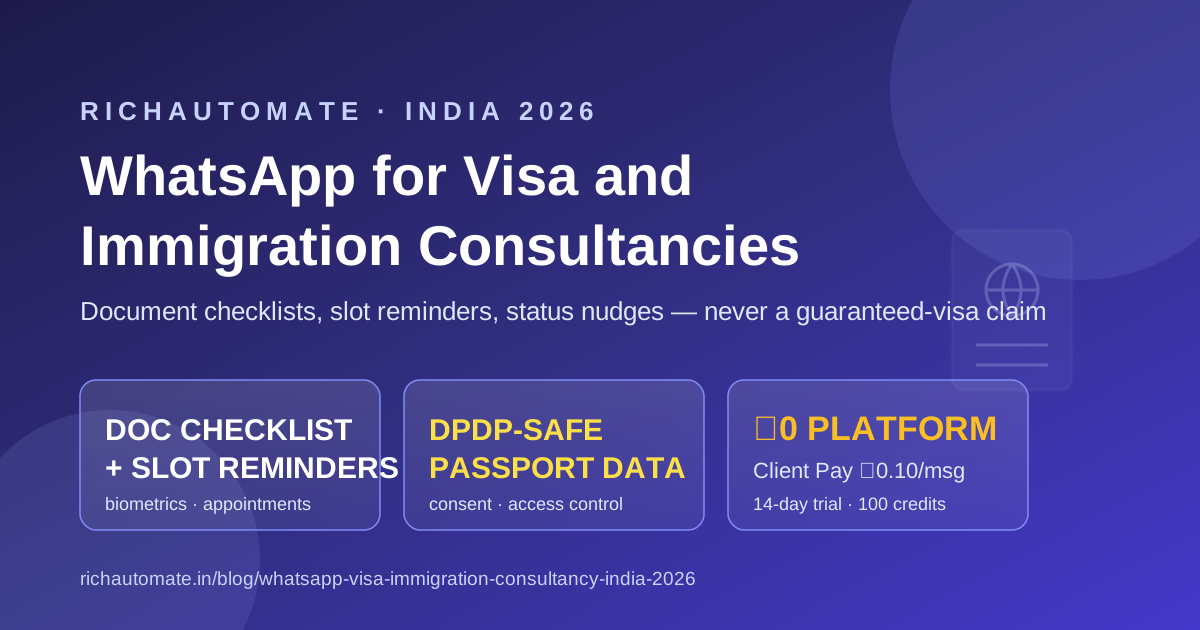
A visa or immigration consultancy does not sell a stamp in a passport. It sells the calm, document-by-document confidence that a high-stakes, expensive, deeply personal application — a student's admission abroad, a worker's skilled-migration dream, a family's permanent-residency move, a business owner's investor route — is being handled correctly, on time, by someone who will not let a missing bank statement or a missed biometrics slot sink months of effort. Indian outbound migration is enormous and growing: students heading to study destinations, skilled workers chasing points-based residency, tourists and business travellers, and families pursuing PR — each a long, anxious, document-heavy journey worth a high-ticket fee. Yet the operations are punishing: enquiry calls at all hours from different time zones, document checklists chased over scattered emails and phone calls, appointment and biometrics slots that vanish if not booked in time, application statuses the client refreshes obsessively while the consultant stays silent, and multiple destination-country desks each with their own rules. The consultancies that win in 2026 are not the ones promising the most — they are the ones whose clients trust the thread: every document collected and acknowledged, every slot reminder sent before it lapses, every status change relayed promptly, and every sensitive financial record handled with visible care. This is the deep-research playbook for running that whole enquiry-to-outcome lifecycle over WhatsApp Business — for the study-abroad consultant, the work-visa and skilled-migration agent, the PR and family-sponsorship advisor, and the tourist and business-visa desk. It covers the high-ticket lead economics, the full lifecycle, document-checklist collection, appointment and biometrics reminders, application-status nudges, multi-country desk routing, the strict DPDP handling of passports and financials, why generic CRMs fail immigration work, and how to start. One rule runs through every line: a consultancy assists with a process whose outcome only the embassy, consulate or immigration authority decides — never promise a guaranteed visa, never promise no rejection, and hedge every embassy, regulator, scheme and figure as “verify the current position as of 2026.” All cohort numbers are illustrative, and none of this is legal or immigration advice.
Why trust, not promises, is the business. An immigration journey is paid for up front and judged over months by an anxious client who cannot see the work happening and whose outcome rests with a foreign authority. The consultancy's real product is visible diligence: proof the file is moving, the right documents collected and acknowledged, the appointment booked before the slot closes, the status relayed the moment it changes, and the sensitive papers — passport, bank statements, financials, sponsor letters — handled with obvious care. Every one of those moments is a message, and every silent gap is where anxiety spikes, a 2am refund-demand call lands, or a client defects to the agent down the road who at least answers. A WhatsApp Business workflow that acknowledges the enquiry, sends the country-and-visa-type document checklist, chases and confirms each document, reminds before every appointment and biometrics slot, nudges the status, routes the right destination desk, and does it all without ever claiming a guaranteed result turns a fragile, fear-driven engagement into a trusted, completed one. WhatsApp never replaces the consultant's judgement or the authority's decision — it carries the diligence the client actually judges you on. Verify the operative embassy, consulate, ICCRC/registered-migration-agent-equivalent and DPDP positions and Meta's policy as of 2026.
The high-ticket lead economics of an immigration consultancy
Start with the money, because it explains every design choice that follows. An immigration consultancy's revenue is not high-volume and low-value — it is the opposite: a relatively small number of high-ticket, long-cycle engagements, each worth a substantial fee, each taking weeks or months from enquiry to outcome, each carrying enormous emotional weight for the client. The cost of acquiring a qualified lead is high (the client is comparison-shopping, often referred, and rightly cautious about scams), and the sales cycle is long (a study-abroad or PR decision is a life decision, not an impulse). That makes two leaks fatal. The first is lead leakage: an enquiry that never gets a fast, credible first response defects to whoever answered first, and a high-ticket lead lost is real money gone. The second is mid-process churn: a client who paid but then drowns in silence — no document acknowledgement, no slot reminder, no status update — loses faith, demands a refund, posts a bad review, or simply disengages and lets the application stall. WhatsApp attacks both: instant, credible lead acknowledgement and qualification at the top, and visible, timed diligence through the long middle. This is directional — model your own fee structure, conversion and timelines — but the shape holds across study, work, PR, tourist and business-visa desks.
The enquiry-to-outcome lifecycle
Before any automation, internalise the lifecycle, because every WhatsApp message in this playbook is timed against a stage. An immigration engagement moves through a predictable arc from a hopeful first enquiry to the final outcome the authority alone decides, and each stage has its own follow-up load. This is directional and varies by country, visa type and individual case — verify your own process and never compress a stage into a promise.
| Stage | What happens | What the consultancy must coordinate over WhatsApp |
|---|---|---|
| 1. Enquiry + eligibility triage | A prospect asks about a country and visa route | Acknowledge fast, capture destination, visa type, profile basics; set honest, no-guarantee expectations; book the counselling call |
| 2. Counselling + engagement | The route and fee are agreed | Share the scope, the honest assessment and the fee/agreement; confirm engagement; assign the country desk |
| 3. Document collection | The file is built from the client's papers | Send the country-and-visa-type checklist; chase and acknowledge each document; flag gaps before they delay the file |
| 4. Application + appointment | The application is lodged and slots booked | Confirm submission; remind before every appointment, biometrics and medical slot; brief the client on what to carry |
| 5. Status nudges + queries | The application sits with the authority | Relay each status change promptly; answer queries; manage the anxious waiting period honestly without inventing timelines |
| 6. Outcome + next steps | The decision arrives from the authority | Relay the outcome with care; on approval, brief next steps; on refusal, explain options honestly — never as a failure that was promised away |
The single operational truth that falls out of this table: a client's trust and the consultancy's reputation are both made or lost at the handoffs — the first response, the document chase, the slot reminder, the status silence — not inside any one form. A perfectly prepared file means nothing if the client never knew a document was missing until it delayed the case; a flawless submission means nothing if the biometrics slot lapsed because nobody reminded them. WhatsApp's job is to make every handoff visible, timed and recorded — especially the easy-to-forget document acknowledgement and the slot reminder. It never replaces the consultant's assessment or the authority's decision, which are exactly what cannot and must never be promised away. For the closely adjacent study-route playbook this builds on, the WhatsApp for study-abroad and overseas-education consultancies guide is a strong companion. Treat every timing above as directional and verify it against your own process.
Document-checklist collection: the file that makes or breaks the case
The operational heart of an immigration consultancy is the document file, and it is where manual operators bleed both time and cases. Every country and every visa type has its own checklist — passport, photographs, bank statements and financial proof, academic records, employment letters, sponsor and relationship documents, medical and police clearances — and a single missing or wrong document can stall or sink an application. Today most consultancies chase these over a chaos of emails, phone calls and a client who sends a blurry photo of the wrong page. A WhatsApp-driven collection turns that into a fast, recorded, acknowledged workflow. Map the recurring document events to their automation and the case makes itself.
| Document event | WhatsApp automation | Why it wins |
|---|---|---|
| Checklist delivery | Send the exact country-and-visa-type checklist as a clear, structured message or PDF | The client knows precisely what is needed — no guesswork, no half-files |
| Document intake | Client uploads each document straight into the thread they already use | One place, time-stamped, tied to the case — not scattered across email and DMs |
| Acknowledge + verify-receipt | Each received document is acknowledged; gaps and wrong submissions flagged back | The client knows it landed; the consultant catches a wrong page before it delays the file |
| Gap chasing | Pending-document reminders run politely until the file is complete | No document forgotten; the file is ready when the slot opens, not after |
| Structured intake form | A WhatsApp Flows form captures profile and case basics in validated fields | Clean, complete case data from the start — not a half-legible reply chain |
| Sensitive-doc handling | Passport, financials and sponsor papers handled under documented consent and access control | Visible care with the most sensitive records — the trust the client is paying for |
The asymmetry is the argument: these document and reminder messages are largely utility-category conversations — the cheapest tier — and they directly protect the two things that decide an immigration consultancy's year: completed, on-time files (outcomes and reputation) and retained, trusting clients (revenue and referrals). One document gap caught before it delays a case, or one client kept calm through the wait instead of churning, can save an engagement worth many times the messaging bill, which is a rounding error against it. For keeping this service messaging in the cheaper lane, the WhatsApp WABA pricing and cost-optimisation guide covers the utility-vs-marketing category economics.
The WhatsApp compliance self-audit walks through the consent and record-keeping gaps that cause most notices.
Appointment and biometrics slot reminders
Here is the feature that quietly saves cases, because in immigration the calendar is unforgiving. Visa appointment slots, biometrics enrolment, medical examinations, document-submission windows and interview dates are often hard to get, easy to miss, and costly to rebook — and a slot lapsed through silence can delay a case by weeks or blow an intake deadline entirely. WhatsApp is the ideal channel for this because the client already lives there and a reminder is read in minutes, not buried in an inbox. The discipline is to make these utility reminders precise and timely: the appointment confirmation when the slot is booked, a reminder ahead of the date, a what-to-carry brief so the client arrives prepared, and a gentle morning-of nudge. The consultancy turns a fragile, deadline-driven calendar into a series of confirmed, prepared attendances — and removes one of the most common and most avoidable ways a high-ticket case quietly goes wrong. Keep every reminder factual and never let it imply that attending guarantees an outcome.
The slot-reminder principle, in one line. A missed biometrics or appointment slot is one of the most expensive, most avoidable ways an immigration case is damaged — and a precise, timely WhatsApp reminder with a what-to-carry brief is the cheapest insurance against it. Keep reminders factual and utility-category, confirm the booking, remind ahead, brief on documents to carry, and nudge on the morning — but never let any message imply that attendance or a complete file guarantees approval, because the decision is the authority's alone. Verify the current appointment, biometrics and category-pricing rules as of 2026.
Application-status nudges and the anxious waiting period
The longest and most fragile stretch of any immigration engagement is the wait — the weeks or months the application sits with the embassy, consulate or immigration authority while the client refreshes a tracking page and imagines the worst. This is where consultancies lose clients not because anything went wrong, but because nothing was said. A client in silence assumes neglect, calls demanding an update, threatens a refund, or posts that the consultant “disappeared after taking the money.” The fix is honest, proactive status communication: relay each genuine status change the moment it appears, answer the predictable waiting-period questions, and — critically — manage expectations truthfully rather than inventing a comforting timeline that the authority will not honour. WhatsApp makes proactive status nudges effortless and recorded, so the client always knows the file is being watched even when there is nothing new to report. The hard discipline here is honesty: never fabricate a processing time, never promise an outcome to soothe an anxious client, and always frame the wait as the authority's process that the consultancy is monitoring, not controlling. Verify current processing-time guidance from each authority as of 2026, and present it as guidance, never a guarantee.
Get a 1-minute BSP audit on WhatsApp
Drop your WhatsApp number — we line-item your current invoice against Meta India rates in under 60 seconds. India-hosted, DPDP-compliant.
Multi-country desk routing
A serious immigration consultancy is rarely single-country — it runs a Canada desk, an Australia desk, a UK or Europe desk, a US desk, each with its own rules, checklists, timelines and case officers. The operational risk is cross-wiring: a Canada checklist sent to an Australia applicant, a query routed to the wrong desk, a client left waiting because their thread sat with someone who does not handle their country. WhatsApp routing solves this cleanly. An enquiry is tagged by destination at intake, the thread is routed to the right country desk, the correct country-and-visa-type checklist and reminders are triggered, and the team inbox shows each case officer only their cases. Map the routing need to the workflow and the case is clear.
| Routing need | Owned WhatsApp desk workflow | Manual / shared-inbox approach |
|---|---|---|
| Tag the case by destination | Captured at intake; thread tagged Canada/Australia/UK/US etc. | Remembered, or lost in a shared mailbox |
| Route to the right desk | Auto-assigned to the country case officer | Forwarded by hand, sometimes to the wrong person |
| Country-correct checklist + reminders | The right country-and-visa-type flow fires automatically | Wrong template sent, gaps appear later |
| Case officer sees only their cases | Scoped team inbox per desk | Everyone sees everything, or nobody owns it |
| Escalation across desks | Handoff in-thread with full history intact | Context lost in the forward |
The conclusion most multi-desk consultancies reach: WhatsApp is the routing and ownership layer that keeps each country's cases on the right rails with the right rules — so a client never gets the wrong checklist and a case never falls between desks. This comparison is directional; verify your own desk structure and rules as of 2026.
The sensitive-data carve-out: DPDP, passports and financials
This is the carve-out that separates a careful immigration consultancy from a reckless one, and it is where the stakes are highest because the data is extraordinarily sensitive: passports, identity documents, bank statements, salary slips, tax records, sponsor financials, sometimes medical and police-clearance papers — the exact material identity thieves and fraudsters covet. Personal data of this kind sits at the heart of India's Digital Personal Data Protection framework, and an immigration consultancy holds about the most sensitive bundle a small business ever handles. The discipline is non-negotiable. Map the obligation to the practice and the boundary is clear.
| Obligation (verify 2026) | What it means for the consultancy |
|---|---|
| Consent before collecting and messaging documents | Capture explicit, documented consent to collect and handle passports, financials and sensitive papers over WhatsApp; record who consented to what |
| Purpose limitation | Use the client's documents and data only to prepare and lodge this application; never repurpose for unrelated marketing without separate consent |
| Data minimisation | Collect only what the specific visa route genuinely requires; do not hoard documents the case does not need |
| Access control | Scope which staff can see a client's passport and financials; the wrong case officer should not have access to another client's sensitive file |
| Retention + deletion | Define how long sensitive documents are kept after the case closes, and honour opt-out and deletion requests; do not keep passports forever by default |
| No guaranteed-outcome claim, ever | Never represent — in any message, ad or template — that a visa is guaranteed or rejection impossible; the decision is the authority's and misrepresentation carries legal and ethical risk |
The principle every responsible consultancy internalises: WhatsApp collects, coordinates and reminds; it never decides the outcome and never claims to. The eligibility assessment is the consultant's professional judgement, the decision is the embassy's or immigration authority's, and the documents are the client's sensitive property held in trust — those realities define the boundary, and no automation should ever blur it with a false promise. For the full opt-in, consent and sensitive-data mechanics, see the DPDP rules 2026 business changes guide. Note too the regulatory and ethical backdrop you operate within: advertising and consumer-protection rules on misleading claims, any registration or accreditation expected of immigration advisors in your operating context, anti-fraud expectations, and the destination authorities' own rules on representatives — all of which you should verify with your advisers. This is operational guidance, not legal or immigration advice; verify every provision as of 2026.
Why generic CRMs fail immigration work
Most immigration consultancies have tried to run on a generic sales CRM, a spreadsheet, or a pile of email folders, and it fails for structural reasons. A sales CRM is built to push a deal to a close; an immigration business is built around a long, document-heavy, deadline-driven, consent-bound relationship where the checklist, the document acknowledgement, the biometrics reminder, the status nudge, the country-desk routing and the sensitive-data handling are all one connected thread with a vulnerable, anxious client. A sales CRM has no concept of a country-specific document checklist, a biometrics slot reminder, a passport held under consent, or a status wait that must be managed honestly. The result is the familiar mess: documents scattered across email, the checklist half-remembered, the slot reminder forgotten, the status silence that breeds refund demands, and sensitive financials sitting in an inbox with no access control. This comparison is directional — verify your own fit — but the gap is consistent.
| Need | Owned WhatsApp immigration workflow | Generic sales CRM / spreadsheet / email folders |
|---|---|---|
| Country-specific document checklist + chase | Right checklist auto-sent, each doc acknowledged, gaps chased | Half-remembered list, blurry photos, missing pages found late |
| Reaches the client where they answer | Yes — the app they open all day | Email the client rarely opens promptly |
| Appointment + biometrics slot reminders | Native, timed, with what-to-carry brief | Manual, often forgotten until the slot lapses |
| Honest, proactive status nudges | Each status change relayed; wait managed truthfully | Silence, then a refund-demand call |
| Multi-country desk routing | Tagged at intake, routed to the right case officer | Forwarded by hand, sometimes wrongly |
| Sensitive-doc consent + access control | Consented, scoped, retention-defined | Passports and financials loose in an inbox |
The conclusion most consultancies reach: WhatsApp is the best coordination, document and trust layer for an immigration business — not a replacement for the consultant's judgement or the authority's decision, but the one channel where clients already are and where every checklist, document, reminder, status update and desk handoff can be timed, consented, written and recalled, without ever making a promise that is not yours to make. For organising the client relationships, follow-ups and renewals behind all this, the best WhatsApp CRM for India guide is a useful companion, and consultancies that also run a study-route desk will recognise the same pattern in the study-abroad playbook linked above.
The automation stack that runs it — and getting started
The reassuring news for an immigration consultancy is that none of this needs a developer or new hardware — it maps onto a standard WhatsApp Business API automation stack, with the professional judgement and the authority's decision untouched. Enquiry and eligibility triage run through a short Flows form (destination, visa type, profile basics) and a fast, honest, no-guarantee acknowledgement instead of a missed call. The scope, honest assessment and fee agreement are sent as document and media deliveries in-thread. The country-and-visa-type document checklist is a structured message or PDF, with documents collected, acknowledged and chased through intake automations. Appointment, biometrics and medical reminders run as scheduled utility reminders with a what-to-carry brief. Status changes are relayed as proactive, honest status nudges. The case is tagged by destination at intake and routed by multi-desk routing to the right country case officer in a scoped team inbox, so each officer sees only their cases and sensitive documents stay access-controlled. A chatbot FAQ handles predictable questions — rough timelines as guidance, document basics, how the process works, fee structure — and a fast human handoff takes over the instant anything case-specific, sensitive or contractual arises, and especially before any question that touches the outcome. The consultant's assessment, the file preparation and the authority's decision stay exactly where they belong; WhatsApp is the consented coordination, document, reminder and routing layer on top. The discipline is to keep the bot scoped to logistics and general guidance and never let it imply, suggest or promise a guaranteed visa or a no-rejection outcome.
Keep the diligence visible — and never promise what is not yours to promise
A visa or immigration consultancy's reputation is not won by the boldest promise — it is won by the fact that the client always knows their document was received, their slot is booked and reminded, their status was relayed the moment it changed, and their sensitive papers were handled with obvious care, all the way to an outcome that the consultancy honestly framed as the authority's to decide. That is a coordination, document and trust problem, and a long, deadline-driven, consent-bound relationship with an anxious, high-paying client is exactly what a spreadsheet, an email pile and a sales CRM cannot hold. From the first hopeful enquiry and an honest eligibility triage, through counselling and engagement, the country-specific document checklist collected and acknowledged, the application lodged and every appointment and biometrics slot reminded with a what-to-carry brief, the anxious wait managed with proactive and truthful status nudges, multi-country desk routing that keeps every case on the right rails, to the outcome relayed with care — WhatsApp can be the one consented, recorded thread that runs the whole lifecycle, while your professional judgement and the embassy or immigration authority's decision stay the source of truth and the hard boundary, and you assist the process without ever claiming a guaranteed visa or a no-rejection result. On illustrative numbers that means fewer leaked leads, fewer churned clients, fewer missed slots, and more cases completed with the trust already earned. RichAutomate's pricing stays flat through all of it: ₹0 platform fee, ₹0 setup, ₹0 monthly — Client Pay at ₹0.10 per message with Meta's conversation charges billed direct by Meta, or SaaS Pay at ₹1.20 marketing / ₹0.30 utility all-in, and checklists, document acknowledgements, slot reminders and status nudges are utility conversations, the cheaper category. Start the 14-day free trial with 100 credits, WhatsApp us at 917434901027, or book a 30-minute walkthrough at https://calendly.com/inrichdaddy/30min. (All cohort and conversion figures here are illustrative — model your own — and embassy and consulate rules, immigration-authority processing times, appointment and biometrics procedures, advisor-registration and advertising rules, DPDP and GST treatment all change; verify the current position as of 2026. This is operational guidance, not legal or immigration advice, and nothing here is a representation that any visa is guaranteed or any rejection avoidable.)
Start your 14-day free trial → · See full pricing · Read the study-abroad consultancy playbook
Related: Best WhatsApp API for Study Abroad Consultants in India 2026 — the enquiry-to-departure workflow an overseas-education consultancy runs on WhatsApp: consent capture, counselling booking, SOP and document collection, deadline reminders and offer/visa-stage updates.