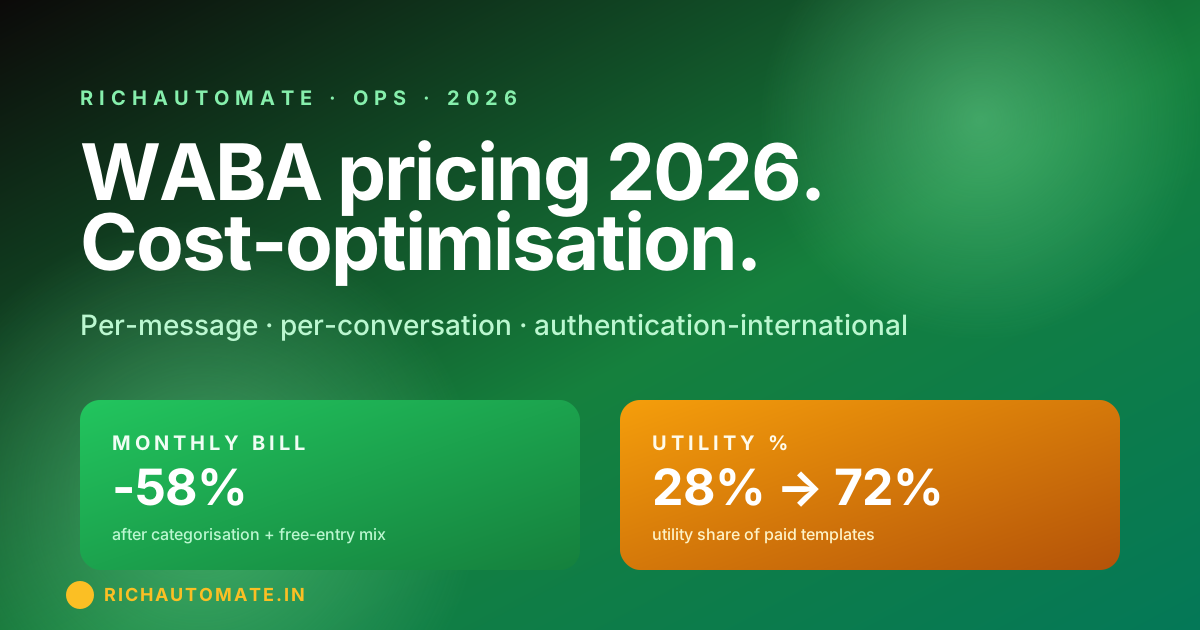
Meta restructured WhatsApp Business Cloud API pricing twice between 2024 and 2026, moving from per-conversation (24h-window) to per-message billing for utility + marketing + authentication categories, while keeping free entry-point conversations (CTWA, wa.me, WhatsApp Business Search) genuinely free for the first 72 hours. Indian brands that didn't restructure their template architecture under the new model are paying 2-4× what disciplined operators pay for the same outbound volume. This guide is the 2026 pricing playbook for Indian D2C, SaaS, BFSI, ticketing, and B2C brands: the actual rate cards as of 2026, the four pricing categories, free-entry mechanics, real cost-optimisation patterns, and the architectural changes that cut WABA bills 40-60% without reducing reach or quality.
The 2026 WABA Pricing Model: What Indian Brands Actually Pay
| Category | India rate (per message) | What it covers |
|---|---|---|
| Utility | ₹0.115 | Order updates, account alerts, reminders, post-purchase, transactional notifications triggered by customer behaviour or context |
| Marketing | ₹0.96 | Promotional broadcasts, drop announcements, offer campaigns, re-engagement |
| Authentication | ₹0.135 | OTP, password reset, account verification |
| Service (within 24h customer-initiated session) | Free | Free-form replies, bot responses, agent messages within active session |
| Free Entry-Point (first 72h) | Free | CTWA ad clicks, wa.me link, WhatsApp Business Search, business profile click |
Rates are India-region; vary by country. Authentication-International (cross-border OTP) is more expensive at ₹0.92 — relevant for Indian brands serving NRI / SEA / GCC customers.
Free Entry-Point: The Most Underused Lever
Customers who enter your WhatsApp via a Free Entry-Point (CTWA ads, wa.me link clicks, WhatsApp Business Search results, profile click) get 72 hours of completely free conversation — including outbound business-initiated messages within that window. No utility fee, no marketing fee. Most Indian brands don't architect for this:
- Drive customer acquisition through CTWA instead of landing-page form. Subsequent 72h of touchpoints (welcome, qualifier, lead magnet delivery, first-purchase nudge) are free.
- Bias outbound campaigns to recently-engaged customers who came via free entry-points. Paid template fees only apply after the 72h window.
- QR code campaigns (packaging insert, OOH) drive customers via the free entry-point flow — convert sunk-cost media into free conversational acquisition.
Real Indian Brand Cost-Structure Comparison
D2C beauty brand, 80,000 active customers, 240,000 monthly outbound messages
| Cost line | Pre-optimisation | Post-optimisation |
|---|---|---|
| Marketing template volume | 72% of paid messages | 28% of paid messages |
| Utility template volume | 28% | 72% |
| Free Entry-Point traffic share | 4% | 34% |
| Inside-session free replies | 14% of total volume | 41% of total volume |
| Total monthly WABA bill | ₹2,84,000 | ₹1,18,000 |
| Cost per customer touched | ₹3.55 | ₹1.48 |
SaaS B2B, 12,000 customers, 180,000 monthly outbound (heavy on auth + utility)
| Metric | Pre-optimisation | Post-optimisation |
|---|---|---|
| Auth template volume | 34% | 34% unchanged |
| Utility share (account alerts, billing, status) | 22% | 61% |
| Marketing share | 44% | 5% |
| Total bill | ₹1,28,400 | ₹52,800 |
The Eight Cost-Optimisation Patterns
| Pattern | Saving | How |
|---|---|---|
| Categorise transactional templates as Utility | 8.3× cost cut per misclassified template | Order, delivery, account, billing = Utility (₹0.115) not Marketing (₹0.96) |
| Move acquisition to CTWA + Free Entry-Point | 72h of free outbound per customer | Drive ads to wa.me / CTWA instead of landing pages |
| Inside-session free-form replies | Replace marketing template re-engagement | If customer is in 24h session, no template needed |
| Single template + button instead of multi-msg text | 1 message vs 3-5 | Outbound notification with reply button gets same engagement at 1/5 cost |
| Cap marketing frequency | 50-70% wasted send reduction | Max 3-4 marketing per customer per 14 days; quality also improves |
| Suppression rules at quality + behaviour level | 15-25% volume cut | Recently-purchased, low-engagement, opt-outs all suppressed |
| Auth template via WhatsApp instead of SMS | SMS ₹0.18-0.24 vs WhatsApp Auth ₹0.135 + 100× delivery | Migrate OTP traffic to WhatsApp Auth template |
| Single Flow surface vs multi-step text | 1 trigger msg vs 5+ | KYC, profile, booking via Flow not text loops |
The Marketing Quality Multiplier (Indirect Cost)
Marketing templates have an indirect cost beyond the ₹0.96 sticker price: low engagement → block rate spike → quality rating drop → tier demotion or throttling. Disciplined Indian brands measure marketing-template economic value as:
Net economic value per marketing send =
  (revenue attributed) - (₹0.96 send cost) - (quality-rating-impact penalty)

Quality-rating-impact penalty includes:
  - Throttled delivery on subsequent sends
  - Tier demotion blocking high-volume reach
  - Yellow / Red recovery cost (lost revenue during recovery period)

A poorly-targeted marketing send with 0.4% block rate
costs roughly ₹4-6 in long-term reach degradation
on top of the ₹0.96 sticker.
Operating Rule
The single highest-leverage move for any Indian brand running WhatsApp at scale is auditing every outbound template against utility-category eligibility and re-categorising mis-classified marketing templates to utility. Order updates, account alerts, reminders, billing, post-purchase status, replenishment nudges with customer-context — all qualify as Utility (₹0.115/msg). Brands routinely categorise these as Marketing (₹0.96/msg) and pay 8× per send. A single quarter of audit + re-submission cuts monthly bills 30-50% on real Indian D2C ops without reducing reach.
Get a 1-minute BSP audit on WhatsApp
Drop your WhatsApp number — we line-item your current invoice against Meta India rates in under 60 seconds. India-hosted, DPDP-compliant.
The Six Anti-Patterns That Inflate WABA Bills
- Marketing-categorised order updates. "Your order is shipped" sent as Marketing template = ₹0.96 per send when ₹0.115 was available. 8× cost burn.
- Sending templates inside the 24h customer-initiated session. Free-form replies are free; sending a templated "Hi, how can I help" inside an active session is wasted spend.
- Using SMS for OTP when WhatsApp Auth is available. SMS ₹0.18-0.24/msg + 30-50% delivery rate vs WhatsApp Auth ₹0.135/msg + 96% delivery. Migrate OTP traffic.
- Multi-message text bursts for structured capture. 3-5 separate template messages at ₹0.96 each vs single Flow trigger message — 80% cost cut + better completion.
- Bulk marketing without segmentation. 80% of recipients see irrelevant content; block rate spikes; quality degrades; future reach cut. Segment + cap frequency.
- Skipping Free Entry-Point architecture. Driving paid acquisition to landing-page forms then re-engaging via Marketing templates ignores the 72h free outbound window CTWA + wa.me unlock.
Trigger + Routing Architecture for Cost Optimisation
Pre-send check (every outbound message):
  Is customer inside an active 24h session? → free-form reply (no template, no fee)
  Is this a Utility-eligible message? → Utility template (₹0.115)
  Is customer within 72h of Free Entry-Point arrival? → free outbound
  Is this a marketing broadcast? → check frequency cap, segmentation, quality risk
  Otherwise → Marketing template (₹0.96)

Daily cost dashboard:
  Spend per category (utility / marketing / auth / service / free)
  Cost per customer-touched
  Cost per attributed conversion
  Quality-rating impact estimate
  Mis-categorisation alerts (templates that look like utility but submitted as marketing)

Quarterly audit:
  Top-10 marketing templates by volume → audit if utility-eligible
  Top-10 by mis-categorisation flags
  Re-submit re-categorised templates to Meta
  Run A/B: same intent / different category → measure quality + cost delta

Free Entry-Point amplification:
  Audit ad creative budget → shift to CTWA / wa.me where applicable
  QR code campaigns on packaging / OOH / retail print
  WhatsApp Business Search optimisation (profile completeness + verification)
  Track 72h free-window utilisation rate (target 60-80% of free-entry traffic)
SMS-to-WhatsApp Migration Calculator (Real Indian Numbers)
| Scenario | SMS cost / month | WhatsApp cost / month | Saving |
|---|---|---|---|
| 500k OTP / month | ₹90,000-1,20,000 | ₹67,500 | 25-44% |
| 2M order updates / month | ₹3,60,000-4,80,000 (DLT + SMS) | ₹2,30,000 (Utility) | 36-52% |
| 100k marketing broadcasts | ₹18,000-24,000 | ₹96,000 (Marketing) | negative — keep on SMS |
WhatsApp cost-wins are decisive on transactional + Auth traffic; on pure promotional broadcast SMS remains cheaper per send. Optimise traffic mix accordingly.
Compliance + Operational Notes
- Template categorisation — Meta enforces correct categorisation. Mis-categorised templates trigger rejection + retry; repeated mis-categorisation can affect WABA standing.
- DPDP Act 2023 — opt-in for Marketing category; opt-in not strictly required for Utility / Authentication but best-practice consent flows recommended.
- RBI / TRAI rules — financial transactional notifications + DLT-equivalent logging. WhatsApp doesn't require DLT registration but consent + audit trail still required.
- Quality rating impact — bad marketing categorisation triggers block rate spike → Yellow / Red → throttling. Cost optimisation must be paired with quality maintenance.
- Pricing changes — Meta has restructured WABA pricing twice in 24 months; expect further changes. Build cost-monitoring dashboards independent of any single rate card.
Optimise WABA bills on RichAutomate.
Pre-send template categorisation auditor. Free Entry-Point traffic share dashboard. CTWA + wa.me + QR campaign tooling. Inside-session free-form-reply automation. Frequency caps + suppression rules built in. Cuts monthly WABA bill 40-60% on real Indian D2C + SaaS pilots without reach loss. 14-day trial.
The WhatsApp pricing calculator by country is the fastest check on what each destination market actually costs.
Related reading
- WhatsApp 24h-Window + Session Economics India 2026: 48% Free-Window Share, ₹1.1L Monthly Saving on 240k Volume
- WhatsApp Deliverability + WABA Tier Graduation India 2026: Tier 1 to Unlimited in 60 Days
- WhatsApp WABA Disaster Recovery Architecture India 2026: Multi-WABA Failover + Quality-Rating Isolation
- Wati vs Gupshup India 2026: Pricing Decoded
- Client Pay vs SaaS Pay: How RichAutomate's Dual WhatsApp Billing Saves Indian D2C ₹21 Lakh/Year
New to the terminology? The WABA full form explained for Indian businesses walks through what the account holds — numbers, templates, messaging limit tier — before you start optimising what it costs.