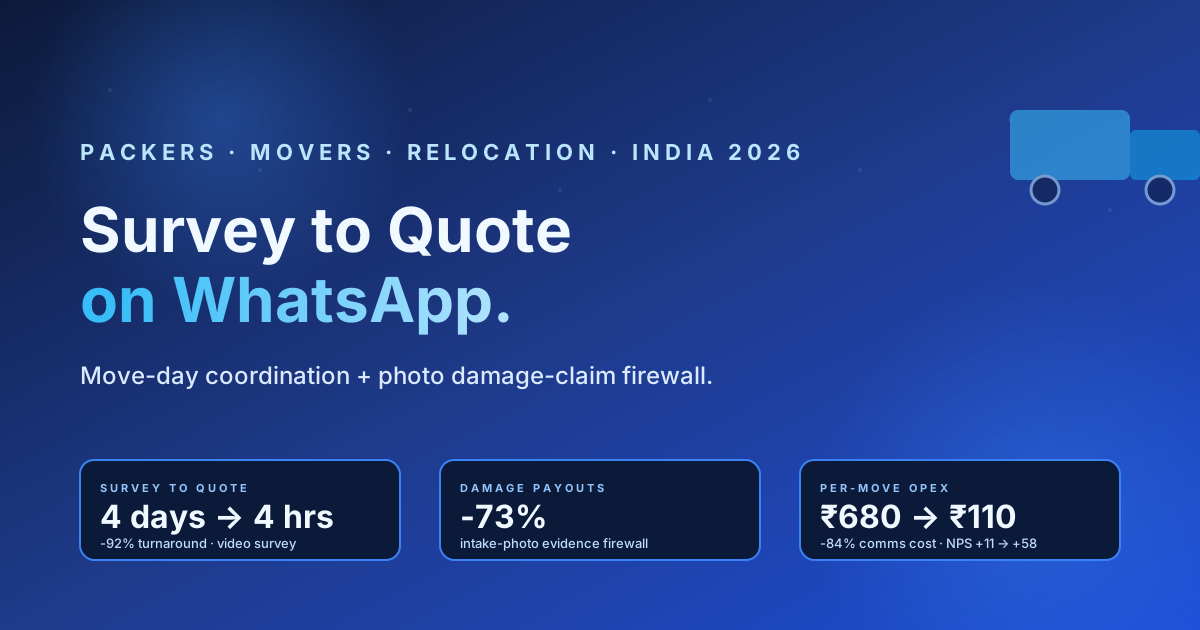
A house move is one of the most stressful, trust-heavy purchases an Indian family makes — and it runs almost entirely on coordination a packers-and-movers business does badly over scattered phone calls. A customer enquires; someone has to survey the goods to quote; a quote has to be sent and an advance collected; a crew has to reach the right address on the right morning; the truck has to be tracked across a city or a state; goods have to be handed over with proof; and if a wardrobe arrives scratched, a damage claim has to be settled without a shouting match. Today most of that lives in missed calls, a WhatsApp forward here, a paper challan there, and a dispatcher's memory. This guide maps the entire relocation lifecycle onto a structured WhatsApp coordination layer — enquiry capture, pre-move survey scheduling with photos and video of the goods, itemised quotes with an advance-payment link, move-day crew dispatch and live tracking, delivery with photo proof and signature, final settlement, and the damage or insurance claim thread — with the GST, e-Way Bill, consumer-protection and IBA-empanelment context that frames it, every regulatory specific hedged "verify as of 2026." It is written for the fragmented, mostly unorganised Indian packers-and-movers market, where trust and proof win the booking. All numbers here are illustrative; consult your CA and legal adviser for your actual position.
Why relocation is a natural fit for WhatsApp
Two things define the moving business and both point straight at WhatsApp. First, it is enquiry-heavy: a single mover may field dozens of "kitna lagega" enquiries for every booking that closes, because customers shop three or four quotes before committing. Phone tag and email both leak those enquiries — a missed call at 9pm is a lost job. Second, it is trust-sensitive in a way few services are: the customer is handing strangers an advance payment and every physical possession they own, then waiting anxiously for it to arrive intact. The two big anxieties — "will they take my advance and vanish?" and "will my things arrive broken?" — are precisely the anxieties that visual proof and transparent status dissolve. WhatsApp lets a customer photograph their goods for an accurate quote, see an itemised price before paying, watch the truck's ETA, and receive timestamped photo proof at handover. For a market where the unorganised majority competes mostly on price and word of mouth, being the mover who communicates with photos, tracking and clear quotes is a cheap, durable differentiator.
The core idea: a relocation has a long, fragile chain of handoffs — enquiry, survey, quote, payment, dispatch, transit, delivery, claim — and every handoff is where a customer's trust either deepens or breaks. WhatsApp is not a magic CRM; it is the one channel the customer already checks every few minutes, on which you can attach a photo, a payment link, a location and a status in the same thread they enquired on. Used as a structured coordination layer rather than ad-hoc chat, it shortens the enquiry-to-booking gap and replaces "trust me" with "here is the proof."
Enquiry capture and the pre-move survey
The first leak in most moving businesses is the enquiry itself. A WhatsApp Business number on the website, Google listing and ads becomes the single front door: every "I'm shifting from Andheri to Pune next month" lands in one place, time-stamped, with the customer's number already attached — no callback roulette. A simple structured opener (a list message or WhatsApp Flow) can capture the essentials up front: from-pincode, to-pincode, move date, home size (1BHK / 2BHK / 3BHK / villa), and whether a vehicle is being moved. That alone qualifies the lead and routes a hot one to a human fast.
The harder, more valuable step is the pre-move survey — the assessment of how much there is to move, which determines the truck size, crew count and price. Traditionally this means sending a surveyor home, which is slow and expensive, or quoting blind over the phone, which is inaccurate and the root cause of most "the final bill was double the quote" disputes. WhatsApp enables a middle path: ask the customer to send photos and short videos of each room — the hall, the kitchen, the bedrooms, the loft, any large or fragile items — directly in the chat. A trained estimator reviews the media and produces a far more accurate volume estimate than a phone guess, without a site visit for smaller moves. For large or commercial moves the on-site survey still wins, but even then WhatsApp schedules and confirms the surveyor's slot. The result: faster, more accurate quotes and fewer move-day price shocks.
| Stage | Phone / email enquiry | WhatsApp survey-to-quote |
|---|---|---|
| Enquiry capture | Missed calls; details on a notepad; lost after hours | One number, time-stamped, customer number attached, structured opener |
| Goods assessment | Blind phone guess or a slow, costly site visit | Customer sends room-by-room photos/video; estimator reviews remotely |
| Quote accuracy | Rough verbal range; frequent move-day revisions | Itemised quote from real visuals; far fewer price shocks |
| Speed to quote | Hours to days (await callback or surveyor) | Often same-day for standard household moves |
| Record of what was quoted | None, or buried in email | Quote + the photos it was based on, in one thread |
Itemised quotes and the advance-payment link
A relocation quote that earns trust is itemised, not a single scary number: packing material, labour, transport, loading/unloading, any storage, taxes shown separately, and clearly stated whether transit protection is included or optional. Sent as a clean WhatsApp message (or an attached PDF), it lets the customer see exactly what they are paying for — the transparency that beats the unorganised competitor who quotes a vague lump sum. When the customer says yes, the booking is usually confirmed with an advance, and this is the highest-anxiety moment of the whole job: a stranger asking for money before any work is done.
WhatsApp lets you collect that advance with a UPI / payment link sent in the same thread, so the customer pays from a chat they trust, gets an instant digital receipt, and the booking, the agreed itemised quote and the payment confirmation all live together. That single thread is itself a trust artefact — months later, in a dispute, the agreed scope and the receipt are right there. For how to wire this cleanly, see our guide to WhatsApp native payments and UPI checkout. A few honest caveats: never ask for an advance over WhatsApp before the scope is agreed in writing; show GST treatment transparently (relocation services attract GST — verify the current rate and input-credit position with your CA as of 2026); and make refund and cancellation terms explicit before the customer pays.
Why transparency is the moat: in a market crowded with operators who under-quote to win the job and then inflate the move-day bill, the mover who sends an itemised quote, takes the advance through a clean payment link with an instant receipt, and keeps the whole scope visible in one thread is the one who gets the referral. Trust, documented, compounds — and in relocation it is worth more than being the cheapest quote.
Move-day dispatch and live tracking
Move day is where coordination either holds or collapses, and it has two audiences: the crew and the customer. A WhatsApp group or broadcast for the assigned crew carries the job sheet — customer name, both addresses with map pins, contact number, home size, special items (piano, aquarium, fragile art), reporting time and packing-material checklist — so the team rolls out with everything they need instead of three confused phone calls from the truck. The customer, meanwhile, gets the messages that calm the single most stressful morning of their year: a "crew dispatched, here are the names and the vehicle number," a live location or ETA as the truck approaches, and a heads-up when packing is complete and the truck is leaving for the destination city. For an interstate or long-haul move, periodic transit updates ("crossed Nashik, on schedule for tomorrow afternoon") replace the anxious "where is my stuff?" calls that otherwise flood the office line.
| Move-day task | Manual phone coordination | WhatsApp coordination |
|---|---|---|
| Crew briefing | Verbal call; details forgotten; wrong address reached | Written job sheet + both map pins + special-items list in one message |
| Customer reassurance | Customer calls office repeatedly; office can't always reach the truck | Proactive "crew dispatched + vehicle no." and ETA pushed automatically |
| Crew identity / safety | Stranger at the door; customer uneasy | Crew names + vehicle number shared in advance; customer expects them |
| Long-haul transit | Black box; customer anxious for days | Periodic location/ETA checkpoints across the route |
| Exceptions (delay, traffic) | Discovered when customer complains | Flagged proactively in the thread, expectations reset early |
For the deeper fleet-and-route coordination patterns behind this — drivers, vehicles, multi-stop runs — our WhatsApp for logistics, 3PL and freight coordination guide goes further, and the last-mile and gig-logistics piece covers crew dispatch at scale. Note on transport paperwork: the movement of household goods by road may require an e-Way Bill depending on consignment value and applicability — verify the current e-Way Bill thresholds and rules for your consignments as of 2026 with your CA; WhatsApp can carry a copy of the document to the crew and customer but is not a substitute for compliant generation.
Get the India 2026 WhatsApp BSP price comparison
Wati vs AiSensy vs Interakt vs RichAutomate: Meta rates, platform fees and hidden costs, side by side. We send it to your WhatsApp in a minute.
Delivery, photo proof and digital POD
Handover is where the relationship is won or lost, and it is the stage that most rewards WhatsApp's native strength: photographic proof. At delivery, the crew can capture and send, in the customer's thread, timestamped photos of the goods as unloaded, the customer's signed delivery acknowledgement (a photo of the signed challan, or a typed "received, all items present" confirmation), and a note of any item the customer flags on the spot. This digital proof-of-delivery (POD) does three jobs at once: it confirms completion, it creates a shared dated record both sides hold, and — crucially — it establishes the condition of goods at handover, which is the single most important piece of evidence if a damage claim follows. A move that ends with a clean, photo-backed POD in the customer's own WhatsApp is a move that ends in a five-star review far more often than one that ends with a paper slip nobody can find.
Damage, insurance claims and the dispute thread
Damage is the part of moving nobody wants to discuss and everybody eventually faces. A scratched table or a chipped TV, handled badly, becomes a one-star review and a refund fight; handled well, it can actually build trust. WhatsApp makes the good path possible because the entire evidence chain already lives in one thread: the pre-move survey photos (condition before), the delivery POD photos (condition at handover), and now the customer's damage photos with a description. A structured claim flow — "send a photo of the damaged item, a short description, and the room it was in" — collects clean evidence, opens a claim reference, and routes it to the right person, with the customer kept updated at each step ("claim received," "under review," "approved, settlement on its way"). If transit insurance applies, that same evidence pack is what the insurer needs.
Be careful and honest here: do not over-promise on insurance. Whether goods are covered, by what policy, with what excess and exclusions, is a contractual and regulatory matter — verify your transit-insurance terms and the applicable consumer-protection norms as of 2026, and state coverage clearly to the customer before the move, never after a breakage. WhatsApp is the channel that gathers and tracks the claim transparently; it is not the policy and does not decide the outcome.
| Claim evidence checklist | Where it comes from |
|---|---|
| Condition of goods before the move | Pre-move survey photos/video in the enquiry thread |
| What was agreed and paid | Itemised quote + advance-payment receipt in the thread |
| Condition at handover | Delivery POD photos + signed acknowledgement |
| The damage itself | Customer photo + description + room, via the claim flow |
| Claim status trail | Time-stamped "received / under review / settled" updates |
Reviews, referrals and corporate / IBA moves
A relocation is a one-off for the customer but a referral engine for the mover — people move rarely, but they tell friends and colleagues who is moving next. A short post-delivery WhatsApp asking for a rating, a Google review link, and a referral offer turns a clean move into the next two leads, while a low rating routes privately to a manager to fix before it becomes public. For corporate and defence relocations, the trust bar is higher still: employers and the armed forces often prefer IBA-approved or empanelled packers for employee and personnel transfers, with their own documentation and settlement norms — verify the current IBA empanelment criteria and any applicable defence-move rules as of 2026. WhatsApp suits these moves well because they are documentation-heavy: the survey media, itemised quote, dispatch sheet, POD and claim trail form exactly the audit pack a corporate or institutional client expects, all retrievable from one thread.
The PII problem — customer addresses and goods inventory over WhatsApp
Here is the carve-out a moving business must take seriously. To do its job, a mover collects two genuinely sensitive datasets over WhatsApp: the customer's home address (both old and new) and a detailed inventory and photos of everything they own. Together that is a near-complete picture of a household's possessions and where they will be — exactly the kind of data that, mishandled, is a privacy and even a safety problem. Under the DPDP framework, this is personal data and the principles apply: collect only what you need for the move (data minimisation), state why you are collecting it, restrict who on the crew can see it, and delete or anonymise survey photos and inventories once the move and claim window are closed (retention limits) rather than letting years of customers' household photos sit in a chat backup forever.
Worth knowing the scale of the risk, and the DPDP penalty calculator estimates it from your own numbers.
Practical guardrails: get clear consent for collecting and using the photos and address; do not forward a customer's goods inventory or address into unrelated groups; restrict access to the staff who need it; and have a defined retention-and-deletion policy. Our DPDP Act WhatsApp compliance checklist walks the principles in depth. The exact obligations and timelines depend on the final DPDP rules — verify your obligations with a legal adviser as of 2026. The point is simple: a mover holds unusually sensitive personal data, and treating it carefully is both a legal duty and, given the trust-sensitivity of the business, a competitive advantage.
Minimisation in one line: a mover needs the inventory to quote and the address to deliver — it does not need to keep a stranger's photographs of every room in their house indefinitely. Collect for the move, use for the move, delete after the claim window. That discipline protects the customer and shrinks your own risk surface.
What it costs on RichAutomate
The coordination layer above does not need an expensive platform. RichAutomate's pricing is flat and in rupees so the cost scales with jobs, not with a fixed subscription: ₹0 platform fee, ₹0 setup, ₹0 monthly. On Client Pay it is ₹0.10 per message and Meta's conversation charges are billed to you directly by Meta at Meta's own rates — no markup in the middle. On SaaS Pay it is all-in: ₹1.50 per marketing conversation and ₹0.50 per utility conversation, so high-frequency status updates — dispatch alerts, ETA, delivery confirmation — sit in the cheaper utility bucket, while a "shifting season" promo lands in the marketing bucket. A 14-day free trial with 100 credits lets a mover wire one real enquiry-to-delivery flow end-to-end before committing. See the full card at richautomate.in/pricing and size your own volume with the WABA cost calculator. Meta's conversation-category pricing changes over time, so verify current Meta rates as of 2026.
Run your moves on proof, not promises
From the first "kitna lagega" to the signed delivery photo, a relocation is a chain of handoffs where trust either deepens or breaks. WhatsApp lets you capture enquiries in one place, quote from real survey photos, collect the advance through a clean payment link, dispatch and track the crew, hand over with timestamped photo proof, and settle any damage claim with the whole evidence trail in one thread — the difference between a one-star fight and a five-star referral. RichAutomate gives you that layer at ₹0 platform fee, ₹0 setup and ₹0 monthly, billed in rupees: Client Pay at ₹0.10 per message with Meta conversation charges billed direct by Meta, or SaaS Pay all-in at ₹1.50 marketing / ₹0.50 utility, with a 14-day free trial and 100 credits to start. Wire your enquiry-to-delivery flow, then WhatsApp us at 918160311319 or book a 30-minute walkthrough at https://richautomate.in/book/demo. (All figures here are illustrative; verify current Meta conversation rates, GST treatment, e-Way Bill rules, transit-insurance terms, IBA empanelment criteria and your DPDP obligations with your own advisers as of 2026. No platform can guarantee message delivery, account approval or freedom from policy action; follow Meta's rules.)
Start your 14-day free trial → · See full pricing · Run the WABA cost calculator
Related: WhatsApp for self-drive car rental fleets in India (2026) — booking, KYC, deposits and photo-evidence handovers in one thread.
Related: WhatsApp for car rental & self-drive agencies in India 2026 — quote, verify DL/KYC, take the deposit and confirm the booking on one thread.