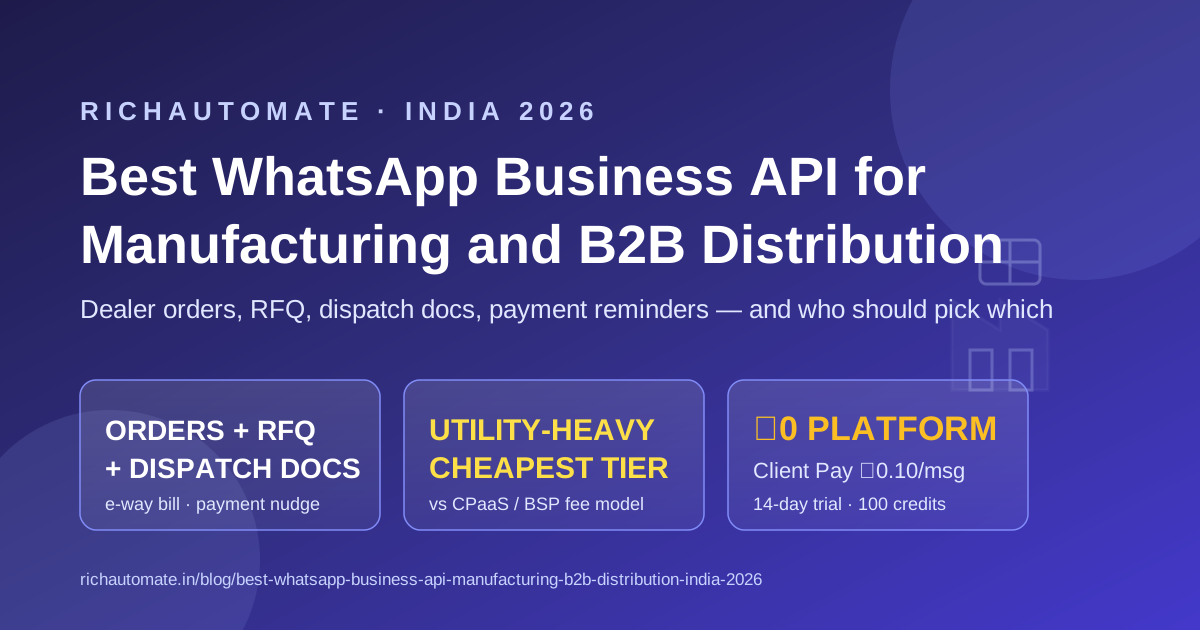
If you run a manufacturing unit or a B2B distribution business in India, your day does not look like a D2C brand's. You are not chasing impulse buyers — you are coordinating a network of dealers and distributors who place repeat orders, ask for quotations on bulk SKUs, want dispatch and e-way-bill documents the moment goods leave the dock, and need a polite nudge when an invoice crosses its credit period. Your field-sales reps are on the road across multiple states, your plant or warehouse runs on schedules, and your buyers are other businesses who judge you on responsiveness and paperwork, not on a clever ad. So when you go looking for the best WhatsApp Business API for manufacturing and B2B distribution, the question is not “which platform has the prettiest dashboard” — it is “which one lets my dealers place orders, get RFQs and quotations, receive dispatch documents and payment reminders, and keep my multi-location field team productive, without a platform fee eating into already-thin distribution margins.” This is the honest, buyer-side comparison: how RichAutomate stacks up against typical CPaaS providers and BSPs (Business Solution Providers) for a manufacturer or distributor, who should pick which, the rupee math on a mid-size distributor's monthly volume, and how to migrate in 24–48 hours. All competitor pricing is hedged — verify the live number on each vendor's own site as of 2026 — and the rupee figures here are illustrative; model your own.
The one thing that separates the choices. Every WhatsApp Business API provider routes the same Meta Cloud API underneath, so the message itself is the same. What differs is the commercial model on top of Meta's charges and how well the platform fits a dealer/distributor workflow. Most CPaaS and BSP players add a monthly platform fee or a per-MAU (monthly active user) charge or a markup on every conversation — which is painful for a distribution business where you message hundreds of dealers, send dispatch documents and payment reminders all month, and run on single-digit margins. RichAutomate charges ₹0 platform fee, ₹0 setup and ₹0 monthly, then either Client Pay at ₹0.10 per message with Meta's own conversation charge billed direct to you by Meta, or SaaS Pay at an all-in ₹1.20 per marketing conversation and ₹0.30 per utility conversation. For a high-volume, low-margin distribution operation, that fee structure is usually the deciding factor — but read the “who should pick which” section, because RichAutomate is not the right answer for every buyer.
What a manufacturer or distributor actually needs from WhatsApp
Before comparing vendors, pin down the workflow, because the “best” platform is the one that fits these jobs — not the one with the longest feature list. A manufacturing or B2B distribution business runs six recurring WhatsApp jobs, and almost all of them are utility-category conversations (the cheaper tier), which matters enormously for the cost math later.
| Job to be done | What it looks like over WhatsApp | Conversation type |
|---|---|---|
| Dealer / distributor order-taking | A dealer places or repeats a bulk order in the thread; catalogue and SKU list shared; order confirmed | Mostly utility |
| RFQ + quotation | Buyer requests a quote on a bulk SKU; structured RFQ captured via a Flows form; quotation PDF sent back | Utility |
| Dispatch + dispatch documents | Invoice, e-way bill, packing list and LR/transport details sent the moment goods leave the dock | Utility |
| Payment / credit-period reminders | A polite, timed nudge as an invoice nears or crosses its credit period | Utility |
| Field-sales rep enablement | Reps log orders, pull stock and price lists, and route queries from the field across states | Utility / service |
| New-product / scheme announcements | A new SKU, price revision or dealer scheme pushed to the network (opt-in) | Marketing |
Notice the pattern: five of the six core jobs are utility or service conversations, and only the broadcast announcement is marketing. That single fact reshapes the cost comparison — a distributor's WhatsApp bill is dominated by the cheap utility tier, so any platform that adds a flat monthly fee or a per-conversation markup punishes exactly the high-frequency, low-value messages that run a distribution business. For the underlying order-and-stock pattern this builds on, the WhatsApp for B2B FMCG distribution playbook is a close companion, and the broader plant-to-dealer view is in the manufacturing and supply-chain automation guide.
RichAutomate vs typical CPaaS / BSP: the head-to-head
Here is the comparison that matters to a manufacturer or distributor buyer. “Typical CPaaS / BSP” is the common shape of the market — many providers price on a monthly platform fee, or per-MAU, or a markup over Meta's conversation rate; the specifics vary by vendor and tier, so treat this column as the prevailing pattern and verify the exact number on each vendor's own site as of 2026. The RichAutomate column is its real, current pricing.
Work out the real switching cost first, because the BSP migration cost calculator accounts for the number port, template re-approval and overlap month.
| Criterion | RichAutomate | Typical CPaaS / BSP (verify per vendor, 2026) |
|---|---|---|
| Platform fee | ₹0 | Often a monthly platform fee or per-MAU charge — verify on the vendor's site |
| Setup fee | ₹0 | Sometimes a one-time onboarding/setup fee — verify |
| Monthly minimum | ₹0 | Many enforce a monthly commitment or tier minimum — verify |
| Per-message charge | Client Pay ₹0.10/message (your own WhatsApp number) or SaaS Pay ₹1.20 marketing / ₹0.30 utility all-in | Frequently a markup added on top of Meta's conversation rate — verify the per-conversation number |
| Meta conversation cost | On Client Pay, billed direct to you by Meta at Meta's own rates — no middle markup | Often bundled with a markup into the vendor's per-conversation price — verify |
| Support | Direct India support; WhatsApp + Calendly walkthrough | Varies by tier — entry tiers may be email-only; verify SLA |
| DPDP-aware consent + opt-out | Built into the opt-in, broadcast and template flows | Generally supported — verify the consent/opt-out tooling |
| No-code builder + Flows | Visual flow builder + WhatsApp Flows forms for RFQ/order capture, no developer needed | Most offer a builder; depth and Flows support varies — verify |
| Migration effort | Number/WABA migration typically 24–48h; no rebuild of your stack | Varies; some lock templates or charge for migration — verify |
| Free trial | 14-day free trial + 100 credits | Trial length and credits vary — verify |
The structural takeaway: because the underlying Meta Cloud API and message quality are identical across all compliant providers, the differentiator for a distribution buyer is the commercial layer — whether you pay a fee and markup on top of Meta, or pay Meta direct with a flat ₹0 platform charge. For a business sending high volumes of cheap utility messages (dispatch docs, payment reminders, order confirmations), the ₹0-platform, Meta-direct model usually wins on total cost. But “usually” is not “always” — the next section is the honest part.
Who should pick which — honestly
No single platform is right for every manufacturer or distributor, and a comparison that pretends otherwise is not worth trusting. Here is the candid version.
Pick RichAutomate if you are a manufacturer or distributor with a high volume of utility messaging (order confirmations, dispatch documents, e-way bills, payment reminders) across a dealer/distributor network, you run on thin distribution margins and want ₹0 platform/setup/monthly with Meta's conversation cost billed to you directly, you want a no-code flow and Flows-based RFQ/order capture without hiring a developer, and you value direct India support and a fast 24–48h migration. This is the sweet spot the ₹0-platform, Meta-direct model is built for.
Pick a large enterprise CPaaS (think the big telecom-grade providers) if you are a very large manufacturer needing deep, multi-channel CPaaS — SMS, voice, email and WhatsApp under one enterprise contract with carrier-grade SLAs, dedicated solution engineering, and procurement-friendly enterprise billing — and a platform fee is a rounding error against your scale. At that size, an integrated multi-channel contract and a named account team can be worth more than a flat per-message price. Verify their current platform-fee and per-conversation model on the vendor's own site as of 2026.
Get a 1-minute BSP audit on WhatsApp
Drop your WhatsApp number — we line-item your current invoice against Meta India rates in under 60 seconds. India-hosted, DPDP-compliant.
Pick a specialised vertical/ERP-embedded WhatsApp module if your distribution already runs inside a specific ERP or DMS (distributor management system) and that vendor offers a tightly embedded WhatsApp add-on that writes orders straight into your existing system with zero integration work. The deep native fit can outweigh a higher fee — check whether the lock-in and the per-conversation markup are acceptable, and verify the pricing as of 2026.
The honest rule: if your messaging is dominated by cheap, high-frequency utility conversations and you do not need a bundled multi-channel enterprise contract, the ₹0-platform model is hard to beat. If you need enterprise multi-channel CPaaS or a deep ERP-native module, a fee-bearing provider may genuinely fit better. Choose on workflow fit and total cost, not on the longest feature grid.
The rupee break-even math for a mid-size distributor
Make it concrete with an illustrative mid-size distributor — numbers are directional, so model your own. Say you serve 300 active dealers and, across a month, send each on average 20 utility messages (order confirmations, dispatch documents, e-way bills, payment reminders, stock and price updates) plus you run 4 marketing broadcasts to the opted-in network. That is roughly 6,000 utility messages and 1,200 marketing conversations a month.
| Line item (illustrative) | RichAutomate SaaS Pay | Fee-bearing provider (illustrative) |
|---|---|---|
| Platform / monthly fee | ₹0 | A monthly platform fee (verify the vendor's number, 2026) |
| 6,000 utility conversations | ~₹1,800 (6,000 × ₹0.30 all-in) | Meta's utility rate + the vendor's markup × 6,000 (verify) |
| 1,200 marketing conversations | ~₹1,440 (1,200 × ₹1.20 all-in) | Meta's marketing rate + the vendor's markup × 1,200 (verify) |
| Indicative monthly total | ~₹3,240, no platform fee | Messaging + a recurring platform fee on top (verify) |
The point of the math is not the exact rupees — it is the shape. On a ₹0-platform model your bill scales purely with messages sent, dominated by the cheap utility tier; on a fee-bearing model you pay the same Meta-driven message cost plus a fixed platform fee every month whether you send 6,000 messages or 600. The break-even logic is simple: the higher your monthly volume and the thinner your margin, the more a flat platform fee hurts and the more the ₹0-platform model saves. On Client Pay (your own number, ₹0.10/message, Meta billed direct) the structure tilts even further toward usage-only cost. Run your real dealer count and message frequency through the WABA cost calculator, and to understand which billing model fits your business, read the Client Pay vs SaaS Pay billing breakdown. All figures here are illustrative; verify Meta's live conversation rates and the GST position as of 2026.
For a cluster-level worked example of these patterns inside one vertical, see WhatsApp API for tile and sanitaryware manufacturers in Morbi.
DPDP and B2B data: the part you cannot skip
A distribution business holds a lot of personal and commercial data — dealer contacts, field-rep numbers, pricing, credit terms — and India's Digital Personal Data Protection framework applies. The good news is that WhatsApp B2B messaging is mostly consent-friendly when done right: dealers and distributors who transact with you have a clear business relationship, your utility messages (order confirmations, dispatch docs, payment reminders) are service communications they expect, and your marketing broadcasts run on explicit opt-in with an easy opt-out. The discipline is the same regardless of platform: capture and record consent for marketing, keep utility messaging tied to the actual transaction, give a clear opt-out, apply purpose limitation (use a dealer's number to service their account, not to spam unrelated offers), and define retention. Any compliant provider supports this; verify the consent and opt-out tooling on whichever you choose, and verify the operative DPDP provisions as of 2026. For the full consent and opt-in mechanics, see the broader pattern in the FMCG-distribution and CRM guides linked here. This is operational guidance, not legal advice.
Migrating in 24–48 hours — without disrupting dispatch
The fear that keeps manufacturers and distributors on a clunky setup is migration risk — nobody wants order-taking or dispatch documents to break for a week. In practice, moving your WhatsApp Business API number and WABA to a new provider is usually a 24–48 hour exercise that does not touch your ERP, your dispatch process or your dealer relationships. The shape of it:
| Step | What happens | Typical timing |
|---|---|---|
| 1. Prepare | Confirm your WABA, number and existing templates; start the 14-day free trial to build flows in parallel | Day 0 |
| 2. Migrate the number/WABA | Initiate the number migration to the new provider; Meta verification proceeds; existing chats are unaffected | Within 24–48h |
| 3. Recreate templates + flows | Rebuild order, RFQ, dispatch-document and payment-reminder templates and the no-code flows (done in parallel during the trial) | Overlaps step 2 |
| 4. Go live + verify | Send a test order confirmation and dispatch document to a friendly dealer; confirm delivery and opt-out work; switch the network over | Day 1–2 |
Because templates and flows are built during the trial before you cut over, dispatch and order-taking keep running on the old setup until the new one is verified — there is no dark window. Verify your specific number-migration steps and any template-portability constraints with the provider as of 2026, since Meta's migration rules evolve. To organise the dealer relationships, follow-ups and reorders behind all this, the best WhatsApp CRM for India guide is a useful companion.
The best WhatsApp Business API for your distribution business is the one that fits your workflow and your margin
For a manufacturer or B2B distributor, the “best” WhatsApp Business API is not a trophy — it is the platform that lets your dealers place and repeat orders, lets buyers send RFQs and get quotations, ships dispatch documents and e-way bills the moment goods leave the dock, nudges payments politely as credit periods close, keeps your multi-state field-sales team productive, and does it without a platform fee eroding already-thin distribution margins. Because every compliant provider routes the same Meta Cloud API, the real decision is the commercial layer and the workflow fit: a high-volume, utility-heavy distribution operation on thin margins is usually best served by a ₹0-platform, Meta-direct model, while a very large multi-channel enterprise or a deeply ERP-embedded operation may genuinely fit a fee-bearing provider better — choose on total cost and fit, not on the longest feature list. RichAutomate's pricing stays flat: ₹0 platform fee, ₹0 setup, ₹0 monthly — Client Pay at ₹0.10 per message with Meta's conversation charge billed direct by Meta, or SaaS Pay at ₹1.20 marketing / ₹0.30 utility all-in, and your order confirmations, dispatch documents and payment reminders are utility conversations, the cheaper category. Start the 14-day free trial with 100 credits and wire one dealer segment's order-and-dispatch flow end-to-end first, WhatsApp us at 917434901027, or book a 30-minute walkthrough at https://calendly.com/inrichdaddy/30min. (All competitor pricing is the prevailing market pattern, not a quote — verify the live number on each vendor's own site as of 2026 — and every rupee and cohort figure here is illustrative; model your own. Meta's conversation rates, migration rules, DPDP provisions and GST treatment all change; verify the current position as of 2026. This is operational guidance, not legal advice.)
Start your 14-day free trial → · See full pricing · Run the WABA cost calculator
Building the machines rather than distributing them? The capital-sale playbook is different: WhatsApp for machine tool and capital equipment OEMs.