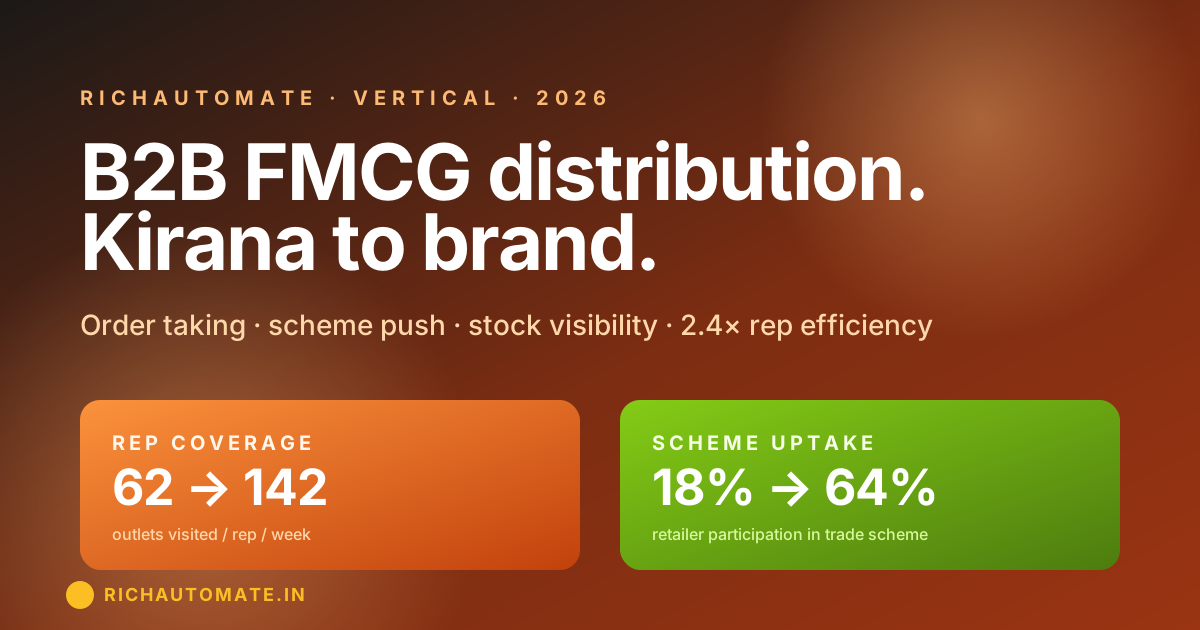
Indian FMCG runs on the longest, deepest, most complicated distribution chain in modern retail — brand → super-stockist → distributor → wholesaler → retailer (kirana / general trade) → consumer. 12 million general trade outlets, 800+ stock-keeping districts, three to five intermediaries between manufacturing and shelf. Channel ops are dominated by feet-on-street sales reps doing daily / weekly beats, paper / spreadsheet order-taking, scheme communication via printed pamphlets, and stock visibility achieved by phone calls. The brands compounding fastest in 2026 (HUL, ITC, Nestle, Dabur, plus mid-market players like Tata Consumer + Marico + Patanjali distribution arms) are running their general-trade ops on WhatsApp — order-taking by retailer, scheme push, stock visibility, primary + secondary sales reporting. Rep coverage climbs from 62 outlets/week to 142; trade-scheme uptake from 18% to 64%. This guide is the 2026 implementation playbook for FMCG brands, distributors, super-stockists, and B2B-aggregators serving Indian general trade: the seven WhatsApp moments, real numbers, the SFA + DMS integration architecture, and the compliance pattern.
Why Indian FMCG Distribution Is Different from Other B2B Sales
Three structural quirks:
- Retailer is mobile-first, app-averse. Indian kirana owner uses WhatsApp daily for personal + family + supplier communication. App downloads + logins fail at scale; WhatsApp adoption is essentially 100% in the segment.
- Order patterns are habitual + hyperlocal. Retailer reorders the same SKUs daily / weekly with predictable cadence; scheme triggers (e.g., diwali pack, winter line) need to land in the channel customers actually open.
- Distributor margins are razor-thin (2-4%). Cost-to-serve per outlet visit is the dominant economic lever; anything that lets a rep cover more outlets per day is pure margin.
The Seven WhatsApp Moments Across FMCG GT Distribution
| Moment | Trigger | WhatsApp action | Lift target |
|---|---|---|---|
| Order taking from retailer | Retailer wants to reorder | Catalog + 1-tap order + confirmation utility | Rep coverage 62 → 142 outlets/week |
| Scheme push to retailer | New scheme announced | Personalised scheme card + 1-tap opt-in + projected earning | Scheme uptake 18% → 64% |
| Stock visibility for distributor | Daily morning | Inventory snapshot + reorder suggestions per SKU | Stock-out reduction 22% → 6% |
| Primary sales reporting | Distributor → super-stockist | Daily sell-in report + invoice attachment | Reporting cycle 4 days → 1 day |
| Secondary sales claim | Distributor claims scheme reimbursement | Scheme proof upload (photo + invoice) | Claim approval 14 days → 4 days |
| Field rep beat plan | Daily 7 AM IST | Optimised route + outlet priority + scheme focus | Productive time +28% |
| Retailer credit / payment | Outstanding tracking | Statement + UPI link + pay-by-date reminder | DSO 22 days → 9 days |
Real Indian FMCG Distribution Numbers
Mid-tier FMCG brand, 4-state region, 380 distributors, 64,000 retail outlets
| Metric | Phone + paper + SFA app | WhatsApp + SFA hybrid |
|---|---|---|
| Rep outlets visited / week | 62 | 142 |
| Order-taking time per outlet | 14 min | 4 min |
| Scheme uptake (retailer participation) | 18% | 64% |
| Stock-out rate (distributor side) | 22% | 6% |
| Primary sales reporting cycle | 4 days | 1 day |
| Scheme claim approval cycle | 14 days | 4 days |
| Cost per active outlet served | ₹220 | ₹84 |
Personal-care super-stockist, 12 distributors, 8,400 outlets across 3 districts
| Metric | Without WhatsApp | With |
|---|---|---|
| Days Sales Outstanding (DSO) | 22 days | 9 days |
| Repeat-order frequency / outlet / month | 2.1 | 4.4 |
| New-SKU push uptake (within 30d of launch) | 14% | 42% |
| Order-form errors / week | 180 | 22 |
SFA + DMS Integration Architecture
Indian FMCG ops use multiple systems already — SFA (Sales Force Automation: Bizom, Botree, FieldAssist), DMS (Distribution Management System: TallyPrime, in-house), retailer-facing ordering apps. WhatsApp doesn't replace these; it becomes the customer-facing surface that connects them.
- Retailer-side WhatsApp surface: order taking, scheme push, statement, support. Webhook bridges to DMS for inventory + invoice + dispatch.
- Distributor-side WhatsApp surface: stock visibility, primary sales reporting, scheme claim upload, payment tracking. Bridges to brand DMS via API.
- Field rep WhatsApp surface: daily beat plan, route optimisation, retailer call notes, on-the-ground photos (planogram compliance, competitor SKU). Bridges to SFA app.
Operating Rule
The single highest-leverage move for any Indian FMCG brand running general-trade distribution is retailer order-taking via WhatsApp Catalog with 1-tap reorder of last cycle's SKUs. Per-outlet order-taking time drops from 14 min (rep + paper / SFA app) to 4 min (retailer self-serve via WhatsApp). Same field rep covers 142 outlets/week vs 62 — a 2.3× efficiency gain that flows straight to gross margin given paper-thin distributor economics. Build this single touchpoint first; layer scheme push, stock visibility, and primary sales reporting over the next 90 days.
Get a 1-minute BSP audit on WhatsApp
Drop your WhatsApp number — we line-item your current invoice against Meta India rates in under 60 seconds. India-hosted, DPDP-compliant.
The Six Anti-Patterns That Wreck FMCG WhatsApp Distribution
- Forcing retailer onto a separate ordering app. Indian kirana owner doesn't install + log in to brand-specific apps; abandons within 2 weeks. WhatsApp adoption is 100%; meet retailer where they already are.
- Generic scheme blast to all retailers. Personalisation by past purchase volume + category + region matters; generic scheme push gets 18% uptake vs personalised 64%.
- Marketing template for order confirmation / dispatch / invoice. All transactional with B2B context = utility (₹0.115/msg). Marketing categorisation = 8× cost burn + lower deliverability.
- No SFA / DMS integration. Standalone WhatsApp ordering creates parallel order book + reconciliation nightmare. Integrate via webhook bidirectional sync; orders flow into DMS within 30 sec of WhatsApp confirmation.
- Single language across all states. Hindi for North, Tamil / Telugu for South, Bengali for East, Gujarati / Marathi for West. Catalog + scheme push in retailer's preferred regional language.
- Skipping the secondary sales claim flow. Distributor claims for trade scheme reimbursement stuck in 14-day approval cycles destroy distributor cash flow + brand goodwill. WhatsApp photo + invoice upload + auto-validation cuts cycle to 4 days.
Trigger + Routing Architecture
Retailer onboarded:
  Capture: phone, outlet name, GSTIN, district, language, distributor mapping
  Push welcome utility template with WhatsApp catalog access + sample order

Daily rep beat:
  7 AM IST: rep gets utility template with optimised route + outlet priority + focus SKU
  At each outlet: rep + retailer place order via WhatsApp catalog (assisted) OR retailer self-serves
  Order placed → DMS webhook → invoice generated → dispatch scheduled
  Confirmation utility template to retailer

Scheme launch:
  Brand launches scheme; segment-aware push:
    Region × past purchase volume × category preference
  Personalised scheme card with projected retailer earning
  1-tap opt-in → tagged for scheme reimbursement

Distributor stock visibility:
  Daily 6 AM IST: distributor receives utility template with:
    Inventory snapshot per SKU
    Reorder-suggestion (based on past 4 weeks velocity)
    Outstanding orders + dispatch status

Primary sales reporting:
  Distributor → super-stockist daily sell-in via WhatsApp Flow
  Auto-attached invoices + scheme claims
  Bridges to brand DMS

Secondary sales claim:
  Distributor uploads scheme proof (retailer order copy + photos + invoice)
  Auto-validation against scheme rules
  Approval cycle: D+0 submit → D+1 review → D+4 disbursal

Retailer credit + payment:
  Outstanding statement weekly via utility template
  UPI pay-link + EMI option
  Reminder cadence: D-3 / D-1 / D+0 / D+3 overdue

Field rep efficiency:
  Daily summary at end-of-day:
    Outlets covered, orders placed, scheme uptake, exceptions
  Coaching nudges: missed-priority outlet, SKU push gap, planogram non-compliance

Quarterly:
  Per-region uptake analysis
  Scheme ROI per segment
  Rep productivity tier (top / mid / bottom decile)
  DMS-WhatsApp reconciliation audit
Compliance + Operational Notes
- DPDP Act 2023 — retailer + distributor + rep data captured (phone, GSTIN, outlet location, ordering history) classified as personal data; explicit consent + storage controls.
- Meta categorisation — order confirmation, dispatch, invoice, statement, scheme claim status, beat plan = Utility (₹0.115/msg). New product launch broadcasts, scheme promotional pushes (cold) = Marketing (₹0.96/msg). Scheme push to opted-in retailers (transactional context) = Utility.
- GST + invoicing — invoice format must comply with GST norms; e-way bill linkage for inter-state dispatch.
- SFA app coexistence — field reps still use Bizom / Botree / FieldAssist for planogram compliance, attendance, route optimisation. WhatsApp augments customer-facing flows; doesn't replace SFA.
- Indian-region storage — order history, retailer master, scheme claims stored in Indian region per DPDP Act + GST audit retention rules (5 years minimum).
Food-category distributors with daily rate volatility and batch traceability — for example a WhatsApp for spice and masala manufacturers — run a specialised version of this same order-to-dispatch lifecycle.
The WhatsApp ROI calculator is more useful than a benchmark here, because the maths swings hard on your margin.
Run FMCG distribution WhatsApp on RichAutomate.
Retailer-side WhatsApp catalog with 1-tap reorder. Personalised scheme push by region + volume tier. SFA / DMS integration (Bizom / Botree / TallyPrime). Daily distributor stock-visibility dashboard. Primary + secondary sales reporting flows. Pre-approved utility templates for full GT lifecycle. Cuts cost-per-outlet 62% on real Indian mid-tier FMCG pilots. 14-day trial.
Related reading
- WhatsApp for Indian Automotive Dealerships 2026: 24% Lead-to-Delivery, 78% Y3 Service Retention, Real Dealer Numbers
- WhatsApp for Indian Event Ticketing + Venue 2026: 38% Day-1 Sell-Through, 8% No-Show Rate, Real Cohort Numbers
- WhatsApp for Indian QSR + Food Delivery 2026: 22% Margin Recovery, 2.1× Reorder Frequency, Real Cohort Numbers
- WhatsApp for Indian Insurance Distribution 2026: 86% Y2 Persistency, 38% Quote-to-Bind, IRDAI Compliant
- WhatsApp Business API Cost India 2026: ₹0.11–₹0.99/msg
Related: WhatsApp for ice-cream & frozen-dessert distributors in India 2026 — outlet reorders, deep-freezer breakdown tickets, cold-chain delivery proof and peak-season nudges on one thread.
Related: WhatsApp for granite, marble & natural-stone dealers in India 2026 — slab enquiries, live-photo reservation holds, e-way-bill dispatch proof and breakage claims on one thread.
Related: WhatsApp for namkeen & snack-food manufacturers in India 2026 — distributor rate broadcasts, order intake, e-way-bill dispatch proof, batch traceability and near-expiry clearance on one thread.
Related: WhatsApp for sanitary napkin & menstrual hygiene manufacturers in India 2026 — distributor rate broadcasts, government-tender coordination, e-way-bill dispatch proof, batch/lot traceability and near-expiry clearance on one thread.
Sub-categories inside FMCG run the same playbook with different SKU shapes — see how agarbatti and incense manufacturers handle dealer orders on WhatsApp, where a single brand carries sixty fragrances and reorders land every ten days.