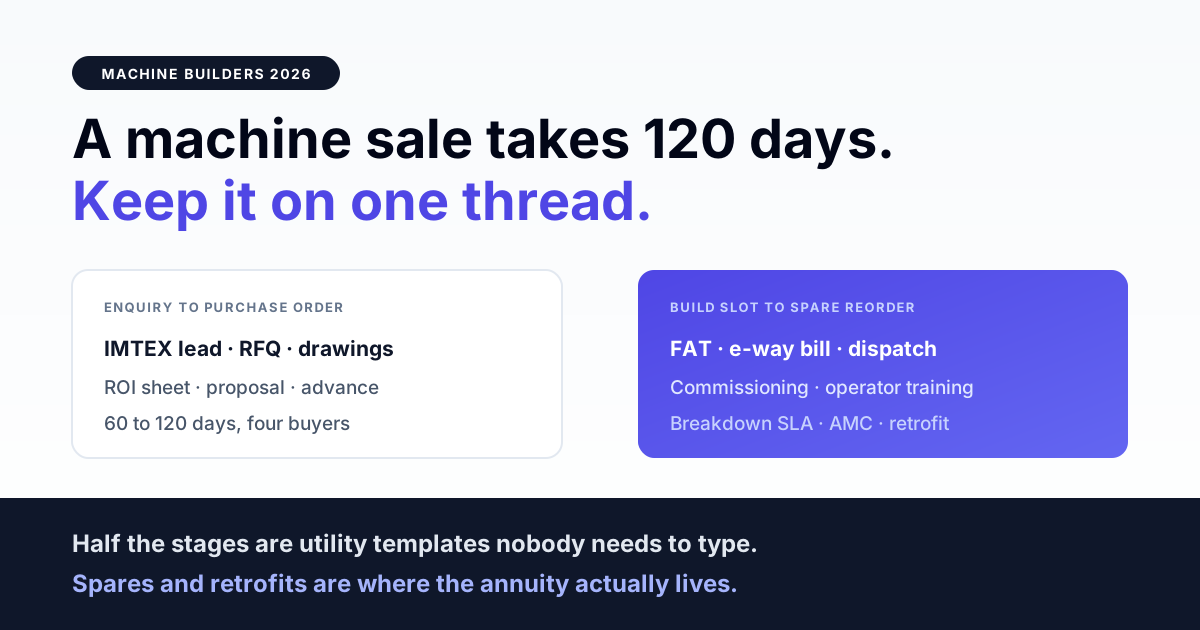
WhatsApp Business API gives an Indian machine tool or capital equipment OEM one auditable thread that carries a deal from the first IMTEX enquiry through spec freeze, proposal, purchase order, build slot, FAT, dispatch, installation, operator training, warranty and spare part reorder. For a capital sale that typically runs 60 to 120 days from enquiry to PO and another 8 to 20 weeks from PO to dispatch, depending on build slot and import lead times, that single thread is usually the difference between a live enquiry and a dead one.
Scope note, read this first. This guide covers only the OEM and machine builder side: firms that design and build CNC and VMC machines, special purpose machines, presses, packaging machinery and their subsystems. If you run an equipment rental or AMC service business rather than building machines, the operational playbook is different and lives in our guide to WhatsApp for industrial boiler suppliers and IBR AMC contracts. If you distribute components rather than build machines, start with WhatsApp for industrial bearing and power transmission dealers. Everything below assumes you own a build slot calendar.
Why capital equipment enquiries quietly die in an inbox
A machine order is not one buyer. It is a production head who wants cycle time, a maintenance head who wants spare availability, a purchase officer who wants three comparative quotes, and a finance approver who wants payback in months. Email threads fork across all four, attachments get renamed, and by week six nobody is sure whether the buyer has Rev B or Rev C of the general arrangement drawing.
So the buyer does what every Indian factory buyer does: moves the real conversation to WhatsApp on your salesperson's personal handset. That works until it does not. There is no shared history, no second agent who can pick up when the salesperson is at a commissioning site in Coimbatore for ten days, no record of what was promised on delivery, and when the salesperson resigns the entire pipeline walks out on their SIM.
WhatsApp Business API fixes the structural part. One business number, many agents with roles, permanent per contact history, and automation that fires on stage changes instead of on somebody remembering. The consumer WhatsApp Business app cannot do this: it is single device, has no approved templates, no CRM sync and no audit trail. The wider argument for manufacturers is laid out in our comparison of the best WhatsApp Business API platforms for manufacturing and B2B distribution.
The enquiry to reorder spine, mapped to WhatsApp
Every machine builder runs roughly the same twelve stage spine. The value of the API is that each stage has a message type that actually moves it forward, rather than a generic follow up call.
| Stage | Typical elapsed | Who is on the thread | WhatsApp message that moves it |
|---|---|---|---|
| Enquiry capture | Day 0 | Sales engineer | Instant auto reply with capability PDF, opt in confirmed |
| Spec and RFQ | Day 2 to 15 | Production head | Interactive list for options, document message for spec sheet |
| Proposal and ROI | Day 10 to 30 | Purchase, finance | Quotation PDF plus payback calculation as documents |
| Technical negotiation | Day 20 to 60 | All four roles | Drawing revisions with version label in the caption |
| PO and advance | Day 60 to 120 | Purchase, accounts | Utility template: PO acknowledged, proforma attached |
| Build slot allotted | PO plus 3 to 10 days | Project coordinator | Utility template with slot week and target FAT date |
| In build progress | Weeks 2 to 14 | Buyer project team | Fortnightly progress update with two shop floor photos |
| FAT | Before dispatch | Buyer QA, production | FAT protocol, checklist, signed scan returned on thread |
| Dispatch | FAT plus 3 to 10 days | Stores, logistics | Invoice, packing list, e-way bill number, vehicle number |
| Installation and commissioning | Delivery plus 1 to 4 weeks | Maintenance head | Pre installation checklist, engineer schedule confirmation |
| Operator training | Commissioning week | Shift supervisors | Training slot booking, attendance list, manual PDF |
| Warranty, AMC, spares | Month 1 to 96 | Maintenance, stores | Service reminders, spare reorder prompts, retrofit offer |
Read that table as an automation map. Roughly half of those rows are pure utility templates that no human needs to type.
IMTEX and IMTMA lead follow-up without a call centre
A serious stand at a machine tool exhibition collects a few hundred cards across five or six days, and the usual outcome is a single bulk email two weeks later after somebody has typed the cards into a spreadsheet. By then the buyer has already shortlisted two competitors who called on day three.
The fix is to make the stand itself the opt in point. Put a click to WhatsApp QR code on the machine, on the banner and on the handout. Scanning it opens a chat with a prefilled message such as the machine model code, which does three things at once: it captures a verified mobile number, it establishes opt in, and it opens a 24 hour service window in which you can send anything without a template. Inside that window, push the spec sheet, the video of the machine cutting, and one qualifying question about the component the buyer wants to make.
After the window closes, follow up with a utility template referencing the specific enquiry. Do not import the exhibitor directory and blast it. Unsolicited bulk sending drives block and report rates up, which pulls your quality rating down and eventually throttles your messaging limit. No platform, including ours, can promise that unsolicited sends stay safe, and any vendor who does is selling you a problem.
Spec, RFQ and proposal: drawings, ROI and version control
Capital buyers do not decide on a price list. They decide on cycle time, accuracy retention, tooling cost per component and payback. Every one of those is a document, and documents are where WhatsApp is genuinely better than email for Indian factory buyers: a PDF sent on WhatsApp gets opened, on average, within minutes rather than days.
Three practical rules. First, name the revision in the caption, not only in the file name, because forwarded files lose context. Second, use interactive list messages for configurable options such as tool changer capacity, chip conveyor type, coolant system and controller brand, so the buyer's selection returns as structured data you can drop into the quotation. Third, send the ROI calculation as a separate one page document, because purchase forwards the quote to finance and finance will only read the page with the payback number on it. Firms selling technically dense instruments handle this the same way, as covered in our guide to WhatsApp for lab equipment and scientific instrument dealers.
PO, GST milestone invoicing and the build slot
Machine orders in India are commonly structured as an advance of roughly 20 to 40 percent against the PO, a milestone payment at FAT or before dispatch, and a retention of 5 to 10 percent released after successful commissioning. The exact split varies by machine value and buyer, but the messaging pattern does not.
For a supply of goods, GST is payable at the time of invoice rather than on receipt of the advance, so the advance acknowledgement you send is a receipt voucher, not a tax invoice. Getting that distinction right in the template text saves your accounts team a fortnight of arguments with the buyer's accounts team. Each milestone then triggers its own utility template with the invoice PDF attached and the due date stated plainly.
Get a 1-minute BSP audit on WhatsApp
Drop your WhatsApp number — we line-item your current invoice against Meta India rates in under 60 seconds. India-hosted, DPDP-compliant.
The build slot is the most underrated message an OEM can send. Buyers accept a 14 week build far more calmly when they receive a fortnightly two line update with a photograph of their machine on the shop floor than when they receive silence followed by a delay call. Automate it against the production schedule and let the project coordinator only handle exceptions.
FAT sign-off, e-way bill and dispatch on one thread
Factory acceptance test documentation is the highest friction paperwork in the whole cycle, because it needs the buyer's QA signature before you can invoice and dispatch. Send the FAT protocol and the inspection checklist as documents two weeks ahead, confirm the buyer's visit date with a template, and after the test push the signed scan back onto the thread so both parties hold a timestamped copy.
Dispatch is a document burst: tax invoice, packing list, lorry receipt, insurance and the e-way bill. Any consignment above the Rs 50,000 threshold needs an e-way bill, and for machine movements Part B with the vehicle number often gets generated only when the trailer is actually loaded, sometimes at night. Sending the e-way bill number and vehicle number to the buyer's stores contact the moment it is generated prevents the classic scenario where a machine reaches the gate and nobody at the receiving plant has the paperwork. Over dimensional consignments need the same discipline with more lead time. Packaging machinery builders shipping to converting plants will recognise the pattern from our piece on WhatsApp for corrugated box and packaging manufacturers.
WhatsApp is the delivery and acknowledgement layer here. Your ERP stays the legal record for GST and e-way bill compliance.
Commissioning, operator training and the warranty clock
More commissioning visits are wasted on site unreadiness than on machine faults. Foundation not cured, three phase supply not drawn, compressed air line missing, no overhead crane slot on the day the engineer lands. Send the pre installation checklist and the foundation drawing two to three weeks before dispatch, then send a confirmation template 48 hours before the engineer travels asking the maintenance head to confirm each item. A single template can save a repeat visit that costs you a week of an engineer plus airfare.
Once commissioning is signed off, three things should fire automatically: the warranty start date confirmation with the end date spelled out, the operator training completion list with the trained operator names, and the digital manual. Then schedule the first service reminder at the correct running hours or calendar interval, whichever your warranty defines. Most warranty disputes in Indian machine building come down to nobody being able to prove what was communicated on commissioning day. The thread proves it.
Breakdown response SLA tiers and spare part reorder
Once the machine is in production, your response clock is the product. A line down event at a tier one auto component plant costs the buyer far more per hour than your entire AMC is worth, so the acknowledgement speed is what gets remembered at reorder time.
| Severity | Situation | Target acknowledgement | WhatsApp mechanics |
|---|---|---|---|
| P1 | Machine down, production stopped | Within 30 to 60 minutes, round the clock | Auto acknowledgement with ticket number, instant routing to the on call service group |
| P2 | Running degraded, accuracy or output loss | Same working day | Ticket created, engineer assigned, visit date confirmed by template |
| P3 | Spare enquiry, consumable, documentation | Next working day | Interactive list for part category, quote returned as document |
| Planned | Preventive service, calibration due | Scheduled 7 to 14 days ahead | Utility reminder template with proposed slot and confirm button |
Remember the window mechanic: a customer message opens 24 hours of free form conversation. After that, only an approved template can reopen the thread, which is exactly why your service ticket updates should be utility templates rather than plain text your agent hopes will deliver.
Spares is where the annuity lives. Imported subsystems such as ballscrews, linear guideways, spindles and specific drive cards commonly carry 4 to 12 week lead times, and consumables carry minimum order quantities that buyers forget until the line stops. Send a reorder prompt tied to running hours or to the last order date, quote the MOQ and the honest lead time in the same message, and offer the retrofit or controller upgrade at the year five to eight mark when the mechanical structure is still sound but the electronics are obsolete. The reorder discipline is identical to the one described in our guide to WhatsApp for industrial MRO and PPE distributors.
Templates, opt-in, compliance and what it actually costs
Three template categories exist, and picking the wrong one costs you both money and deliverability.
| Template category | OEM use | Examples | SaaS Pay rate |
|---|---|---|---|
| Utility | Anything tied to an existing order or ticket | PO acknowledged, build slot, FAT date, dispatch and e-way bill, commissioning schedule, service ticket, spare order status | Rs 0.30 per message |
| Marketing | Genuinely promotional outreach to opted in contacts | IMTEX stand invitation, new model launch, retrofit upgrade offer, festive scheme | Rs 1.20 per message |
| Authentication | Login and verification codes for a customer portal | Spare parts portal OTP, dealer login OTP | Charged as authentication |
On RichAutomate there is Rs 0 setup and Rs 0 monthly platform fee, so you pay for usage only. Client Pay, where you attach your own Meta billing account, is Rs 0.10 per message on our side with Meta invoicing you directly for conversations. SaaS Pay is the all in option at the rates above with no separate Meta bill. A machine builder's traffic is overwhelmingly utility, so the effective blended cost usually sits close to the Rs 0.30 line.
Two compliance points that are not negotiable. First, opt in is required before you message anyone, and quality rating penalties from block and report events are real, which is why nobody can responsibly promise that bulk or unsolicited campaigns will stay unaffected. Second, GST registration is effectively mandatory to go live on WhatsApp Business API as a commercial sender in India. You can trial and build without it, but business verification for a live commercial number realistically requires GST backed documents, so treat GST as a prerequisite rather than an option.
A 30 day rollout for a machine builder
Week one: register the business number, complete Meta business verification with GST and incorporation documents, and import your existing customer master with the machine model, serial number and commissioning date against each contact. That machine level data is what makes every later automation specific rather than generic.
Week two: submit the first eight templates. Enquiry acknowledgement, quotation sent, PO acknowledged, build slot confirmed, FAT scheduled, dispatch with e-way bill, commissioning engineer confirmed, service ticket raised. Keep the variables minimal and the wording factual, because factual utility templates clear review fastest.
Week three: wire the click to WhatsApp entry points, the website enquiry form, the QR code artwork for your next exhibition, and route inbound by keyword to sales, service or spares. Set the P1 auto acknowledgement and the on call routing group.
Week four: connect the thread to your ERP or CRM so PO, dispatch and service ticket events fire templates automatically, then measure three numbers only: first response time on new enquiries, enquiry to quotation conversion, and spare reorder rate on machines older than 24 months.
If you build machines in India and your enquiry to PO cycle currently lives in four inboxes and two personal handsets, put it on one thread instead. Create your free RichAutomate account to start on the usage only plan with Rs 0 setup and Rs 0 monthly fee, connect your WhatsApp Business number, and have your first utility templates live before your next dispatch. Full details are at richautomate.in.