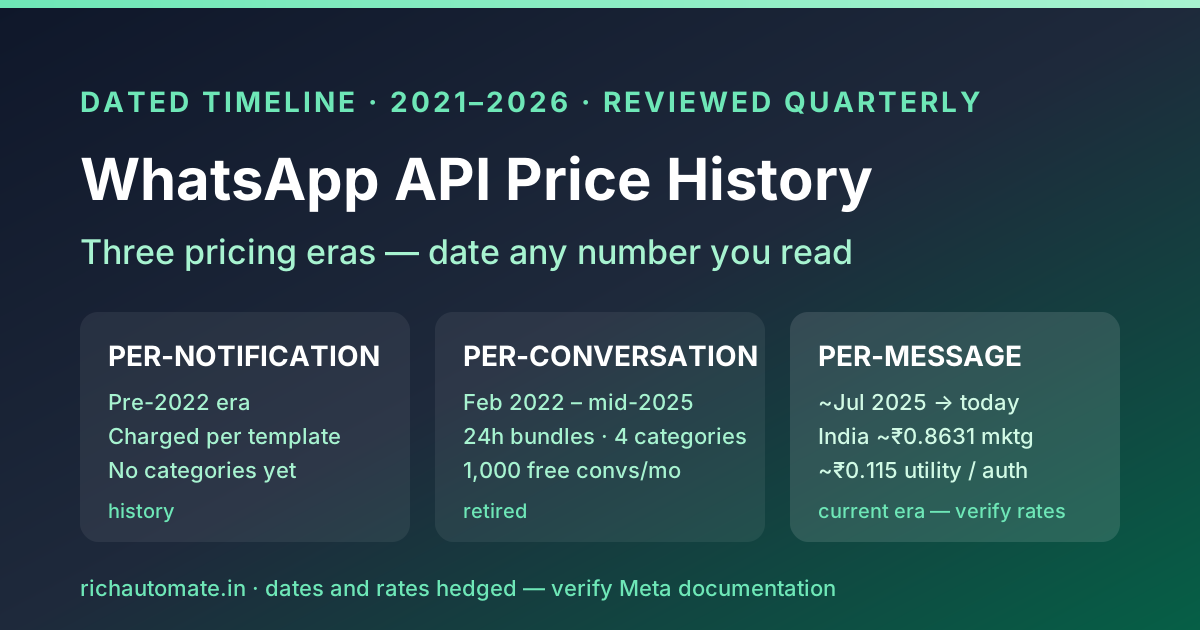
The short answer. WhatsApp Business API pricing has been rebuilt three times: the early per-notification era, the per-conversation model (February 2022 – mid-2025), and today's per-message model (rolled out around July 2025). Every old blog post, BSP quote and budget sheet belongs to one of these eras — and mixing them up is the #1 source of WhatsApp budget confusion in India. This timeline dates every major change so you can place any number you read. All dates and rates hedged: verify against Meta's current documentation — this page is a dated map, not a rate card. Last reviewed: 3 July 2026.
Why this matters: when a 2024 article says "a marketing conversation costs ₹0.88", it is describing a 24-hour bundle. When a 2026 rate card says "₹0.8631 per message", that is each message. Same-looking numbers, different billing physics.
1 October 2026: service messages become chargeable
The latest change: from 1 October 2026 Meta charges service replies beyond roughly 1,000 a month, and utility templates sent inside an open 24-hour window, at the utility rate (about ₹0.115 + 18% GST in India). The 72-hour free entry point window stays free. Details in WhatsApp service message charges from October 2026 and how to cut WhatsApp API cost after October 2026.
The timeline (2021 → 2026)
| When (verify) | Change | What it meant for buyers |
|---|---|---|
| Pre-2022 | Per-notification era — charges per template notification sent outside the session window; session replies free | Simple but crude; no category logic — an OTP cost the same class of charge as a promo |
| Feb 2022 | Conversation-based pricing v1 — billing per 24-hour "conversation", user-initiated vs business-initiated rates | The big mental shift: one charge opened a 24h bundle; smart senders packed follow-ups into open windows |
| 2022 | Free tier: first 1,000 conversations per month free | Made small-business experimentation effectively free — a major adoption driver in India |
| Mar–Jun 2023 | Category split: marketing / utility / authentication / service categories with separate rates; service (user-initiated) conversations become free; utility rates cut sharply vs marketing | The marketing-vs-utility price gap was born — template categorisation became a cost lever, not paperwork |
| 2024 | Utility-in-window free begins rolling in + per-user marketing frequency caps tighten (dates vary by region — verify) | Meta starts pushing quality: utility inside an open service window stops costing money; spammy marketing gets throttled (error 131049) |
| ~Jul 2025 | Per-message pricing replaces per-conversation for marketing, utility and authentication; service messages stay free in the 24h window; free monthly conversation tier retired with the model | The current era: every delivered template message is billed individually — no more "free rides" inside a marketing conversation window |
| 2025–26 | Volume tiers on marketing messages + destination-based rates continue; India marketing ≈ ₹0.8631/msg, utility & authentication ≈ ₹0.115/msg (approximate — verify current card) | High-volume senders negotiate/graduate into cheaper marketing bands; utility remains the cheap workhorse |
Dates are the widely reported rollout points; Meta staged several changes by region and account. Treat every row as "verify against Meta's changelog for your account".
How to date any WhatsApp pricing claim you read
Says "per notification"? Pre-2022 — ignore entirely. Says "per conversation" or "24-hour session charge"? Feb 2022 – mid-2025 era — the numbers are bundles, not messages; do not compare them to per-message rates. Says "free 1,000 conversations"? Retired with the per-message switch — any page still promising it is stale. Says "per message" with category rates? Current era — check the publish date and whether volume tiers are included.
Get a 1-minute BSP audit on WhatsApp
Drop your WhatsApp number — we line-item your current invoice against Meta India rates in under 60 seconds. India-hosted, DPDP-compliant.
What each era did to Indian budgets (illustrative)
A D2C brand sending a 3-message promo sequence to 10,000 opted-in users: in the conversation era, that was ~10,000 marketing conversations (all 3 messages inside one 24h window) ≈ one charge per user. In the per-message era, it is 30,000 billed messages. Same campaign, roughly 3× the billable units — which is why sequence discipline, utility-window routing and template consolidation became the 2026 cost levers. Full current-era math: API cost guide and the cost calculator; provider-by-provider fees: 18-BSP pricing index.
Before you commit to a move, the BSP migration cost calculator gives you the all-in figure rather than the sticker price.
The three evergreen cost rules that survived every era
1. User-initiated is always cheapest — service replies inside the 24h window have been free (or cheapest) in every model; funnel designs that get the customer to message first never stopped paying off. 2. Utility beats marketing on price in every era since the 2023 split — correct categorisation is a recurring 4–7× saving (₹0.115 vs ₹0.8631 today, verify). 3. Quality throttles are permanent — frequency caps and quality ratings only tightened over time; the cheap strategy and the safe strategy converged. Definitions for every term used here: the API glossary.
Methodology & change-log
Method: timeline reconstructed from Meta's public announcements and widely documented rollout reporting; India rates quoted approximately as of the stamp date; all specifics hedged because Meta staged changes by region/account. Stamp: v1.0, 3 July 2026 · reviewed quarterly · next refresh October 2026. Corrections welcome on WhatsApp at +91 81603 11319.
Budgeting in the per-message era? RichAutomate — official Meta Cloud API, ₹0 platform fee, transparent per-message pricing in INR. Start the 14-day free trial (100 credits, no card), see pricing, or WhatsApp us at +91 81603 11319 / book a free 30-min call.