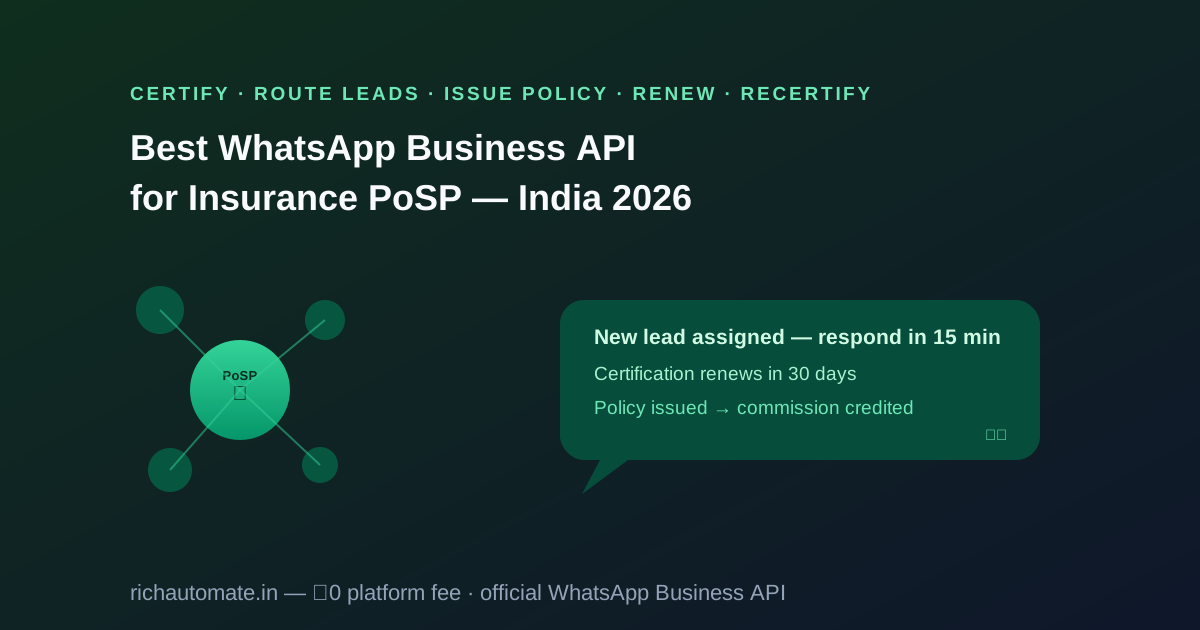
A Point-of-Sales Person (PoSP) insurance platform lives or dies on one number: how many PoSPs are actively selling this month, not how many are registered. The gap between those two numbers is almost always a WhatsApp gap — a PoSP who took a 15-hour certification course, passed the exam, and then never got a lead, a renewal nudge, or a commission update ever again. This page is an honest comparison of what to look for in a WhatsApp Business API partner if you run (or are building) a PoSP-model insurance distribution platform in India.
What a PoSP platform actually needs from a WhatsApp partner
The generic "insurance company on WhatsApp" playbook — policy reminders, claims updates — is only half of what a PoSP platform needs. The other half is a two-sided marketplace problem: keeping thousands of individually-certified PoSPs engaged and active, while also serving the end customer buying a policy through them. A WhatsApp partner built for a single insurer's customer base won't naturally handle the PoSP side — the certification tracking, the lead-routing logic, the commission visibility that keeps a PoSP selling instead of going dormant after their first sale.
Criteria for choosing a WhatsApp partner as a PoSP platform
| Criterion | Why it matters for PoSP |
|---|---|
| Two-way conversation threading per PoSP + per customer | You're running two audiences (PoSPs and their customers) through the same number — needs clean thread separation, not one broadcast list |
| Flow builder for structured onboarding | PoSP certification (15-hr course + IIB exam) has a multi-step, document-heavy onboarding — a visual Flow beats a chain of manual messages |
| Webhook/API for policy-issuance events | Policy issuance and lead-assignment need to trigger a WhatsApp push in near-real-time from your core system, not a manual export |
| Transparent per-message pricing | At PoSP-platform scale (thousands of messages/month across PoSPs + customers) hidden per-agent or per-seat fees compound fast |
| DPDP-aware data handling | PoSP KYC documents and customer policy/health data both flow through the same channel — needs purpose-limited handling on both sides |
The lifecycle a good WhatsApp setup should cover
- PoSP onboarding: certification-course enrollment, IIB exam reminder, document (Aadhaar/PAN) collection Flow, activation confirmation.
- Lead routing: new customer lead pushed to the right active PoSP based on geography/product line, with a response-SLA nudge if unclaimed.
- Quote-to-policy: quote comparison shared with the customer, policy-issuance confirmation once payment clears.
- Renewal + retention: policy-renewal reminders to the customer, commission/incentive visibility nudges to the PoSP to keep them active.
- Recertification: IRDAI PoSP certification renewal reminders before lapse.
Regulatory notes (hedged — verify current rules)
PoSP distribution operates under IRDAI's PoSP Guidelines (2015, updated 2022) — certification requirements, product restrictions (PoSPs are typically limited to simpler, pre-underwritten products), and commission caps all apply and change periodically (verify current IRDAI circulars). DPDP Act 2023 governs both PoSP personal/KYC data and end-customer policy/health data flowing through the same WhatsApp channel — these should be handled with purpose limitation, not commingled. None of this is insurance-regulatory advice; confirm current requirements with your compliance team.
Get a 1-minute BSP audit on WhatsApp
Drop your WhatsApp number — we line-item your current invoice against Meta India rates in under 60 seconds. India-hosted, DPDP-compliant.
Worth knowing the scale of the risk, and the DPDP penalty calculator estimates it from your own numbers.
Illustrative cost model
A PoSP network with 500 active PoSPs generating roughly 8-10 messages/month each (onboarding, lead pushes, commission nudges, recertification reminders) plus customer-side policy/renewal messages might see 5,000-6,000 total messages/month. On Client Pay (₹0 platform fee + ₹0.10/message + Meta's rate billed direct), that's illustratively ₹3,500-5,000/month — verify current Meta conversation rates. SaaS Pay alternative: ₹1.50/marketing, ₹0.50/utility conversation, all-in.
One-week rollout
- Day 1-2: Connect WhatsApp Business number, import active PoSP roster.
- Day 3: Build the PoSP certification-onboarding Flow (document collection + exam-slot reminder).
- Day 4: Wire the lead-routing webhook from your core platform to trigger PoSP notifications.
- Day 5: Template policy-issuance and renewal-reminder messages for the customer side.
- Day 6: Add the recertification-reminder trigger tied to each PoSP's certification expiry date.
- Day 7: Go live on a pilot cohort of 50 PoSPs, monitor engagement before rolling to the full network.
Who fits which platform
A small independent PoSP network (under 100 PoSPs) can often run on a lighter WhatsApp-plus-spreadsheet setup with manual lead assignment. Once a platform crosses into the hundreds or thousands of PoSPs — with lead-routing logic, commission visibility, and recertification tracking all needing automation — a proper WhatsApp Business API setup with Flow-based onboarding and webhook-driven lead push becomes the difference between PoSPs staying active and PoSPs going dormant after one sale. Enterprise-scale aggregators already running a full agency-management system (AMS) should look for API integration into that system rather than a standalone WhatsApp tool — the AMS stays the system of record, WhatsApp is the notification and engagement layer.
RichAutomate runs on the official WhatsApp Business API — ₹0 platform fee, ₹0 setup, ₹0 monthly minimum. Client Pay is ₹0.10/message plus Meta's rate billed direct; SaaS Pay is ₹1.50/marketing and ₹0.50/utility conversation, all-in. 14-day trial, 100 free credits, no card required to start. Competitor pricing mentioned elsewhere should always be verified on the vendor's own site — rates change. Never any promise of "no ban" for bulk or unsolicited sends — proper opt-in and the official API are what keeps a WABA in good standing.
Related reading
- WhatsApp for Insurance Distribution
- WhatsApp for Motor Insurance (IRDAI)
- WhatsApp for Health Insurance Cashless Claims
- Best WhatsApp Business API for Insurance
- Best WhatsApp CRM
- DPDP Act 2023 Compliance Checklist
- Client Pay vs SaaS Pay
- WhatsApp Business API Cost
Related: Best WhatsApp Business API for mutual fund distributors in India (2026) — goal capture, KYC nudges, SIP-continuity retention and SEBI/AMFI-compliant broadcasts.