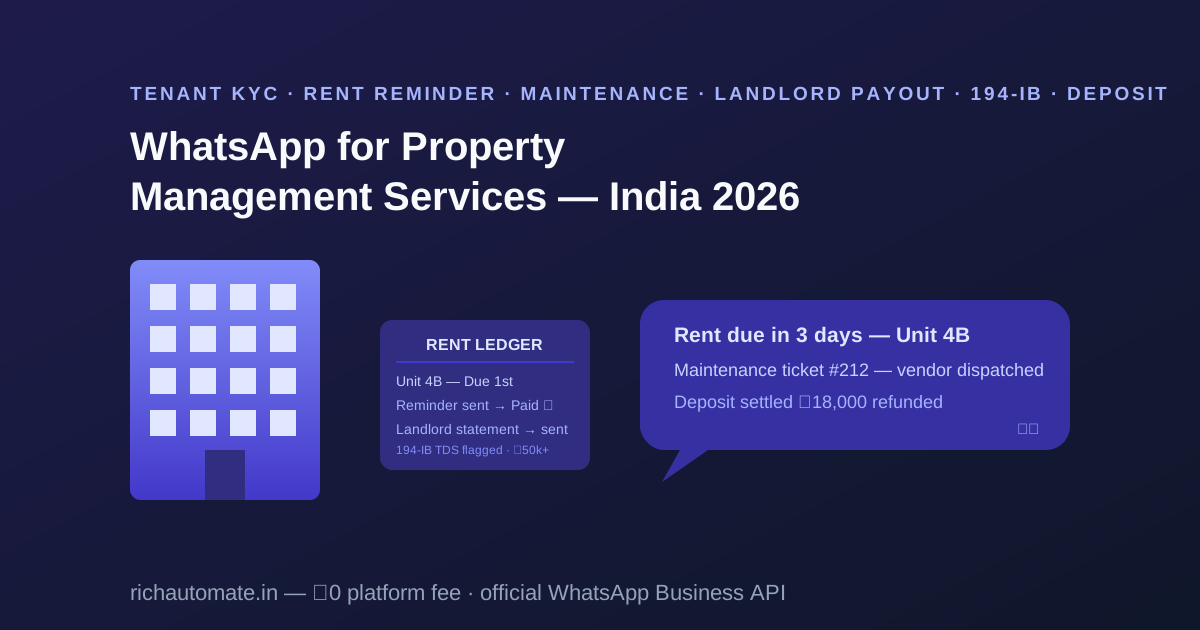
A property management company doesn't lose money on rent. It loses money on the twelve small threads that surround rent: the tenant who moved in without a signed agreement uploaded, the landlord who didn't get last month's statement, the maintenance ticket that sat unread for four days, the TDS deduction nobody explained, and the exit inspection that turned into a deposit dispute. Each thread is a WhatsApp message today anyway — tenants and landlords already text the property manager directly. The only question is whether that traffic is organised into a system of record, or lost in a personal phone that walks out the door when an ops executive resigns.
Why property management is a different WhatsApp problem than real estate sales
A broker's WhatsApp problem is top-of-funnel: capture the enquiry, get the site visit booked, close before the lead cools. A property manager's WhatsApp problem is the opposite — it's maintenance, month after month, for tenancies that can run one to three years. The volume is lower-intensity but never stops, and it involves two parties who don't trust each other by default: the tenant paying rent and the landlord expecting it on time, both of whom message the PM company when something feels off.
That structural difference is why generic real-estate CRMs and generic WhatsApp campaign tools both under-serve this vertical. A campaign tool is built to blast and convert; a PM company needs to route a maintenance photo to the right vendor, remind a specific tenant about a specific due date, and produce a specific landlord's monthly statement — one conversation per unit, not one broadcast to a list.
The six-loop lifecycle
| Stage | What happens on WhatsApp | Why it matters |
|---|---|---|
| 1. Tenant onboarding + KYC | Move-in Flow collects ID proof, agreement acknowledgement, security-deposit receipt, and emergency contact — all logged against the unit | Removes the "nobody signed anything" dispute at exit; agreement copy is retrievable in the same thread a year later |
| 2. Monthly rent-ledger + reminder | 3-day-before and due-date nudge to the tenant, "paid" confirmation pushed the same day the ledger updates | This is the money message — a rent-day reminder that lands before the due date measurably reduces late-payment chase calls |
| 3. Maintenance-ticket routing | Tenant sends a photo + one line, bot opens a ticket with a unit ID and SLA timer, vendor gets dispatched, tenant gets a resolution update | Maintenance response time is the #1 tenant-satisfaction and renewal driver in every PM survey (verify current benchmarks) — an unread WhatsApp photo is a renewal lost |
| 4. Landlord payout statement | Monthly PDF/summary — rent collected, PM fee, maintenance deducted, net payout, sent same day as bank transfer | Landlords who don't hear from their PM company assume something's wrong; a same-day statement is retention for the *landlord* side of the two-sided relationship |
| 5. Section 194-IB TDS nudge | For rent above ₹50,000/month, a reminder to the tenant on TDS deduction timing and Form 26QC filing (reference only, not tax advice) | Tenants routinely miss this; a PM company that flags it before the deadline looks competent and avoids being blamed for a tenant's compliance miss |
| 6. Move-out + deposit settlement | Exit-inspection scheduling, photo-log of unit condition, itemised deduction breakdown, deposit-refund confirmation | Deposit disputes are the single biggest source of PM-company one-star reviews; a photo-logged, itemised thread ends most arguments before they start |
Regulatory and compliance spine (hedged — verify current rules)
Property management sits across income-tax, state rent law, and data-protection obligations, none of which the bot should ever resolve on its own judgment:
The customer LTV calculator shows what a retained customer is worth before you set the spend.
Get a 1-minute BSP audit on WhatsApp
Drop your WhatsApp number — we line-item your current invoice against Meta India rates in under 60 seconds. India-hosted, DPDP-compliant.
- Income Tax Act Section 194-IB — tenants paying rent above ₹50,000/month must deduct TDS (currently 2%, verify current rate) and file Form 26QC; the PM company's role is reminder-only, never filing on the tenant's behalf.
- State-specific Rent Control / Tenancy Acts — notice periods, deposit caps, and eviction procedures vary by state (Model Tenancy Act adoption is state-by-state, verify which states have notified it); the thread should reference dates and documents, never give a legal opinion on eviction rights.
- Registration Act, 1908
- DPDP Act, 2023 — tenant KYC documents (ID proof, PAN, address history) and landlord bank details are personal data requiring purpose limitation and secure storage; never forward a tenant's ID document to an unrelated third party over WhatsApp.
- GST — PM service fees are typically taxable services; residential-rent GST treatment has its own carve-outs (verify current thresholds and exemptions with a tax advisor).
What the bot should never do
It never adjudicates a deposit dispute, never gives an opinion on eviction validity or notice-period law, never files Form 26QC or any tax document on anyone's behalf, never shares one tenant's or landlord's financial data with another party, and never sends a maintenance vendor's contact details to a tenant without the PM company's sign-off. It records, reminds, and routes — the judgment calls (dispute resolution, legal notices, vendor selection) stay with the human PM team.
Illustrative cost math
A PM company managing 400 units might see, per unit per month: 1 rent reminder + 1 payment confirmation + 1 landlord-statement notification + occasional maintenance-ticket exchanges (say 0.5 tickets/unit/month averaging 3 messages) — roughly 5-6 utility-category messages per unit, or 2,000-2,400 messages/month across the portfolio. On Client Pay (₹0 platform fee + ₹0.10/message platform charge + Meta's per-conversation fee billed directly), that's illustratively ₹1,800-2,600/month total — verify current Meta conversation rates, which vary by category and have changed multiple times through 2024-2026. SaaS Pay alternative: ₹1.50/marketing-conversation, ₹0.50/utility-conversation, all-in. Either way it's a rounding error against the PM fee revenue from 400 units, and it directly reduces two of the costliest line items in this business: late-payment chasing and deposit disputes.
One-week rollout for a single PM portfolio
- Day 1-2: Connect WhatsApp Business number, import active tenant + landlord contacts against unit IDs, build the move-in KYC Flow.
- Day 3: Set up the rent-reminder + payment-confirmation sequence tied to each unit's due date.
- Day 4: Build the maintenance-ticket intake Flow with SLA-timer routing to your existing vendor list.
- Day 5: Template the monthly landlord-statement message and test against one real payout cycle.
- Day 6: Add the 194-IB reminder trigger for units above the ₹50,000/month threshold.
- Day 7: Go live on one building/portfolio segment, monitor delivery and response rates for a week before rolling to the full portfolio.
Who fits which platform
A 20-40 unit independent PM operator usually does fine on a lighter WhatsApp-plus-spreadsheet setup. Once the portfolio crosses into the hundreds of units — or spans multiple owners/buildings needing separate statements — a proper WhatsApp Business API setup with per-unit conversation tracking, Flows for KYC/maintenance, and automated ledger-linked reminders pays for itself in reduced late-payment chasing alone. Larger PM platforms already running enterprise property-management software (Yardi, MRI, or India-specific PM suites) should look for CPaaS/API integration into that existing system rather than a standalone tool — the goal is one source of truth for the ledger, with WhatsApp as the notification and intake layer on top, not a second system to reconcile.
RichAutomate runs on the official WhatsApp Business API — ₹0 platform fee, ₹0 setup, ₹0 monthly minimum. Client Pay is ₹0.10/message plus Meta's rate billed direct; SaaS Pay is ₹1.50/marketing and ₹0.50/utility conversation, all-in. 14-day trial, 100 free credits, no card required to start. As always: never any promise of "no ban" for bulk or unsolicited sends — proper opt-in and the official API are what keeps a WABA in good standing, not a specific tool.
For the collection step itself, use our 37 WhatsApp rent reminder message templates covering flats, shops and society maintenance.
Related reading
- WhatsApp for Real Estate Brokers — Site Visits
- WhatsApp for RWA / Apartment Society Management
- WhatsApp for Coworking & Managed Office Operators
- Best WhatsApp Business API for NBFC Lending
- WhatsApp for Law Firms & Advocates
- DPDP Act 2023 Compliance Checklist
- Best WhatsApp CRM
- Client Pay vs SaaS Pay
- WhatsApp Business API Cost
Related: WhatsApp for society AGM & e-voting in India (2026) — statutory notice, quorum tracking, proxies, resolution & committee-election voting and signed minutes in one thread.