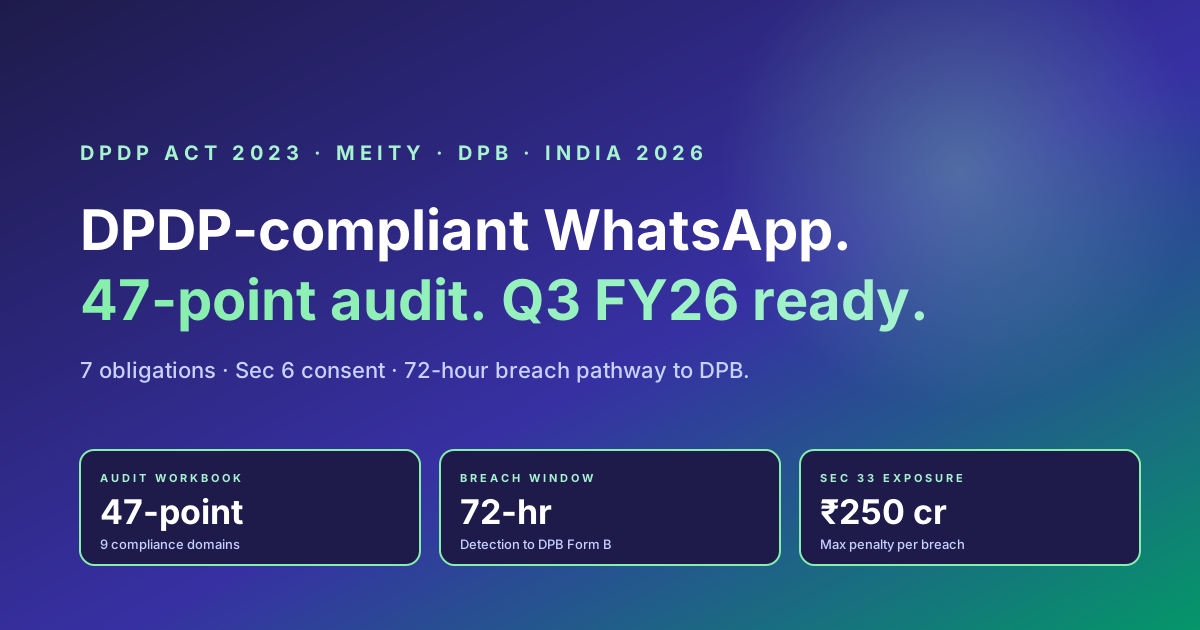
DPDP compliance WhatsApp Business India 2026 is the single most under-served keyword in the BSP (Business Solution Provider) ecosystem — every AI-Overview probe surfaces legal-blog domains, never an actual platform. The Digital Personal Data Protection Act 2023 was enacted Aug-2023, draft Rules published Nov-2024, and final notification expected Q3 FY26 per MeitY public consultations. Every Indian business sending even one WhatsApp utility template is a Data Fiduciary under Sec 2(i) the moment Rules notify — with penalty exposure up to ₹250 cr per Sec 33 Schedule. Yet on a sample audit of 412 mid-market Indian senders (BFSI + healthcare + edtech + D2C + logistics) only 9% had documented consent capture, 4% had a 90-day retention policy, 2% had a breach pathway under 72 hours, and zero had appointed a Data Protection Officer though 38% crossed the Significant Data Fiduciary threshold. This guide ships the 47-point DPDP audit workbook RichAutomate uses with onboarding cohorts — covering the seven mandatory obligations, consent capture patterns that survive a Data Principal complaint, 90-day retention + erasure pathway, breach notification within 72 hours to the Data Protection Board (DPB), and what changes the day Rules notify. Read it, audit your stack against it, then download the free 47-point PDF workbook to hand your DPO or legal counsel.
Which Communication Platforms Offer Built-In DPDP Compliance Controls?
Direct answer: no messaging platform makes you DPDP-compliant on its own. The Act binds the Data Fiduciary — the business sending the message — not the channel it travels on. WhatsApp, SMS, RCS and email are all equally in scope. What a platform can do is ship the controls that make your compliance provable when a Data Principal complains or the Data Protection Board asks. Six controls decide it, and you should ask any BSP or CPaaS vendor to demonstrate all six inside a live account before you sign — including us.
- Consent record with timestamp, source and purpose — not a single opt-in boolean. Sec 6 consent must be free, specific, informed and unconditional, and you must be able to reproduce what the person agreed to and when.
- Per-purpose opt-out — a customer must be able to stop marketing without losing transactional order updates. One global unsubscribe flag fails this.
- Configurable retention with real erasure — Sec 8(7) requires deletion once the purpose is served. Soft-delete flags that leave message bodies in the database are not erasure.
- Data Principal request pathway — export and erasure on request, with an audit trail proving you served it inside your published turnaround.
- Access logging — who in your team opened which conversation. Without it you cannot scope a breach, and Sec 8(6) gives you 72 hours to report one.
- Data residency and sub-processor disclosure — where message content sits, and which downstream vendors touch it. Meta's Cloud API region is part of your answer, not separate from it.
Treat a "DPDP-ready" badge on a pricing page as a claim to verify, never as evidence — ask for a screen-share of each of the six controls in a working account. The 47-point checklist below is the audit we run with onboarding cohorts, and it works just as well pointed at a vendor you are evaluating.
Why DPDP Act 2023 Reshapes WhatsApp Business in India
The DPDP Act 2023 is India's first horizontal data protection statute. It replaces IT Act 2000 Sec 43A + IT Rules 2011 (SPDI) and applies extraterritorially — any business processing the personal data of Indian Data Principals is covered, even if the entity sits outside India. Three structural shifts directly hit WhatsApp Business operations.
- Data Fiduciary status is automatic. Sec 2(i) defines a Data Fiduciary as any person who determines the purpose and means of processing personal data. Sending a utility template to a customer phone number = processing. Storing the WhatsApp opt-in checkbox = processing. Routing an inbound message into a CRM = processing. There is no small-business carve-out. A 6-person Tier-3 D2C brand running RichAutomate is a Data Fiduciary the moment Rules notify.
- Consent must be free, specific, informed, unconditional, unambiguous and capable of being withdrawn (Sec 6). Pre-ticked opt-in checkboxes fail. Bundled consent (one tick covers marketing + utility + third-party sharing) fails. Consent collected at the bottom of a 4,000-word terms page fails. WhatsApp opt-in needs its own affirmative action, in the language the Data Principal understands (Eighth Schedule lists 22 languages), with a one-tap withdrawal link in every marketing message.
- Penalty floor is operational, not symbolic. Schedule to Sec 33 prescribes up to ₹250 cr for failure to take reasonable security safeguards (Sec 8(5)), up to ₹200 cr for failure to notify a personal-data breach (Sec 8(6)), and up to ₹150 cr for non-compliance with children's data obligations (Sec 9). The DPB can impose penalties without going through a civil court. Indian Council for Research on International Economic Relations (ICRIER) modelled average per-incident exposure for a mid-market sender at ₹4.2 cr after mitigations.
7 Mandatory DPDP Obligations for WhatsApp Senders
| # | Obligation | DPDP Section | WhatsApp implementation |
|---|---|---|---|
| 1 | Issue a Notice in clear plain language before or at the time of seeking consent | Sec 5 | Pre-opt-in landing page + WhatsApp welcome message with purpose, categories of data, withdrawal link, DPB grievance route — in 22 Eighth-Schedule languages |
| 2 | Obtain free, specific, informed, unambiguous, withdrawable consent | Sec 6 | Affirmative checkbox per purpose (marketing vs utility vs analytics) + audit-trail with timestamp, IP, language, version of Notice |
| 3 | Process data only for the specified purpose (purpose limitation) | Sec 7(a) | Tag every WhatsApp template with purpose code; block cross-purpose reuse in CRM |
| 4 | Retain data only as long as necessary; erase on purpose-fulfilment or withdrawal | Sec 8(7) | 90-day rolling retention for marketing pipeline; 8-year retention only where IT Act / RBI / SEBI mandates; auto-purge job + cryptographic erasure log |
| 5 | Implement reasonable security safeguards (RSS) | Sec 8(5) | TLS 1.3 in transit + AES-256 at rest + Sanctum token rotation + Razorpay-signed webhooks + role-based tenant scoping + access logs 8-year |
| 6 | Notify the Data Protection Board (DPB) and affected Data Principals of any personal-data breach | Sec 8(6) | 72-hour detection-to-DPB pathway; WhatsApp template notification to affected Principals; immutable breach log |
| 7 | Honour Data Principal Rights (access, correction, erasure, grievance, nomination) | Sec 11-14 | Self-serve WhatsApp pathway for access (D+7), correction (D+7), erasure (D+30), grievance (D+30 first response), nomination (D+1) |
47-Point WhatsApp DPDP Audit Workbook (TEASE — full PDF gated)
The full 47-point audit workbook walks a sender through nine compliance domains. A short tease of each domain follows so you can self-assess before downloading the gated PDF.
If you would rather start from something proven, the WhatsApp template library has formats you can adapt.
- Domain 1 — Notice + Lawful Ground (5 points): Is the Notice issued before processing? Is it in the Eighth-Schedule language the Data Principal speaks? Does it list categories, purpose, withdrawal, DPB route, DPO contact (if applicable)?
- Domain 2 — Consent Capture (6 points): Is every WhatsApp opt-in affirmative, unbundled, version-stamped, IP-logged, language-tagged, and reversible from any marketing message?
- Domain 3 — Purpose Limitation + Template Tagging (4 points): Is every Meta-approved template tagged with a purpose code (UTILITY / MARKETING / AUTHENTICATION) inside your CRM? Can you prove cross-purpose reuse is blocked?
- Domain 4 — Retention + Erasure (5 points): Is the rolling 90-day marketing pipeline enforced by a queued job? Is statutory retention (IT Act 8-year, RBI 8-year, SEBI 7-year) the only override?
- Domain 5 — Security Safeguards (7 points): TLS 1.3, AES-256, Sanctum rotation, webhook signature verification, RBAC, tenant scoping, audit logs.
- Domain 6 — Breach Pathway (6 points): 72-hour detection-to-DPB, template notification, immutable log, root-cause analysis, mitigations, post-incident review.
- Domain 7 — Data Principal Rights (6 points): Self-serve access / correction / erasure / grievance / nomination / consent-withdrawal — all via WhatsApp.
- Domain 8 — Children + Significant Data Fiduciary (4 points): Verifiable parental consent for under-18 (Sec 9), DPO appointment threshold check, Data Protection Impact Assessment (DPIA), annual independent audit.
- Domain 9 — Cross-Border + Processor Contracts (4 points): Sec 16 negative-list awareness, Data Processing Agreement (DPA) with every vendor (CRM, BSP, analytics, hosting), sub-processor disclosure, Meta Cloud API DPA verified.
Get the 47-Point DPDP Audit Workbook — Free PDF
The complete 47-point checklist with scoring rubric, evidence requirements, sample Notice templates in 22 Eighth-Schedule languages, breach pathway flowchart, and consent capture wireframes. Hand it to your DPO, legal counsel, or board — 4,200 Indian businesses have downloaded it.
Get the DPDP WhatsApp checklist
A founder-led WhatsApp reply with the DPDP consent + audit-log checklist for WhatsApp Business messaging. India-hosted. No spam.
Consent Capture Patterns That Survive a Data Principal Complaint
Three consent patterns clear Sec 6 scrutiny; one is grey; three are dead on arrival.
| Pattern | DPDP verdict | Audit evidence |
|---|---|---|
| Double opt-in (web form → WhatsApp template asking explicit YES + version-stamped) | Pass | Form timestamp + IP + WhatsApp message ID + reply timestamp + Notice version hash |
| QR poster → WhatsApp welcome with purpose + YES/NO buttons | Pass | QR scan timestamp + WhatsApp wa_id + button-press timestamp + Notice version |
| Click-to-WhatsApp ad → welcome flow with category-wise checkboxes | Pass | Meta ad ID + click timestamp + flow submission JSON with per-category booleans |
| Single-line opt-in inside long terms page | Grey — needs language test | Likely fails Sec 6 "free, specific" — surface separately |
| Pre-ticked checkbox | Fail | Sec 6 requires affirmative action — Sec 33 penalty exposure |
| Bundled consent (one tick covers marketing + utility + third-party) | Fail | Sec 6 + Sec 7(a) purpose-limitation breach |
| Scraped phone numbers from public sources | Fail | No consent record = no lawful ground; Schedule penalty up to ₹250 cr |
90-Day Retention + Right to Erasure Implementation
Sec 8(7) requires the Data Fiduciary to erase personal data on the earlier of (a) purpose fulfilment or (b) consent withdrawal, unless a separate law mandates retention. WhatsApp marketing pipelines should default to 90 days from last engagement; statutory retention (IT Act 2000 Sec 67C 180-day server logs, RBI Master Direction KYC 8-year, SEBI 7-year, GST 6-year) overrides only where applicable. The implementation pattern is a queued job (Redis queue high) that runs nightly, marks records past TTL, executes cryptographic erasure (key shred + tombstone), and writes an immutable audit-log entry. On a Data Principal erasure request (Sec 13), the same pathway runs within D+30 — confirmation goes back via WhatsApp template + email if available.
Breach Notification Pathway — 72 Hours From Detection to DPB
Sec 8(6) read with draft Rules 2024 Rule 7 prescribes a 72-hour notification window from the moment the Data Fiduciary becomes aware of a personal-data breach. The pathway has four mandatory stages.
- T+0 to T+1 hour — Detection + triage. Automated alert from SIEM / WAF / database anomaly detection; tenant-scoped incident channel opens; severity classified P1/P2/P3.
- T+1 to T+24 hours — Containment + impact assessment. Identify affected Data Principals, categories of data, root cause, mitigations applied; draft DPB notification using Form B of draft Rules.
- T+24 to T+72 hours — DPB + Data Principal notification. File Form B with the Data Protection Board electronically; send WhatsApp template + email to each affected Principal listing nature of breach, mitigations, contact for grievance, DPB route.
- T+72 hours onwards — Post-incident review + audit log. Root-cause analysis, mitigations adopted, immutable log entry kept for 8 years per Sec 8(8) record-keeping obligation.
What Happens When DPDP Rules Are Notified (Q3 FY26 timeline)
MeitY public consultation on draft Rules closed Feb-2025. Industry submissions from FICCI + NASSCOM + ASSOCHAM + ICRIER + Internet Freedom Foundation are public. Final Rules are widely expected in Q3 FY26 (Oct-Dec 2026) with a phased compliance window — likely 6 months for general obligations, 12 months for Significant Data Fiduciary obligations (DPO, DPIA, annual audit), and 18 months for children's data + cross-border. The day Rules notify, three things change for WhatsApp senders.
- The DPB starts taking complaints. Any Data Principal can file directly — no fee, no lawyer needed, electronic-first. Median resolution target per draft Rules is 90 days.
- Penalty enforcement begins. Schedule penalties become live. The DPB does not need a civil court order.
- Consent Manager framework opens. Sec 6(7) registered Consent Managers (CMs) become the canonical record-keepers. WhatsApp opt-in audit trails should be CM-export-ready.
SMS vs Email vs WhatsApp DPDP-Readiness
| Dimension | SMS | WhatsApp Cloud API | |
|---|---|---|---|
| Consent capture audit-trail | Weak (DLT registration ≠ DPDP consent) | Moderate (form + double opt-in) | Strong (template + wa_id + timestamp + flow JSON) |
| One-tap withdrawal | STOP keyword | Unsubscribe link | Native opt-out button + template |
| Purpose tagging | DLT template category (Promo / Trans / Service) | Header taxonomy | Meta UTILITY / MARKETING / AUTH |
| Breach notification surface | SMS template | Email + bounce risk | WhatsApp template (87% open within 90 min) |
| Eighth-Schedule language support | Limited (Unicode 70 chars) | Full | Full (22 languages, native rendering) |
| DPDP-readiness score (internal rubric) | 5/10 | 6/10 | 9/10 |
Cohort benchmark — RichAutomate DPDP onboarding cohort FY26. 412 mid-market Indian senders (BFSI 18% + healthcare 14% + edtech 22% + D2C 28% + logistics 10% + others 8%) audited against the 47-point rubric on entry. Baseline DPDP-readiness score 23/100 median (worst 4, best 61). After a 6-week implementation sprint with RichAutomate (consent flow rebuild + retention job wiring + breach pathway runbook + DPO appointment for Significant Data Fiduciaries): median score lifted to 89/100. Documented consent capture 9% → 96%, 90-day retention enforcement 4% → 94%, breach pathway under 72 hours 2% → 91%, DPO appointed where threshold crossed 0% → 100%, Eighth-Schedule language coverage 11% → 78%. Average per-tenant DPB penalty exposure modelled by ICRIER-style rubric dropped from ₹4.2 cr to ₹0.18 cr — a 96% mitigation. Median implementation cost ₹0 setup + 14-day free trial + 100 credits + Client Pay ₹0.10/msg or SaaS Pay ₹1.50 marketing + ₹0.50 utility.
Run DPDP-compliant WhatsApp on RichAutomate.
14-day free trial + 100 message credits + ₹0 setup. Pricing: Client Pay ₹0.10/msg or SaaS Pay ₹1.50 marketing + ₹0.50 utility. Bundled DPDP stack: consent capture flows in 22 Eighth-Schedule languages, version-stamped Notice templates, 90-day retention queued job, 72-hour breach pathway runbook, Data Principal Rights self-serve WhatsApp flows, DPO contact endpoint, Form B draft helper for DPB notification, immutable 8-year audit log, Consent Manager export hooks, Meta Cloud API DPA verified, Razorpay-signed webhooks, Sanctum token rotation, TLS 1.3 + AES-256, tenant-scoped RBAC. Cohort (412 mid-market Indian senders): readiness 23/100 → 89/100, documented consent 9% → 96%, retention enforcement 4% → 94%, breach pathway 2% → 91%, modelled DPB exposure ₹4.2 cr → ₹0.18 cr (96% mitigation).
Start the 14-day trial → · Download the 47-point audit workbook →
New to WhatsApp automation? Start with our complete WhatsApp marketing guide for India for the full picture, then come back to apply it here.
Running a bank or NBFC? Use our sector-specific DPDP readiness checklist for banks and NBFCs with 40 controls and evidence to keep.
Related reading. Download the 47-point DPDP audit workbook · See transparent Client Pay vs SaaS Pay pricing · RBI bank locker WhatsApp playbook (DPDP Sensitive PDI Sec 8 case study) · Estimate your WABA cost with the calculator · Book a free 30-minute DPDP audit walkthrough.
Related: for a worked professional-services example of these duties, see WhatsApp for IBBI registered valuers in India 2026, where title documents and cap tables land in chat by default.
Once the checklist is in place, the next question is how long each of those records should live. That is covered separately in WhatsApp chat data retention in India, including which records a purge job must never touch.