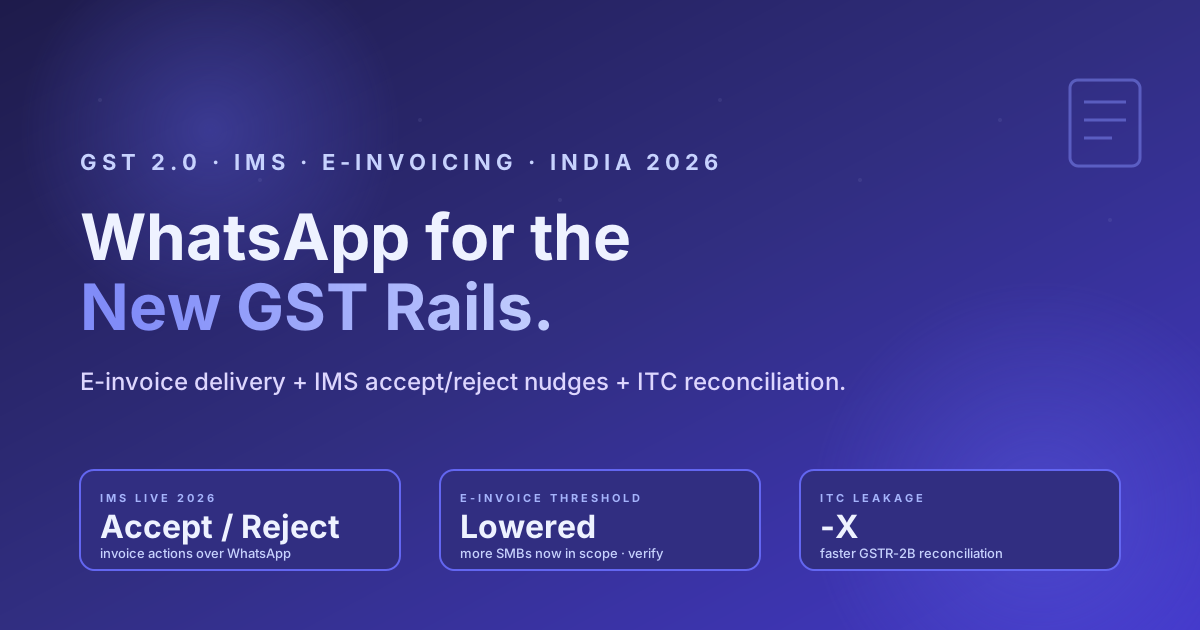
India's GST machinery entered its most operationally invasive phase in 2026. The Invoice Management System (IMS) on the GST portal — rolled out from late 2024 and tightening through 2025-26 — now expects recipients to explicitly accept, reject, or keep-pending every inbound invoice before it flows into their auto-drafted GSTR-2B, and Input Tax Credit (ITC) increasingly hangs on whether the supplier filed and the recipient acted in time. In parallel, the e-invoicing (IRN/IRP) net keeps widening as the aggregate-turnover threshold is lowered, pulling lakhs more SMBs into mandatory e-invoice generation, and GSTR-2B is moving toward a harder-locked, less-editable statement. For a B2B seller or buyer, the practical consequence is brutal: a customer who never received your e-invoice, never opened it, or never actioned it inside IMS can quietly cost you a sale, a payment, or — on their side — a chunk of ITC. The fix is not another portal login nobody checks. It is putting the e-invoice, the IMS nudge, and the reconciliation status on the one channel Indian businesses actually read: WhatsApp. This guide maps the 2026 GST rule-changes (treated as a reaction piece, every clause hedged "verify on the GST portal / CBIC notification") onto a five-stage B2B billing lifecycle, with real-feeling FY26 numbers (directional/estimated), an illustrative cohort marked illustrative, the DPDP and GSTN data-sharing carve-out, and a 5-question FAQ. It is written for finance, accounts-receivable, and SMB owners who would rather their counterparties act on an invoice than ignore it.
What Actually Changed in GST for 2026 — the Three Shifts That Touch Messaging
Three structural shifts define the 2026 GST landscape for B2B billing. Each one is a reason your invoice and reconciliation flow belongs on WhatsApp, not buried in a portal. (All specifics below are directional — verify the exact threshold, date, and clause against the live CBIC notification and GST portal before you rely on them.)
- IMS (Invoice Management System) is now the gatekeeper of ITC. Inbound invoices land in the recipient's IMS dashboard, where they must be accepted, rejected, or kept pending. Accepted invoices flow into GSTR-2B; rejected or un-actioned ones can block or defer the buyer's ITC and trigger supplier follow-ups. The action is no longer passive — somebody has to do something, on time.
- E-invoicing threshold keeps dropping. The aggregate-turnover floor for mandatory e-invoice (IRN from the IRP) has stepped down year after year; the 2026 cut pulls a fresh tier of mid-and-small businesses into scope. If you are newly covered, every B2B invoice needs an IRN + signed QR, and your buyer expects to receive it — fast and in a readable form.
- GSTR-2B is hardening. The auto-drafted ITC statement is moving toward a more locked, sequenced, deadline-bound artifact. "I'll reconcile at year-end" is dying; reconciliation is becoming a monthly, near-real-time discipline driven by what suppliers filed and what recipients actioned in IMS.
The common thread: 2026 GST shifts billing from a quiet back-office filing into a two-sided, time-bound conversation between supplier and buyer. WhatsApp is where that conversation already happens.
| 2026 GST shift | What changed (verify on GST portal) | WhatsApp impact |
|---|---|---|
| IMS accept/reject/pending | Recipients must action inbound invoices in IMS; un-actioned/rejected invoices can defer or block ITC and feed GSTR-2B | Push an "Accept this invoice in IMS" nudge with deep-link + deadline reminder; capture buyer intent in-thread |
| E-invoice threshold lowered | More SMBs must generate IRN + signed QR from the IRP per B2B invoice | Auto-deliver the IRN-stamped e-invoice PDF + QR the moment IRN is generated; buyer gets it without chasing |
| GSTR-2B hardening | ITC statement more locked/sequenced; reconciliation becomes monthly + deadline-bound | Monthly reco summary + mismatch alerts ("3 invoices not in your 2B — ask supplier to file") delivered before the deadline |
| Recovery of mismatched ITC | Tighter scrutiny where 2B and books diverge; interest/reversal exposure | Mismatch-resolution thread routes supplier + buyer to fix before filing, with an audit trail of who said what |
The Five-Stage B2B Billing Lifecycle on WhatsApp
Map the entire invoice-to-reconciliation cycle onto five WhatsApp-native stages. Each stage has a trigger, an automation surface, and a compliance guardrail.
Stage 1 — E-invoice generation and instant delivery
The moment your accounting/ERP system (Tally, Zoho Books, Marg, Busy, Vyapar, SAP) generates the IRN from the IRP, RichAutomate fires a utility-category template to the buyer's authorised contact: the signed e-invoice PDF, the IRN, the QR, and a one-line "Tap to view / save to GST records." No portal login on the buyer's side, no email that sits unread. Delivery becomes near-instant and provable.
It is worth passing each draft through the WhatsApp template approval checker first, because most rejections are a handful of repeat mistakes.
Stage 2 — Receipt acknowledgement and IMS action nudge
Once delivered, an interactive nudge asks the buyer to confirm receipt and reminds them to action the invoice in IMS before the cut-off. The thread can carry a deep-link to the GST portal IMS dashboard (verify the current IMS URL/flow) and a short "Why this matters: un-actioned invoices can affect your ITC" explainer. This is the single highest-leverage automation of 2026 — it converts a passive portal task into a prompted action.
Stage 3 — Payment follow-up tied to the invoice
Because the invoice already lives in the WhatsApp thread, the payment reminder is contextual, not cold. A Pathway sends D-3 / D-0 / D+3 nudges with a UPI / payment-link one-tap option and the exact invoice reference, so the buyer pays against the right document and your AR team stops reconciling stray transfers.
Stage 4 — Monthly GSTR-2B reconciliation summary
Before each monthly filing deadline, a reconciliation summary goes to the finance owner: invoices reflected in their auto-drafted 2B, invoices missing (supplier hasn't filed), and invoices flagged for mismatch. Each line is actionable in-thread — "Ping supplier to file" or "Mark resolved" — so reconciliation moves from a year-end fire-drill to a monthly habit.
Stage 5 — Mismatch resolution and audit trail
When 2B and books diverge, a structured resolution thread loops in both supplier and buyer, records the agreed fix, and timestamps it. That audit trail is gold during scrutiny — you can show exactly when the invoice was sent, received, actioned, and reconciled, all in one WhatsApp conversation history exportable for your records.
| Stage | Trigger | WhatsApp automation | Compliance guardrail (verify) |
|---|---|---|---|
| 1. E-invoice delivery | IRN generated at IRP | Utility template: signed PDF + IRN + QR auto-pushed | Send only to consented, authorised business contact; no marketing copy on a utility invoice |
| 2. Receipt + IMS nudge | Invoice delivered | Interactive "confirm receipt" + IMS deep-link + deadline reminder | Frame as factual nudge; do not give tax advice ("verify in your IMS dashboard") |
| 3. Payment follow-up | Due-date window | D-3/D-0/D+3 Pathway + UPI/payment-link with invoice ref | Payment within DPDP-consented window; honour opt-out |
| 4. 2B reconciliation | Pre-filing deadline | Monthly summary: matched / missing / mismatched + in-thread actions | Figures sourced from GSTN with consent; mark "verify on portal before filing" |
| 5. Mismatch resolution | 2B vs books divergence | Two-sided resolution thread + timestamped audit trail | Retain records per GST + DPDP; no PII beyond purpose |
Why E-invoice + IMS Belong on WhatsApp, Not Email or a Portal
The case is open-rate and action-rate. A B2B e-invoice emailed to accounts@ competes with hundreds of unread threads; an IMS task sits on a portal the buyer logs into monthly at best. WhatsApp utility messages get read in minutes and acted on while the buyer is on their phone. In a regime where ITC depends on someone actioning an invoice on time, the channel with the highest read-and-respond rate is not a nice-to-have — it is the difference between credit claimed and credit lost.
Get the DPDP WhatsApp checklist
A founder-led WhatsApp reply with the DPDP consent + audit-log checklist for WhatsApp Business messaging. India-hosted. No spam.
| Capability | Email to accounts@ | GST portal / IMS only | WhatsApp (RichAutomate) |
|---|---|---|---|
| Invoice actually seen | Often buried/unread | Only on monthly login | Read within minutes |
| IMS action prompted | No | Buyer must remember | Nudged with deadline + deep-link |
| Payment in same place | No | No | UPI/link in the invoice thread |
| Reconciliation visibility | Manual | Portal-bound | Monthly summary pushed pre-deadline |
| Audit trail of who-actioned-when | Fragmented | Portal logs only | One timestamped thread, exportable |
The Regulator and Standards Landscape (Verify Before You Rely)
The bodies and instruments that govern this lifecycle — treat every specific as "confirm against the current notification":
- CBIC + GST Council: set e-invoicing thresholds, IMS rules, GSTR-1/2B/3B mechanics, and ITC conditions via notifications and circulars. The exact threshold, effective date, and IMS deadline must be verified on the official notification.
- GSTN: operates the GST portal, IMS dashboard, GSTR-2B auto-drafting, and the API surface that accounting software uses. Any data your WhatsApp flow surfaces from GSTN must be sourced with the taxpayer's consent.
- IRP (Invoice Registration Portal): issues the IRN + signed QR for e-invoices. Your delivery automation triggers off IRN generation.
- Section 16 ITC conditions (CGST Act): govern when ITC is available — supplier filing, recipient possession of invoice, and time limits. The IMS action layer sits on top of these conditions; verify current wording.
- DPDP Act 2023 + Rules 2026: govern consent for the business-contact PII you message and any GSTN-sourced data you process. Purpose-limit to billing/reconciliation; honour withdrawal.
- WhatsApp / Meta template policy: e-invoice and reconciliation messages are utility-category; keep them transactional and consented — verify against current WhatsApp template guidelines.
Two lines you cannot blur. First, an e-invoice or IMS nudge is a utility message — keep it factual and transactional, never wrap promotional copy around a tax document, or you risk a template-category violation. Second, you are not the buyer's tax advisor — every IMS/2B nudge must say "verify in your IMS dashboard / with your CA" and never assert a definitive ITC outcome. Get those two lines right and the entire flow stays compliant and trusted.
The Consent and Data Carve-Out (DPDP + GSTN)
Two consent surfaces matter. The business-contact PII (the buyer's authorised phone number) needs DPDP-grade opt-in, purpose-limited to invoicing and reconciliation, with a clean withdrawal path. The GSTN-sourced data (anything you pull about their 2B or filing status) must be fetched with the taxpayer's consent through compliant API access — you cannot surface someone's reconciliation status without the right to do so. Build the consent ledger first: collect → store → prove → withdraw. When a buyer opts out of WhatsApp, you fall back to email/portal for the statutory delivery but stop the nudges. Verify the exact DPDP Rules 2026 obligations and any GSTN data-sharing terms before you wire the integration.
Illustrative Cohort — One Mid-Market Distributor (Illustrative)
The following cohort is illustrative and directional, not a guaranteed outcome — your numbers depend on your buyer base, sector, and discipline. Picture a B2B building-materials distributor newly inside the lowered e-invoice threshold, issuing a few thousand B2B invoices a month to a long tail of dealer-buyers, moving e-invoice delivery + IMS nudges + 2B reconciliation onto WhatsApp via RichAutomate.
| Metric (illustrative) | Before (portal + email) | After (WhatsApp lifecycle) |
|---|---|---|
| E-invoice "received + acknowledged" by buyer | low | high (read within minutes) |
| Invoices actioned in IMS before deadline | partial | +X (nudged with deep-link) |
| Payment days outstanding (DSO) | baseline | -X days (contextual reminders) |
| ITC mismatch tickets at month-end | high | -X (caught monthly, not year-end) |
| Finance hours on reconciliation chase | baseline | -X (in-thread resolution) |
The "+X / -X" deltas are left unprinted by design — the mechanism (prompted IMS action, contextual payment, monthly reconciliation, two-sided mismatch resolution) is the durable claim; the magnitude is yours to measure.
The reconciliation flywheel. When every e-invoice arrives, is acknowledged, is actioned in IMS, and is reconciled inside one WhatsApp thread, two things compound. Your buyers protect their ITC because they actually acted on time — so they keep buying from a supplier who makes compliance effortless. And your finance team stops the year-end fire-drill because mismatches surface monthly while they are still cheap to fix. The channel that gets read becomes the channel that gets reconciled.
Six Anti-Patterns That Wreck a GST WhatsApp Flow
- Marketing copy on a tax document. Wrapping a discount banner around an e-invoice turns a utility message into a policy violation. Keep the invoice thread strictly transactional.
- Giving tax advice. Never assert "your ITC is safe." Nudge the action, point to the IMS dashboard, and tell them to verify with their CA.
- Messaging without DPDP consent. A buyer's accounts number is PII. No opt-in, no withdrawal path, no flow.
- Hard-coding thresholds and dates. The e-invoice threshold and IMS deadlines change by notification. Drive them from a config you can update, and label every number "verify on portal."
- Surfacing GSTN data you have no right to. Reconciliation status comes from consented, compliant API access — not scraped or assumed.
- One-way blasts with no action surface. If the buyer cannot acknowledge, action, or pay in the thread, you have built a notification, not a workflow.
A Pragmatic Rollout Order
- Weeks 1-2: Wire e-invoice delivery off IRN generation from your accounting/ERP stack; ship the utility template (PDF + IRN + QR). Build the DPDP consent ledger for buyer contacts.
- Weeks 3-4: Add the receipt-acknowledgement + IMS-nudge interactive flow with a deadline reminder and a "verify in your dashboard" line.
- Weeks 5-6: Layer the payment Pathway (D-3/D-0/D+3 + UPI/link with invoice ref) onto the same thread.
- Weeks 7-8: Stand up the monthly 2B reconciliation summary (matched/missing/mismatched) sourced from consented GSTN data, with in-thread actions.
- Weeks 9-10: Add the two-sided mismatch-resolution thread + timestamped audit-trail export. Review, measure your own deltas, and harden.
Put your GST e-invoice + IMS + reconciliation flow on WhatsApp with RichAutomate.
Auto-deliver IRN-stamped e-invoices the moment they generate, nudge buyers to action invoices in IMS before the deadline, follow up on payment in the same thread, and push a monthly GSTR-2B reconciliation summary — all DPDP-consented and utility-compliant, all on the channel your buyers actually read. ₹0 platform fee, ₹0 setup, ₹0 monthly. Client Pay ₹0.10/msg + Meta charges direct, or SaaS Pay ₹1.50/msg marketing and ₹0.50/msg utility-auth. 14-day free trial + 100 free credits. All GST specifics here are directional — verify thresholds, dates, and IMS rules on the official GST portal / CBIC notification before you rely on them.
Start your 14-day trial → · WhatsApp 918160311319 · Book a 30-min demo
Related reading: WhatsApp GST invoice automation (Tally / Zoho / Marg), native UPI payments + checkout builder, and the best WhatsApp CRM for India. See full pricing.