Indian GST-registered businesses spend 4–11 staff hours per week on invoice delivery, B2B follow-up for missing GSTINs, and reconciliation queries. Email-only invoice delivery hits 22% open rate; couriered hard-copy invoices burn ₹15–₹40 each at scale; manual WhatsApp-to-individual-customer invoice sharing is fragile and breaks audit trails. WhatsApp utility templates with tokenised invoice links solve all three. This guide is the 2026 implementation playbook for Indian B2B and D2C brands — how WhatsApp + GST e-invoicing integrates with Tally / Zoho Books / Marg / SAP, the GSTIN capture workflow that boosts B2B input-credit accuracy, and the five anti-patterns that crash quality rating in this vertical.
Why WhatsApp GST Invoice Delivery Wins
| Channel | Open rate | Per-invoice cost | Audit trail |
|---|---|---|---|
| Email-only | 22% | ~₹0.10 | Email log only |
| Hard-copy courier | ~98% (delivery) | ₹15–₹40 | Tracking + signature |
| Manual rep WhatsApp | 88% | Free | None — rep's personal phone |
| Official WhatsApp utility template | 91% | ₹0.115 | BSP audit log + Meta delivery receipt |
The Four Workflows GST-Registered Brands Need on WhatsApp
- Invoice delivery on payment confirmation. Order paid → backend generates GST invoice in Tally / Zoho / Marg → WhatsApp utility template fires with tokenised PDF link + invoice number + amount. Customer authenticates on tap to view.
- B2B GSTIN capture before invoice issue. B2B customer paid via UPI / bank transfer → utility template prompts for GSTIN via Flow form → backend validates against GSTN portal API → invoice generated with correct GSTIN for input-credit eligibility.
- Credit-note + refund delivery. Refund processed → utility template with credit-note PDF + ARN reference + refund-status tracking.
- Year-end + GSTR-1 reconciliation reminders. Quarterly utility template to B2B customers with summary of invoices issued + GSTIN-validation status. Reduces year-end reconciliation queries by 40-60%.
Real Indian Brand Numbers
Mid-size B2B distributor (₹14cr revenue, 2,400 invoices/month)
| Metric | Email + courier | WhatsApp utility template |
|---|---|---|
| Invoice-receipt confirmation | 22% (email open) | 91% |
| GSTIN-discrepancy queries / month | ~140 | ~22 |
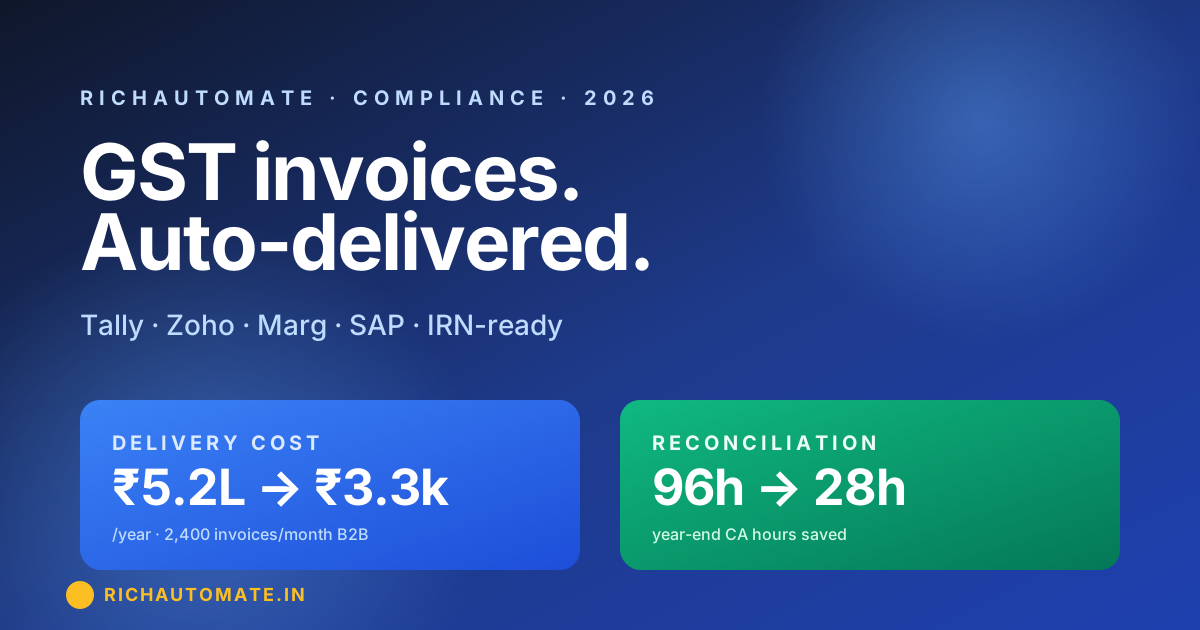
| Year-end reconciliation hours | ~96 | ~28 |
| Per-invoice delivery cost | ~₹18 (mix) | ~₹0.115 |
| Annual delivery cost | ~₹5.2L | ~₹3,300 |
D2C subscription brand (₹4cr revenue, 18,000 monthly invoices)
| Metric | Email-only | WhatsApp + email |
|---|---|---|
| Customer invoice access rate | 34% | 89% |
| "Where is my invoice" tickets / month | ~280 | ~24 |
| Refund-related ticket volume | ~110 | ~32 |
The B2B GSTIN Capture Workflow
T+0:    B2B customer pays for service / product
T+30s:  Utility template fires:
        "Need GST invoice? Share your GSTIN below.
        Skip if not required."
        Flow form with GSTIN field

Customer submits GSTIN:
T+1s:   Backend validates via GSTN portal API
        (validate format + active status)

If valid:
T+5s:   Invoice generated with GSTIN
        Utility template fires with PDF link + GSTIN echo

If invalid / expired:
T+5s:   Utility template:
        "GSTIN [XXXXXXX] is not active.
        Please verify or skip."
        Quick-replies: [Re-enter] [Skip — no GST]

If skipped:
T+5s:   B2C invoice generated (no GSTIN)
        Utility template with PDF link
Tally / Zoho / Marg / SAP Integration Patterns
| System | Trigger | Integration approach |
|---|---|---|
| Tally Prime | Tally Connector + ODBC | Polling-based; 1-5 min latency |
| Zoho Books | Webhook on invoice.created | Real-time |
| Marg ERP | Marg API + webhook | Real-time |
| SAP B1 / S4 | SAP Cloud Connector + webhook | Real-time enterprise |
| Custom ERP | Generic webhook on invoice generation | Real-time |
E-Invoicing + IRN Workflow
Indian GST e-invoicing (B2B, B2G, exports) requires Invoice Reference Number (IRN) generation via Invoice Registration Portal (IRP). Workflow on WhatsApp:
- Invoice generated in ERP with all mandatory fields.
- ERP submits to IRP (NIC or GSP) → returns IRN + signed QR code.
- IRN-bearing invoice PDF generated.
- WhatsApp utility template fires with tokenised IRN-PDF link + IRN number in body for visibility.
- Customer accesses → IRN + QR code visible for input-credit verification.
Mandatory for businesses with annual turnover above ₹5cr (as of 2026 threshold). WhatsApp delivery is the customer-facing leg; IRN generation happens in ERP / GSP.
Get the DPDP WhatsApp checklist
A founder-led WhatsApp reply with the DPDP consent + audit-log checklist for WhatsApp Business messaging. India-hosted. No spam.
Operating Rule
For Indian B2B brands above ₹5cr annual turnover, WhatsApp invoice delivery typically pays back the integration cost within 30 days through reduced reconciliation effort + GSTIN-discrepancy resolution alone. The compounding effect: faster invoice acknowledgement → faster GSTR-1 / GSTR-3B reconciliation → faster customer input credit → faster collection cycles. Add this on top of the existing ERP, don't replace anything.
Compliance Specifics
- GST law mandates PDF / electronic invoice retention 6 years. WhatsApp delivery doesn't replace storage — store invoices in Indian-region object storage with 6-year retention; WhatsApp is the delivery surface.
- Tokenised invoice links must expire. Don't send public PDF links — use signed URLs that expire in 7-30 days. Customer authenticates on tap (OTP or login) to view.
- DPDP Act 2023. Invoice data is sensitive (PAN / GSTIN / amount). Capture explicit opt-in for invoice-via-WhatsApp at customer onboarding. Audit-log retention 6 years (GST) + 5 years (DPDP).
- E-invoicing IRN mandate above ₹5cr turnover. Backend must integrate with IRP (NIC / Govt GSP) before sending invoice PDFs to customers.
- TDS / TCS notifications. If TDS deducted on B2B sale, accompanying utility template informs customer. Form 26Q / 27Q reconciliation eased.
The Five Anti-Patterns That Crash GST Invoice Delivery
- Sending invoice PDFs as direct attachments inside chat body. Heavy attachments hit Meta limits + load slowly on weak connections. Always send tokenised links.
- Skipping GSTIN validation before invoice issue. Wrong GSTIN means customer can't claim input credit + amendment costs ~₹500-₹2,000 in CA hours per invoice. Validate against GSTN portal at capture moment.
- Not renewing tokenised links on customer request. Customer comes back 60 days later wanting invoice → original token expired → support ticket. Build "regenerate invoice link" self-serve path.
- Mass-broadcasting invoice copies to wrong customer numbers. Mismatched customer-to-phone mapping = data leakage. Always validate customer + phone at order capture.
- Using marketing templates for invoice delivery. Invoice is utility, not marketing. Marketing categorisation triggers higher per-message cost (₹0.96 vs ₹0.115) + may breach Meta policy (deceptive categorisation).
Tooling Reference
| Layer | Component |
|---|---|
| WhatsApp BSP | Cloud API + utility templates |
| ERP / accounting | Tally / Zoho Books / Marg / SAP / custom |
| E-invoicing IRP integration | NIC IRP direct OR GSP (ClearTax / IRIS / Masters India) |
| GSTIN validation | GSTN portal API or GSP search-API |
| PDF storage | AWS S3 / GCS Mumbai / Azure India — 6-year retention |
| Tokenised link generation | Backend signing + expiry tracking |
Three Real Indian Adoption Examples (Anonymised)
- B2B distributor (electrical components, ₹14cr revenue). Tally Prime + WhatsApp utility templates. Invoice receipt 22% → 91%. Year-end reconciliation hours 96 → 28. Annual delivery cost ₹5.2L → ₹3.3k.
- D2C wellness subscription (₹4cr revenue). Zoho Books + WhatsApp. "Where is my invoice" tickets 280 → 24. Customer satisfaction with invoice handling +18 NPS points.
- SaaS firm (B2B, ₹22cr ARR). Custom ERP + GSTIN-capture flow on WhatsApp. B2B customer GSTIN-accuracy 78% → 96%. Reduced GSTR-1 mismatches and faster customer input-credit claims.
Run GST invoice delivery on RichAutomate.
Pre-built integrations for Tally / Zoho Books / Marg / SAP. GSTIN-capture Flow form with real-time GSTN-portal validation. IRN-PDF tokenised delivery with signed URLs + expiry. Audit-log retention 6 years per GST law. Invoice link regeneration self-serve flow. 14-day trial.
Related reading
- WhatsApp for GST 2.0, IMS and E-Invoicing India 2026: Invoice Delivery + IMS Accept/Reject Nudges + GSTR-2B Reconciliation
- WhatsApp + AI Receipt OCR for SMB GST India 2026: Tally Zoho Marg Vyapar IRP GSTR-2B MSME-SAMADHAAN Pathway
- WhatsApp for GST Composition Dealers + CBIC + e-Invoice IRP India 2026: CMP-08, GSTR-4, Transition Pathway
- WhatsApp GST 2.0 IMS Invoice Reconciliation for B2B India 2026
- DPDP Act WhatsApp Compliance Checklist India 2026