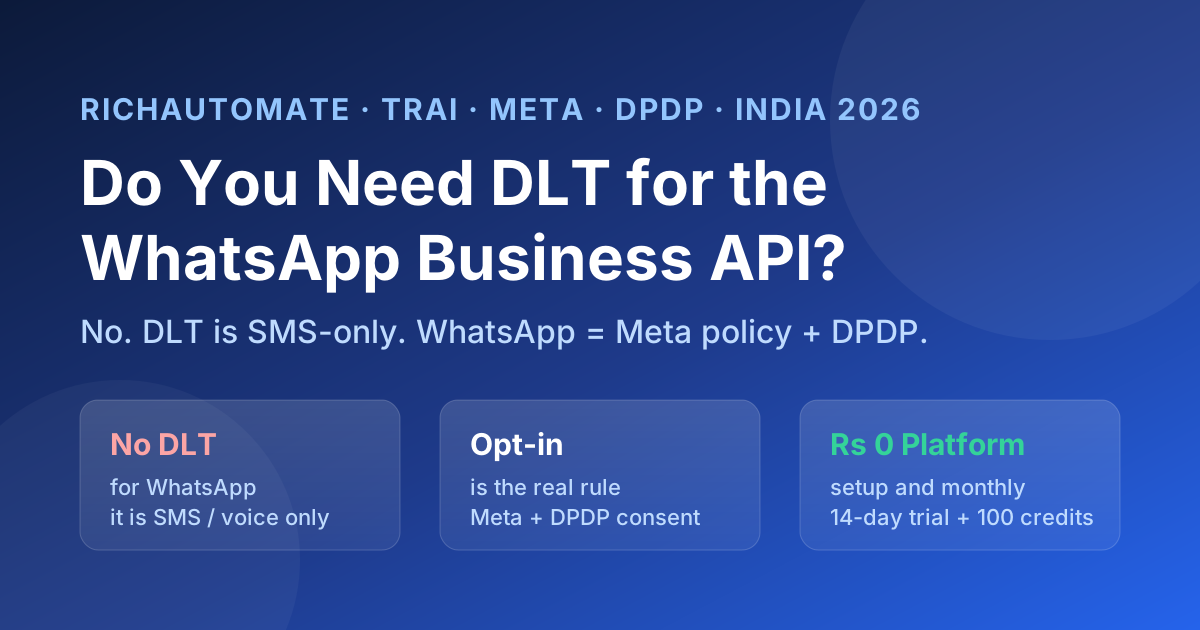
Do you need DLT registration to send WhatsApp Business API messages in India? Short answer: no. DLT (the Distributed Ledger Technology registration mandated by TRAI under the TCCCPR for SMS and voice) does not apply to WhatsApp. WhatsApp runs on Meta's global platform and is governed by Meta's WhatsApp Business Messaging Policy and India's Digital Personal Data Protection (DPDP) framework — not by TRAI's DLT regime. This is one of the most common misconceptions among Indian businesses migrating from bulk SMS, where DLT sender-ID and template registration on operator portals is mandatory. This answer-first guide explains exactly why DLT does not extend to WhatsApp, what compliance does apply instead, and where the genuine obligations sit. Treat every regulatory specific below as "verify as of 2026" — Indian telecom and data-protection rules move quickly, and this is operational guidance, not legal advice.
The 10-second answer. No DLT registration is required for WhatsApp Business API. DLT is a TRAI/TCCCPR framework specific to SMS and voice traffic carried by Indian telecom operators. WhatsApp is an over-the-top (OTT) Meta service, so its rules are Meta's Business Messaging Policy plus the DPDP Act — opt-in/consent, template approval and quality-rating discipline, not a DLT principal-entity or sender-ID registration. Verify the current position as of 2026.
Why doesn't DLT apply to WhatsApp?
DLT exists because SMS and voice ride on the licensed telecom network that TRAI regulates. To curb spam, the TCCCPR (Telecom Commercial Communications Customer Preference Regulations) requires every commercial sender to register as a principal entity on a telecom operator's DLT portal, register headers/sender IDs, and pre-register message templates and consent. WhatsApp does not ride that network — it is an internet-based messaging app owned by Meta, sending over data, not over the operator's SMS channel. Because the message never touches the regulated SMS/voice path, the DLT registration that governs that path simply does not reach it. The regulator for WhatsApp business messaging is effectively Meta's own policy layer plus India's data-protection law, which is why there is no WhatsApp equivalent of a DLT principal-entity number.
So who actually regulates WhatsApp business messaging in India?
Two layers, neither of them TRAI's DLT. Treat these as the surfaces to verify as of 2026.
| Layer | What it governs for WhatsApp | Your obligation |
|---|---|---|
| Meta WhatsApp Business Messaging Policy & Commerce Policy | What you may send, opt-in requirements, template approval, quality rating, prohibited content | Get valid opt-in, use approved templates, keep quality high |
| DPDP Act & rules (data protection) | Consent, purpose limitation, data minimisation, retention, grievance, breach notice | Lawful basis for every contact; honour opt-out and data rights |
| TRAI / TCCCPR (DLT) | SMS and voice only — not WhatsApp | None for WhatsApp; still applies if you also send SMS |
For the SMS/voice side, our TRAI, TCCCPR and DLT for WhatsApp explainer maps the boundary in detail, and the DPDP Act WhatsApp compliance checklist covers the data-protection obligations that genuinely do apply.
The customer LTV calculator turns repeat rate and margin into a per-customer number you can budget against.
I already have DLT for SMS — do I need to register again for WhatsApp?
No. Your existing DLT registration covers your SMS and voice campaigns and has no bearing on WhatsApp. You do not re-register your DLT principal entity, your headers or your SMS templates anywhere for WhatsApp. WhatsApp has its own, separate, parallel concept: message template approval inside Meta, where each template you want to send proactively (outside the 24-hour service window) is submitted to Meta for review and categorised as marketing, utility or authentication. That is a Meta process, not a TRAI/operator process, and it replaces — for WhatsApp — the role DLT template registration plays for SMS. So you run two parallel compliance tracks if you use both channels: DLT for SMS, Meta template approval for WhatsApp.
Is WhatsApp marketing legal in India without DLT?
Yes, provided you meet the rules that do apply. Sending WhatsApp marketing without DLT is not a TRAI violation because DLT never governed WhatsApp. But "legal" is not automatic — it depends on Meta's policy and DPDP. The non-negotiables: you must have a valid, demonstrable opt-in before sending marketing or utility template messages; you must use Meta-approved templates; you must honour opt-out/stop requests; and you must treat personal data lawfully under DPDP. Skipping DLT is fine; skipping opt-in is not. Our DPDP opt-in compliance guide details what a defensible opt-in looks like.
Get the DPDP WhatsApp checklist
A founder-led WhatsApp reply with the DPDP consent + audit-log checklist for WhatsApp Business messaging. India-hosted. No spam.
Do I need opt-in / consent to send WhatsApp messages?
Yes — opt-in is the real compliance backbone for WhatsApp, far more important than the DLT question. Meta requires that you collect users' explicit consent to receive messages from your business on WhatsApp, through a clear opt-in where the user understands they are agreeing to hear from you on WhatsApp specifically. Under DPDP, consent must be free, specific, informed and capable of being withdrawn. In practice that means a checkbox or click that names WhatsApp, a record of when and how consent was given, separate consideration for marketing versus transactional messaging, and a frictionless way to opt out. This is where Indian businesses actually get into trouble — not from missing DLT, but from blasting un-opted-in lists, which tanks quality rating and risks restriction. Verify the operative opt-in standards as of 2026.
Can I be fined or banned for sending WhatsApp promotions without opt-in?
The risks are real but they come from Meta and DPDP, not from TRAI/DLT. On the Meta side, sending to people who did not opt in drives blocks and "not useful" reports, which lower your quality rating and can lead to messaging-limit downgrades or account restriction. On the DPDP side, processing personal data without a lawful basis can attract regulatory consequences under the Act's penalty framework. Note an honest caveat: no provider can promise "no ban" — staying safe is about consent hygiene, relevant content and quality rating, not a guarantee. The way to protect deliverability is disciplined opt-in and useful, expected messaging. Our template approval and rejection guide helps keep your sends inside policy.
What about WhatsApp template approval — is that like DLT template registration?
It plays a similar role but is a wholly separate system. For SMS, DLT requires you to pre-register templates on the operator portal. For WhatsApp, Meta requires you to submit each proactive template for approval and assigns it a category (marketing, utility, authentication) that also determines pricing. There is no overlap or transfer between the two — a DLT-approved SMS template means nothing to Meta, and a Meta-approved WhatsApp template means nothing to the DLT portal. If you run both channels, you maintain both libraries independently. Our WhatsApp template categories guide explains how Meta classifies and prices each one.
Run a compliant WhatsApp programme on RichAutomate
RichAutomate handles the compliance surface that actually applies to WhatsApp — Meta template submission and category management, opt-in capture, opt-out handling and quality-rating-friendly sending — without any DLT registration, because none is required for WhatsApp. The platform layer is flat: ₹0 platform fee, ₹0 setup, ₹0 monthly. On Client Pay you pay only ₹0.10 per message plus Meta's own per-conversation charge billed to you directly by Meta at Meta's rates; on SaaS Pay it is an all-in ₹1.20 per marketing conversation and ₹0.30 per utility conversation. There is a 14-day free trial with 100 credits. Keep Meta as the source of policy truth, keep your opt-in records clean under DPDP, and verify the current TRAI/TCCCPR boundary, Meta policy and DPDP rules as of 2026 — this is operational guidance, not legal advice. See the full pricing page for details.
Skip DLT — but never skip opt-in
You do not need DLT registration to run the WhatsApp Business API in India, because DLT is TRAI's SMS-and-voice framework and WhatsApp is a Meta OTT service governed by Meta's policy and the DPDP Act instead. What you genuinely need is valid opt-in, Meta-approved templates, opt-out handling and a healthy quality rating — the things that actually keep your account safe and your messages delivered. RichAutomate runs that whole compliant stack with no DLT step and flat pricing: ₹0 platform fee, ₹0 setup, ₹0 monthly — Client Pay at ₹0.10 per message with Meta conversation charges billed direct by Meta, or SaaS Pay at ₹1.20 marketing / ₹0.30 utility all-in. Start the 14-day free trial with 100 credits, WhatsApp us at 918160311319, or book a 30-minute walkthrough at https://calendly.com/inrichdaddy/30min. (TRAI/TCCCPR, Meta policy and DPDP rules change; verify the current position as of 2026. This is operational guidance, not legal advice, and no provider can guarantee against account restriction.)
Start your 14-day free trial → · See full pricing · Read the TRAI/DLT explainer