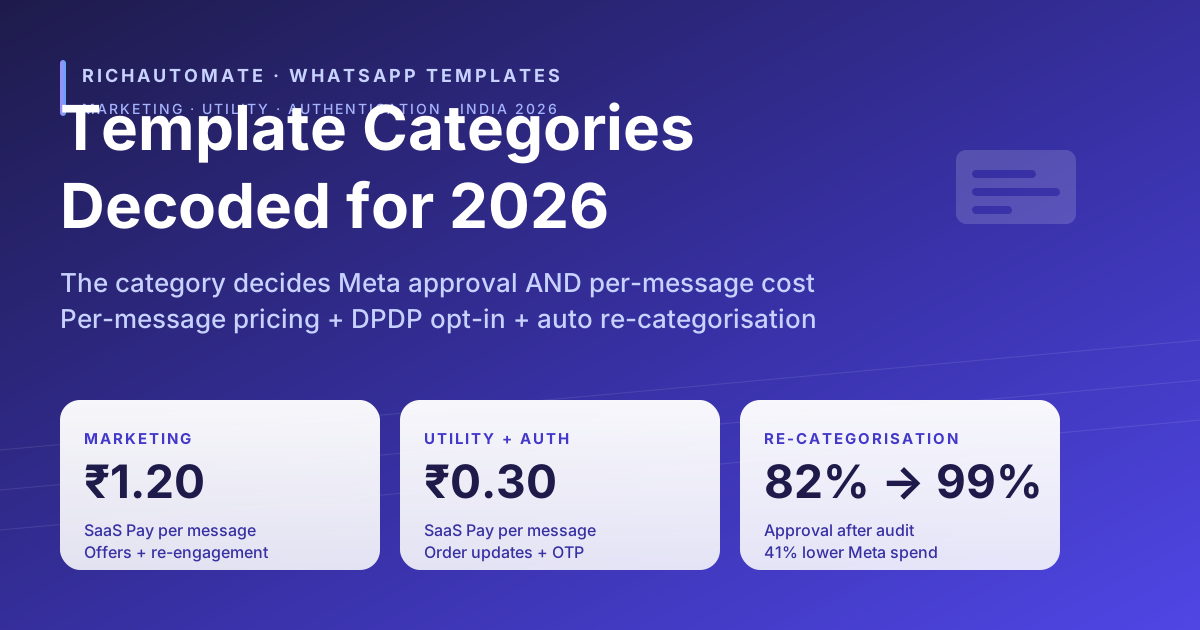
WhatsApp message templates fall into three categories — Marketing, Utility, and Authentication — and the category you pick decides both whether Meta approves the template and how much each conversation costs. Marketing templates carry promotions and cost the most; Utility templates carry transactional updates tied to an action the user took; Authentication templates carry one-time passcodes. On RichAutomate (₹0 platform, ₹0 setup, ₹0 monthly), Client Pay tenants pay a flat ₹0.10/message plus Meta's own per-conversation fee, while SaaS Pay tenants pay ₹1.50 per marketing message and ₹0.50 per utility or authentication message — all-inclusive. As of June 2026, Meta bills per delivered template message, not per 24-hour conversation.
The Three WhatsApp Template Categories Explained
- Marketing. Anything promotional — offers, product launches, festival sales, abandoned-cart nudges, newsletters, re-engagement, win-back. If the message sells, upsells, or brings a lapsed customer back, Meta classifies it as Marketing. It is the highest-priced category and the one most likely to be rejected if it sneaks promotional language into a non-marketing template. Requires explicit opt-in under the DPDP Act 2023 and Meta's Business Messaging Policy.
- Utility. Transactional messages tied to a specific action or transaction the customer already initiated — order confirmations, shipping updates, delivery ETAs, payment receipts, appointment reminders, account alerts, ticket status. The trigger must be a real event (an order placed, a payment made, a booking confirmed). Utility cannot carry any promotional content; mixing in a discount code re-classifies it as Marketing.
- Authentication. One-time passcodes and login/verification codes only. These use Meta's fixed authentication template format (a code plus an optional copy-code or one-tap autofill button) and cannot include marketing copy, links, or extra context. Built for OTP delivery during signup, login, password reset, and transaction verification.
The category is decided by content, not by your intent. Meta's classifier reads the template body and reassigns the category if your content does not match the one you selected. A "Utility" template that says "Your order shipped — use code FEST20 for 20% off your next buy" will be re-categorised to Marketing (and billed at the higher rate) or rejected outright. As of June 2026, automatic category reassignment happens at review time and on edits, so picking the right category up front is what keeps both your approval rate and your per-message cost predictable.
WhatsApp Template Categories Compared (as of June 2026)
| Attribute | Marketing | Utility | Authentication |
|---|---|---|---|
| Purpose | Promotions, offers, re-engagement, newsletters | Transactional updates tied to a user action | One-time passcodes / verification codes |
| Trigger | Business-initiated outreach | A specific transaction or event (order, payment, booking) | Login / signup / reset / transaction verification |
| Opt-in required | Yes — explicit, DPDP-grade consent | Yes — opt-in still required under Meta policy | Yes — user requested the code |
| Promotional content allowed | Yes | No | No |
| Buttons / links | Up to quick-reply + URL + call buttons | Quick-reply + URL buttons (no promo) | Copy-code / one-tap autofill only |
| Relative Meta cost | Highest | Lower | Lower (India OTP rate) |
| RichAutomate SaaS Pay rate | ₹1.50 / message | ₹0.50 / message | ₹0.50 / message |
| RichAutomate Client Pay rate | ₹0.10 / message + Meta direct | ₹0.10 / message + Meta direct | ₹0.10 / message + Meta direct |
| Typical rejection cause | Misleading offer, missing opt-in, broken variable | Promotional language inside a utility body | Extra copy beyond the code + button |
How Meta Prices Each Category in India (as of June 2026)
WhatsApp moved from per-conversation pricing to per-message pricing for template messages. That means you are billed for each delivered Marketing, Utility, or Authentication template message — not for a 24-hour conversation window. The practical effect for Indian businesses:
The conversation window cost calculator is the quickest way to see what the window rules do to your monthly bill.
- Marketing is the most expensive per-message category and should be reserved for messages with a clear commercial payoff. Batch sends, segment tightly, and never send marketing without opt-in.
- Utility is materially cheaper, which is why moving order, payment, delivery, and appointment messages into properly-built Utility templates is the single biggest WhatsApp cost lever for most Indian D2C and services brands.
- Authentication uses Meta's India-specific OTP pricing and is the workhorse for fintech, BFSI, and any login-heavy app. Keep the body to the code plus an optional autofill button to stay compliant and approved.
- Service / free-form replies (your agent replying inside the 24-hour customer-service window, with no template) remain free of Meta template charges — only template-initiated messages are categorised and billed.
Cohort number — Indian D2C brand template re-categorisation. A mid-size Indian D2C brand (1.4 lakh monthly template sends across order, shipping, payment, win-back, and OTP) audited its template library and found 38% of transactional sends were misfiled as Marketing. After re-building them as compliant Utility templates: monthly Meta template spend down 41%, template approval rate 82% → 99%, average review time 9h → under 2h, OTP autofill success 71% → 94%, and zero category-reassignment surprises across a full billing cycle. Net effect — same message volume, materially lower bill, faster approvals.
Get a 1-minute BSP audit on WhatsApp
Drop your WhatsApp number — we line-item your current invoice against Meta India rates in under 60 seconds. India-hosted, DPDP-compliant.
Choosing the Right Category — A Decision Guide
- Is the message a login/verification code and nothing else? Use Authentication. Code + optional copy-code or one-tap autofill button only.
- Did the customer just do something (order, pay, book, raise a ticket) and you are updating them about that exact thing? Use Utility. No offers, no discount codes, no upsell.
- Are you initiating outreach to sell, promote, re-engage, or announce? Use Marketing — and confirm you hold explicit opt-in.
- Does the body mix a transactional update with a promo line? Split it. Send the Utility update, then a separate Marketing message — combining them gets the whole thing priced and reviewed as Marketing.
- Unsure? Default to the stricter category. Meta will upgrade Utility-to-Marketing on its own if content warrants, but it will not silently downgrade — so building lean Utility templates protects your cost.
Need ready-to-copy Utility examples? Start with these booking confirmation message templates for appointments and reservations, service reminder message templates for due-date and maintenance nudges, and apology message templates for customers for when an order or service goes wrong.
Common Template-Category Mistakes Indian Businesses Make
- "Order shipped + here's 10% off" in one Utility template. The discount line forces Marketing classification and the higher rate. Keep the two messages separate.
- OTP templates padded with branding or links. Authentication templates must be code-plus-button. Extra copy triggers rejection.
- Sending Marketing without DPDP-grade opt-in. The DPDP Act 2023 plus Meta's Business Messaging Policy require explicit, purpose-bound consent before any marketing template — missing consent risks quality-rating damage and number bans.
- Treating category as a billing-only choice. Category drives approval, deliverability, quality rating, and cost simultaneously. Get it right at template-creation time, not after rejection.
- Ignoring per-message pricing. Since Meta bills per delivered template message (as of June 2026), high-frequency Marketing blasts compound fast — segment and earn the send.
Authority References
- Meta WhatsApp Business Platform — Template Categories & Guidelines: official definitions for Marketing, Utility, and Authentication, plus automatic category reassignment rules. developers.facebook.com — Message Templates
- Meta — WhatsApp Business Pricing (per-message): current category-based per-message pricing model and India rates. developers.facebook.com — Pricing
- Meta Business Help — Template message categorisation: how content determines category and what causes reassignment. business.whatsapp.com — Business Platform
- DPDP Act 2023 (MeitY): consent and purpose-limitation requirements that govern Marketing opt-in for WhatsApp in India. meity.gov.in — Data Protection Framework
Template categories are approved by Meta, not by any telecom registry — so you do not need DLT registration for the WhatsApp API.
Ship the right template category on RichAutomate.
Build Marketing, Utility, and Authentication templates with category guard-rails, opt-in capture, and live cost preview before you submit to Meta — so you stop paying Marketing rates for transactional messages. ₹0 platform fee, ₹0 setup, ₹0 monthly. Client Pay ₹0.10/message plus Meta direct, or SaaS Pay ₹1.50 marketing + ₹0.50 utility/authentication, all-inclusive. Start free with a 14-day trial and 100 message credits. WhatsApp +91 81603 11319 or book a 30-minute walkthrough.
New to WhatsApp automation? Start with our step-by-step guide to getting the WhatsApp Business API for the full picture, then come back to apply it here.
For ready-to-adapt Marketing-category copy, browse our promotional WhatsApp message examples for India.
For a worked Utility example, see these WhatsApp payment confirmation templates and how an added offer flips them to Marketing.
For worked examples of an intro written as a Marketing template, and one written as Utility onboarding, see these introduction message templates for WhatsApp.
\nRelated reading
- WhatsApp template rejection fixes — what to do when Meta bounces your marketing or utility template
- WhatsApp Business API cost in India 2026 — the per-category rates behind marketing vs utility vs authentication
- state of WhatsApp API pricing in India 2026 — research data on how category pricing shifted this year
Sending login or verification codes? Compare channels in WhatsApp OTP vs SMS OTP.
For a festive example of marketing vs utility categories in practice, see these Chhath Puja WhatsApp message templates.