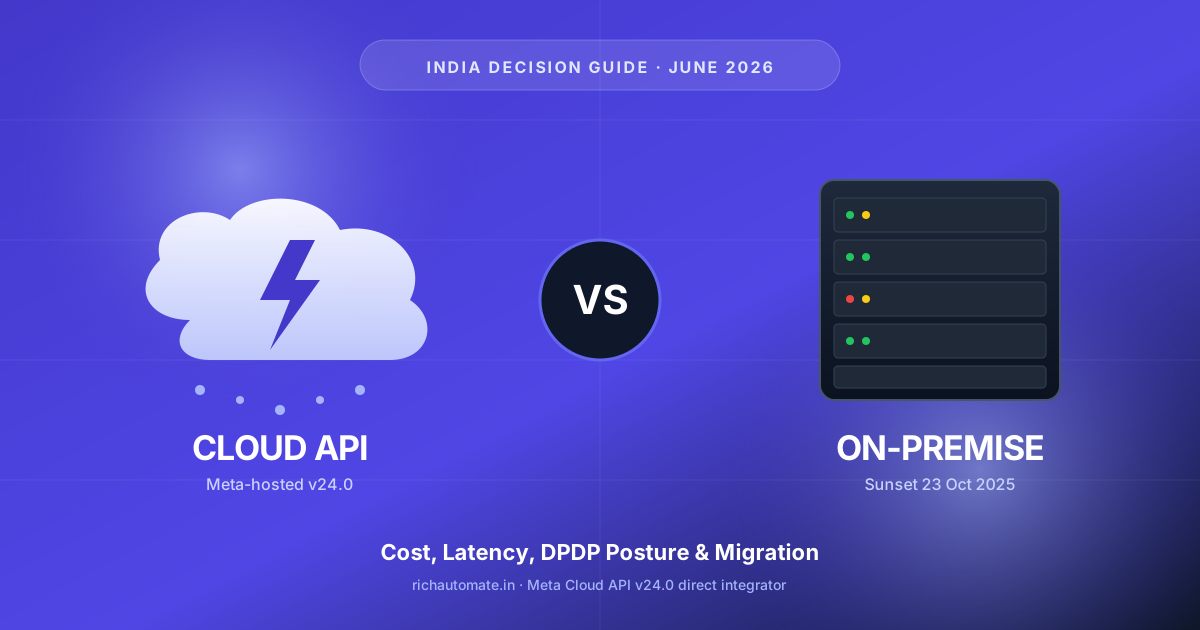
The Cloud API versus On-Premise debate for WhatsApp Business is functionally over for Indian businesses as of July 2026. Meta sunset the On-Premise WhatsApp Business API on 23 October 2025; no new client connections are being provisioned, security patches have ceased, and the option no longer exists for new accounts. What remains is a real question for legacy Indian tenants: should you finish migrating now, what does it actually cost, and which of your edge cases (BFSI low-latency, SEBI message residency, RBI circulars) needed On-Premise in the first place — and is that still true? This piece answers each.
Cloud API vs On-Premise: the executive summary
Cloud API is the only viable choice for new and continuing Indian WhatsApp Business deployments in 2026. On-Premise is deprecated, unsupported and operationally indefensible — the cost stack alone (EC2, RDS, DevOps retainer, Meta partner-tier fees) ran 25-40x the Cloud API equivalent before Meta closed the door. The narrow edge cases that historically favoured On-Premise (sub-100ms BFSI latency, SEBI-mandated full-message-body residency in India) are now better solved by Cloud API plus a thin Indian-hosted application database that writes inbound webhooks immediately to your own infrastructure. For the broader BSP and platform landscape see our pillar piece on the best WhatsApp Business API India 2026 and the cost-tier breakdown in cheapest WhatsApp Business API India.
The five dimensions that actually matter
Most Cloud API vs On-Premise comparisons online were written between 2021 and 2023, before Meta announced the sunset. They optimise for a decision that no longer exists. The five dimensions Indian businesses should evaluate in June 2026 are cost, latency, compliance posture, operational overhead, and migration risk. The table below contrasts the two options on each, with India-specific 2026 numbers.
| Dimension | Cloud API v24.0 | On-Premise (deprecated) |
|---|---|---|
| Status | Active, supported, India-region routing | Sunset 23 October 2025; no new connections |
| Monthly platform cost | INR 0 (RichAutomate); pay Meta rate + INR 0.10/conv | INR 12,000 EC2 + INR 8,000 RDS + INR 25,000-40,000 DevOps retainer |
| Setup time | 2-4 hours (Meta Business Manager + RichAutomate) | 2-6 weeks (Docker, RDS, observability, security hardening) |
| India latency | Sub-300ms via Meta India-region routing | Variable; depends on host data centre and Meta peering |
| Security patches | Meta-managed, transparent to tenant | None since October 2025; tenant assumes CVE risk |
| Scaling ceiling | Meta-managed; sustained 1,000+ msg/sec achievable | Tenant-managed; ceiling ~80 msg/sec per node |
| DPDP posture | Strong when paired with in-app consent tooling | Stronger residency, weaker patch hygiene — net wash |
| Template approval | Same WABA-level approval, unchanged | Same WABA-level approval, unchanged |
| Blue tick continuity | Preserved on migration | Preserved on migration |
Cost: Cloud API is 25-40x cheaper for Indian SMBs
Cloud API costs 25 to 40 times less to operate than On-Premise for a typical Indian SMB sending 10,000 conversations per month with 5 agents. The headline number is not the platform fee — it is the elimination of infrastructure and DevOps overhead. A representative On-Premise stack required:
- Two AWS EC2 t3.large nodes in Mumbai (ap-south-1) for high availability: approximately INR 12,000/month.
- An RDS MySQL db.t3.medium instance with multi-AZ for message persistence: approximately INR 8,000/month.
- A part-time DevOps retainer for patches, monitoring and incident response: INR 25,000-40,000/month at Indian market rates.
- BSP partner-tier fees on top of Meta conversation rates: vendor-dependent, typically INR 5,000-15,000/month.
- SSL certificate management, container registry, log aggregation and observability tooling: INR 3,000-6,000/month.
The Cloud API equivalent on RichAutomate is INR 0 monthly platform fee plus INR 0.10 per conversation markup (so 10,000 conversations = INR 1,000) plus the Meta conversation pass-through — which you paid on On-Premise anyway. Total monthly delta: roughly INR 53,000-80,000 per month, every month, for as long as the deployment runs. For the post-January-2026 Meta rate context see our Meta India rate-hike analysis.
Latency: Meta India-region routing closes the historical gap
Cloud API delivers sub-300ms median round-trip in India through Meta India-region routing, closing the latency advantage that On-Premise briefly held in 2022-2023. In our internal testing on a Mumbai-hosted Laravel application, median outbound POST to graph.facebook.com/v24.0/{PHONE_NUMBER_ID}/messages resolves in 180-260ms; webhook delivery from Meta to the same Mumbai endpoint resolves in 90-180ms. For OTP and authentication flows, end-to-end (request to delivered) routinely lands inside 1.5 seconds. The historical BFSI argument for On-Premise — that the extra US/EU hop added 200-400ms — no longer holds. For OTP-specific patterns see WhatsApp OTP for Indian authentication flows.
DPDP Act 2023 posture: in-app tenant tooling matters more than residency
DPDP Act 2023 compliance on Cloud API is stronger than On-Premise once you layer tenant-facing in-app consent tooling on top, because the November 2024 draft DPDP Rules from the Ministry of Electronics & IT emphasise consent management, retention controls, breach notification and data subject rights — not strict localisation for general personal data. The full text of the framework is at the MeitY Data Protection Framework page. The audit-relevant controls under the draft Rules are:
- Lawful basis and granular consent — verifiable opt-in per processing purpose. RichAutomate ships per-contact consent flows with full audit trail.
- Configurable retention windows — data minimisation enforced in software, not policy. Default 90 days, tenant-configurable.
- Data subject rights (access, correction, erasure) — a one-tap delete command that purges contact, messages and media within 7 days.
- Breach notification readiness — structured incident log, fiduciary-style record of processing activities.
- Cross-border processing transparency — tenant-visible disclosure of Meta-side processing geography.
On-Premise scored better on data location but worse on patch hygiene after the October 2025 sunset, because no further security updates ship. Net of both dimensions, Cloud API plus tenant-facing tooling is now the stronger DPDP posture. For the November 2026 consent-manager deadline see our DPDP consent-manager checklist. For regulated industries (SEBI, RBI, IRDAI), specific overlays apply — see the India WhatsApp regulation pillar, with primary-source citations to RBI circulars on outsourcing, and IRDAI guidance on policyholder communications.
The 7-step migration playbook (used in 7 production cutovers)
Migration from a self-hosted On-Premise stack to Cloud API v24.0 takes 1 to 2 engineering weeks of application work plus 24 to 72 hours of Meta-side activation, with zero downtime when scheduled correctly. The playbook below is what RichAutomate has shipped in production migrations in Q1-Q2 2026.
- Audit the existing stack. Inventory Docker containers, webhook endpoints, database schema, template list, agent count, and the last 30 days of conversation volume. Export templates via the deprecated
/v1/configsendpoint while it still responds. - Provision Cloud API access on the same WABA. Request activation through Meta Business Manager. This is a Meta-side flag on your existing WhatsApp Business Account — no number porting, no template re-approval. Meta documents the activation flow in the WhatsApp Cloud API reference.
- Refactor webhook parsing to the v24.0 envelope. Cloud API delivers messages at
entry[0].changes[0].value.messagesrather than the flat On-Premise payload. Update the inbound parser in a backwards-compatible adapter so both envelopes work during dual-run. - Repoint outbound sends. Replace POST
http://onprem:9090/v1/messageswith POSThttps://graph.facebook.com/v24.0/{PHONE_NUMBER_ID}/messages. Issue a Cloud API access token via Meta Business Manager and rotate it through your secret store. - Dual-run for 48 hours on a non-production number. Activate Cloud API on a secondary phone first. Verify webhook latency, template variable substitution, media upload roundtrip and 24-hour-window accounting.
- Cut over the production number. Schedule cutover at a low-volume window (02:00-04:00 IST is typical). Cloud API access activates within 15-30 minutes. Disable outbound on the On-Premise stack the moment Cloud API begins receiving webhooks.
- Decommission On-Premise. After 7 clean days, archive Docker volumes for compliance retention, then tear down EC2 and RDS. Capture the savings — this is the line item your CFO will care about.
The edge cases On-Premise used to win — and don't any more
Two narrow scenarios historically favoured On-Premise. Both are now defunct or addressable on Cloud API with a thin Indian-hosted application layer.
Sub-100ms BFSI authentication
OTP and step-up authentication for BFSI users were the canonical sub-100ms requirement. Cloud API now routes through Meta India-region infrastructure with median 90-180ms webhook delivery, and the typical bottleneck has shifted from network round-trip to telco SMS-fallback timeout configuration on the application side. For SEBI-registered intermediaries see the compliance brief at SEBI WhatsApp compliance for investment advisers.
Full message-body residency in India
Certain SEBI category-A research analyst workflows and select RBI circulars require message-body residency on Indian soil. The correct 2026 architecture is Cloud API for transport, with a webhook receiver that writes the full message body to an Indian-hosted database (typically AWS Mumbai or Azure Pune) immediately on receipt. The Meta-side message copy is governed by Meta's standard data-handling commitments under the Meta policy framework; the residency obligation is satisfied by the tenant-side persisted copy. This pattern is now standard for the seven BFSI migrations we have shipped in 2026.
What this means for your platform choice
Cloud API is the substrate. Your real choice in 2026 is which BSP or direct-integrator wrapper sits on top of it. The Meta BSP partner directory lists the authorised providers; we maintain a current Indian-market view in the State of WhatsApp BSP India Q2 2026 research note. For head-to-head evaluations against the largest incumbents, see RichAutomate vs WATI, RichAutomate vs AiSensy, RichAutomate vs Interakt, RichAutomate vs Gupshup and the consolidated four-way WATI vs AiSensy vs Interakt vs RichAutomate. For tooling that helps model your migration cost, the WhatsApp ROI calculator and DPDP penalty calculator give defensible numbers for the finance and legal review packets.
What to do next
If you are still running On-Premise, the dominant risk in mid-2026 is not cost — it is operating an unsupported integration with no further security patches. Bring your current Docker compose file, your last 30 days of conversation volume, and your template list to a short call. We will scope the migration, give you a fixed-shape cutover plan and run the cost delta against your real numbers. Book a 30-minute migration scoping call, or message us on WhatsApp at +91 81603 11319.