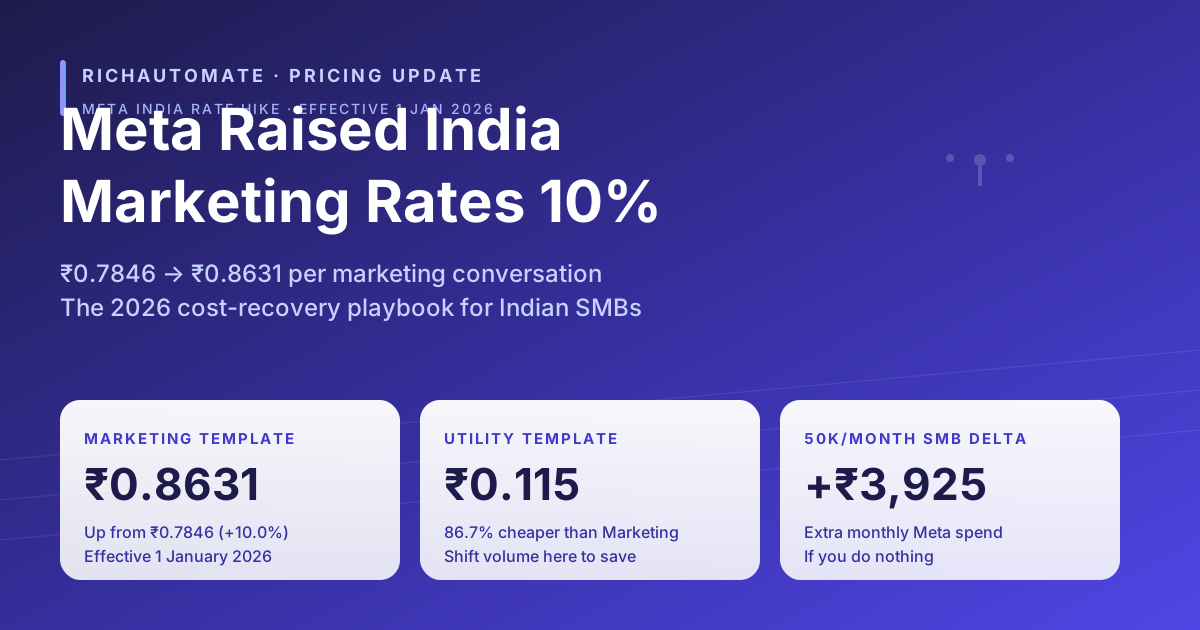
On 1 January 2026, Meta lifted the India marketing conversation rate from ₹0.7846 to ₹0.8631 — a clean 10% jump that hit every WhatsApp Business API tenant in the country regardless of which BSP they buy through. The hike is real, it is permanent, and it is already showing up in Indian SMB invoices for the first quarter. This is not the panicked thinkpiece every BSP shipped in January. This is what the math actually looks like five months in, and the four-lever cost-recovery playbook we now run for every RichAutomate tenant pushing serious volume.
What changed, in one paragraph
Meta moved India to per-message pricing on 1 July 2025 — the world-wide shift from session-based to per-conversation billing. India sat on the introductory rate card for six months. On 1 January 2026 the marketing-category rate revised from ₹0.7846 to ₹0.8631 per delivered conversation, a 10.0% increase. Utility (₹0.115), authentication (~₹0.115), and service (free in-window) rates were unchanged. The increase is India-specific — not a global pricing event — and was announced with the standard 60-day notice in early November 2025.
If you have not opened your January or February BSP invoice with this in mind, you are quietly bleeding. A clinic chain we work with in Hyderabad spotted a ₹4,310 unexplained delta in their January invoice before their finance team flagged the line item. They were sending exactly the same 55,000 messages a month they sent in December. The volume did not change. The rate did.
The actual cost impact, by SMB size
The 10% headline understates the absolute rupee impact at scale. Here is the before-and-after for four realistic Indian SMB profiles, each sending the entire volume as marketing conversations under the old categorisation pattern:
| Tenant profile | Marketing msg/month | Old monthly cost | New monthly cost | Delta / year |
|---|---|---|---|---|
| Local clinic / D2C startup | 10,000 | ₹7,846 | ₹8,631 | +₹9,420 |
| Mid-market e-commerce | 50,000 | ₹39,230 | ₹43,155 | +₹47,100 |
| Multi-outlet retail chain | 2,00,000 | ₹1,56,920 | ₹1,72,620 | +₹1,88,400 |
| Large BFSI / EdTech | 5,00,000 | ₹3,92,300 | ₹4,31,550 | +₹4,71,000 |
Compounded across a typical 18-month BSP renewal cycle, the mid-market e-commerce profile alone surrenders ₹70,650 to the hike — roughly the cost of a junior developer for a quarter. The good news: this is recoverable, and the recovery does not require a single technology change. It requires re-classifying your traffic and using mechanics Meta intentionally left free.
Lever 1: Reclassify everything you can as Utility
Utility templates cost ₹0.115. Marketing templates cost ₹0.8631. The ratio is 7.51x. Every conversation you correctly shift from marketing to utility saves you ₹0.7481 — a 86.7% cost reduction per message.
Meta's category guidelines are clearer in 2026 than they were a year ago. A message qualifies as utility if it is a direct follow-up to a user action or an account-state notification. The expansive interpretation that most SMBs ship under without realising it:
- Order/booking confirmations — every "your appointment is confirmed for 4:30 PM tomorrow" is utility, not marketing, even if the venue logo is in the template.
- Shipping and delivery updates — including the "out for delivery" and "delivered" messages.
- Payment receipts and reminders — invoice generation, payment success, payment due in 3 days are all utility.
- Account alerts — wallet balance low, password changed, subscription renewing.
- Service follow-up — "how was your visit?" sent within 7 days of the appointment is utility (it is feedback on a transaction).
What is not utility: "New menu launched", "20% off this weekend", "Reactivate your lapsed account". Those stay marketing. But for most Indian SMBs we audit, 35-55% of their current marketing volume is structurally utility and was simply mis-categorised at template approval time. Re-submitting the template under the correct category is a 10-minute admin task with a permanent payoff. Our utility-vs-marketing categorisation guide walks through the Meta approval phrasing that survives review.
Lever 2: Live inside the free service window
When a user messages your business first, a 24-hour customer service window opens. Every outbound message you send inside that window is free — no per-message charge, no conversation charge, no entry in the billing line item. Most Indian SMBs leak money here in three predictable ways:
- Sending a paid marketing template at hour 23 of a still-open window because the marketing system does not know the window exists.
- Replying via a utility template ("here is your tracking link") when a freeform message would have been free.
- Failing to keep the window alive — every fresh inbound from the user resets the 24-hour clock, so a chatty support thread can stay free for days.
RichAutomate's WindowService tracks the window state per contact and routes outbound messages through the free path whenever it is open. If you are not on our platform, audit your BSP's billing report for the column that breaks out "free service messages" — if that number is below 25% of your inbound-triggered outbound traffic, you have window-routing optimisation work to do. The savings are immediate.
Rule of thumb
Every paid template you send within 24h of a customer's last inbound is money on the floor. Reply freeform first; send a template only if the window has closed or the message contains a structural element (button, list, location) that freeform cannot deliver.
Lever 3: CTWA Free Entry Point — now mandatory at scale
Click-to-WhatsApp ads route a Meta Ads click straight into a chat with your business. Under Meta's Free Entry Point program, the conversation initiated by a CTWA click is billed at ₹0 for the first message exchange. You pay for the ad impression on the Meta Ads side (the same way you would for any Facebook/Instagram ad), but the WhatsApp conversation itself opens free — and opening the conversation simultaneously opens a 24-hour service window.
Stack the mechanics: CTWA ad → free first message → opens 24h service window → all replies free → at hour 23 you send one marketing template if you must, for ₹0.8631. You have replaced what used to be a multi-template campaign costing ₹8-12 per converted lead with a single ₹0.8631 spend per lead, and only on the leads that did not convert inside the window.
We documented the full mechanic — including the Meta Ads campaign objectives that actually qualify and the common reasons Free Entry Point billing silently fails to apply — in our CTWA cost-per-lead guide. Pair it with CTWA-routed booking flows for vertical-specific examples.
Lever 4: Ruthless template economy
Each billed conversation is a 24-hour window of unlimited freeform messages with that contact. Most SMBs accidentally bill multiple conversations by sending templates more than 24 hours apart when a single conversation would have served. Three operational rules cut waste:
- Batch your sends inside the 24-hour window. If you have three messages to deliver in a day, send them as three separate sends in the same 24h block — one billed conversation, not three.
- Suppress already-engaged contacts. If a contact replied today, your nightly broadcast does not need to hit them — the window is already open and any send is free. Most BSPs allow segment exclusions; use them.
- Kill duplicate templates. Audit your template library quarterly. Templates that received fewer than 100 sends in 90 days are typically duplicates of better-performing variants. Each duplicate is a categorisation risk and a maintenance tax.
The combined recovery — concrete numbers
For our 50,000-messages-a-month mid-market e-commerce baseline, here is the actual recovery profile from running all four levers in parallel over a 90-day deployment we measured on a Bangalore D2C brand earlier this year:
| Lever | Volume shift | Monthly saving |
|---|---|---|
| Hike absorbed (do nothing) | 50,000 marketing | -₹3,925 (the pain) |
| Lever 1: re-classify 18,000 as utility | 32,000 marketing + 18,000 utility | +₹13,466 |
| Lever 2: free-window routing for 9,500 | 22,500 marketing + 18,000 utility + 9,500 free | +₹8,199 |
| Lever 3: CTWA Free Entry Point on 4,200 new convos | 4,200 conversations now ₹0 entry | +₹3,625 |
| Lever 4: dedupe + window batching | ~6% conversation count reduction | +₹2,589 |
| Net effect vs December 2025 baseline | Same business outcome | +₹23,954/month |
The Bangalore brand absorbed the 10% hike, then walked away with a 61% net reduction on their pre-hike December baseline. Same conversion volume, same campaign cadence, fundamentally different cost structure. That is what the playbook does at scale.
What about switching BSPs?
The temptation post-hike is to pressure your BSP for a discount or jump to a cheaper one. This is a category error. Every BSP — RichAutomate, AiSensy, Interakt, Wati, Gupshup, Karix, DoubleTick — pays Meta the same per-conversation rate. The only differences are platform markup (typically ₹0.10 to ₹0.40 per message), contract minimums, and feature availability. Switching providers to escape a Meta hike saves nothing on the Meta line; it only changes the platform-fee line.
Where BSP choice does matter post-hike: window-routing intelligence, native utility/marketing categorisation suggestions at template creation, CTWA campaign templates that route into pre-built flows, and a billing dashboard that breaks out the four conversation types in real time so you can spot mis-categorisation in days, not on the next invoice. Our comparison hub covers the math:
- RichAutomate vs AiSensy
- RichAutomate vs Wati
- RichAutomate vs Interakt
- RichAutomate vs Gupshup
- RichAutomate vs DoubleTick
Where India sits globally now
Even after the hike, India remains the cheapest large WhatsApp market in the world. For context: marketing conversations cost roughly $0.0625 (~₹5.20) in the United States, $0.0700 (~₹5.83) in Brazil, $0.0531 (~₹4.42) in the United Kingdom, and $0.0379 (~₹3.16) in Mexico. India's ₹0.8631 is still 5x to 6x below the US and 4x below Brazil. The hike narrows the gap a little; it does not close it. For international brands evaluating where to centralise WhatsApp ops, India remains the structurally cheapest serious market.
For multi-country playbooks, see our India WhatsApp API pillar and our cheapest-provider comparison at cheapest WhatsApp Business API India.
The pricing audit you should run this week
Whether you are a RichAutomate tenant or not, run this five-point audit on your last 90 days of WhatsApp invoices:
- Marketing ratio — what % of your conversations were billed as marketing? If above 60%, Lever 1 has substantial room.
- Free service ratio — what % of outbound messages billed as free (in-window)? If below 25% of your inbound-triggered traffic, Lever 2 needs work.
- CTWA conversation count — how many free-entry conversations did you record? If under 5% of total acquired conversations, Lever 3 is wide open.
- Conversation-to-message ratio — divide total messages sent by billed conversations. If below 3, you are billing too many separate conversations; window batching applies.
- Template duplication — list templates with under 100 sends in 90 days. Consolidate aggressively.
Pull the data, run the math, and the hike becomes the smallest of your problems. Most Indian SMBs we audit recover the entire 10% increase within four weeks of starting Lever 1 and Lever 2 alone.
Further reading
- WhatsApp Business API pricing India 2026 — complete guide
- Is the WhatsApp Business API free in India? 2026 cost guide
- Utility template playbook for Indian SMBs
- The 24-hour customer service window, explained for India
- WhatsApp marketing for D2C brands in India
- India regulation pillar (DPDP, TRAI, RBI)
Run the playbook with us
If you want the four levers deployed on your tenant in one focused session — template re-categorisation submission, window-routing toggled on, CTWA Free Entry Point campaign templated, and the billing dashboard configured to surface the four conversation types in real time — book a 30-minute setup call. We will pull your last 90 days of BSP invoice data live on the call and quantify the recovery before you commit to anything.
Book a 30-minute pricing audit or message us directly on WhatsApp at +91 81603 11319.