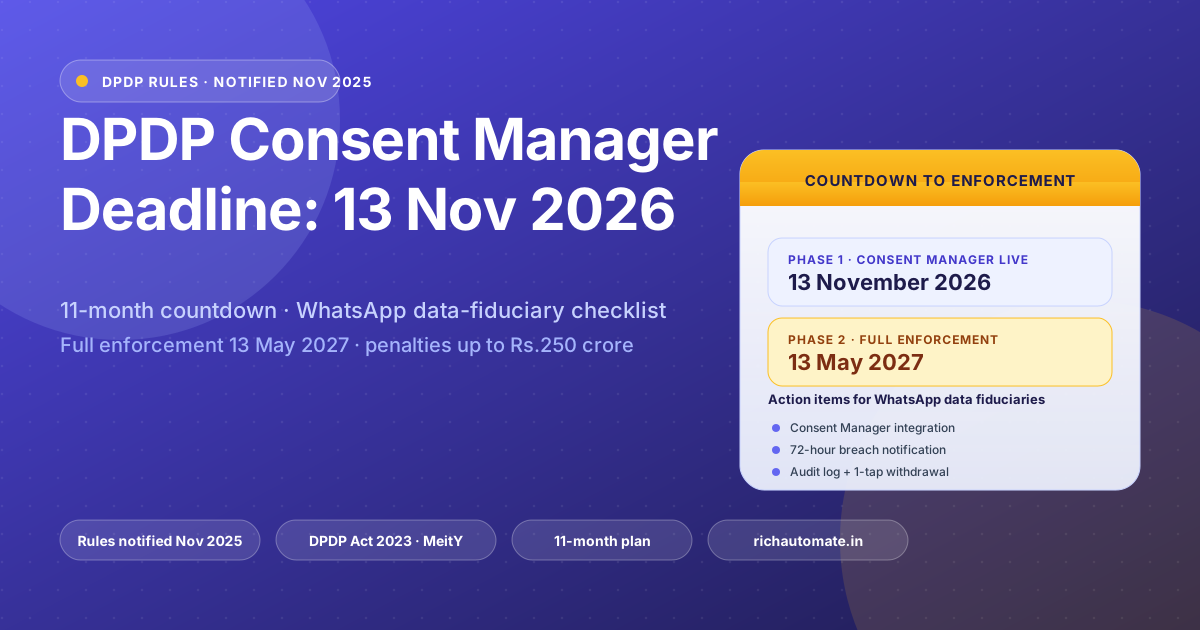
For two and a half years the Digital Personal Data Protection Act 2023 sat in a strange legal half-life: passed by Parliament, signed by the President, but with no operative Rules and no notified commencement date. That ended in November 2025 when MeitY finally notified the DPDP Rules and pinned the timeline to two specific dates — 13 November 2026 for the Consent Manager framework, and 13 May 2027 for full enforcement of the penalty regime. Twelve months and eighteen months from notification, respectively. For Indian businesses running customer engagement on WhatsApp, that is no longer a planning horizon. It is a build year.
The two dates that actually matter
Strip away the noise from the 50+ pages of the Rules and only two dates govern your roadmap. The first, 13 November 2026, is when the Consent Manager framework formally activates and the operational obligations — the way you collect notice, store consent, surface withdrawal, and respond to data-principal requests — become legally cognisable. The second, 13 May 2027, is when the Data Protection Board of India can begin enforcement proceedings under Section 33, including the headline penalty tiers of up to ₹250 crore for security-safeguard failures and up to ₹200 crore for failure to notify a personal data breach.
That 6-month gap between Phase 1 and Phase 2 is a deliberate grace window. Treat it as such. Anyone trying to fit a Consent Manager integration into Q2 of 2027 is going to be on the wrong side of an enforcement notice while the rest of the market has been live for six months. The November 2026 date is the real deadline.
Why this is suddenly real (and why most teams missed the memo)
Between the August 2023 passage of the Act and the November 2025 notification of the Rules, an entire generation of compliance content was written on the assumption that the timeline would slip again — as it had slipped for the IT Rules of 2011, the Personal Data Protection Bill of 2019, and the Data Protection Bill of 2022. That assumption is now wrong. The November 2025 Rules carry specific commencement dates inside the gazette text itself. International law firms — Hogan Lovells, Fisher Phillips and Glocert — published timeline briefings within weeks. Indian counsel has been quieter; we are filling that gap here from the practitioner side, not the legal-opinion side.
The other reason the memo got lost: most WhatsApp content guides published in 2024 and early 2025 referenced a January 2025 draft of the Rules and assumed those draft provisions would be the operative ones. They are not. Several substantive provisions changed between the January 2025 draft and the November 2025 final notification — most importantly around Consent Manager interoperability, breach notification timelines (tightened to 72 hours from the earlier "reasonable time"), and the verifiable parental consent mechanism for minors. If your DPDP readiness deck cites the January 2025 draft, it is already outdated. We have a deeper teardown in our DPDP Act 2023 WhatsApp compliance guide and the draft-Rules impact analysis; cross-read both.
The 11-month action plan, broken into 6 milestones
Working backwards from 13 November 2026 with the assumption you start in June 2026, the build divides cleanly into six milestones. Each one is sized to a single sprint for a small product team.
1. Data inventory + record of processing activities (RoPA)
You cannot comply with a law you cannot map. Build a single spreadsheet (or, better, a database table) listing every category of personal data you receive over WhatsApp — phone number, name, location share, document upload, payment metadata, KYC artefacts — with columns for purpose, legal basis, retention, processor, sub-processor and cross-border transfer destination. Without RoPA, the next five milestones cannot be scoped.
2. Consent capture redesign on every WhatsApp surface
Every place a user opts in — Click-to-WhatsApp ad landing, web widget, lead form, sign-up bot — needs to meet the four DPDP notice elements (data, purpose, fiduciary identity, withdrawal mechanism). Build a single reusable Consent Capture component and force every channel through it. In our flow builder this is one node. See the CTWA lead capture surface for a worked example.
3. Consent Manager integration (pick one, ship the API)
Pick one of the Consent Managers registered with the Data Protection Board (the registry will be live ahead of 13 November). Implement the consent-artefact create/read/revoke APIs against their sandbox. Store the consent_artefact_id as a first-class column on your contacts and message-log tables so every outbound communication can be traced back to a specific consent.
4. Withdrawal endpoint + data-principal rights workflows
Build the four DPDP rights pathways: right to access (a user messages "my data" and gets a JSON or PDF export within the statutory window), right to correction, right to erasure, and right to nominate. Each one needs a WhatsApp utility template, an internal worker job, and a logged audit trail. Withdrawal must be at least as easy as the original opt-in — usually one tap on a quick-reply button.
5. Breach detection + 72-hour notification playbook
The 72-hour window is the deadline by which the Data Protection Board must be notified. To hit it, you need detection alerting (anomalous export volume, failed-auth spikes, leaked credential signals), a severity-scoring rubric, a pre-drafted Board notification template, and a WhatsApp utility template approved in advance for mass-send to affected users. Practice the drill before November.
6. Vendor DPAs, audit log retention, re-notice campaign
Sign updated Data Processing Agreements with Meta (your message-delivery processor), with your BSP if you use one, with every sub-processor in the message pipeline, and with any analytics or CRM vendor that receives WhatsApp metadata. Set audit-log retention to at least 7 years (defensive default). Run the DPDP Re-Notice campaign to your existing contact base on or before 13 May 2027.
The penalty math — why ₹250 crore is the wrong number to fixate on
Every DPDP article you read leads with the ₹250 crore figure. It is the maximum penalty under Section 33 for failure to take reasonable security safeguards. It is also a ceiling — the Board has discretion to impose a much smaller penalty calibrated to the nature of the breach, the type and sensitivity of personal data, the impact on data principals, whether it was deliberate or negligent, and whether the fiduciary took mitigating action. In practice, expect a tiered enforcement pattern: warnings and improvement directions for first offences at SMBs, mid-five-figure to low-seven-figure penalties for mid-market fiduciaries with sloppy practices, and the headline-grabbing numbers reserved for repeated or wilful violations at scale. Our DPDP penalty calculator walks through the framework.
The number you should fixate on instead is your breach-window cost: the operational expense of being unable to send any utility or marketing messages to your customer base for the 30–90 days it takes to respond to an enforcement notice, plus the legal and forensic costs, plus the inevitable churn from public disclosure. For a typical mid-market WhatsApp deployment sending 2 lakh outbound messages a month at an average revenue-per-message of ₹4, that is ₹8 lakh per month in direct revenue impact alone. Compliance is cheaper than enforcement by an order of magnitude.
Penalty tiers under Section 33 — at a glance
| Violation category | Maximum penalty | Most common WhatsApp trigger |
|---|---|---|
| Failure to take reasonable security safeguards | Up to ₹250 crore | Leaked contact database, unencrypted backups, exposed S3 bucket of conversation logs |
| Failure to notify the Board or affected users of a breach | Up to ₹200 crore | Quiet remediation without 72-hour Board notification |
| Non-fulfilment of additional obligations of an SDF | Up to ₹150 crore | Designated SDF without appointed DPO or independent audit |
| Non-fulfilment of obligations re: children's data | Up to ₹200 crore | Marketing message to a verifiably minor data principal without parental consent |
| Breach of any other provision of the Act or Rules | Up to ₹50 crore | Most procedural defaults — late access-request response, missing notice element, etc. |
| Data principal failing duties | Up to ₹10,000 | Filing frivolous grievances — limited relevance to fiduciaries |
Your WhatsApp BSP, Meta, and the processor chain
Most Indian businesses use a BSP (Business Solution Provider — Wati, AiSensy, Interakt, Gupshup, Karix, RichAutomate) sitting between them and Meta's WhatsApp Cloud API. Under DPDP, you are the data fiduciary and both Meta and the BSP are processors. That means you owe data principals everything; the processors owe you contractual obligations that flow through. As of mid-2026, our audit of BSP contracts (we tracked the public DPAs of the major Indian BSPs through the compare grid — see AiSensy, Wati, Interakt, Gupshup and Karix) shows that not one has updated its standard DPA to reflect the November 2025 Rules. Push your BSP for an addendum. If they cannot produce one by Q3 2026, switch.
The specific clauses you need in a DPDP-compliant BSP DPA are: (a) processor breach reporting back to you within 24 hours so you can hit the 72-hour Board deadline; (b) named sub-processor list with right-of-objection on additions; (c) data localisation commitment for processing within India unless an explicit cross-border transfer notification is in place; (d) return-or-delete of all personal data on contract termination, with verification; (e) cooperation obligation for data-principal rights requests; and (f) audit rights. RichAutomate's standard DPA carries all six.
What about cross-border transfers?
The DPDP Act adopts a "negative list" approach — personal data can flow out of India by default, except to countries the central government specifies otherwise. As of June 2026, no such restriction notification has been issued, meaning transfers to the EU, UK, US, Singapore and the UAE remain permitted. That can change at any time; if your WhatsApp engagement has a cross-border component (UAE, Singapore, GCC) you should track the negative-list notifications quarterly and have a contingency plan for repatriating processing back to India. Our UAE-Singapore-India cross-border guide and the India regulation pillar are kept up to date.
The Significant Data Fiduciary question
Section 10 of the Act lets MeitY designate a class of data fiduciaries as Significant Data Fiduciaries (SDFs) based on factors including volume and sensitivity of data, risk to electoral democracy, security of the state, and public order. SDF status carries three extra obligations: appoint a Data Protection Officer based in India, conduct periodic Data Protection Impact Assessments, and undergo independent audit. Most SMB and mid-market WhatsApp deployments will not be designated. If your tenant processes more than ~5 million data principals, handles sensitive categories (health, finance, biometric), or operates in regulated verticals (banking, insurance, healthcare), pre-build the SDF posture — designation can come with a 90-day implementation window which is brutal if you start from zero.
The minor-consent provision — most often missed
The Rules require verifiable parental consent before processing personal data of a child (under 18). The Rules describe acceptable verification mechanisms including reference to a virtual token mapped to a government-issued ID, or to an authorised consent token issued by an entity entrusted with reliable identity data. For WhatsApp data fiduciaries in EdTech, gaming, and child-oriented commerce this is the highest-risk single clause in the entire Rules text — get it wrong and you sit in the ₹200 crore tier. Design defensively: if you cannot verify age, do not process. Our flow builder has an Age Gate node that defaults to refusal-on-uncertainty.
A note on language and notice plainness
The Rules require notice to be "clear and plain" and offered in any of the languages listed in the Eighth Schedule of the Constitution. That means English alone is not sufficient — at minimum, offer Hindi and the principal regional language for the data principal's state. WhatsApp's template approval flow handles multilingual templates well; budget for legal translation (not machine translation) of your consent notice into the 7–10 languages your user base actually uses. This is one of the cheapest line items in the build but the one most often deferred.
Where RichAutomate fits
We have spent the last six months retrofitting the product for the November 2025 Rules so our tenants do not have to build everything from scratch. What is live today: Consent Capture flow node with the four DPDP notice elements; consent_artefact_id as a first-class column; one-tap withdrawal templates; a templated breach-notification campaign pack; a multilingual notice generator (Hindi, English, plus 8 regional); the model BSP DPA addendum; the DPDP Re-Notice template; and a complete audit log with 7-year retention default. What is on the build roadmap for Q3 2026: live Consent Manager API integration (we are tracking three CM candidates in their sandbox), the children's-data Age Gate node v2 with reference-token support, and a quarterly cross-border-transfer notification monitor.
For deeper reading, the India regulation pillar is the canonical map of every DPDP, RBI, IRDAI, SEBI and TRAI obligation that touches WhatsApp. Operators in regulated verticals should also read the core DPDP compliance guide, the utility vs marketing template separation, and the DLT-skip on WhatsApp deep dive.
If you start nothing else this week, start this
Open a spreadsheet. List every WhatsApp opt-in surface your business operates — every CTWA ad, every web widget, every lead form, every sign-up flow. For each one, write down: (a) what data you collect, (b) what purpose you process it for, (c) what consent text the user sees, (d) how the user can withdraw. If any of the four columns is empty or vague, that surface is your highest-risk audit failure on 13 November 2026. Fix it before the others.
And if the spreadsheet exercise is daunting, book a 30-minute compliance review call or message us on WhatsApp at +91 81603 11319 — we will run the inventory with you and hand back a milestone-mapped action plan in one sitting.