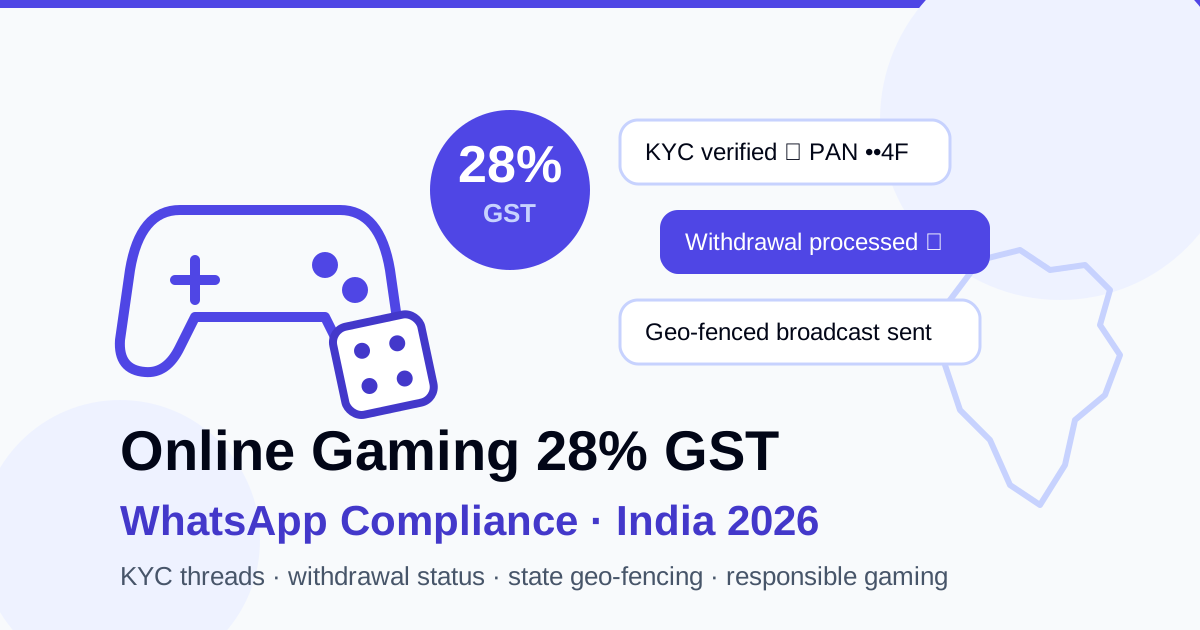
For India's online gaming operators, 28% GST on full deposit face value plus the 2025 central clampdown on online money games means WhatsApp is no longer a growth channel — it is a compliance channel: KYC verification threads, withdrawal and refund status updates, responsible-gaming nudges, geo-fenced broadcasts that exclude restricted states, and clean migration messaging for the pivot to free-to-play and esports formats. Operators who re-tool their WhatsApp stack around utility messages (₹0.115 each at Meta's 2026 India rate) instead of marketing blasts cut both regulatory exposure and messaging spend — this guide maps exactly which threads to keep, which to kill, and how to geo-fence the rest.
What changed: the 2023–2026 regulatory pile-up
No Indian consumer-tech vertical has absorbed more regulatory shock in three years than real-money gaming (RMG). The sequence, briefly — and note that this space moves monthly, so verify the current status of every item below with counsel before acting on it:
- 28% GST on face value (October 2023). CGST/IGST amendments and CBIC notifications moved online money gaming to 28% GST on the full face value of deposits — not on the platform's rake/GGR. A ₹100 deposit attracts ₹28 tax before a single game is played. The industry's effective tax burden multiplied several-fold overnight (verify the current notification and valuation rules — review petitions and rate-rationalisation discussions have continued).
- Retrospective demands. Show-cause notices running to lakhs of crores were issued for pre-October-2023 periods on the same face-value basis; the consolidated litigation reached the Supreme Court. The outcome materially changes survival math for every operator (verify current litigation status — do not assume any figure or outcome).
- MeitY online gaming rules (2023). The IT Amendment Rules created a framework for self-regulatory bodies to certify "permissible online real money games" — a framework that was never fully operationalised (verify current status).
- The central 2025 Act. The Promotion and Regulation of Online Gaming Act, 2025 went much further than the MeitY framework: it targets online money games nationally — prohibiting their offering, advertising and financial facilitation — while promoting esports and social/casual gaming (verify the Act's current enforcement status, rules notified under it, and any judicial challenges before treating any format as open or closed).
- The state patchwork underneath. Tamil Nadu's Prohibition of Online Gambling Act (with real-money game restrictions and time/age gates), Telangana's long-standing Gaming Act ban, Karnataka's ban-struck-down-then-redrafted cycle, plus Andhra Pradesh, Assam, Odisha, Nagaland and Sikkim's differing regimes — each state's position has its own litigation history and current text (verify per state; several have moved even within the last year).
The net position for 2026: pure RMG operation in India carries existential tax and legal risk, several large operators have suspended or exited paid formats, and the viable paths are esports, free-to-play, social and non-stake skill gaming — plus a long, regulator-scrutinised tail of winding down old RMG balances. Every one of those paths runs through customer messaging, which is where WhatsApp comes in. (For the pre-2025 engagement mechanics — contest alerts, team-deadline reminders, result notifications — see our fantasy sports WhatsApp lifecycle guide; this article is the tax/regulatory layer on top of it.)
The WhatsApp comms impact map
Here is the same regulatory timeline read as a messaging-operations table — what each event does to your WhatsApp stack:
| Regulatory event | Status (verify — moves monthly) | WhatsApp comms consequence |
|---|---|---|
| 28% GST on deposit face value (Oct 2023) | In force; valuation/review questions live | Deposit-confirmation messages must show GST split; "bonus cash" promo copy needs tax-treatment review before sending |
| Retrospective GST demands / SC litigation | Sub judice | Preserve messaging records — timestamped deposit/withdrawal threads become audit evidence |
| MeitY 2023 SRB framework | Never fully operationalised | Don't cite "MeitY-certified" in customer copy — no such certification exists to claim |
| Central Online Gaming Act, 2025 | Enacted; enforcement rules evolving | Stop all money-game promotion nationally; advertising a prohibited money game is itself targeted — marketing templates for RMG formats must be retired, not just paused |
| State bans (TN, Telangana, KA, AP…) | Patchwork, each litigated | Geo-fence every broadcast — exclude restricted-state users even for formats legal elsewhere; state law can be stricter than central |
| DPDP Act, 2023 | Enforcement phasing through 2026 | KYC data minimisation in chat; consent records; retention windows on identity documents shared over WhatsApp |
Two structural shifts fall out of this table. First, your message mix inverts: an RMG-era operator sent mostly marketing (contest promos); a 2026-compliant gaming operator sends mostly utility (KYC status, withdrawal status, account/format-migration notices) — which happens to be 7.5× cheaper per message (₹0.115 vs ₹0.8631 on Meta's 2026 India card). Second, "send to all" dies as a concept: every broadcast needs a state filter in front of it.
The BSP migration cost calculator covers the costs people forget: the overlap month and re-approving every template.
The geo-fence playbook: exclude restricted states from every broadcast
State-level restrictions apply to the user's location, not your office. A promotional broadcast for a paid tournament that is arguably permissible in one state can be an offence when it lands on a phone in Tamil Nadu or Telangana. The operating rules:
- Tag every contact with a state attribute at signup (address/KYC state, pincode, or self-declared state) and store it as a contact attribute in your WhatsApp platform — this becomes the master filter.
- Default-deny, not default-allow. Broadcast segments should be built as "include only states on the cleared list for this format", not "exclude the banned ones" — so a new user with no state tag gets no stake-linked messaging until classified.
- Maintain a format × state matrix with counsel (e.g., esports content: all states; free-to-play with paid cosmetics: verify; anything stake-linked: assume closed nationally under the 2025 Act unless counsel clears a specific format) and re-review it monthly — states amend faster than product teams notice.
- Transactional ≠ exempt from geo-sense. Even utility messages need care: a "withdraw your remaining balance" notice is fine everywhere (indeed, expected by regulators winding down RMG), but a "your deposit bonus expires tonight" nudge is promotional in substance regardless of template category.
- Log the filter with the send. When a regulator or your own audit asks "prove Telangana users were excluded from this campaign", the answer should be a stored segment definition plus the send log — WhatsApp platform campaign reports give you both.
Mechanically this is ordinary segmentation — the same contact-attribute filters an e-commerce brand uses for city-level offers — pointed at a legal constraint instead of a marketing one. If your platform cannot filter broadcasts on a custom attribute, that is disqualifying for this vertical.
KYC and withdrawal threads: the patterns that survive 2026
Whatever format you operate — esports platform, casual gaming with in-app purchases, or an RMG operator running an orderly wind-down — three thread patterns carry the compliance load:
Get the DPDP WhatsApp checklist
A founder-led WhatsApp reply with the DPDP consent + audit-log checklist for WhatsApp Business messaging. India-hosted. No spam.
1. KYC verification thread
Trigger a utility template when verification starts: what documents are needed, a secure upload link (prefer a link into your own KYC portal over documents pasted into chat — see the DPDP carve-out below), and status updates at each stage ("PAN verified · bank account pending"). One thread, timestamped, doubles as your audit trail that verification preceded any money movement. Where formats require age verification, the KYC thread is also your age gate: verify date of birth against the document, not a self-declared checkbox, and hard-stop underage accounts — minors must never receive gaming communications, and several state laws add their own age and hour restrictions on top (verify per state; thresholds and mechanics differ).
2. Withdrawal / refund status thread
In a wind-down or dispute-heavy environment, "where is my money?" is your entire support queue. Automate it: withdrawal-requested confirmation (amount, net of applicable TDS on winnings — winnings attract their own income-tax withholding regime, distinct from GST; verify current rates and thresholds with your CA), processing update, UTR-number confirmation on payout. Every message is a utility template at ₹0.115. This is the same discipline regulated fintech verticals already run — the payout-status patterns in our RBI payment aggregator rules guide and the TDS-communication patterns in the Section 194-O e-commerce TDS guide map almost one-to-one onto gaming payouts.
3. Responsible-gaming and migration nudges
Time-spent and spend-limit nudges ("you've been playing 3 hours today"), self-exclusion confirmations, and cool-off acknowledgements — send them as utility messages, word them plainly, and keep copies. If you are migrating users from a retired money format to a free-to-play or esports product, the migration notice itself is a compliance document: state clearly that the paid format is discontinued, how remaining balances are returned, and what the new format is — without promotional framing of the old one. Operators in other high-scrutiny verticals learned this pattern the hard way; the wind-down messaging playbook in our VDA/crypto broker WhatsApp guide is directly reusable here.
Compliance carve-out: DPDP, data minimisation and copy discipline
Gaming operators hold exactly the data mix the Digital Personal Data Protection Act, 2023 cares about: identity documents, financial details, and behavioural data — often belonging to young users. For the WhatsApp layer specifically:
- Minimise what lives in chat. Collect KYC documents through a secure portal link sent via WhatsApp, not as images in the thread. If documents do arrive in chat, extract to your KYC system and purge per a stated retention window.
- Mask in messages. "PAN ending 4F verified", "payout to account ••6789" — never echo full identifiers back into a chat thread that lives on the user's device forever.
- Consent and purpose. Opt-in records for any marketing (of permissible formats only), separate from transactional consent; honour STOP instantly and log it.
- No minors, ever. DPDP's children's-data provisions plus gaming-specific age rules mean an unverified-age contact should receive nothing beyond the verification prompt itself.
- Copy discipline. No "guaranteed winnings", no "100% legal in your state" claims, no describing a money game as a "skill contest" to route around ad restrictions — the 2025 Act reaches advertising and promotion directly, and platform policies (Meta's own gambling/gaming ad rules apply to WhatsApp templates too) are enforced independently of Indian law. Meta can and does reject or flag gaming-related templates; nothing immunises a number against enforcement, so keep templates factual and utility-shaped.
The tech stack for a 2026-compliant gaming operator
- WhatsApp Business API (not the app) — template governance, audit logs, multi-agent support, and an API your backend can drive on KYC/withdrawal state changes.
- Attribute-filtered broadcasts — state tag on every contact, segment-level include-lists, campaign send logs you can produce on demand.
- Template library — KYC-start, KYC-status, withdrawal-requested, payout-confirmed (with UTR), responsible-gaming nudge, self-exclusion confirmation, format-migration notice. All utility category; get them approved once and fire via API.
- Flow-builder journeys — a verification chatbot that walks new users through KYC steps and answers "why is my withdrawal pending?" from live status, cutting support tickets in the exact period (wind-downs, tax deductions on winnings) when they spike.
- Webhook + API integration — your gaming backend triggers messages on state change; support agents see the full thread in a shared inbox instead of users repeating account details.
On cost: this stack on RichAutomate runs at ₹0 setup, ₹0 monthly, ₹0 platform fee. Client Pay is ₹0.10/message plus Meta's rates billed direct at cost (₹0.8631 marketing / ₹0.115 utility-auth on the 2026 India card, hiked ~10% on 1 January 2026); SaaS Pay is ₹1.50 marketing / ₹0.50 utility all-inclusive. A 50,000-user operator sending 4 utility messages per user per month spends roughly ₹43,000 at Meta rates + ₹20,000 platform on Client Pay — trivial against the compliance exposure it documents. Full math in the WhatsApp Business API pricing breakdown.
7-day readiness checklist
- Day 1: Freeze all RMG-promotional templates. Inventory every active template and classify: keep (utility), rewrite (promotional-in-substance), retire (money-game marketing).
- Day 2: Backfill state tags on your contact base from KYC records; quarantine untagged contacts from all broadcasts.
- Day 3: Build the format × state matrix with counsel; encode it as broadcast include-lists.
- Day 4: Submit the compliance template set — KYC-status, withdrawal-status, payout-UTR, responsible-gaming, migration-notice — for Meta approval.
- Day 5: Wire backend webhooks: KYC state change → status message; withdrawal state change → status message.
- Day 6: DPDP pass — masking in message copy, portal links instead of in-chat documents, retention windows, STOP handling.
- Day 7: Dry-run a geo-fenced broadcast to a test segment; verify the send log shows the state filter; document the runbook.
One standing caveat across all seven days: nothing in this article is legal or tax advice, the GST, central-Act and state-law positions described here all carry "verify current status" flags for a reason, and no messaging platform can promise immunity from Meta's own policy enforcement — disciplined, utility-first sending is the only durable protection.
Re-tool your gaming comms for the compliance era
RichAutomate gives gaming and esports operators the full compliance messaging stack — state-filtered broadcasts, KYC and withdrawal status templates, responsible-gaming journeys, shared team inbox and a public API for your backend — at ₹0 setup, ₹0 monthly, ₹0 platform fee. Client Pay at ₹0.10/msg with Meta's rates billed direct at cost, or SaaS Pay at ₹1.50 marketing / ₹0.50 utility all-inclusive. Start with a 14-day free trial and 100 free credits, WhatsApp us at 918160311319, or book a 30-minute compliance-comms walkthrough at https://richautomate.in/book/demo.
Start your 14-day free trial → · See full pricing · See the cost breakdown