All articles
Guide

WhatsApp for Pre-Owned Luxury Resale & Authentication India 2026

The authentication-and-provenance playbook for pre-owned luxury resellers - a structured photo-submission Flow that captures serials, receipts and defect close-ups at intake, a written valuation + authentication trail, digital authenticity certificates in the buyer thread, wishlist re-engagement on one-of-one inventory, GST margin-scheme / Consumer Protection / trademark / customs / DPDP compliance notes (hedged), and honest cost math (Rs 1,200-2,000/mo, illustrative) on a Rs 0-platform model.

RichAutomate Team
9 min read 0 views
WhatsApp for Pre-Owned Luxury Resale & Authentication India 2026

The short answer. Pre-owned luxury resale in India - designer bags, Swiss watches, fine jewellery, limited-edition sneakers - is a trust business before it is a retail business. Every deal lives or dies on one question: is it genuine, and can you prove it? WhatsApp on the official Business API is the authentication-and-provenance rail for this trade: a photo-submission thread that captures a seller's item (serial, date code, receipts, hardware close-ups) in one auditable place, an authentication + valuation quote delivered with a written record the seller can hold you to, a consignment/buyout agreement and payout trail, buyer-enquiry routing on listed pieces, and a digital authenticity certificate + after-sale care loop that turns a one-time buyer into a repeat collector. A boutique reseller processing ~200 sell-side submissions and ~80 sales a month runs the whole loop for roughly ₹1,200-2,000 a month on RichAutomate's ₹0-platform model (illustrative math below). Compliance first: the Consumer Protection Act 2019 and E-Commerce Rules, the GST margin scheme for second-hand goods, Legal Metrology declarations, customs rules on imported pre-owned pieces, trademark law on counterfeits, and DPDP all touch this trade - verify each with your CA and counsel before you list a single item.

A first-copy Birkin and a genuine one photograph almost identically on a listing page. The difference lives in the details a phone camera can capture - stitching count, stamp font, hardware engraving, date code - and in the paper trail. WhatsApp is where both already arrive: the seller's first "I want to sell my bag" message comes with photos attached.

Why WhatsApp fits pre-owned luxury resale

This is a two-sided, high-anxiety funnel. On the sell side, the owner of a ₹3-lakh watch is not going to fill a web form and wait; they want to send five photos to a human-feeling channel and get a "yes, we'll look at it" within the hour. On the buy side, a customer about to spend ₹80,000 on a pre-owned bag wants three things before paying: proof of authentication, condition photos of the exact piece (not stock images), and a person who answers questions about the corner scuff in photo four. Both conversations are photo-heavy, document-heavy and trust-heavy - exactly what a WhatsApp thread does better than email or a marketplace chat widget. And unlike Instagram DMs, where most of this trade currently limps along, the official API gives you templates, structured Flows for intake, a team inbox so no enquiry dies with one staffer's phone, and an auditable record when a dispute surfaces six months later.

StageWhat happensWhatsApp jobCategory
1. Sell-side enquiryOwner wants to sell; sends brand, model, condition, photosPhoto-submission Flow: serial/date-code, receipts, box/dust-bag, defect close-upsUtility
2. Authentication + valuationExpert reviews photos, may call item in for physical checkWritten valuation quote + authentication outcome + pickup/drop logisticsUtility
3. Agreement + intakeConsignment or outright buyout agreedTerms summary + agreement link + item-received confirmation with photo logUtility
4. Listing + buyer enquiriesPiece is listed; buyers ask about condition, price, provenanceEnquiry routing + condition-photo replies + hold/reserve requestsUtility / service window
5. Sale + certificateBuyer pays; item ships or is collectedPayment link + digital authenticity certificate + shipping/tracking updatesUtility
6. After-sale + re-engagementCare guidance, seller payout, wishlist alertsCare-tips message + payout confirmation + opt-in "new arrivals in your size/brand" alertsUtility + Marketing (opt-in)

The authentication thread - the money message

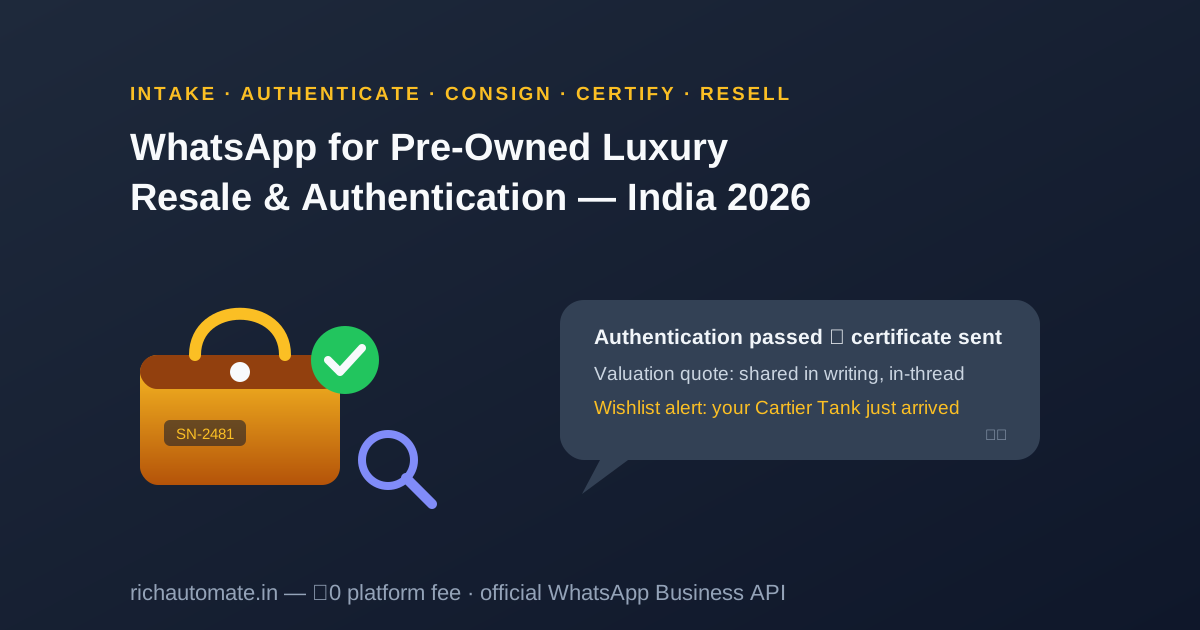
The single highest-value automation in this vertical is the structured photo-submission Flow at intake. Instead of "send some pics" and a back-and-forth that stretches over three days, the Flow asks for exactly what your authenticator needs on the first pass: full front/back, serial number or date code, hardware and zipper close-ups, stamp/engraving macro shots, original receipt or warranty card if available, and honest defect photos. Two things happen. First, your authenticator can give a provisional read - or a confident "bring it in" - in one review instead of four. Second, and more important legally, the thread becomes a time-stamped provenance record: what the seller claimed, what they showed, what your expert said, and what price was agreed. When a buyer later questions a piece, or a seller disputes a payout, that thread is your evidence. Resellers who run intake through Instagram DMs lose exactly this - DMs get deleted, accounts get lost, and nothing links the photos to the agreement.

The certificate closes the loop on the buy side. A digital authenticity certificate - item, serial/reference, authentication date, authenticator - delivered in the buyer's WhatsApp thread alongside the invoice does more for repeat business than any discount: it makes the buyer's purchase defensible when they resell it later, which is the quiet reason collectors return to the same reseller.

Regulator + compliance spine (verify everything)

  • Consumer Protection Act 2019 + E-Commerce Rules 2020 - if you sell to consumers (and especially if you list online), misdescription of condition or authenticity is an unfair trade practice; the E-Commerce Rules add disclosure duties (seller details, return/refund terms, grievance officer for marketplaces). "Sold as-is" does not cover a piece sold as genuine that turns out not to be. Verify how the rules apply to your model - inventory-led vs marketplace - with counsel.
  • GST margin scheme for second-hand goods - Rule 32(5) of the CGST Rules lets a dealer in second-hand goods pay GST on the margin (resale price minus purchase price) rather than the full sale value, provided the goods are sold as-is or after minor refurbishment and no input tax credit was claimed on purchase. Consignment vs buyout structures are treated differently, and the scheme's conditions are specific - this is a CA conversation, not a blog paragraph; verify your structure before your first GST return.
  • Trade Marks Act + counterfeit liability - knowingly selling a counterfeit is trademark infringement with civil and criminal exposure, and "a supplier gave it to me" is not a defence a reseller wants to test. Your authentication process is not just a marketing feature; it is your primary legal risk control. Reject and return anything your expert cannot stand behind, and never let the bot or a junior staffer certify authenticity.
  • Customs / imported pre-owned goods - pieces sourced from abroad (carry-in, grey-market imports, international consignors) sit under customs and foreign-trade rules that differ from a domestic resale; import of second-hand goods has its own restrictions and duty treatment. If any inventory crosses a border, verify the current position with a customs broker before it does.
  • Legal Metrology - where you sell packaged or labelled goods (boxed sneakers, sealed accessories), declaration requirements can apply; for jewellery-adjacent inventory, BIS hallmarking norms govern gold articles. Verify what your specific inventory mix triggers.
  • DPDP Act 2023 - seller KYC (you should know who you're buying a ₹5-lakh watch from), address, bank details for payouts, and ID documents shared in-thread are personal data. Collect the minimum, state your retention period, honour deletion requests once statutory retention (tax, anti-fraud) is satisfied, and take explicit opt-in before any marketing broadcast. See the DPDP compliance checklist.

The carve-out - what the bot must never do

The automation collects photos, routes enquiries, sends quotes a human approved, and delivers certificates a human issued. It must never declare an item genuine or fake - authentication is an expert's call on the physical piece, never the bot's call on photos; never auto-generate an authenticity certificate; never quote a buyout/consignment price that hasn't been set by your valuer; never promise a seller a guaranteed resale price or timeline; and never list or forward an item your expert flagged. On the buy side, the bot must not oversell condition - condition grades and defect photos are stated facts, and the honest close-up of the scuff is what keeps the Consumer Protection Act on your side. When a submission smells wrong (mismatched serial, a "receipt" that looks edited, a seller pushing for same-day cash), the correct bot behaviour is to flag a human, not to keep the funnel moving.

Stop overpaying on WhatsApp

Get a 1-minute BSP audit on WhatsApp

Drop your WhatsApp number — we line-item your current invoice against Meta India rates in under 60 seconds. India-hosted, DPDP-compliant.

DPDP-compliant · India-hosted · 1-min reply

Consignment vs buyout - keep the terms in the thread

The two commercial models age very differently, and WhatsApp should reflect that. An outright buyout is one clean exchange: quote, acceptance, item received, payout confirmed - four messages and the relationship goes quiet until the next piece. A consignment is a months-long open loop: the seller wants to know whether the bag has sold, whether the price should drop, when the payout lands. Silence is where consignment relationships die - the seller who hasn't heard anything in six weeks assumes the worst, calls twice, then pulls the piece and lists it themselves. A monthly automated consignment-status update ("still listed, 14 enquiries, 2 holds fell through; suggest a 7% price revision - reply YES to apply") keeps the seller informed, gets price drops approved in writing, and quietly documents that every revision was consented to - which matters when the payout is questioned later. The same template logic handles the end of the consignment window: renew, revise or return, with the seller's one-word reply recorded in the thread.

Buyer-side re-engagement - the wishlist engine

Luxury resale inventory is one-of-one: when the Speedy 30 in that colourway arrives, exactly one buyer gets it. That scarcity is a re-engagement gift. An opt-in wishlist alert - "you asked about Cartier Tank models; one just cleared authentication" - is the highest-converting marketing message this trade can send, because it is precisely targeted, genuinely scarce and expected. Run it as an opt-in marketing template, cap the frequency, and let buyers set brand/category preferences through a simple Flow. The same engine works sell-side: a quarterly "prices for your brand are strong this season - selling anything?" nudge to past consignors keeps supply coming without buying a single ad.

What it costs - illustrative math on RichAutomate

A boutique reseller handling ~200 sell-side submissions and ~80 completed sales a month: intake-Flow confirmations, valuation quotes, agreement and item-received messages, buyer enquiry replies (mostly free inside the 24-hour service window), payment links, certificates, shipping updates and payout confirmations add up to roughly 1,200-1,800 utility messages a month, plus a modest opt-in wishlist/new-arrival broadcast. On Client Pay: ₹0 platform fee + ₹0.10 per message, with Meta's conversation charges billed to you directly by Meta; on SaaS Pay: ₹1.20 per marketing conversation / ₹0.30 per utility conversation, all-in. Monthly cost lands around ₹1,200-2,000 on Client Pay - less than the margin on a single entry-level bag, for the rail that protects every deal's paper trail. Verify current Meta conversation rates - they change. Full workings in the cost breakdown and the Client Pay vs SaaS Pay guide. 14-day free trial, 100 free credits, ₹0 platform / ₹0 setup / ₹0 monthly.

One-week rollout

  1. Day 1-2: Official WhatsApp Business API on the store number; build the photo-submission intake Flow (brand/model, serial/date-code shots, receipts, defect close-ups, seller KYC basics).
  2. Day 3: Valuation-quote, item-received and payout-confirmation templates submitted for approval; agreement-link message wired to your consignment/buyout paperwork.
  3. Day 4: Buy-side templates - payment link, authenticity-certificate delivery, shipping/tracking updates; team-inbox routing so buyer enquiries hit the sales desk, sell-side hits the authenticator's queue.
  4. Day 5: Wishlist-preference Flow + opt-in new-arrival broadcast segments by brand/category; frequency caps set.
  5. Day 6-7: Pilot on this week's live submissions and listings, tighten the intake Flow's photo prompts based on what the authenticator still had to ask for, then switch the Instagram bio link to the WhatsApp intake.

Who fits this / who doesn't

RichAutomate fits the independent luxury reseller, watch dealer or consignment boutique that lives on Instagram discovery but needs the intake, authentication record and certificate trail on a channel that is auditable and team-operable - at ₹0 platform cost, with every authenticity judgment staying with a human expert. A casual peer-to-peer flipper doing two sales a month doesn't need the API; a large marketplace with in-house apps and its own escrow rails may want deeper custom integration than a WhatsApp-first stack provides out of the box. Related reading: art & collectibles, luxury jewellery retail, refurbished-electronics circular commerce, used-car dealerships, and the best WhatsApp CRM guide.

Standing honesty line: no platform - ours included - can promise a ban-proof WhatsApp number, and in this trade the real risk was never a ban; it's a counterfeit that slipped past a rushed check, or a provenance dispute with no paper trail. Keep intake structured, keep authentication human, keep every claim in writing. Start the 14-day free trial or see pricing.

Ready to ship this?

Get the full migration playbook on WhatsApp

A founder-led 1-minute reply with the migration steps, template approval timeline, and a 14-day pilot offer. DPDP-compliant. India-hosted. No spam.

DPDP-compliant · India-hosted · 1-min reply
Tagged
WhatsApp Business APILuxury ResalePre-OwnedAuthenticationGST Margin SchemeDPDPIndia2026
Written by
RichAutomate Team
Editorial team at RichAutomate. We build the WhatsApp Business automation platform Indian D2C brands, fintechs, and agencies use to ship campaigns and flows on the official Meta Cloud API.
FAQ

Frequently asked questions

Can a luxury item actually be authenticated over WhatsApp?
Photos over WhatsApp are the first-pass screen, not the verdict. A structured photo-submission Flow (serial or date code, hardware close-ups, stamp macros, receipts) lets an expert give a provisional read and decide whether to call the piece in for a physical inspection - which is where real authentication happens. The thread's value is the time-stamped record of what the seller claimed and showed; the authenticity call itself is always a human expert examining the physical item.
How does GST work on second-hand luxury goods in India?
Rule 32(5) of the CGST Rules offers a margin scheme: a dealer in second-hand goods can pay GST on the margin (resale price minus purchase price) instead of the full sale value, provided the goods are sold as-is or after minor refurbishment and no input tax credit was claimed on the purchase. Consignment and outright-buyout structures are treated differently, and the conditions are specific - verify your exact structure with a chartered accountant before filing.
What is the legal risk if a counterfeit slips through?
Selling a counterfeit exposes a reseller to trademark-infringement liability under the Trade Marks Act (civil and potentially criminal) plus unfair-trade-practice claims under the Consumer Protection Act 2019 - and sourcing it unknowingly from a supplier is not a comfortable defence. The authentication process is the primary risk control: reject anything an expert cannot stand behind, never let a bot or junior staff certify authenticity, and keep the intake thread as your provenance evidence.
What seller data can a reseller collect under the DPDP Act?
Seller KYC (identity, address, bank details for payouts) is legitimate to collect - you should know who you are buying a high-value item from - but it is personal data under the DPDP Act 2023. Collect the minimum needed, state a retention period, keep ID documents out of open team chats, honour deletion requests once tax and anti-fraud retention obligations are met, and take separate explicit opt-in before sending any marketing broadcast.
Does the WhatsApp bot issue the authenticity certificate?
No. The certificate is issued by the human authenticator after inspecting the physical piece; the bot only delivers it into the buyer's thread alongside the invoice and shipping updates. The bot must never declare an item genuine or fake, never auto-generate certificates, and never quote a valuation that was not set by the valuer - those calls carry the legal exposure, so they stay human.
What does this cost a boutique reseller on RichAutomate?
A reseller handling around 200 sell-side submissions and 80 sales a month typically sends 1,200-1,800 utility messages (intake confirmations, quotes, agreements, payment links, certificates, tracking, payouts), landing around Rs 1,200-2,000 a month on Client Pay - Rs 0 platform fee plus Rs 0.10 per message, with Meta's conversation charges billed directly by Meta. SaaS Pay is Rs 1.20 per marketing / Rs 0.30 per utility conversation all-in. There is a 14-day free trial with 100 credits; verify current Meta rates as they change.
RichAutomate · WhatsApp BSP for India 2026

Ship WhatsApp campaigns + flows on a transparent, compliance-ready BSP.

₹0 platform fee. DPDP audit log included. Visual flow builder. Multi-tenant from day one.

Start free trial
Want this for your brand?

Get a free 24-hour BSP audit

Send us your last invoice. We line-item it against Meta's published rates and benchmark against three alternatives.

Limited Spots Available

Get a Free
Automation Audit

Stop leaving revenue on the table. Get a custom roadmap to automate your growth.

Secure & Confidential

Continue reading

All articles
Guide

WhatsApp for Amusement & Water Park Ticketing India 2026

The capacity-ticket-and-weather-rain-check playbook for amusement and water parks - a capacity-confirmed e-ticket with a QR code the moment payment clears (the money message), a pre-visit info push, an instant weather rain-check reschedule thread, in-park fast-pass upsells, and a season-pass renewal campaign.

Read article
Guide

WhatsApp for Mobile Phone & Electronics Repair Shops India 2026

The job-card-and-estimate-approval playbook for phone, laptop and electronics repair shops - a photo job-card that records the device and fault on drop-off, a 1-tap diagnosis-estimate approval before work starts (the highest-ROI message a shop sends), ready-for-pickup pings, AMC/screen-protection renewal nudges, Right-to-Repair / e-waste EPR / DPDP compliance notes (hedged), and honest cost math (Rs 800-1,200/mo, illustrative) on a Rs 0-platform model.

Read article
Guide

WhatsApp Business API Cost India 2026: 10 Questions Answered

The 10 questions Indian buyers ask before going live on WhatsApp Business API: cost, is it free, green tick, setup time, DPDP and the cheapest option.

Read article
Guide

WhatsApp for Dialysis Centres & Nephrology India 2026

The thrice-weekly playbook for dialysis centres - session-slot reminders (shift + chair + one-tap confirm/cancel = missed-session and empty-chair killer), instant reallocation of freed slots, vascular-access and monthly-lab nudges (reminder only, no results in-thread), PMJAY/Ayushman + state-scheme claim threads, transport and co-pay coordination, and consented adherence check-ins - all built on strict DPDP-first data-minimisation (logistics in-thread, clinical detail off it). NABH / NMC / PMJAY / DPDP compliance notes (hedged) and honest cost math (Rs 2,000-3,500/month for 60 stations, illustrative) on a Rs 0-platform model.

Read article
Guide

WhatsApp BSP Contract Red Flags: 12 Clauses to Check (2026)

The 12-clause red-flag checklist for WhatsApp BSP contracts in India - lock-in mechanics, movable markups, WABA ownership, data-export rights, SLA credits and exit cooperation - each with the exact question to ask the vendor instead. Plus the 60-second five-question pre-signature test.

Read article
Guide

WhatsApp for Pest Control Operators India 2026: CIB&RC Ready

Pest control is a licence-and-proof business — CIB&RC-registered chemicals under the Insecticides Act, state operator licences, and restaurant clients who need your service records for their own FSSAI audits — yet most operators still run bookings on a personal number with no service trail. This India 2026 playbook for pest-control operators covers the regulator stack (Insecticides Act 1968 and CIB&RC registration, state licensing for commercial operations, FSSAI record requirements, label-claim discipline — all hedged, verify current rules), market direction (hygiene awareness, compliance pull, AMC economics), the 5-stage WhatsApp lifecycle — enquiry and inspection booking, quote with chemical disclosure, service-day coordination with prep instructions, post-service photo proof and service-card PDFs, AMC renewals and seasonal campaigns (monsoon termites, winter rodents) — the FSSAI-audit evidence angle that wins B2B contracts, DPDP handling of household data and society/RWA lists, the RichAutomate automation stack, illustrative cost math for a 300-AMC portfolio, honest limits (chemical advice never automated), and safety copy rules: never claim a treatment is 100% safe.

Read article