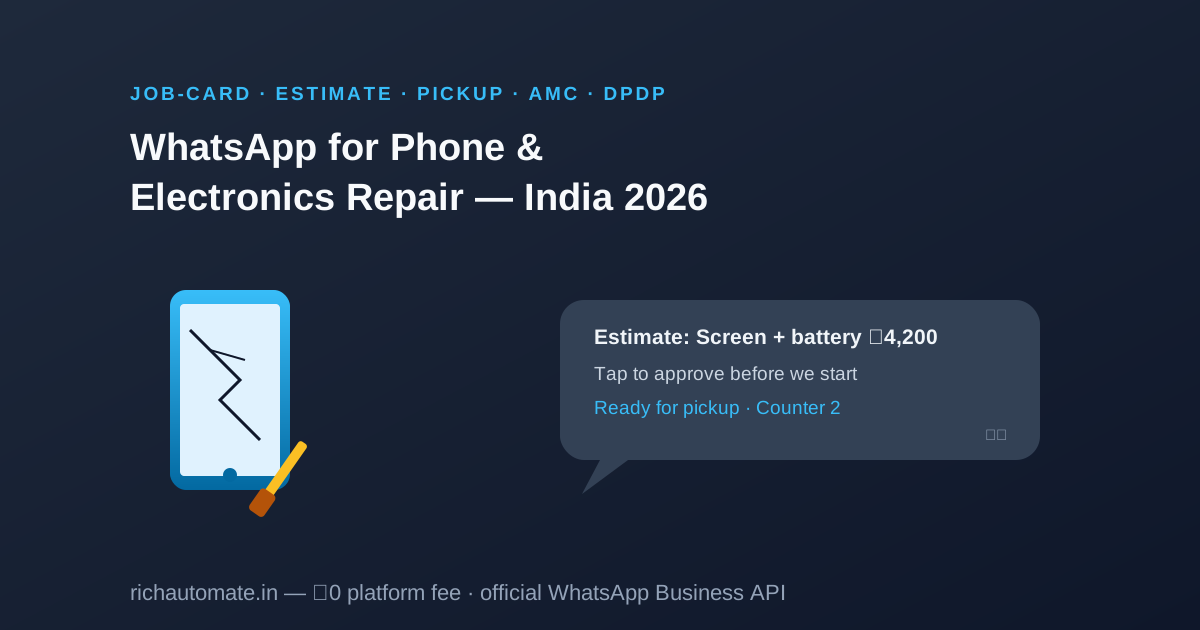
WhatsApp Business API lets a mobile phone or electronics repair business in India run its entire job lifecycle — repair enquiry, fault triage, device drop-off job-card with IMEI photo-log, estimate approval, repair-done pickup alert, digital warranty card and AMC re-service reminders — on the one app every customer already opens 20+ times a day. On a ₹0-platform-fee model the utility messages that power this cost about ₹0.115 each (Meta's 2026 India rate), so a 500-job-a-month service centre digitises its whole counter workflow for a few hundred rupees — while cutting "is my phone ready?" phone calls and no-show pickups dramatically. The same job-card and estimate-approval thread scales to large appliances in our multi-appliance repair & AMC aggregator playbook.
Why 2026 is the year repair shops go on WhatsApp
India's device repair market has always been huge and almost entirely unorganised — the corner mobile shop, the local TV mechanic, the laptop guy in the electronics market. That is changing fast. Branded multi-city repair chains, doorstep-repair startups and authorised-service aggregators are consolidating the market, and the thing they all compete on is not soldering skill — it is trust and communication: a proper job-card, a written estimate before work starts, a warranty that exists somewhere other than a fading thermal print.
Three regulatory currents push the same direction in 2026:
- Right to Repair framework. India's Department of Consumer Affairs launched a Right to Repair portal (righttorepairindia.gov.in) covering mobiles/electronics among its sectors, nudging OEMs toward published repair information and spare availability (verify current scope — the framework is still evolving and largely voluntary). Independent repair businesses that look organised and documented are best placed to benefit.
- Consumer Protection Act, 2019. Deficiency-in-service complaints over repairs — wrong estimates, parts swapped without consent, warranty disputes — are routine consumer-forum fare. A timestamped WhatsApp thread showing the quoted estimate, the customer's explicit approval and the delivered warranty terms is the cheapest dispute insurance a repair shop can own.
- E-Waste (Management) Rules, 2022. Dead boards, swollen batteries and beyond-repair units fall under EPR-linked e-waste channels; batteries additionally under battery waste rules. Shops that document "customer declined repair / unit handed to registered recycler" in writing protect themselves — and offer buy-back/exchange hooks (verify applicability with your recycler/consultant; obligations differ for retailers vs producers).
Add the boring-but-real ones: GST treats repair service (typically 18%) and spare parts supply differently depending on how you invoice the composite job (talk to your CA about the dominant-element treatment), and Legal Metrology's declared-price rules apply to packaged spares you retail over the counter. Every one of these is easier to live with when your quotes, approvals and invoices exist as structured WhatsApp messages instead of verbal promises.
The 5-stage repair lifecycle on WhatsApp
Stage 1 — Enquiry, fault triage and instant quote
Most repair enquiries are the same six questions. A WhatsApp chatbot triages them before a technician ever gets involved: device brand/model → symptom (screen, battery, charging port, water damage, motherboard, software) → photos or a short video of the fault → indicative price band and turnaround time. A click-to-WhatsApp ad or a QR sticker on your shopfront drops the lead straight into this flow. For common jobs (screen replacement on popular models), the bot can quote a firm price from your rate list; for diagnosis-needed jobs it books a drop-off or doorstep-pickup slot. Every enquiry is captured with name, number and device — no more leads evaporating because the counter was busy.
Stage 2 — Drop-off and the digital job-card (IMEI photo-log)
This is the stage that separates an organised chain from a corner shop. At intake, the counter staff triggers a job-card utility message to the customer's WhatsApp: job-card number, device model, IMEI/serial number, reported fault, visible physical condition (photos of the device from all sides shot at the counter and sent into the same thread), accessories received, estimated diagnosis time, and your terms (data risk disclaimer, uncollected-device policy). The customer now holds a timestamped, tamper-evident record — and so do you. "Your shop scratched my phone" and "there was a memory card in it" disputes die instantly when intake photos live in the chat. The IMEI in the job-card also protects you on stolen-device risk: it is your documented proof of what you received and from whom.
Stage 3 — Diagnosis, estimate approval and spare ETA
The single biggest source of repair-shop disputes is work done without documented consent. On WhatsApp the fix is one interactive message: "Diagnosis complete for JC-4821: display assembly damaged, battery health 61%. Estimate: display ₹4,200 + battery ₹1,400 + labour ₹500 = ₹6,100 (incl. GST). Spare ETA: 2 days." — with Approve / Call me / Decline quick-reply buttons. One tap and you have Consumer-Protection-Act-grade written consent, timestamped, in the customer's own chat history. Partial approvals ("display yes, battery later") happen in the same thread. If the spare is back-ordered, automated ETA updates keep the customer from calling twice a day. Declined jobs trigger the return/disposal flow (see e-waste above) instead of joining the shelf of forgotten devices.
Stage 4 — Repair done, pickup alert and digital warranty card
When the technician closes the job, the customer gets: repair-complete notification, final invoice (PDF in-chat), pickup OTP or QR (so the right person collects the right device), and a digital warranty card — job-card number, parts replaced, warranty period per part, and claim terms — living permanently in the WhatsApp thread. No thermal-paper warranty that fades in a wallet; when the customer claims 4 months later, both sides scroll up. Payment closes in the same thread via UPI link. Pickup no-shows drop because the reminder sequence (day 3, day 7, day 15 with storage-charge warning) runs itself.
Stage 5 — AMC upsell, screen-protection plans and re-service reminders
The repair transaction is the beginning of the relationship, not the end. Thirty days after a battery job: a battery-health check-in. Ten months after a screen job: "your tempered glass is due for replacement." For laptop and appliance customers: an annual maintenance contract pitch with service-visit reminders scheduled automatically. Repair chains layer screen-protection/extended-warranty plans here — recurring revenue sold as a utility follow-up to someone who already trusts you with their device. Marketing messages to opted-in customers cost ₹0.8631 each (Meta 2026 India rate); one converted AMC pays for thousands of them. This stage is where WhatsApp stops being a cost line and becomes your highest-ROI retention channel — the same playbook detailed in our AC and appliance repair WhatsApp guide.
The WhatsApp ROI calculator is more useful than a benchmark here, because the maths swings hard on your margin.
Compliance carve-out: device data, IMEI and the DPDP Act
A repair shop holds two sensitive things: the customer's device data (photos, chats, banking apps on a phone handed over unlocked) and identifiers (IMEI/serial mapped to a name and number). Under the Digital Personal Data Protection Act, 2023, both are personal data you are processing — and DPDP enforcement is ramping through 2026 (verify current rule notifications and applicability thresholds for your scale).
Get a 1-minute BSP audit on WhatsApp
Drop your WhatsApp number — we line-item your current invoice against Meta India rates in under 60 seconds. India-hosted, DPDP-compliant.
- Consent at intake: your job-card message should state what access the technician needs (e.g., "device will be unlocked for display testing only") — one line in the template, permanent proof in the thread.
- Data-wipe attestation: for buy-backs, exchanges and beyond-repair units headed to recycling, send a written data-wipe confirmation message ("Device IMEI ...xxxx wiped per job JC-4821 on 12 Jan 2026") — customers increasingly ask, and a copy in their own WhatsApp beats a verbal assurance.
- IMEI handling: store IMEIs in your CRM against the job, not in staff personal phones. A WhatsApp Business API setup means the business owns the thread — technicians never chat with customers from personal numbers, which is both a DPDP hygiene win and how you stop technicians walking away with your customer list.
- Retention: purge device photos and identifiers per a stated retention window instead of hoarding them forever.
What it costs: WhatsApp API pricing for a repair business
Nearly every message in the repair lifecycle is a utility message (job-cards, estimates, pickup alerts, warranty cards) — the cheap category. Only promotions and AMC pitches are marketing. Meta's India rates were revised roughly +10% on 1 January 2026; current card (verify before budgeting):
| Item | Rate (India, 2026) | Repair-shop usage |
|---|---|---|
| Meta utility message | ₹0.115 | Job-card, estimate, approval, pickup, warranty, reminders |
| Meta marketing message | ₹0.8631 | AMC offers, screen-plan upsells, festive campaigns |
| RichAutomate platform fee | ₹0 setup · ₹0 monthly | No subscription regardless of volume |
| Client Pay model | ₹0.10/msg + Meta rates billed direct at cost | Lowest total cost; you see Meta's exact charges |
| SaaS Pay model | ₹1.50 marketing / ₹0.50 utility all-inclusive | One INR line item, GST invoice |
Worked example — a service centre doing 500 jobs/month: ~6 utility messages per job (job-card, diagnosis, estimate, approval confirmation, ready-alert, warranty card) = 3,000 utility messages ≈ ₹345 at Meta rates + ₹300 platform (Client Pay) ≈ ₹645/month. Add 2,000 opted-in AMC marketing messages ≈ ₹1,726 + ₹200. Total under ₹3,000 for a fully digitised, dispute-proof operation. Subscription platforms charge ₹1,500-3,200/month before a single message — the full comparison is in our no-monthly-fee WhatsApp platforms guide, and the complete cost mathematics in the WhatsApp Business API pricing breakdown.
The tech stack: what a repair business actually needs
- WhatsApp Business API account (not the free app — you need multi-agent access, automation and templates; note GST registration is effectively required to take a WABA live).
- Triage chatbot / flow builder: no-code flows for enquiry → model → fault → quote/booking. Build once, runs 24×7 including Sunday-evening "screen cracked" panics.
- Template library: job-card, estimate-approval (with quick-reply buttons), spare-ETA update, ready-for-pickup, warranty card, data-wipe attestation, AMC reminder — submitted once for Meta approval, then fired via API from your job sheet or POS.
- Shared team inbox: counter staff, technicians and the owner on one number with assignment and internal notes — customers message the brand, not an individual's personal number.
- CRM/job-sheet integration: a public API so your existing repair-management software (or even a Google Sheet at small scale) triggers messages on status change. Multi-branch chains report per-outlet from one WABA.
- Catalog: list accessories, tempered glass and refurbished devices in a WhatsApp catalog for counter-adjacent sales — the same commerce motion covered in our electronics and appliance retail guide.
If you also install or maintain CCTV, networking or other electronic systems alongside device repair, the AMC-heavy version of this playbook is in the CCTV and electronic security installer guide.
Getting started: a 7-day rollout plan
- Day 1-2: Register on a WhatsApp API platform, verify your business, connect a number (a fresh number or your existing one after migration).
- Day 2-3: Submit core templates — job-card, estimate-approval, ready-for-pickup, warranty card. Meta approval typically lands within hours to a day.
- Day 3-4: Build the triage flow (brand → fault → photos → quote/slot) in the visual builder. Put the WhatsApp QR on your counter, shopfront and invoice footer.
- Day 5-7: Run every walk-in through the job-card flow. Train counter staff: intake photos into the thread, estimate button before any work, warranty card at closure.
- Week 2+: Switch on pickup-reminder sequences, then the 30/90/300-day re-service and AMC campaigns to opted-in customers.
Two rules that keep your number healthy: message only customers who opted in or have an active job with you, and keep marketing frequency humane. Meta's quality rating is real and no platform can promise immunity from enforcement — disciplined sending is the only durable protection.
Put your job-cards on WhatsApp this week
RichAutomate gives mobile and electronics repair businesses the full stack — triage chatbot, job-card and estimate-approval templates, shared team inbox, catalog and a public API for your job-sheet software — at ₹0 setup, ₹0 monthly, ₹0 platform fee. Pay per message: Client Pay at ₹0.10/msg with Meta's rates billed direct at cost, or SaaS Pay at ₹1.50 marketing / ₹0.50 utility all-inclusive. Start with a 14-day free trial and 100 free credits, WhatsApp us at 918160311319, or book a 30-minute setup walkthrough at https://richautomate.in/book/demo.
Start your 14-day free trial → · See full pricing · See the cost breakdown
Related reading: WhatsApp for Waterproofing & Repair Contractors 2026 walks through the same WhatsApp setup for a neighbouring use case.