Run an AC and home-appliance repair business in India in 2026 — a single-city operator doing split-AC servicing, fridge gas-charging and washing-machine repairs, a multi-brand service franchise running a fleet of technicians across a metro, or an AMC outfit servicing offices, showrooms and apartment complexes on annual contracts — and you already know the business lives or dies on two things you cannot fake: how fast you respond to a "my AC stopped cooling, can someone come today" message, and whether the customer ever calls you again instead of the next ad. A homeowner whose AC dies on a 44°C afternoon messages three operators at once; the one who replies with a slot in the next ten minutes wins the visit, the other two never hear back. A fridge customer waits two days for a spare-part quote that never comes and books the brand whose service centre replied the same evening. An AMC on a showroom's five ACs lapses silently because nobody sent the renewal, so the compressors run unserviced, one fails in peak summer, and the client blames you. A technician shows up at the wrong slot because the office, the technician and the customer were never on one thread. AC and appliance repair is an urgent, seasonal, trust-heavy, recurring-revenue service that runs on technician dispatch and AMC renewals, and the customer is already on WhatsApp comparing your reply speed against the service centre whose JustDial listing they tapped thirty seconds ago. A slow reply loses the visit; a missed slot breaks the contract; a forgotten renewal hands a recurring customer to a competitor. The AC and appliance repair businesses that compound in 2026 are the ones that turn that urgency-and-recurrence chaos into a system: instant enquiry response, fault and appliance capture, transparent quoting, visit scheduling with technician dispatch and ETA, spare-part quote follow-ups, post-service feedback, and AMC renewal reminders — all on the WhatsApp Business API. This is the buyer's guide to choosing the best WhatsApp Business API for an AC and appliance repair business in India in 2026: what actually matters for this vertical, the service lifecycle it has to carry, and how to pick a platform that does not eat a recurring-revenue service's margins. Treat every commercial and pricing specific below as "verify as of 2026," treat every figure as illustrative, and treat none of this as legal, tax or financial advice.
Why AC and appliance repair is a WhatsApp problem. An appliance breakdown is an urgent, trust-sensitive purchase tied to a specific fault — an AC that stopped cooling in peak summer, a fridge that is no longer cold, a washing machine that will not spin, a microwave that has died — and the deciding moments are all short, time-critical messages: the "can you come today" question, the "how much to fix it" quote, the slot confirmation, the technician's "on my way" with an ETA, the spare-part quote and approval, the payment, and the next-service or AMC-renewal reminder. The buyer already lives on WhatsApp, opens messages within minutes, and is actively comparing your reply speed against two other service centres' listings. A small office team that has to choose between dispatching a technician and replying to a fresh enquiry will always drop one. WhatsApp is where an appliance repair operator answers the urgency question, captures the fault and appliance details, sends a clear quote, confirms the slot, dispatches the technician with a live ETA, sends the spare-part estimate, collects the payment, and nudges the AMC renewal that brings recurring revenue — provided every send is consent-based, honest and customer-respectful. Verify advertising and DPDP data rules as of 2026; nothing here is legal advice.
What "best" actually means for an AC and appliance repair operator
The "best WhatsApp Business API" for an AC and appliance repair business is not the one with the most features or the loudest brand — it is the one that fits the specific shape of an urgent, seasonal, trust-heavy, recurring-revenue service that runs on technician dispatch and AMC renewals. Before comparing logos, get clear on the criteria that actually decide outcomes for this vertical. The table below is the buyer's checklist — weigh each against your own job volume and contract mix as of 2026.
| What to evaluate | Why it matters for appliance repair | What good looks like |
|---|---|---|
| Speed-to-first-reply on enquiries | A dead AC in peak summer is urgent; the first operator to reply with a slot usually wins the visit over two others | Instant auto-reply on every enquiry, day or night, with a human for diagnosis and custom quotes |
| Fault & appliance capture | The quote and the spare needed depend entirely on appliance, brand, model and symptom — miss one and the technician arrives unprepared | Chatbot that captures appliance type, brand, fault symptom, location and urgency up front |
| Scheduling & technician dispatch | A repair is a timed site visit; a no-show or clash on a peak-summer morning costs the visit and the review | Slot confirmation, day-before reminder and an on-my-way ETA on a shared office-technician-customer thread |
| Spare-part quotes & approvals | Most repairs hinge on a part the customer must approve; a slow quote stalls the job and frees a competitor to win it | Quick spare-part estimate, photo of the faulty part, and one-tap approval before the technician proceeds |
| Feedback, callbacks & AMC renewals | Warranty callbacks and annual contracts are the heart of the recurring revenue — a missed reminder is a lost customer | Post-service feedback, consent-based callback handling and AMC renewal reminders before the contract lapses |
| Transparent, low pricing | A high-frequency, mixed-ticket service cannot carry a fat per-seat SaaS fee on every office login | ₹0 platform fee, pay only per message and Meta's conversation charge |
The reframe most appliance repair owners eventually make: the platform is not the product — the customer-relationship engine it lets you run is. An operator that picks on price-per-message alone, but cannot reply fast or send AMC reminders, has bought a cheaper way to lose urgent visits and forget recurring contracts. Pick for the service journey, then optimise the cost. If you dispatch across appliance categories, map the full lifecycle in our multi-appliance repair & AMC aggregator playbook.
The end-to-end AC and appliance repair WhatsApp lifecycle
Here is the full lifecycle an appliance repair operator can run over WhatsApp, from the first enquiry to the post-service feedback and the AMC renewal, mapped to the automation at each stage and the guardrail that keeps it ethical. Treat the automation column as a reference pattern and verify advertising and data-protection specifics as of 2026.
| Lifecycle stage | WhatsApp automation | Guardrail (verify 2026) |
|---|---|---|
| 1. Enquiry capture | A JustDial listing, click-to-WhatsApp ad or website button opens a chat; bot replies instantly and captures appliance, brand, fault symptom, location and urgency | Capture consent at first contact; honour opt-out; serviceability checked honestly |
| 2. Diagnosis & quote | Bot shares indicative service-visit and common-repair price bands by appliance and routes complex faults to a human for a diagnostic visit | Honest estimates; no inflated faults or unnecessary part swaps |
| 3. Booking & slot | Slot confirmation, address capture, the visit/inspection charge stated up front, and a prep note (keep the appliance accessible) | Secure payment links only; visit charges disclosed clearly before booking |
| 4. Technician dispatch | Reminder the day before, an on-my-way update with the technician's name and a live ETA, and a running thread between office, technician and customer | Accurate ETAs; minimise personal data on chat; honour the agreed slot |
| 5. Spare-part quote & approval | A photo of the faulty part, a clear spare-part estimate, warranty on the part, and one-tap approval before the technician proceeds | Genuine parts disclosed; transparent pricing; no work without approval |
| 6. Service completion & payment | Job-complete update with the work done, the part replaced, the warranty period, a secure payment link and a post-service feedback request | Honest record of work; accurate warranty terms; secure payment only |
| 7. AMC renewal, callback & referral | Consent-based renewal reminder before the annual contract lapses, an easy warranty-callback path, a review request after a clean job, and a referral offer | Opt-in only; easy opt-out; frequency caps so it never feels like spam |
Notice the rhythm: WhatsApp carries an urgent, trust-heavy job that is too time-critical for phone tag to sustain, then keeps the customer by remembering the warranty window and the contract date — which is where an appliance repair operator's real growth lives. For the adjacent recurring-service views the WhatsApp for commercial HVAC and central-AC AMC guide and the water-purifier and RO service AMC playbook go deep on the renewal side.
AMC renewals: where an appliance repair operator's recurring revenue is won
The single most under-run part of an AC and appliance repair business is the renewal engine. An operator sits on a goldmine that almost nobody mines: every serviced AC, fridge and washing machine carries a next-service window and, on contracts, a renewal date — half-yearly AC servicing before each summer, annual AMCs for homes, offices, showrooms and apartment complexes — that comes around like clockwork. The showroom you signed for a five-AC annual contract last year needs its pre-summer service now; the homeowner whose AMC expires next month will need a renewal; the question is whether your gentle, opted-in reminder reaches them first, or whether the contract lapses silently and a competitor's ad catches them when the AC fails in peak summer. Most operators never store the appliance, the service history or the contract date in a usable way, never store the consent, and never send the reminder — so they re-acquire the same customer at full ad cost every single time instead of renewing them with one tap. WhatsApp turns the service log into a consent-based renewal engine: a friendly, opt-in "your AC AMC is due for its pre-summer service next week — shall we book the same slot?" that renews the contract before anyone else gets a chance. Done well and honestly, the renewal engine is the highest-leverage, lowest-cost recurring-revenue lever an appliance repair operator has, and it is almost entirely untapped.
Get a 1-minute BSP audit on WhatsApp
Drop your WhatsApp number — we line-item your current invoice against Meta India rates in under 60 seconds. India-hosted, DPDP-compliant.
The renewal engine, in one principle. Treat every service visit as the start of a recurring relationship you have permission to nurture, not a one-off transaction you forget the moment the technician leaves. Capture the appliance, the service history and the contract date, store explicit consent for reminders, cap the frequency so it never feels like spam, send a warm opt-in nudge ahead of the renewal or next-service date, and make opting out a single tap. The thread should feel like an operator who keeps the customer's appliances running — never like a channel engineered to pester. Verify advertising and DPDP data rules as of 2026; this is not legal advice, and no platform guarantees against Meta quality or ban actions.
Per-seat SaaS vs a ₹0-platform model: the margin question
An AC and appliance repair business handles a high volume of mixed-ticket jobs — a ₹500 AC service visit and a ₹40,000 multi-AC annual contract on the same day — with sharp seasonal spikes when summer arrives and every AC in the city needs attention, so a fixed monthly platform fee on every office login is dead weight in the quiet winter weeks and an arbitrary tax in the peak ones. Most legacy BSPs charge a per-seat or tiered monthly platform fee on top of Meta's own per-conversation charge; a ₹0-platform model charges only for what you actually send. This comparison is directional — verify current pricing on each vendor as of 2026.
| Dimension | ₹0-platform model (RichAutomate) | Typical per-seat / tiered SaaS BSP |
|---|---|---|
| Platform / setup / monthly fee | ₹0 platform, ₹0 setup, ₹0 monthly | Monthly platform fee, often per seat or per tier |
| What you pay for | Only per message + Meta's conversation charge | Subscription + markup on conversations |
| Fit for a spiky, seasonal service | Costs scale with jobs and reminders sent; a quiet winter week costs little | You pay the subscription even in a slow off-season week |
| Margin impact on a ₹500 service visit | Messaging cost is a few paise against the visit | Fixed fee eats into a thin-margin small job |
| Billing transparency | Client Pay: Meta bills you direct at Meta rates | Often a bundled markup you cannot see through |
The conclusion most appliance repair owners reach: for a high-frequency, mixed-ticket, seasonal business, a model where the messaging cost is a few paise against each visit beats a fixed monthly tax that you pay whether you run ten jobs or four hundred. Read the WhatsApp Business API cost breakdown and the pricing page before committing.
The automation stack that runs it
The good news for an AC and appliance repair operator is that none of this needs custom engineering. The building blocks map onto a standard WhatsApp Business API automation stack: a QR and click-to-WhatsApp enquiry-capture flow on listings, ads and the website that captures appliance, brand, fault symptom, location and urgency instantly; a chatbot FAQ that answers the predictable questions — service-visit charges, which brands and appliances you cover, serviceable areas, whether you do gas-charging and inverter-board repairs, warranty terms — without a human; a quote-and-booking step with indicative pricing, slot confirmation, the visit charge stated up front and a secure payment link; a technician-dispatch engine with day-before reminders, on-my-way updates with a live ETA, and a shared office-technician-customer thread; a spare-part quote-and-approval step with a photo of the faulty part and one-tap approval; a service-completion engine with the work done, the part replaced, the warranty period, a payment link and a feedback request; a warranty-callback path within the cover window; an AMC renewal sequence that renews annual and pre-summer contracts with opted-in reminders; a review-and-referral step after a clean job; segmented broadcast for opted-in seasonal offers (pre-summer AC service drives, monsoon appliance check-ups); and a human handoff the moment a customer needs a diagnosis, a commercial contract or raises a complaint. For the recurring-contract and field-service parallels the WhatsApp for electronics and appliance retail guide is a close adjacent reference, and the vehicle service-workshop retention playbook shares the same dispatch-and-renewal shape. The discipline is to keep the chatbot scoped to logistics and FAQs, and route every diagnosis, commercial and complaint conversation to a human.
The customer LTV calculator shows what a retained customer is worth before you set the spend.
The economics: an illustrative operator cohort
Criteria and architecture are the floor; the reason to run WhatsApp across the appliance repair lifecycle is faster enquiry response, more urgent visits won, smoother dispatch with live ETAs, faster spare-part approvals, and an AMC renewal engine that compounds. Consider an illustrative single appliance repair operator running a mix of JustDial and click-to-WhatsApp ad enquiries, walk-in and call enquiries, and an opted-in base of past customers with logged appliances, service history and contract dates across residential one-off repairs, half-yearly AC servicing and commercial annual AMCs. Every figure below is illustrative — model your own.
| Metric (illustrative) | Without WhatsApp lifecycle | With WhatsApp lifecycle |
|---|---|---|
| Speed to first reply on an enquiry | Minutes to hours, if the office gets to it | Seconds; instant acknowledgement, human follow-up for diagnosis |
| Urgent visits won against rival service centres | Lower (slow reply loses the urgent visit) | Higher (instant reply and fault capture) |
| Spare-part quotes approved same day | Sporadic, many stall and cool off | Higher (photo of the part plus one-tap approval) |
| AMC contracts renewed | Sporadic, many lapse silently | Higher (opted-in renewal reminders before lapse) |
| WhatsApp messaging cost | ₹0 | Utility scheduling and reminder messages at the cheapest tier |
The asymmetry is the argument: booking confirmations, day-before reminders, on-my-way ETAs, spare-part approvals, service-complete records and AMC renewal reminders are largely utility-category conversations — the cheapest tier — and they directly reduce the most expensive failures in an appliance repair business, namely slow replies that send an urgent visit to a rival, no-shows and clashes that earn a one-star review, spare-part quotes that stall and cool off, and a base of past customers whose AMC renewals are never re-booked. A handful of extra won visits, approved parts and renewed contracts a month dwarf the messaging bill, which is a few paise against each visit. Run your own figures on the features overview and the cost guide before committing.
Build the appliance repair lifecycle on RichAutomate
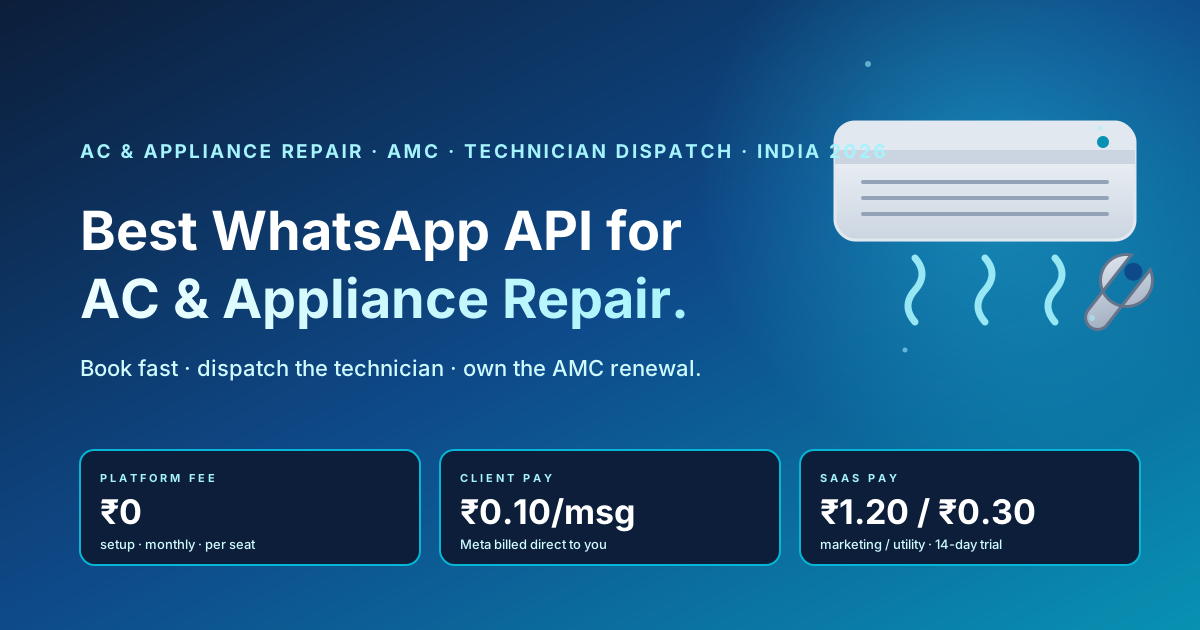
You can stand up the entire customer-relationship layer — instant enquiry capture from listings, ads and the website, chatbot answers on visit charges, covered brands and appliances, serviceable areas and warranty terms, fault-and-appliance capture, quote and booking with the visit charge stated up front and payment links, technician dispatch with day-before and on-my-way ETAs, spare-part quote and one-tap approval, service-complete records with payment and feedback, warranty-callback handling, opted-in AMC renewal reminders, and review and referral nudges — without engineering lift, while your office, schedule and technicians stay the source of truth. RichAutomate charges ₹0 platform fee, ₹0 setup, ₹0 monthly. On Client Pay you pay only ₹0.10 per message plus Meta's own per-conversation charge billed to you directly by Meta at Meta's rates; on SaaS Pay it is an all-in ₹1.20 per marketing conversation and ₹0.30 per utility conversation — and confirmations, dispatch ETAs, spare-part approvals and renewal reminders are utility conversations, the cheaper category. There is a 14-day free trial with 100 credits, so you can measure the visit-win and renewal improvement before committing. Keep WhatsApp as the conversation layer, keep your schedule and technicians as the source of truth, and verify advertising and DPDP data rules as of 2026. New to the API? The WhatsApp Business API setup guide walks through onboarding step by step.
Stop letting urgent visits and AMC renewals leak
An AC and appliance repair operator does not have to let a "my AC stopped cooling" enquiry go cold because the office had closed for the night, watch a fridge customer book elsewhere because the spare-part quote took two days, or forget the showroom's annual contract whose renewal date passed while a competitor's ad re-books the customer first. From the instant listing or click-to-WhatsApp capture, through the fault-and-appliance guidance, the quote and booking, the technician dispatch with a live ETA, the spare-part approval, and the service-complete record with an opted-in AMC renewal reminder — WhatsApp can be the one continuous customer thread, while your schedule and technicians stay the source of truth. On illustrative numbers that means faster enquiry response, more urgent visits won, smoother dispatch, faster part approvals and more contracts renewed, for a messaging bill that is a few paise against each visit. RichAutomate's pricing stays flat through all of it: ₹0 platform fee, ₹0 setup, ₹0 monthly — Client Pay at ₹0.10 per message with Meta conversation charges billed direct by Meta, or SaaS Pay at ₹1.20 marketing / ₹0.30 utility all-in. Start the 14-day free trial with 100 credits, WhatsApp us at 918160311319, or book a 30-minute walkthrough at https://calendly.com/inrichdaddy/30min. (All cohort, visit and renewal figures here are illustrative — model your own — no platform guarantees against Meta quality or ban actions, and advertising and DPDP rules change; verify the current position as of 2026. This is operational guidance, not legal, tax or financial advice.)
Start your 14-day free trial → · See full pricing · Read more on the blog
Related guide: See the WhatsApp Business API playbook for mobile repair shops for a vertical-specific breakdown.
Related: selling inverters & batteries? See WhatsApp for inverter & battery dealers in India 2026 — auto replacement reminders that bring customers back.
Related: WhatsApp for water purifier & RO AMC business in India 2026 — filter-due and AMC-renewal reminders, service-ticket capture and technician job cards.