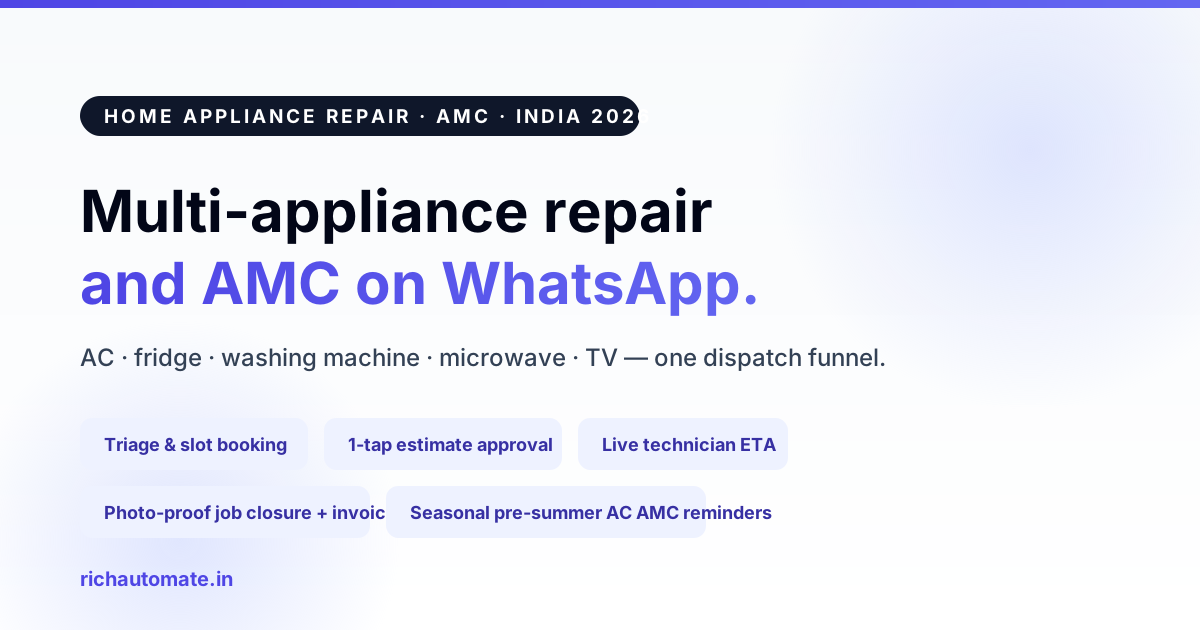
A home-appliance repair aggregator in India runs its whole multi-category operation — AC, refrigerator, washing machine, microwave and TV — on the official WhatsApp Business API: a customer raises a service request and triages the appliance and fault in one chat, gets a slot with an assigned technician and live ETA, approves the on-site spare-parts estimate with one tap, receives a photo-proof job-closure card with warranty and GST invoice, and is later pulled back with an annual maintenance contract (AMC) and seasonal pre-summer AC service reminder. That single lifecycle turns a scattered call-and-dispatch business into a tracked, recurring-revenue engine where no request, no estimate approval and no AMC renewal leaks to a missed call — the same UrbanCompany-style dispatch playbook, run on the one app every household already opens. Figures here are directional; verify current market data, GST treatment, e-waste and refrigerant rules with the relevant authorities.
Why a multi-appliance repair aggregator is a natural WhatsApp business
India's after-sales appliance-service market is large and fragmented — directionally a multi-thousand-crore opportunity growing at a double-digit CAGR as AC, refrigerator and washing-machine penetration climbs across tier-2 and tier-3 towns (verify current sizing with an industry source before quoting it). Unlike a single-category shop, an aggregator dispatches technicians across five very different appliance types, each with its own fault language, spare-parts catalogue and warranty rules. The two things that leak money are slow first response — a fridge that stops cooling in summer means the customer messages three operators at once — and one-and-done jobs that never convert to an AMC. WhatsApp fixes both, because it is the channel a household actually opens, and because a structured thread carries the estimate, the photo proof and the renewal nudge that a phone call cannot. The same recurring-service discipline that our WhatsApp playbook for RO water-purifier service and AMC brings to a single category scales across an appliance fleet — only the parts catalogue and the technician skill-matrix widen.
The 5-stage appliance-repair lifecycle on WhatsApp
Map every stage of the job to a WhatsApp touchpoint and the dispatch funnel stops leaking:
- 1. Service request + appliance/issue triage: a Click-to-WhatsApp ad, a QR sticker on the appliance, or a "Book a repair" link opens a WhatsApp Flow that captures appliance type (AC / fridge / washing machine / microwave / TV), brand, symptom, warranty status and pin-code — a qualified, routable ticket instead of a vague "my machine is not working" call.
- 2. Slot + technician assignment + live ETA: the customer self-books a visit window, the system assigns a technician whose skill-set matches the appliance, and a live ETA plus the technician's name and photo go to the customer before arrival — the reassurance that separates an aggregator from a random JustDial number.
- 3. On-site diagnosis + spare-estimate 1-tap approval: the technician diagnoses on site and sends a line-item estimate — service charge plus any spare parts with declared prices — into the same thread, and the customer approves or declines with one tap. This estimate-approval thread is the audit trail that kills billing disputes.
- 4. Job-closure photo-proof + warranty-card + invoice: on completion the technician attaches before/after photos of the repair or replaced part, and the customer receives a digital service-warranty card and a GST invoice — proof the job was done and the part is covered.
- 5. AMC-plan upsell + seasonal service-due reminders: after the job, nudge an annual maintenance contract covering the household's appliances, then fire seasonal utility reminders — the pre-summer AC service-and-gas-check being the single highest-value one — plus filter, descaling and periodic-service due dates. This is the recurring-revenue engine: AMC plus seasonal reminders turn a one-time repair into an annuity.
The AC leg of this funnel — high-ticket, seasonal, refrigerant-regulated — has its own provider considerations mapped in our guide to the best WhatsApp Business API for AC and appliance repair, while multi-site commercial contracts follow the commercial HVAC and central-AC AMC playbook.
You can skip the URL-encoding entirely, since the click-to-WhatsApp link generator generates it.
The regulatory spine: what shapes your templates and estimates
An appliance-repair aggregator sits at the intersection of consumer-protection, environmental and tax law. Build these into your templates and estimate flow from day one — treat them as the reason to get the workflow right, not as a blocker (and verify the current position with the relevant authority):
- Consumer Protection Act, 2019 (service deficiency): a documented estimate, an approved scope and a photo-proof closure are your defence against "deficiency of service" complaints. The WhatsApp estimate-approval and job-closure thread is exactly the transparent record this points toward.
- Right to Repair India (2024 portal): the Department of Consumer Affairs launched the Right to Repair Portal India covering sectors including consumer durables, pushing manufacturers to share repair information, spare-part availability and pricing. Verify the current scope and which appliance categories are covered; the direction favours transparent parts pricing, which a declared-price estimate already provides.
- E-waste (Management) Rules with EPR: replaced or scrapped units and old parts are electronic waste, and the extended-producer-responsibility (EPR) regime governs their channelisation to authorised recyclers. Log what you remove and route scrap to authorised recyclers rather than the informal market — verify your obligations and any producer/collection tie-ups.
- Refrigerant / F-gas handling (CPCB, ozone rules): AC and refrigerator work involves regulated refrigerants; venting gas to atmosphere is an environmental offence and technicians should recover and handle gases per the applicable ozone-depleting-substance and F-gas norms. Verify the current CPCB and Ozone Cell requirements and keep technician records.
- GST — service vs spare-parts split: a repair invoice typically mixes a service component and goods (spare parts), which can carry different GST treatment. Show the split clearly on the invoice and get your exact classification and rates confirmed by a qualified tax professional.
- Legal Metrology on declared part prices: spare parts carry MRP/declared-price obligations; quote parts at their declared price on the estimate rather than an opaque lump sum, which also aligns with the Right-to-Repair transparency push.
Handling customer and appliance data the DPDP way
Booking and dispatch flows pull in exactly the data the Digital Personal Data Protection Act, 2023 treats as personal — home address, phone, appliance and purchase details. A few disciplines keep an aggregator on the right side (verify the current DPDP Rules and their commencement as they roll out through 2026):
Book a WhatsApp booking demo
See how brands run bookings, reminders, and re-engagement on WhatsApp — DPDP-compliant, India-hosted. Book a 15-minute demo.
- Address & appliance PII minimisation: collect only what dispatch and the repair need — pin-code, address, appliance and fault — not a permanent purchase-history lake, and take clear opt-in before any marketing broadcast.
- Technician-side access limits: a technician should see only the job in hand — customer name, address and appliance — not the full customer database. Use an API stack with role-based access, not a shared WhatsApp group where every field agent sees every customer.
- Consent for seasonal re-contact: AMC-upsell and seasonal reminders to a past customer need a lawful basis and easy opt-out; keep utility service-due reminders separate from marketing offers, and honour data-principal access and erasure requests.
The automation tech stack
Three building blocks on the official API run the whole lifecycle:
- WhatsApp Flows for booking & estimate approval: a Flow captures the structured service request (appliance, brand, symptom, warranty, slot) in-chat, and a second Flow presents the line-item spare-parts estimate for one-tap approval — no app install, no web redirect.
- Utility templates for reminders & ETA: visit confirmations, live-ETA updates, job-closure cards, AMC-due and seasonal service reminders are transactional and sit in the cheaper utility category. Keep AMC-sale and cross-appliance offers in the marketing category, which needs prior opt-in.
- Live technician ETA & two-way status: assignment, "technician on the way", "job started" and "job closed" statuses flow back to the customer thread, so the household is never left wondering when someone will arrive.
The same job-card, estimate-approval and warranty-reminder pattern powers adjacent electronics-service verticals — see our WhatsApp playbook for mobile-phone and electronics repair and, on the retail side, the best WhatsApp Business API for electronics and appliance retail.
What a WhatsApp setup costs an appliance-repair aggregator on RichAutomate
RichAutomate runs on the official Meta WhatsApp Business API with ₹0 platform fee, ₹0 setup and ₹0 monthly — you pay only for messages. Two models:
- Client Pay — ₹0.10 per message plus Meta's conversation charges billed to you directly at cost by Meta.
- SaaS Pay — ₹1.50 marketing / ₹0.50 utility per message, all-inclusive on one INR GST invoice, tiering down toward ₹0.50 at volume.
Because most dispatch traffic — booking confirmations, ETA updates, job-closure cards and seasonal service reminders — is utility, the running cost stays low even for an aggregator handling hundreds of jobs a day across appliance categories. Going live on the official API needs a verified business, and in India GST is effectively required to move a WhatsApp Business Account to live status, so treat it as necessary, not optional. See the full WhatsApp Business API pricing breakdown for the per-conversation maths. A 14-day free trial with 100 free credits lets an aggregator pilot a booking Flow and a seasonal AC-reminder campaign before committing.
Start with these AMC service reminder message templates for appliance and RO filter visits.
Run your appliance-repair aggregator on WhatsApp
From multi-appliance service requests and technician dispatch with live ETA, to one-tap spare-estimate approval, photo-proof job closure with warranty and GST invoice, to AMC upsell and seasonal pre-summer AC reminders — RichAutomate runs it all on the official Meta WhatsApp Business API at ₹0 setup, ₹0 monthly, ₹0 platform fee. Client Pay is ₹0.10/message plus Meta's rates billed direct at cost; SaaS Pay is ₹1.50 marketing / ₹0.50 utility all-inclusive. Start with a 14-day free trial and 100 free credits, or book a 30-minute walkthrough. This is general information; verify current consumer-protection, Right-to-Repair, e-waste EPR, refrigerant, GST and DPDP specifics with the relevant authorities.
Start your 14-day free trial → · Book a 30-min walkthrough · WhatsApp us on 91 81603 11319
Related: WhatsApp for water purifier & RO AMC business in India 2026 — filter-due and AMC-renewal reminders, service-ticket capture and technician job cards.