Walk into any consumer-electronics and home-appliance showroom in India in 2026 — a multi-brand store in a tier-2 high street, a large-format chain, or a neighbourhood appliance dealer — and you will see the same thing: a counter buzzing with WhatsApp chats the staff cannot keep up with. A customer who liked a 55-inch TV yesterday has gone quiet. A buyer wants the best price on a 1.5-ton inverter AC plus installation before the weekend. Someone is asking whether a particular washing machine is in stock and what the EMI works out to. A past customer's refrigerator is out of warranty and needs an AMC renewal. Turning that into a recurring service contract is the whole point of our multi-appliance repair & AMC aggregator playbook. Electronics and appliance retail is a high-ticket, comparison-heavy, footfall-driven business — and the buyer is already on WhatsApp, comparing your price against the store down the road and the marketplace app in their pocket. A missed reply means the sale walks to a competitor; a slow quote means the customer buys online; a forgotten service follow-up means a lost AMC and a lost repeat customer. The retailers who win in 2026 are the ones who turn that chaos into a system: instant enquiry response, fast quotes with EMI and exchange details, stock answers, delivery-and-installation updates, warranty and AMC follow-up — all on the WhatsApp Business API. This is the buyer's guide to choosing the best WhatsApp Business API for an electronics and appliance retailer or dealer in India in 2026: what actually matters for this vertical, the lifecycle it has to carry, and how to pick a platform that does not eat thin retail margins. Treat every GST, finance and pricing specific below as "verify as of 2026," treat every figure as illustrative, and treat none of this as legal, tax or financial advice.
Why electronics & appliance retail is a WhatsApp problem. A TV, AC, refrigerator or washing-machine purchase is high-ticket and comparison-led: the buyer wants the spec, the best price, the EMI option, the exchange value, the delivery date and the installation plan — and they want it fast, because they are comparing you against the next store and the marketplace app. They want it on WhatsApp, where they already share product screenshots and ask "kitne ka doge?". A missed reply means the footfall converts at a rival; a slow quote means the sale goes online; a forgotten AMC reminder means a repeat customer lost. WhatsApp — opened within minutes, read far more than email — is where a retailer answers the price question, shares the spec and EMI, confirms stock, schedules delivery and installation, and stays the trusted store for the next appliance and every service call, provided every send is consent-based and honest. Verify GST, financing and warranty rules as of 2026.
What "best" actually means for an electronics & appliance retailer
The "best WhatsApp Business API" for an electronics and appliance retailer is not the one with the most features or the loudest brand — it is the one that fits the specific shape of a high-ticket, comparison-driven, service-heavy retail sale. Before comparing logos, get clear on the criteria that actually decide outcomes for this vertical. The table below is the buyer's checklist — weigh each against your own counter and service desk as of 2026.
| What to evaluate | Why it matters for electronics & appliances | What good looks like |
|---|---|---|
| Speed-to-quote with EMI & exchange | High-ticket buyers compare price, EMI and exchange across stores in minutes | Fast quote sharing with a human, plus instant auto-reply so no enquiry waits |
| Spec & media sharing | TVs, ACs, appliances sell on specs, images and short demo clips | Quick send of product images, spec sheets and the WhatsApp catalogue by category |
| Stock & availability answers | "Is this model in stock, what colour, when delivered?" decides the sale | A chatbot or quick-reply that handles common stock and delivery questions |
| Footfall recapture | Customers who visited and left are the warmest, most-lost leads | Opted-in follow-up to recapture walk-ins who went quiet |
| Transparent, low pricing | Electronics retail margins are thin; a fat per-seat SaaS fee eats them | ₹0 platform fee, pay only per message and Meta's conversation charge |
| Delivery, installation, warranty & AMC | The sale is only the start; service and AMC drive repeat revenue | Delivery and installation updates, warranty and AMC-renewal reminders on one line |
The reframe most retailers eventually make: the platform is not the product — the sales-and-service engine it lets you run is. A retailer who picks on price-per-message alone, but cannot quote fast or recapture a walk-in, has bought a cheaper way to lose footfall to the store down the road. Pick for the journey, then optimise the cost. End-of-life appliances a retailer takes back flow to an authorised e-waste recycler, whose pipeline we map in our e-waste EPR recycler playbook.
The end-to-end electronics & appliance retail WhatsApp lifecycle
Here is the full lifecycle an electronics and appliance retailer can run over WhatsApp, from the first enquiry to the repeat AMC relationship, mapped to the automation at each stage and the guardrail that keeps it honest. Treat the automation column as a reference pattern and verify trade, finance and warranty specifics as of 2026.
| Lifecycle stage | WhatsApp automation | Guardrail (verify 2026) |
|---|---|---|
| 1. Enquiry capture | Walk-in, click-to-WhatsApp ad or in-store QR opens a chat; bot replies instantly and captures product interest and budget | Capture consent at first contact; honour opt-out |
| 2. Spec & price | Bot shares spec sheets, images and short demo clips; sales sends a clear quote with price, EMI and exchange value | Accurate price, EMI and exchange terms; no misleading offers |
| 3. Stock & finance | Quick-reply handles stock, colour and delivery questions; finance and EMI options shared with a human | Honest availability; finance terms accurate; route approvals to a human |
| 4. Order & payment | Order confirmation, advance or full payment link, and a delivery-date commitment | Secure payment; accurate delivery commitment |
| 5. Delivery & installation | Dispatch, delivery-slot and installation-scheduling updates with reminders | Factual logistics; reminders only to opted-in customers |
| 6. Warranty & service | Warranty registration, service-request booking, complaint tracking and repair updates | Honest service handling; separate service vs marketing consent |
| 7. AMC & repeat | AMC-renewal reminders, opted-in festive and new-model offer broadcasts, exchange-upgrade nudges | Consent-based broadcasts only; easy opt-out; minimise data |
Notice the rhythm: WhatsApp carries a high-ticket sale that is too comparison-heavy and too service-dependent for phone tag to sustain, then keeps the customer for the next appliance, the AMC renewal and the festive upgrade — which is where an electronics retailer's real lifetime value lives. For the broader catalogue-and-checkout view the WhatsApp catalogue commerce playbook goes deep, and for festive demand spikes the WhatsApp drip campaigns guide is a useful companion.
The click-to-WhatsApp link generator produces the link and the QR code together if you need both.
The quote thread: where electronics sales are won
The single highest-leverage part of an electronics or appliance sale is the quote moment: the buyer wants the best price, the EMI option and the exchange value, and they want it before they walk into the next store or open the marketplace app. A retailer who can instantly send a clear quote — model, price, EMI per month, exchange value, delivery date — looks like a serious, trustworthy store. A retailer who says "come back tomorrow" loses the high-intent buyer to whoever answers first. WhatsApp's instant, conversational nature turns the quote thread into something a salesperson can deliver in seconds, to a customer standing in a rival's showroom comparing prices. Done well, the quote thread is what converts comparison-shopping footfall into a closed, financed sale — and the warranty and AMC follow-up is what brings that customer back.
The quote thread, in one principle. Treat your pricing and service as a fast, honest, consent-based quote you can deliver in seconds, not a haggle the customer has to chase. Send clear price, EMI and exchange terms, share accurate specs and stock, confirm delivery and installation honestly, and make warranty, service and AMC easy to reach on the same thread. The thread should feel like a well-run store that values the customer's time — never like a pushy spam channel. Verify GST, financing, warranty and DPDP data rules as of 2026; this is not tax, finance or legal advice, and no platform guarantees against Meta quality or ban actions.
Get a 1-minute BSP audit on WhatsApp
Drop your WhatsApp number — we line-item your current invoice against Meta India rates in under 60 seconds. India-hosted, DPDP-compliant.
Per-seat SaaS vs a ₹0-platform model: the margin question
Electronics and appliance retail margins are thin and fiercely competitive against marketplaces, and demand is seasonal — festive and summer-AC peaks, quieter months between. The WhatsApp platform you pick should not be a fixed monthly tax on every counter salesperson regardless of how many appliances close. Most legacy BSPs charge a per-seat or tiered monthly platform fee on top of Meta's own per-conversation charge; a ₹0-platform model charges only for what you actually send. This comparison is directional — verify current pricing on each vendor as of 2026.
| Dimension | ₹0-platform model (RichAutomate) | Typical per-seat / tiered SaaS BSP |
|---|---|---|
| Platform / setup / monthly fee | ₹0 platform, ₹0 setup, ₹0 monthly | Monthly platform fee, often per seat or per tier |
| What you pay for | Only per message + Meta's conversation charge | Subscription + markup on conversations |
| Fit for seasonal demand | Costs scale with sends; quiet months cost little | You pay the subscription even in a slow month |
| Margin impact on a ₹50K appliance sale | Messaging cost is a rounding error | Fixed fee eats into thin retail margin |
| Billing transparency | Client Pay: Meta bills you direct at Meta rates | Often a bundled markup you cannot see through |
The conclusion most retailers reach: for a vertical with thin margins, seasonal demand and high ticket values, a model where the messaging cost is a rounding error against the sale beats a fixed monthly tax that you pay whether you close one appliance or fifty. Run your own numbers on the WABA cost calculator and read the Client Pay vs SaaS Pay billing breakdown before committing.
The automation stack that runs it
The good news for an electronics and appliance retailer is that none of this needs custom engineering. The building blocks map onto a standard WhatsApp Business API automation stack: a QR and click-to-WhatsApp enquiry-capture flow in-store and on ads that captures product interest and budget instantly; a catalogue layer that sends spec sheets, images and demo clips by category; a chatbot FAQ that answers the predictable questions — stock, colour, delivery, EMI, warranty — without a human; a quote-and-order layer with EMI, exchange and payment links; delivery and installation updates with reminders; a warranty-and-service desk for registration, complaints and repair tracking; segmented broadcast for opted-in festive and new-model offers and AMC renewals; and a human handoff the moment a buyer wants to negotiate or needs real service support. For the relationship-management view across your whole counter, the best WhatsApp CRM for India guide is a useful companion. The discipline is to keep the chatbot scoped to specs, stock, logistics and service, and route every price negotiation and warranty claim to a human.
The economics: an illustrative retailer cohort
Criteria and architecture are the floor; the reason to run WhatsApp across the electronics-and-appliance lifecycle is faster quotes, more comparison-shopping footfall closed, fewer enquiries lost to a slow reply, and more repeat AMC and upgrade revenue. Consider an illustrative multi-brand retailer running a mix of walk-in footfall, click-to-WhatsApp ad leads and past-customer service contacts across TVs, ACs, refrigerators, washing machines and small appliances. Every figure below is illustrative — model your own on the calculator.
| Metric (illustrative) | Without WhatsApp lifecycle | With WhatsApp lifecycle |
|---|---|---|
| Speed to first quote | Hours; customer already at rival store | Seconds; clear quote with EMI and exchange |
| Walk-ins recaptured | Few; no follow-up after the visit | More; opted-in recapture of quiet leads |
| Delivery / installation no-shows | Higher (no reminders) | Lower (reminders before the slot) |
| AMC renewals captured | Few; no reminder system | More; scheduled AMC-renewal nudges |
| WhatsApp messaging cost | ₹0 | Utility reminders at the cheapest tier |
The asymmetry is the argument: quotes, order confirmations, delivery and installation updates, warranty notices and AMC reminders are largely utility-category conversations — the cheapest tier — and they directly reduce the most expensive failures in an electronics business, namely slow replies that send the footfall to a rival or a marketplace, un-recaptured walk-ins, missed delivery slots, and an installed base that is never re-engaged for AMC or upgrades. A handful of extra closed appliances a month dwarf the messaging bill, which is a rounding error against a ₹50,000 sale. Run your own figures on the WhatsApp Business API cost guide before committing.
Build the electronics & appliance lifecycle on RichAutomate
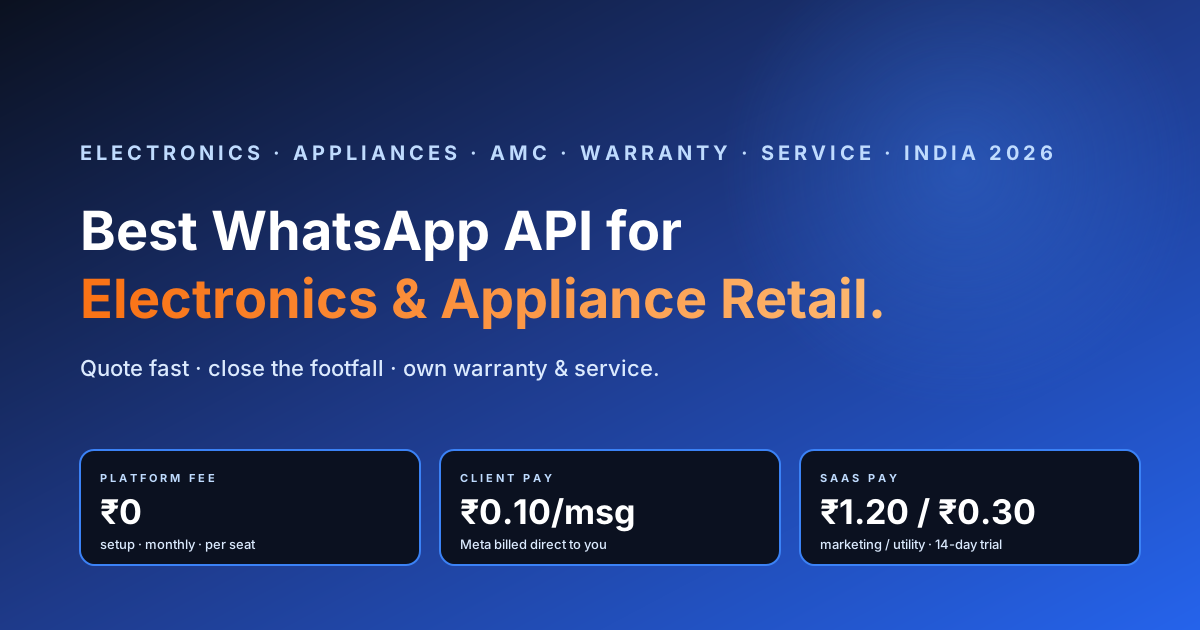
You can stand up the entire retail sales-and-service layer — instant enquiry capture from in-store QR and click-to-WhatsApp ads, spec, image and demo-clip sharing, chatbot answers on stock, colour, delivery and EMI, fast quotes with exchange and payment links, delivery and installation scheduling with reminders, warranty registration and service-request tracking, and a segmented festive, new-model and AMC-renewal broadcast engine — without engineering lift, while your billing and team stay the source of truth. RichAutomate charges ₹0 platform fee, ₹0 setup, ₹0 monthly. On Client Pay you pay only ₹0.10 per message plus Meta's own per-conversation charge billed to you directly by Meta at Meta's rates; on SaaS Pay it is an all-in ₹1.20 per marketing conversation and ₹0.30 per utility conversation — and quotes, delivery updates, installation reminders, warranty notices and AMC nudges are utility conversations, the cheaper category. There is a 14-day free trial with 100 credits, so you can measure the quote-speed and footfall-recapture improvement before committing. Keep WhatsApp as the conversation layer, keep your billing and team as the source of truth, and verify GST, financing, warranty and DPDP data rules as of 2026. See the full pricing page for details.
Stop losing high-ticket footfall to a slow reply
An electronics and appliance retailer does not have to let high-intent footfall leak away because the quote took an hour, the walk-in was never followed up, or the AMC renewal was forgotten. From the instant in-store QR or click-to-WhatsApp capture, through the spec and demo share, the fast quote with EMI and exchange, the order and delivery, the installation and warranty registration, the service desk, and the opted-in festive and AMC-renewal relationship — WhatsApp can be the one continuous customer thread, while your billing and team stay the source of truth. On illustrative numbers that means faster quotes, more footfall recaptured, fewer missed slots and more repeat AMC and upgrade revenue, for a messaging bill that is a rounding error against a ₹50,000 appliance sale. RichAutomate's pricing stays flat through all of it: ₹0 platform fee, ₹0 setup, ₹0 monthly — Client Pay at ₹0.10 per message with Meta conversation charges billed direct by Meta, or SaaS Pay at ₹1.20 marketing / ₹0.30 utility all-in. Start the 14-day free trial with 100 credits, WhatsApp us at 918160311319, or book a 30-minute walkthrough at https://calendly.com/inrichdaddy/30min. (All cohort, quote-time and footfall figures here are illustrative — model your own on the calculator — no platform guarantees against Meta quality or ban actions, and GST, financing and warranty rules change; verify the current position as of 2026. This is operational guidance, not legal, tax or financial advice.)
Start your 14-day free trial → · See full pricing · Read the furniture retail guide
Related: selling inverters & batteries? See WhatsApp for inverter & battery dealers in India 2026 — auto replacement reminders that bring customers back.
Related: WhatsApp for water purifier & RO AMC business in India 2026 — filter-due and AMC-renewal reminders, service-ticket capture and technician job cards.