Run an eye hospital or ophthalmology practice in India in 2026 — a single-doctor OPD clinic doing refractions and routine check-ups, a day-care cataract centre running multiple IOL surgeries a week, or a multi-specialty eye hospital with cataract, retina, glaucoma, cornea, LASIK and a optical dispensing counter under one roof — and you already know the real bottleneck is not the operating microscope, it is the front desk. A patient who needs cataract surgery calls to ask about the IOL options and the cost, the line is busy because the counter is registering a walk-in, and by the time anyone calls back the family has booked the eye hospital down the road that picked up first. A diabetic patient who must come back every six months for a retina screening never returns because nobody reminded them, and walks in two years later with changes that could have been caught. A cataract patient turns up on the surgery date without having read the pre-op fasting and medication instructions, and the slot is wasted. A LASIK enquiry that took a week to get a quote goes cold. A post-op patient with a red, watering eye has no quick way to ask whether it is normal, and either floods the OPD or, worse, ignores a real complication. An eye practice is a recall-driven, appointment-dense, instruction-heavy business where a missed reminder costs sight and a slow first reply loses a high-value surgical case — and the whole patient relationship now runs on WhatsApp, where the appointment is booked, the pre-op instruction is read, the surgery is confirmed, the post-op doubt is answered and the six-month recall is honoured. The eye hospital that turns that WhatsApp relationship into a system — instant enquiry response, OPD and surgery booking, pre-op and post-op instructions, recall reminders for screenings and reviews, report and prescription delivery, and a consent-based optical and review engine — fills the OT, protects the recall base and grows the surgical practice. This is the buyer's guide to choosing the best WhatsApp Business API for an eye hospital or ophthalmology practice in India in 2026: what actually matters for this vertical, the patient lifecycle it has to carry, and how to pick a platform that respects a clinical, recall-driven, high-value surgical practice. Treat every commercial and pricing specific below as "verify as of 2026," treat every figure as illustrative, and treat none of this as medical, legal or financial advice.
Why an eye hospital is a WhatsApp problem. An ophthalmology engagement is a recall-driven, appointment-dense, instruction-heavy clinical relationship made of decision moments that are all short, time-sensitive messages: the surgical enquiry where the fastest credible reply usually wins the cataract or LASIK case, the OPD appointment booking, the pre-op fasting and medication instructions, the surgery-date confirmation, the post-op eye-drop schedule and review reminders, the report and prescription delivery, and the periodic recall for diabetic retina screenings, glaucoma reviews and annual check-ups. The patient already lives on WhatsApp, opens messages within minutes, and judges a hospital by how quickly and clearly it responds. A busy front desk that has to choose between registering the walk-in queue and calling back a surgical enquiry will always drop one. WhatsApp is where an eye hospital wins the surgical case by replying first, protects clinical outcomes by getting pre-op and post-op instructions read, and protects revenue by honouring the recall base that drives repeat footfall — provided every send is consent-based, accurate and genuinely useful. Verify advertising, DPDP and applicable health-data rules as of 2026; nothing here is medical or legal advice, and no platform guarantees against Meta quality or ban actions.
What "best" actually means for an eye hospital
The "best WhatsApp Business API" for an eye hospital is not the one with the most features or the loudest brand — it is the one that fits the specific shape of a recall-driven, appointment-dense, instruction-heavy clinical practice where a missed reminder costs sight and a slow first reply loses a high-value surgical case. Before comparing logos, get clear on the criteria that actually decide outcomes for this vertical. The table below is the buyer's checklist — weigh each against your own case mix and patient volume as of 2026.
| What to evaluate | Why it matters for an eye hospital | What good looks like |
|---|---|---|
| Speed-to-first-reply on surgical enquiries | A cataract, retina or LASIK case goes to the hospital that answers first with a credible response; a busy line loses it | Instant auto-reply that captures the complaint and routes to a counsellor for the consultation |
| OPD & surgery appointment booking | A busy front desk drops calls; double-booked OT slots and no-shows waste expensive surgical time | Slot booking with confirmation and reminders for OPD visits and surgery dates |
| Pre-op & post-op instruction delivery | A cataract patient who misses fasting or eye-drop instructions wastes the slot or risks a complication | Stage-timed instruction messages with read confirmation and a question channel |
| Recall & screening reminders | Diabetic retina screenings, glaucoma reviews and annual check-ups lapse when nobody reminds; lapses cost sight and revenue | Consent-based, scheduled recall reminders tied to each patient review interval |
| Report, prescription & optical handoff | Reports and spectacle prescriptions sink in queues; the optical counter loses the captive sale | Secure report and prescription delivery with a consent-based optical and review nudge |
| Transparent, low pricing | A clinical practice should not carry a fat per-seat SaaS fee on every counter login between case waves | ₹0 platform fee, pay only per message and Meta's conversation charge |
The reframe most eye hospitals eventually make: the platform is not the product — the patient relationship and recall base it lets you run is. A hospital that picks on price-per-message alone, but cannot reply fast or honour a recall, has bought a cheaper way to lose surgical cases and let its screening base lapse. Pick for the patient journey, then optimise the cost. For the closely adjacent clinical and dispensing views, the best WhatsApp Business API for hospitals and clinics guide and the optical and eyewear retail playbook share much of the same appointment-and-recall shape.
The end-to-end eye hospital WhatsApp lifecycle
Here is the full lifecycle an eye hospital can run over WhatsApp, from the first enquiry through the OPD visit, the surgery, the post-op reviews and the long-term recall, mapped to the automation at each stage and the guardrail that keeps it ethical and clinically safe. Treat the automation column as a reference pattern and verify advertising, data-protection and applicable health-data specifics as of 2026.
| Lifecycle stage | WhatsApp automation | Guardrail (verify 2026) |
|---|---|---|
| 1. Enquiry capture | A referral, hospital site, Google or click-to-WhatsApp ad opens a chat; bot replies instantly and captures the complaint, age and preferred location, then routes a surgical enquiry to a counsellor | Capture consent at first contact; honour opt-out; never diagnose over chat — route clinical questions to a clinician |
| 2. OPD appointment | Bot books the OPD slot, shares timing, doctor and what to bring, and confirms with a reminder the day before | Accurate slot and doctor details; honour the booking; minimise personal health data on chat |
| 3. Diagnosis & surgery counselling | After the OPD visit, a counsellor shares the indicative procedure, IOL or LASIK options and cost on the thread and books the surgery date | Honest clinical and cost framing; no over-promising on outcomes; a clinician owns the clinical advice |
| 4. Pre-op instructions | Stage-timed fasting, medication and arrival instructions before the surgery date, with read confirmation and a question channel | Clinically accurate instructions; clear escalation path; never replace a clinician's judgement |
| 5. Surgery & discharge | Surgery-day confirmation, then a discharge summary with the eye-drop schedule and do's and don'ts on the thread | Accurate drop schedule and warning signs; explicit when-to-come-back-urgently guidance |
| 6. Post-op reviews | Scheduled post-op review reminders (day 1, week 1, month 1) and a safe channel to ask whether a symptom is normal | Triage to a clinician for any red-flag symptom; never reassure away a real complication |
| 7. Recall, optical & review | Long-term recall for retina screenings, glaucoma reviews and annual check-ups, a consent-based optical-prescription nudge, and a review request | Opt-in only; easy opt-out; frequency caps so a recall never feels like spam |
Notice the rhythm: WhatsApp carries a clinical journey that a busy phone line and printed instruction sheet let slip, then compounds the practice by honouring the recall base that drives repeat surgical and screening footfall — which is where an eye hospital's durable revenue lives. For the broader patient-comms view the diagnostic labs guide goes deep on report delivery, and the physiotherapy clinics playbook is a useful companion for the recall-and-review side of any clinical practice.
You can skip the URL-encoding entirely, since the click-to-WhatsApp link generator generates it.
The recall base: where an eye hospital's durable revenue is won
The single most under-run asset an eye hospital owns is its recall base. Ophthalmology is unusually recall-driven: a diabetic patient needs a retina screening every six to twelve months, a glaucoma patient needs pressure checks for life, a cataract patient often returns for the second eye, a LASIK patient comes back for reviews, and almost every patient needs a fresh spectacle prescription on a predictable cycle — yet most eye hospitals do nothing deliberate to honour that recall. The diabetic patient who should return in six months never gets reminded and walks in two years later with avoidable damage; the second-eye cataract is never followed up; the spectacle-prescription patient buys glasses elsewhere because the optical counter never reached out. WhatsApp turns a one-time visit into a living recall base: a consent-based screening reminder tied to each patient's clinical interval, a second-eye and review nudge, a spectacle-prescription renewal note that feeds the optical counter, and a periodic check-up reminder that keeps the practice top of mind. The hospital that reminds every patient, at the right clinical interval, in a professional and easy-to-act way, compounds both its clinical outcomes and its revenue with the lowest-cost, highest-trust footfall there is; the hospital that lets the recall lapse re-competes for cold enquiries forever and lets preventable disease progress. Most eye hospitals never capture the consent, never schedule the recall, and never reach out — so the screening base that should be the backbone of the practice is left to chance. Done well and ethically — a genuine clinical reminder at the right interval, never pestering, never alarming — the recall engine is the highest-leverage, lowest-cost growth lever an eye hospital has, and it protects sight while it protects revenue.
Get a 1-minute BSP audit on WhatsApp
Drop your WhatsApp number — we line-item your current invoice against Meta India rates in under 60 seconds. India-hosted, DPDP-compliant.
The recall engine, in one principle. Treat every patient as a relationship you have permission to keep clinically warm, not a visit that ends at discharge. Capture explicit consent, schedule the recall to the patient's own clinical interval, deliver the reminder clearly and calmly, cap the frequency so it never feels like spam, route any clinical question to a clinician, and make opting out a single tap. The thread should feel like a trusted hospital looking after the patient's eyes — never like a channel engineered to upsell. Verify advertising, DPDP and applicable health-data rules as of 2026; this is not medical or legal advice, and no platform guarantees against Meta quality or ban actions.
Per-seat SaaS vs a ₹0-platform model: the margin question
An eye hospital runs uneven case waves — busy cataract camps and quiet weeks — across multiple counter and OPD logins, so a fixed monthly platform fee charged on every seat is dead weight between waves and an arbitrary tax during them. Most legacy BSPs charge a per-seat or tiered monthly platform fee on top of Meta's own per-conversation charge; a ₹0-platform model charges only for what you actually send. This comparison is directional — verify current pricing on each vendor as of 2026.
| Dimension | ₹0-platform model (RichAutomate) | Typical per-seat / tiered SaaS BSP |
|---|---|---|
| Platform / setup / monthly fee | ₹0 platform, ₹0 setup, ₹0 monthly | Monthly platform fee, often per seat or per tier |
| What you pay for | Only per message + Meta's conversation charge | Subscription + markup on conversations |
| Fit for recall-driven, uneven volume | Costs scale with appointments and recalls sent; a quiet week costs little | You pay the subscription even between case waves |
| Margin impact per surgical case | Messaging cost is negligible against a cataract or LASIK fee | Fixed monthly fee runs whether the OT is full or idle |
| Billing transparency | Client Pay: Meta bills you direct at Meta rates | Often a bundled markup you cannot see through |
The conclusion most eye hospitals reach: for a recall-driven practice with uneven case flow, a model where the messaging cost is negligible against each surgical fee beats a fixed monthly tax you pay even in the quiet weeks. Run your own numbers on the WABA cost calculator and read the Client Pay vs SaaS Pay billing breakdown before committing.
The automation stack that runs it
The good news for an eye hospital is that none of this needs custom engineering. The building blocks map onto a standard WhatsApp Business API automation stack: a click-to-WhatsApp and hospital-site capture flow that captures the complaint, age and location instantly and routes surgical enquiries to a counsellor; a chatbot FAQ that answers the predictable questions — OPD timings, doctor availability, cataract and LASIK cost ranges, insurance and cashless queries — without a human; an appointment-booking step with slot confirmation and reminders for OPD visits and surgery dates; a pre-op and post-op instruction engine with stage-timed fasting, medication and eye-drop messages and read confirmation; a report and prescription delivery step with a consent-based optical handoff; a recall engine for retina screenings, glaucoma reviews and annual check-ups tied to each patient's clinical interval; a review-and-feedback ask after recovery; and a human handoff the moment a patient reports a red-flag symptom or wants to discuss a diagnosis or complaint. For the dispensing parallels the optical and eyewear retail guide is a close adjacent reference. The discipline is to keep the chatbot scoped to logistics, FAQs and reminders, and route every clinical and diagnostic conversation to a clinician.
The economics: an illustrative hospital cohort
Criteria and architecture are the floor; the reason to run WhatsApp across the patient lifecycle is more surgical cases won, fewer wasted OT slots, recalls honoured on time, and a screening base that compounds. Consider an illustrative single-location eye hospital running a mix of OPD walk-ins and enquiries, a steady flow of cataract and refractive surgeries, and an opted-in recall base of diabetic, glaucoma and review patients. Every figure below is illustrative — model your own on the calculator.
| Metric (illustrative) | Without WhatsApp lifecycle | With WhatsApp lifecycle |
|---|---|---|
| Speed to first reply on a surgical enquiry | Hours, if the counter reaches it between walk-ins | Seconds; instant acknowledgement, counsellor follow-up for the consultation |
| Surgical cases won against rivals | Lower (a busy line loses the case) | Higher (instant, credible first response) |
| Wasted OT slots from missed pre-op prep | Common; patients arrive unprepared | Fewer; stage-timed pre-op instructions with read confirmation |
| Recalls and screenings honoured | Rarely; the base lapses | More; consent-based recall reminders at each clinical interval |
| WhatsApp messaging cost | ₹0 | Utility appointment, instruction and recall messages at the cheapest tier |
The asymmetry is the argument: appointment confirmations, pre-op and post-op instructions, post-op review reminders and recall nudges are largely utility-category conversations — the cheapest tier — and they directly reduce the most expensive failures in an eye hospital, namely slow replies that lose a surgical case, wasted OT slots from unprepared patients, lapsed recalls that cost both sight and revenue, and a screening base left entirely to chance. A single extra cataract or LASIK case won, or one diabetic retinopathy caught early through an honoured screening, dwarfs the messaging bill, which is negligible against a surgical fee. Run your own figures on the dermatology and skin clinics buyer guide before committing.
Build the eye hospital patient lifecycle on RichAutomate
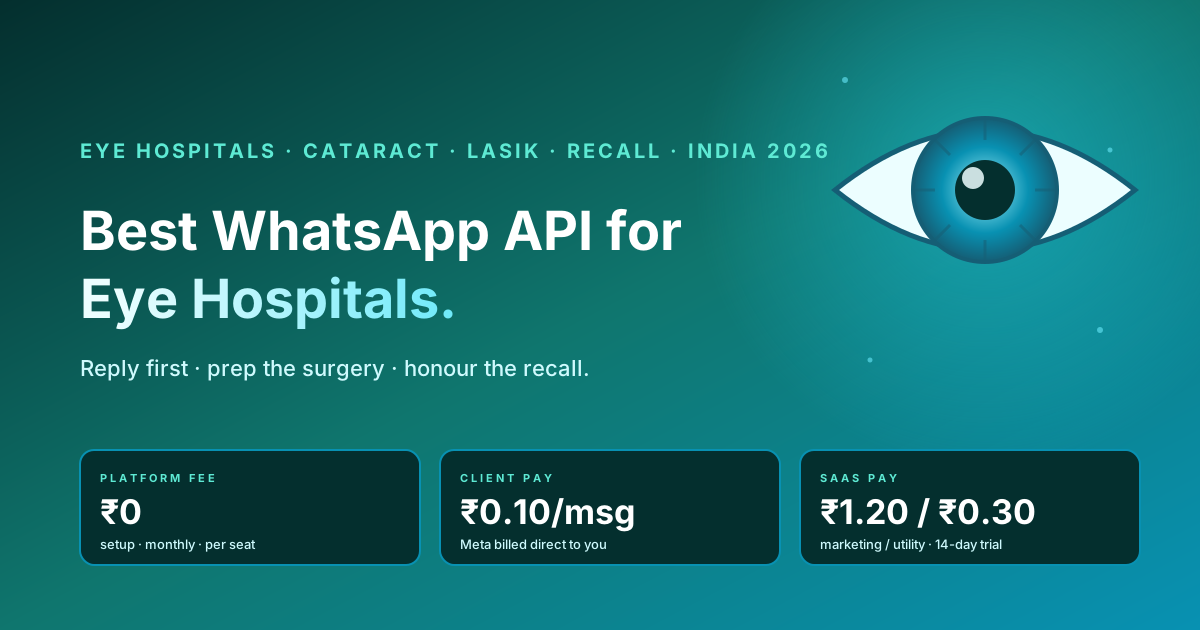
You can stand up the entire patient-relationship layer — instant enquiry capture from referrals, hospital site and ads, chatbot answers on timings, doctors, cataract and LASIK costs and cashless queries, OPD and surgery booking, pre-op and post-op instruction delivery with read confirmation, report and prescription delivery, recall reminders for screenings and reviews, and a consent-based optical and review engine — without engineering lift, while your HMIS and clinical records stay the source of truth. RichAutomate charges ₹0 platform fee, ₹0 setup, ₹0 monthly. On Client Pay you pay only ₹0.10 per message plus Meta's own per-conversation charge billed to you directly by Meta at Meta's rates; on SaaS Pay it is an all-in ₹1.20 per marketing conversation and ₹0.30 per utility conversation — and appointment confirmations, instructions, review reminders and recalls are utility conversations, the cheaper category. There is a 14-day free trial with 100 credits, so you can measure the case-win and recall improvement before committing. Keep WhatsApp as the conversation layer, keep your HMIS and clinical records as the source of truth, and verify advertising, DPDP and applicable health-data rules as of 2026. See the full pricing page for details.
Stop letting cases and recalls leak
An eye hospital does not have to lose a cataract or LASIK case because the first reply never came from a busy counter, waste an OT slot because the patient never read the pre-op instructions, or let a diabetic patient who needed a six-month retina screening slip away until the damage is done. From the instant referral or click-to-WhatsApp capture, through the OPD and surgery booking, the pre-op and post-op instruction delivery, the report and prescription handoff and the long-term recall reminders, to the consent-based optical and review ask — WhatsApp can be the one continuous patient thread, while your HMIS and clinical records stay the source of truth. On illustrative numbers that means more surgical cases won, fewer wasted OT slots, recalls honoured on time, and a screening base that compounds — for a messaging bill that is negligible against a surgical fee. RichAutomate's pricing stays flat through all of it: ₹0 platform fee, ₹0 setup, ₹0 monthly — Client Pay at ₹0.10 per message with Meta conversation charges billed direct by Meta, or SaaS Pay at ₹1.20 marketing / ₹0.30 utility all-in. Start the 14-day free trial with 100 credits, WhatsApp us at 918160311319, or book a 30-minute walkthrough at https://calendly.com/inrichdaddy/30min. (All cohort, case and recall figures here are illustrative — model your own on the calculator — no platform guarantees against Meta quality or ban actions, and advertising, DPDP and health-data rules change; verify the current position as of 2026. This is operational guidance, not medical, legal or financial advice.)
Start your 14-day free trial → · See full pricing · Read the hospitals and clinics guide