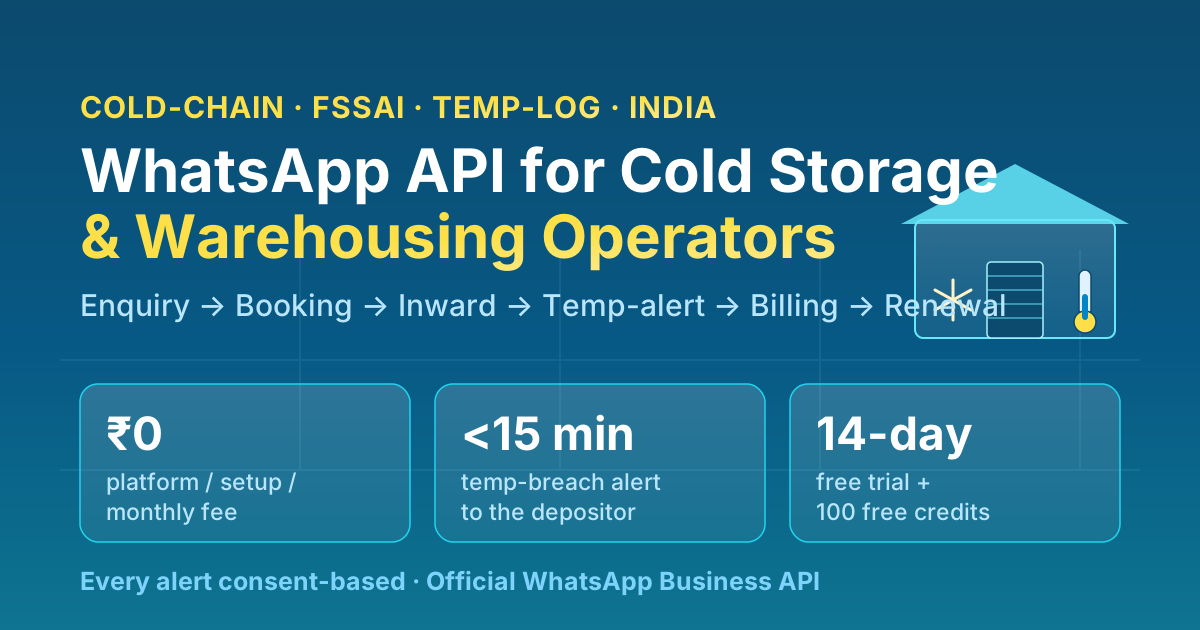
Run a cold storage or warehousing business in India in 2026 — a single-chamber cold store holding potatoes for a season of farmer-depositors, a multi-temperature facility renting rack space to pharma, dairy and frozen-food brands, or a 3PL warehouse handling inward, put-away and dispatch for a dozen distributor accounts — and you already know that your entire reputation rides on two things the depositor cannot see for himself: is my stock safe, and is the temperature holding? A depositor parks lakhs of rupees of perishable goods in your chambers and then spends the season anxious, calling your office for stock balance, chasing you for the monthly rent bill, and panicking the moment he hears a rumour that a chamber tripped. A power cut or a compressor fault sends the temperature drifting, and by the time anyone notices, a consignment is at risk — and the depositor finds out from a loss, not from you. A season ends, the storage contract lapses, and the renewal conversation never happens because nobody followed up. Cold storage and warehousing is a trust business running on razor-thin per-bag or per-pallet margins, and the operators who keep depositors year after year are the ones who communicate proactively — balance on demand, temperature transparency, breach alerts within minutes, clean billing, and a renewal nudge before the contract dies. WhatsApp is the one channel where a warehouse operator can send a booking confirmation, an inward (goods-received) note, a live stock balance, a temperature-excursion alert, a monthly rent invoice with a payment link, and a renewal reminder — all to a depositor who opens WhatsApp within minutes but never checks his email. This is the buyer's guide to choosing the best WhatsApp Business API for a cold storage or warehousing business in India in 2026: what actually matters for a trust-and-perishables operation, the storage lifecycle it has to carry, and how to pick a platform that does not bleed a thin-margin facility dry. Treat every commercial and pricing specific below as "verify as of 2026," treat every figure as illustrative, and treat none of this as legal, tax or financial advice.
Why a cold store is a WhatsApp problem. A warehouse has no shop window and no daily face-to-face with the depositor — the relationship is a season-long act of trust conducted almost entirely by phone calls, paper receipts and the occasional panicked visit. The deciding moments are all short messages: the booking confirmation that locks the rack space, the inward note that proves the goods arrived and were logged, the stock-balance reply when the depositor asks "how many bags do I have left?", the temperature-breach alert that reaches him within minutes instead of after a loss, the monthly rent invoice with a UPI link, and the renewal reminder before the contract lapses. The depositor already lives on WhatsApp and reads it within minutes. WhatsApp is where a warehouse operator turns anxiety into trust and a one-season depositor into a multi-year account — provided every send is consent-based, accurate and genuinely useful. Verify FSSAI, weights-and-measures and DPDP data rules as of 2026; nothing here is legal advice, and no platform guarantees against Meta quality or ban actions.
What "best" actually means for a cold storage operator
The "best WhatsApp Business API" for a warehouse is not the one with the most features or the loudest brand — it is the one that fits the specific shape of a trust-driven, perishables, thin-margin storage business whose single biggest lever is keeping depositors calm, informed and renewing. Before comparing logos, get clear on the criteria that actually decide outcomes for this vertical. The table below is the buyer's checklist — weigh each against your own chamber mix and depositor base as of 2026.
| What to evaluate | Why it matters for a cold store / warehouse | What good looks like |
|---|---|---|
| Temperature-excursion alerting | A breach caught in minutes is a save; caught after a loss it is a claim and a lost depositor | Utility alert to the depositor and ops team the moment a chamber crosses threshold |
| Stock-balance & inward/outward notes | Depositors call constantly for balance; self-serve replies kill the phone queue | On-demand balance lookup and automatic goods-received / dispatch notes |
| Booking & rack-space confirmation | A verbal booking that is not confirmed in writing becomes a dispute at inward | Written booking confirmation with chamber, rate and validity on one thread |
| Monthly rent billing & payment | Cash-flow on thin margins depends on rent collected on time, not chased for weeks | Monthly invoice with a secure UPI or payment link and gentle reminders |
| Renewal & retention nudges | Contracts lapse silently; a timely nudge is the cheapest depositor you will ever keep | Consent-based renewal reminders before the storage period ends |
| Transparent, low pricing | A per-bag / per-pallet margin business cannot carry a fat per-seat SaaS fee | ₹0 platform fee, pay only per message and Meta's conversation charge |
The reframe most warehouse owners eventually make: the platform is not the product — the depositor trust it lets you build and keep is. An operator who picks on price-per-message alone, but cannot fire a temperature alert in minutes or answer a stock-balance query without a phone call, has bought a cheaper way to keep losing depositors every season. Pick for the trust-and-retention journey, then optimise the cost. For the movement-of-goods parallel, the WhatsApp for B2B FMCG distribution guide and the supermarkets & grocery playbook go deeper on the stock-and-order mechanics that a warehouse sits upstream of.
The customer LTV calculator shows what a retained customer is worth before you set the spend.
The end-to-end cold storage WhatsApp lifecycle
Here is the full lifecycle a warehouse can run over WhatsApp, from the first space enquiry to the inward note, the temperature alert, the rent bill and the renewal nudge, mapped to the automation at each stage and the guardrail that keeps it ethical. Treat the automation column as a reference pattern and verify FSSAI, weights-and-measures and data-protection specifics as of 2026.
| Lifecycle stage | WhatsApp automation | Guardrail (verify 2026) |
|---|---|---|
| 1. Space enquiry & quote | Bot captures commodity, quantity, temperature band and dates; shares a rate and validity | Explicit opt-in at first contact; honest availability and rates |
| 2. Booking confirmation | Written confirmation with chamber, rack, rate, storage period and terms | Accurate terms; no verbal-only commitments that become disputes |
| 3. Inward / goods-received note | On arrival, an automatic GRN with lot, bag/pallet count and chamber location | Match physical count; never over-state received stock |
| 4. Stock balance on demand | Depositor asks "balance?" and the bot returns current bags/pallets and location | Live, accurate figures; minimise personal and commercial data on chat |
| 5. Temperature & power alerts | The moment a chamber crosses threshold, a utility alert to the depositor and ops | Genuine alerts only; no false alarms that erode trust; honest about cause |
| 6. Monthly rent & billing | Monthly invoice with amount, period and a secure UPI or payment link; gentle reminders | Correct amounts; transparent charges; no aggressive dunning |
| 7. Outward, renewal & retention | Dispatch note on release, and an opted-in renewal reminder before the period ends | Opt-in only; frequency caps; one-tap opt-out so it never feels like spam |
Notice the rhythm: WhatsApp reassures the depositor at every anxious moment — did my stock arrive, is it safe, what's my balance, is the temperature holding — then retains him with clean billing and a timely renewal nudge, which is where a warehouse's real profit lives. For the payment-collection and reminder side, the WhatsApp COD confirmation & reminder playbook shares the same nudge mechanics, and the WhatsApp loyalty-programme architecture guide is a useful companion for depositor retention.
Temperature alerts: where a cold store's reputation is won or lost
The single highest-leverage move a cold storage operator can make on WhatsApp is closing the gap between the moment a chamber drifts out of range and the moment the depositor knows about it. The arithmetic of trust is brutal: a compressor fault or a long power cut at 2am can put an entire consignment at risk within hours, and in the old world the depositor finds out days later — from spoiled stock, not from you. A single such loss can end a multi-season relationship and spawn a claim that dwarfs a year of rent. Wire a temperature-excursion alert into WhatsApp — the moment a chamber crosses its threshold, a utility message fires to the ops team and, where the depositor has opted in, to the depositor too — and you turn a silent catastrophe into a managed event: the fault is fixed, the depositor is informed within minutes, and the relationship is strengthened rather than destroyed. Most operators never build this, so a breach becomes a loss becomes a lost account becomes a bad reputation in a tight local market. WhatsApp turns temperature transparency into your competitive moat: the depositor who gets a "chamber 3 dipped, corrected in 12 minutes, your stock is safe" message trusts you more than the operator down the road who says nothing until something goes wrong. Done honestly — real alerts, never false alarms, genuine reassurance — the alert engine is the cheapest reputation insurance a cold store can buy, and it is the one thing depositors talk about when they recommend you.
Get a 1-minute BSP audit on WhatsApp
Drop your WhatsApp number — we line-item your current invoice against Meta India rates in under 60 seconds. India-hosted, DPDP-compliant.
The alert engine, in one principle. Treat every chamber threshold as a promise you have permission to keep the depositor informed about — not a number only your ops team watches. Fire the alert the instant it crosses, tell the depositor what happened and what you did about it, capture explicit consent for these updates, cap the frequency so routine fluctuations don't spam, and make opting out a single tap. The thread should feel like a facility that has your stock's back — never like a channel engineered to look busy. Verify FSSAI and DPDP data rules as of 2026; this is not legal advice, and no platform guarantees against Meta quality or ban actions.
Per-seat SaaS vs a ₹0-platform model: the margin question
A cold store earns on razor-thin per-bag or per-pallet rent, seasonal and weather-dependent, so stacking a fixed monthly platform fee on top — charged whether your chambers are full or half-empty in the off-season — is exactly the wrong cost shape for this business. Most legacy BSPs charge a per-seat or tiered monthly platform fee on top of Meta's own per-conversation charge; a ₹0-platform model charges only for what you actually send. This comparison is directional — verify current pricing on each vendor as of 2026.
| Dimension | ₹0-platform model (RichAutomate) | Typical per-seat / tiered SaaS BSP |
|---|---|---|
| Platform / setup / monthly fee | ₹0 platform, ₹0 setup, ₹0 monthly | Monthly platform fee, often per seat or per tier |
| What you pay for | Only per message + Meta's conversation charge | Subscription + markup on conversations |
| Fit for a seasonal, thin-margin warehouse | Costs scale with alerts and notes sent; an empty off-season costs little | You pay the subscription even when chambers sit half-empty |
| Margin impact per stored bag/pallet | Messaging cost is a few paise against the rent | Fixed fee eats into a per-bag margin measured in rupees |
| Billing transparency | Client Pay: Meta bills you direct at Meta rates | Often a bundled markup you cannot see through |
The conclusion most warehouse owners reach: for a business earning paise per bag per month, a model where the messaging cost is a few paise against each depositor's rent beats a fixed monthly fee you pay whether the season is peak or dead. Run your own numbers on the WABA cost calculator and read the WhatsApp Business API cost breakdown before committing.
The automation stack that runs it
The good news for a warehouse operator is that none of this needs custom engineering. The building blocks map onto a standard WhatsApp Business API automation stack: an enquiry-and-quote flow that captures commodity, quantity, temperature band and dates and shares a rate; a booking-confirmation template with chamber, rate and validity; an inward / GRN flow that fires a goods-received note on arrival; a stock-balance lookup the depositor can self-serve; a temperature-and-power alert engine that fires a utility message the instant a chamber crosses threshold; a monthly billing flow with an invoice, a secure UPI link and gentle reminders; a renewal-and-retention nudge before the storage period ends; and a human handoff the moment a depositor has a dispute or a question the bot should not answer. For the payment-and-reminder mechanics the COD confirmation & reminder playbook maps directly, and for the downstream distribution the B2B FMCG distribution guide shares the same order-and-dispatch spine. The discipline is to keep the chatbot scoped to bookings, balances, alerts and billing, and route every dispute and claim to a human.
The economics: an illustrative warehouse cohort
Criteria and architecture are the floor; the reason to run WhatsApp across the storage lifecycle is fewer breach losses that end relationships, fewer stock-balance phone calls clogging your office, rent collected on time, and depositors who renew because you kept them calm all season. Consider an illustrative single multi-chamber cold store running a mix of seasonal farmer-depositors, pharma and frozen-food rack accounts, and a base of repeat depositors on opted-in alerts and billing across several temperature bands. Every figure below is illustrative — model your own on the calculator.
| Metric (illustrative) | Without WhatsApp lifecycle | With WhatsApp lifecycle |
|---|---|---|
| Time from breach to depositor knowing | Hours or days; often after a loss | Minutes; a managed event, not a catastrophe |
| Stock-balance phone calls to the office | Constant; ties up staff all season | Fewer; self-serve balance on WhatsApp |
| Rent collected on time | Chased for weeks; cash-flow strain | Higher; invoice + UPI link + gentle reminders |
| Depositors who renew next season | Silent lapses; relationships end unnoticed | More; timely opted-in renewal nudge |
| WhatsApp messaging cost | ₹0 | Utility alerts and reminders at the cheapest tier |
The asymmetry is the argument: booking confirmations, inward notes, temperature alerts, stock balances and rent reminders are largely utility-category conversations — the cheapest tier — and they directly reduce the most expensive failures in a cold store, namely a breach that becomes a loss and a lost account, an office drowning in balance calls, rent stuck in receivables, and depositors who quietly walk at season-end. A handful of retained depositors and one avoided breach-loss a season dwarf the messaging bill, which is a few paise against each stored bag. Run your own figures on the cloud-kitchens buyer guide for a parallel thin-margin, high-frequency economics view before committing.
Build the cold storage lifecycle on RichAutomate
You can stand up the entire depositor-trust layer — enquiry and quote, booking confirmation, inward GRN, on-demand stock balance, temperature and power alerts, monthly billing with a UPI link, and opted-in renewal nudges — without engineering lift, while your warehouse-management system and temperature loggers stay the source of truth. RichAutomate charges ₹0 platform fee, ₹0 setup, ₹0 monthly. On Client Pay you pay only ₹0.10 per message plus Meta's own per-conversation charge billed to you directly by Meta at Meta's rates; on SaaS Pay it is an all-in ₹1.50 per marketing conversation and ₹0.50 per utility conversation — and booking confirmations, inward notes, temperature alerts, stock balances and rent reminders are utility conversations, the cheaper category. There is a 14-day free trial with 100 credits, so you can measure the retention and breach-response lift before committing. Keep WhatsApp as the depositor conversation layer, keep your WMS and temperature loggers as the source of truth, and verify FSSAI and DPDP data rules as of 2026. See the full pricing page for details.
Stop finding out about a breach from the loss
A cold store does not have to run on anxiety — depositors calling all season for balance, rent chased for weeks, a chamber drifting out of range while nobody outside your ops team knows, and contracts lapsing silently at season-end. From the space enquiry, through the booking confirmation, the inward note, the on-demand stock balance, the temperature-breach alert within minutes, the monthly rent bill with a UPI link, and the opted-in renewal nudge — WhatsApp can be the one owned depositor thread, while your WMS and temperature loggers stay the source of truth. On illustrative numbers that means fewer breach losses that end relationships, fewer balance calls clogging the office, rent collected on time, and more depositors who renew — for a messaging bill that is a few paise against each stored bag. RichAutomate's pricing stays flat through all of it: ₹0 platform fee, ₹0 setup, ₹0 monthly — Client Pay at ₹0.10 per message with Meta conversation charges billed direct by Meta, or SaaS Pay at ₹1.50 marketing / ₹0.50 utility all-in. Start the 14-day free trial with 100 credits, WhatsApp us at 918160311319, or book a 30-minute walkthrough at https://calendly.com/inrichdaddy/30min. (All cohort, breach and renewal figures here are illustrative — model your own on the calculator — no platform guarantees against Meta quality or ban actions, and FSSAI, weights-and-measures and DPDP rules change; verify the current position as of 2026. This is operational guidance, not legal, tax or financial advice.)
Start your 14-day free trial → · See full pricing · Read the B2B FMCG distribution playbook