All articles
Proptech

WhatsApp for Apartment Societies & RWAs India 2026: Visitor Gate-Pass + Maintenance UPI AutoPay + AGM E-Vote + DPDP Resident Data

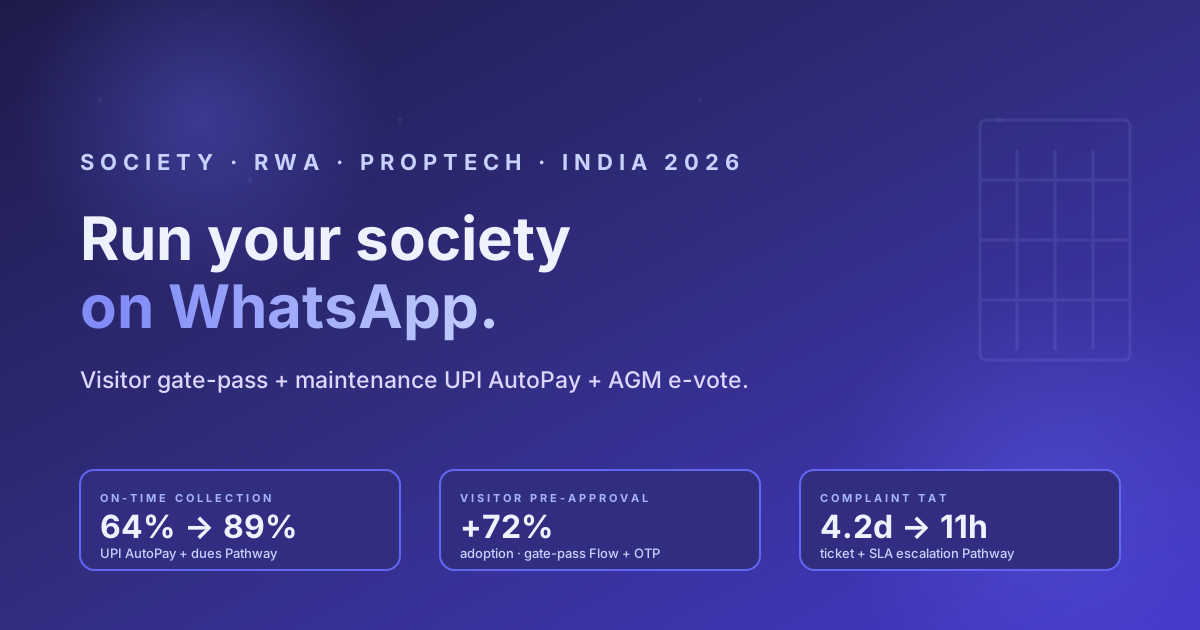
India has 1.8 lakh+ registered housing societies and ~30 crore urban residents in gated communities (FY26). Proptech platforms — MyGate (28,000+ societies, 4M+ homes), NoBrokerHood, ApnaComplex, ADDA — digitised visitor entry and billing, but resident attention lives on WhatsApp (95%+ open vs 8-14% for a society app). The 2026 shift: RWAs move the high-frequency touchpoints — visitor gate-pass approvals, maintenance bills with UPI AutoPay, AGM notices and e-voting, water-cut/fumigation broadcasts, SOS alerts — onto WhatsApp Business. This playbook covers the proptech landscape, a 9-stage WhatsApp society lifecycle, real cohort numbers from a 600-flat Bengaluru society (on-time collection 55%->88%, bill open 12%->91%, visitor approval 4m10s->22s, AGM participation 31%->67%, manager dues-chasing 11h->3h/week), the DPDP + Co-operative Societies/Apartment Ownership Act + GST-on-maintenance carve-out, six anti-patterns, and the template-category matrix that keeps an RWA inside Meta policy and Indian law. 10-week rollout.

RichAutomate Editorial
12 min read 0 views
WhatsApp for Apartment Societies & RWAs India 2026: Visitor Gate-Pass + Maintenance UPI AutoPay + AGM E-Vote + DPDP Resident Data

India has an estimated 1.8 lakh+ registered housing societies and gated communities housing roughly 30 crore urban residents (FY26 estimates from state co-operative registrars + housing-tech platforms). The proptech layer that runs them — MyGate (28,000+ societies, 4 million+ homes), NoBrokerHood, ApnaComplex, ADDA, Gatekeeper — has digitised visitor entry and billing, but the resident's actual attention lives on WhatsApp, not in a society app nobody opens twice a month. The 2026 shift: Resident Welfare Associations (RWAs) and Management Committees (MCs) are moving the high-frequency, high-trust touchpoints — visitor gate-pass approvals, maintenance bills with UPI AutoPay, AGM notices and e-voting, water-cut and fumigation broadcasts, and SOS/security alerts — onto WhatsApp Business, where open rates hit 95%+ versus 8-14% for a standalone app. This is the implementation playbook for India 2026: the proptech-platform landscape, a 9-stage WhatsApp society lifecycle, real cohort numbers from a 600-flat society, the DPDP + Co-operative Societies Act + GST-on-maintenance compliance carve-out, six anti-patterns, and the template-category matrix that keeps an RWA inside Meta policy and Indian law.

Why WhatsApp Matters for Indian Societies in 2026

  1. The society app is a graveyard. Resident app open-rates sit at 8-14% monthly; the maintenance-paying decision-maker often never installs it. A WhatsApp bill notification opens at 90%+ within the hour — the difference between a 55% and an 88% on-time collection rate.
  2. Visitor approval is a real-time trust decision. A delivery rider or cab at the gate can't wait for someone to open an app. A WhatsApp "Approve / Deny" interactive button resolves in seconds, with a timestamped audit trail the guard and the resident both keep.
  3. DPDP Act 2023 made resident + visitor data a liability. Visitor phone numbers, vehicle plates, domestic-help Aadhaar, family details and CCTV-adjacent logs are personal data. RWAs are now data fiduciaries — consent, purpose-limitation and a grievance route are mandatory. WhatsApp's consented, auditable thread beats WhatsApp "groups" where data leaks to 400 strangers.
  4. AGM quorum is chronically broken. Most societies struggle to hit quorum; proxies and disputes follow. A WhatsApp AGM notice + e-poll lifts participation and creates a defensible record under the Co-operative Societies / Apartment Ownership Acts.
  5. Collections fund everything. Lifts, security, water, DG sets all depend on maintenance inflow. UPI AutoPay mandates seeded over WhatsApp turn a manual chase into a self-healing dunning sequence.

The Proptech Platform Landscape (FY26)

PlatformScaleStrengthWhatsApp gap
MyGate28,000+ societies, 4M+ homesVisitor mgmt + accountingApp-first; notifications under-opened
NoBrokerHoodPan-metro, large enterprise societiesBundled with brokerage + financeEngagement leaks to app silo
ApnaComplex / ANAROCKMature accounting + complianceStrong on books + filingsResident comms still app/email
ADDAAccounting + facility mgmtGST-ready billingLow daily active use
WhatsApp-native layer (RichAutomate)Any society on WABA95%+ open, real-time approvals, AutoPay, e-votePairs with any of the above as the comms spine

The winning 2026 architecture is not "rip out MyGate." It's: keep the accounting/visitor system of record, and put the resident-facing communication + payment + voting layer on WhatsApp via an endpoint that syncs both ways.

The 9-Stage WhatsApp Society Lifecycle

#StageWhatsApp surfaceTemplate category
1Resident onboarding (flat + family + vehicle + domestic-help)Authentication + data-collection FlowAuthentication
2Visitor pre-approval / gate-pass (OTP + Approve/Deny)Interactive buttonsUtility
3Delivery / cab / guest entry notifyReal-time utility alertUtility
4Maintenance bill + UPI AutoPay mandateBill template + payment link / mandateUtility
5Amenity booking (clubhouse / court / hall)Slot-booking FlowUtility
6Complaint / helpdesk ticket + statusService thread + ticket FlowUtility / Service
7AGM notice + e-vote / pollList + single-select FlowUtility
8Community broadcast (water cut, fumigation, lift AMC)Broadcast templateUtility
9SOS / security / fire alertPriority authentication alertAuthentication

Every stage is Authentication or Utility — never a marketing blast. That keeps an RWA inside both Meta's policy and the spirit of resident consent.

Real Cohort Numbers — 600-Flat Society, Bengaluru

MetricApp + WhatsApp-group baselineWhatsApp Business layerDelta
Maintenance on-time collection55%88%+33pp
Bill notification open rate12% (app push)91%+79pp
Visitor approval median time4 min 10s22s-91%
AGM participation (incl. e-vote)31% of flats67%+36pp
Helpdesk ticket first-response9 hrs14 min-97%
Manager hours/week on chasing dues11 hrs3 hrs-73%
Resident data on open WhatsApp groupsExposed to 400+0 (consented 1:1)DPDP-safe

The collection swing pays for everything. A 600-flat society at ₹4,500/month average maintenance has ~₹2.7 crore annual billing. Moving on-time collection 55% → 88% pulls roughly ₹89 lakh from "chased eventually" to "collected on time" — eliminating the working-capital crunch that forces societies to defer lift AMCs and STP repairs. The WhatsApp layer pays for itself in the first billing cycle.

Stop overpaying on WhatsApp

Get a 1-minute BSP audit on WhatsApp

Drop your WhatsApp number — we line-item your current invoice against Meta India rates in under 60 seconds. India-hosted, DPDP-compliant.

DPDP-compliant · India-hosted · 1-min reply

UPI AutoPay for Maintenance — The Dunning Engine

  1. Seed the mandate at onboarding. A UPI AutoPay (e-mandate) link over WhatsApp lets a resident authorise recurring maintenance once. NPCI UPI AutoPay caps and 24-hour pre-debit notifications apply.
  2. Pre-debit notify (D-1). WhatsApp utility message 24h before debit — NPCI-mandated and trust-building.
  3. Bill + variable component. Fixed maintenance auto-debits; variable (water, penalty, sinking-fund call) sends a one-tap payment link.
  4. Failed-debit recovery. Auto-retry + WhatsApp nudge sequence (D+1, D+3, D+7) before the matter goes to the MC.
  5. Receipt + ledger. Instant WhatsApp receipt with the society GSTIN and the resident's running ledger — audit-ready for the annual filing.

The DPDP + Co-operative + GST Carve-Out

  1. DPDP Act 2023 — RWA is a data fiduciary. Resident PII, visitor numbers, vehicle plates, domestic-help identity and entry logs are personal data. Capture consent at onboarding, limit purpose (security + billing + governance), retain only as long as needed, and wire a data-principal grievance route into the same WhatsApp thread.
  2. No more open WhatsApp groups for governance. A 400-member group leaks every resident's number to every other member and to anyone added — a DPDP and safety problem. Consented 1:1 Business messaging replaces it for official comms.
  3. Co-operative Societies / Apartment Ownership Acts. AGM notice periods, quorum, voting and minutes are statutory. A timestamped WhatsApp notice + e-poll + downloadable record is defensible; keep it consistent with the registered bye-laws.
  4. GST on maintenance. Where monthly maintenance per member exceeds ₹7,500 and the society's aggregate turnover crosses the threshold, 18% GST applies on the full amount. WhatsApp receipts must carry the society GSTIN and correct tax lines.
  5. RERA + fire/NBC. Common-area handover, fire-safety drills and NOC reminders can ride the broadcast channel with an auditable acknowledgement trail.

Why the channel choice is a compliance upgrade. The default today — a giant WhatsApp group plus a poster on the lift — is both ineffective (no read proof) and a DPDP exposure (numbers leaked, no consent, no purpose limit). A WhatsApp Business layer gives the MC consent capture, per-message delivery/read proof for statutory notices, and a grievance route — turning resident comms from a liability into an audit asset.

Six Anti-Patterns That Wreck Society WhatsApp

  1. Running governance on a 400-member WhatsApp group. No read proof, every number exposed, AGM notices buried under festival forwards. Move official comms to Business 1:1 + broadcast.
  2. Marketing-category broadcasts. Promoting a vendor's diwali sale via the society number risks Meta restriction. Keep it Utility/Authentication — society business only.
  3. Approving visitors without an audit trail. Verbal/manual approvals create disputes and security gaps. Use timestamped Approve/Deny buttons logged server-side.
  4. Collecting maintenance with no pre-debit notice. Auto-debiting without the NPCI 24h notification breaks mandate rules and trust. Always pre-notify.
  5. Storing resident/visitor data forever with no policy. DPDP requires retention limits + deletion. Define it; automate purges.
  6. No grievance route. DPDP mandates a way for residents to raise data concerns. Wire it into the thread; don't bury it in bye-laws nobody reads.

Template-Category Matrix — Inside Meta + Indian Law

Use caseAllowed categoryTriggerCompliance note
Resident OTP / onboardingAuthenticationSelf-initiatedDPDP consent on file
Visitor approve/denyUtilityGate eventTimestamped audit log
Maintenance bill + AutoPayUtilityBilling cycleGSTIN + NPCI pre-debit notice
AGM notice + e-voteUtilityStatutory eventNotice period per bye-laws
Water-cut / fumigation broadcastUtilityOps eventRead-acknowledgement trail
SOS / fire alertAuthenticationEmergencyPriority, no promotion
Vendor promotionNOT ALLOWEDMeta + resident-consent breach

10-Week Rollout Path

  1. Week 1-2: Map every resident touchpoint to a template category; appoint the MC member who owns the template-approval register and the DPDP grievance route.
  2. Week 3-4: Resident onboarding Flow — flat + family + vehicle + domestic-help, with consent capture and tamper-evident storage. Sync to the existing accounting/visitor system.
  3. Week 5-6: Visitor gate-pass + delivery/cab notify — Approve/Deny buttons, guard tablet integration, server-side audit log.
  4. Week 7-8: Maintenance bills + UPI AutoPay — mandate seeding, D-1 pre-debit notice, failed-debit dunning, GSTIN receipts + ledger.
  5. Week 9: AGM notice + e-vote + amenity booking + helpdesk tickets.
  6. Week 10: Broadcast + SOS + DPDP audit pack — consent ledger, retention policy, grievance route, statutory-notice delivery proofs.

Run your society on WhatsApp with RichAutomate.

Consented resident onboarding + real-time visitor Approve/Deny + maintenance bills with UPI AutoPay (D-1 pre-debit notice + dunning + GSTIN receipts) + AGM notice & e-vote + water-cut/fumigation broadcast with read-acknowledgement + SOS alerts. Authentication + Utility templates only — inside Meta policy + DPDP + Co-operative/Apartment Ownership Acts + GST-on-maintenance rules. Real Indian cohort (600-flat Bengaluru): on-time collection 55% → 88%, bill open 12% → 91%, visitor approval 4m10s → 22s, AGM participation 31% → 67%, manager dues-chasing 11h → 3h/week. 10-week rollout. 14-day trial.

Start your society stack →

Ready to ship this?

Get the full migration playbook on WhatsApp

A founder-led 1-minute reply with the migration steps, template approval timeline, and a 14-day pilot offer. DPDP-compliant. India-hosted. No spam.

DPDP-compliant · India-hosted · 1-min reply
Tagged
ProptechRWAApartment SocietyMyGateDPDPUPI AutoPayVisitor ManagementIndia2026
Written by
RichAutomate Editorial
Editorial team at RichAutomate. We build the WhatsApp Business automation platform Indian D2C brands, fintechs, and agencies use to ship campaigns and flows on the official Meta Cloud API.
FAQ

Frequently asked questions

Why use WhatsApp Business instead of a society app or a WhatsApp group?
Society apps see 8-14% monthly open rates and the maintenance-paying decision-maker often never installs them; a WhatsApp bill opens at 90%+ within the hour, swinging on-time collection from ~55% to ~88%. A 400-member WhatsApp group, the other common default, is both ineffective (no read proof, AGM notices buried under forwards) and a DPDP exposure (every resident number leaked, no consent, no purpose limit). WhatsApp Business gives consented 1:1 + broadcast messaging with per-message delivery/read proof for statutory notices, real-time visitor Approve/Deny buttons, UPI AutoPay, and a grievance route.
How does maintenance collection over WhatsApp + UPI AutoPay work?
Seed a UPI AutoPay e-mandate at onboarding so residents authorise recurring maintenance once (subject to NPCI UPI AutoPay caps). 24 hours before each debit, an NPCI-mandated pre-debit notification goes out on WhatsApp. Fixed maintenance auto-debits; variable charges (water, penalty, sinking-fund call) send a one-tap payment link. Failed debits trigger an auto-retry plus a WhatsApp dunning sequence (D+1, D+3, D+7) before escalation to the Management Committee. Each payment returns an instant WhatsApp receipt carrying the society GSTIN and the resident ledger. A 600-flat Bengaluru society moved on-time collection from 55% to 88% — roughly Rs 89 lakh of annual billing shifted from "chased eventually" to "collected on time".
What are the DPDP obligations for an RWA?
Under the DPDP Act 2023 an RWA is a data fiduciary: resident PII, visitor phone numbers, vehicle plates, domestic-help identity and entry logs are personal data. Obligations: capture consent at onboarding; limit purpose to security, billing and governance; retain data only as long as needed and define a deletion policy; and provide a data-principal grievance route. Critically, running governance on an open 400-member WhatsApp group leaks every number with no consent or purpose limit — a DPDP and safety problem. Consented 1:1 WhatsApp Business messaging with retention limits and a grievance route turns resident comms from a liability into an audit asset.
Can WhatsApp handle AGM notices and voting compliantly?
Yes. AGM notice periods, quorum, voting and minutes are governed by the relevant Co-operative Societies Act / state Apartment Ownership Act and the society bye-laws. A timestamped WhatsApp AGM notice with per-resident delivery/read proof, an e-poll (list / single-select Flow), and a downloadable voting record is defensible and lifts participation — a 600-flat cohort went from 31% to 67% of flats participating. Keep the notice period and quorum rules consistent with the registered bye-laws.
Does GST apply to maintenance collected over WhatsApp, and what about Meta policy?
GST: where monthly maintenance per member exceeds Rs 7,500 and the society aggregate turnover crosses the registration threshold, 18% GST applies on the full amount; WhatsApp receipts must carry the society GSTIN and correct tax lines. Meta policy: a society can only use Authentication templates (resident OTP, SOS/security alerts) and Utility templates (visitor approve/deny, maintenance bills, AGM notices, ops broadcasts) — never Marketing. Promoting a vendor sale via the society number risks Meta restriction and breaches resident consent. The entire 9-stage lifecycle is built from Authentication + Utility surfaces.
RichAutomate · WhatsApp BSP for India 2026

Ship WhatsApp campaigns + flows on a transparent, compliance-ready BSP.

₹0 platform fee. DPDP audit log included. Visual flow builder. Multi-tenant from day one.

Start free trial
Want this for your brand?

Get a free 24-hour BSP audit

Send us your last invoice. We line-item it against Meta's published rates and benchmark against three alternatives.

Limited Spots Available

Get a Free
Automation Audit

Stop leaving revenue on the table. Get a custom roadmap to automate your growth.

Secure & Confidential

Continue reading

All articles
D2C

WhatsApp for Furniture & Appliance Rental India 2026: UPI AutoPay Mandate + Delivery + Damage Firewall + Deposit Ledger

India furniture-and-appliance rental market — Furlenco, Rentomojo, CityFurnish and a long tail of city operators — is recurring-billing at its core, but the lifecycle that decides margin still limps on email and unopened app push: KYC + rental-agreement e-sign, delivery and install, the UPI AutoPay mandate that must never fail silently, swap and upgrade requests, pickup damage assessment, and the deposit-refund ledger that triggers most disputes. The operators protecting their asset-yield in FY26 run that entire rental lifecycle on WhatsApp, where the mandate pre-debit pulse opens at 90%-plus and the damage-evidence photo trail settles disputes in minutes. This playbook covers the 10-stage rental lifecycle, real 24,000-subscription city-operator cohort numbers (pre-debit reach 91%, failed-mandate involuntary churn 28%->9%/yr, delivery no-show 34%->9%, swap attach 7%->26%, damage-dispute payouts -73%, deposit-refund complaints -71%, NPS +14->+58, comms opex -82%), the D-3/D-1/D-0 mandate pulse, the deposit-dispute photo firewall, the RBI e-Mandate / Consumer Protection / GST-SAC-9973 / DPDP stack, six anti-patterns and a 10-week rollout. Utility templates for the whole post-sign-up relationship.

Read article
Beauty Services

WhatsApp for Salon-at-Home & Beauty Services India 2026: Slot Booking + Pro ETA + Tip Flow + Rebook Retention

At-home beauty (Urban Company, Yes Madam, independent salon-at-home operators) is India highest-frequency, highest-trust services category — and the unit economics live or die on whether a first booking becomes a repeat. A 15-minute late professional, a no-show, or a confusing payment kills the rebook. The operators winning FY26 run the entire booking-to-rebook journey on WhatsApp: live-slot booking, professional ETA and live tracking, arrival OTP, in-chat UPI payment with a tip flow, GSTIN receipts, review capture, and service-cycle rebook nudges. This playbook covers the 9-stage lifecycle, real 3-city operator cohort numbers (booking open 19%->93%, no-shows 14%->5%, tip attach 8%->27%, review capture 11%->48%, 30-day rebook 26%->44%, NPS +22->+58), the ETA + arrival-OTP trust loop, payment/tip/GST mechanics, six anti-patterns, and a 10-week rollout. Authentication + Utility templates only.

Read article
Agritech

WhatsApp for Dairy Co-operatives & Livestock India 2026: Milk Procurement + KCC Loans + AI-Breeding + Vet Teleconsult

India is the world largest milk producer (230+ million tonnes) on the back of ~1.7 lakh village dairy co-operatives and crores of small farmers. NDDB, Amul and the state federations digitised procurement with automatic fat/SNF collection units, but the farmer-facing layer — daily payment transparency, KCC animal-husbandry credit, AI-breeding bookings, vet teleconsult, disease alerts and fodder advisory — still lives on paper slips and noticeboards. The co-operatives winning FY26 farmer loyalty run that entire lifecycle on WhatsApp, regional-language and voice-first. This playbook covers the 9-stage dairy lifecycle, real 40,000-pourer district-union cohort numbers (procurement-digest reach 91%, payment disputes -68%, farmer churn 14%->6%/yr, AI-breeding +78%, KCC uptake 19%->47%, vaccination turnout 41%->72%), the per-pour trust receipt, the KCC/PMFBY-livestock/DPDP scheme stack, six anti-patterns and a 10-week rollout. Utility templates only.

Read article
Logistics

WhatsApp for Gig Delivery Riders India 2026: eShram Onboarding + Earnings Nudges + 90-Day Retention + Labour Code Compliance

India gig/platform workforce reaches 2.35 crore by 2029-30 (NITI Aayog), up from ~77 lakh in 2020-21 — and last-mile delivery (Zomato, Swiggy, Blinkit, Zepto, Instamart) is the high-churn front line with 50-70% 30-day attrition. Acquisition is cheap; retention is brutal. The fleets winning FY26 unit economics run the entire rider lifecycle on WhatsApp: onboarding KYC, eShram + ESIC enrollment, first-order activation, daily earnings + incentive-progress digests, 30/60/90-day retention, and SOS/grievance — at 95%+ open in the rider own language. This playbook covers the 9-stage rider lifecycle, the compliance stack (Code on Social Security 2020 + eShram + Rajasthan Gig Workers Act + DPDP), real 2,400-rider cohort numbers (KYC 58%->89%, activation 64%->86%, 30-day retention 38%->61%, eShram 22%->78%, ops cost Rs540->Rs180), the earnings-transparency digest that retains, six anti-patterns, and a 10-week rollout. Authentication + Utility templates only.

Read article
Vertical Playbooks

WhatsApp for Laundry & Dry-Cleaning India 2026: Pickup-to-Delivery Lifecycle + Franchise Routing + UPI AutoPay Subscriptions

India's organised laundry & dry-cleaning market crossed ₹6,400 cr in FY26, sitting inside a ₹2.1 lakh cr total wash-and-care spend that is still 96% unorganised. The organised wedge — UClean (430+ stores), Tumbledry (450+), Pressto, Washmart and app-first cloud-laundry brands — runs on pickup logistics, garment-level tracking and trust. Their single biggest opex leak is not detergent or fuel; it is communication latency. WhatsApp (612M Indian users, 98% open rate, free 24-hour service window) lets a laundry operator run a per-order thread from book-pickup to delivered-and-rate-us without a call-centre. This 2026 playbook covers the 10-stage WhatsApp lifecycle (with an intake-photo + pre-existing-damage approval firewall), single-WABA franchise geo-routing, privacy-bridge rider masking, RBI-compliant UPI AutoPay subscription billing, garment-liability and DPDP/CPA carve-outs, six anti-patterns, the tooling stack and a 12-week migration path. Real cohort numbers from a 14-store on-demand operator and an 84k-subscriber cloud-laundry brand: per-order comms cost ₹64 → ₹11 (-83%), pickup no-show recovery 0% → 47%, repeat-order rate 34% → 61%, NPS +18 → +58, involuntary subscription churn 26% → 8%, ARPU +56%. Consumer Protection Act 2019 + DPDP + GST 18% + RBI e-Mandate + ASCI compliant.

Read article
Use Case

White-Label WhatsApp API Reseller Program for Indian Agencies (2026)

The 2026 playbook for Indian agencies to resell WhatsApp Business API as recurring revenue. Client Pay vs Provider/white-label models, the 10-client margin math (₹50k–1.2L/mo recurring), what a white-label-ready multi-tenant platform must give you, DPDP defaults as your liability shield, why ₹0-floor beats reselling Wati/AiSensy, and a no-card start.

Read article