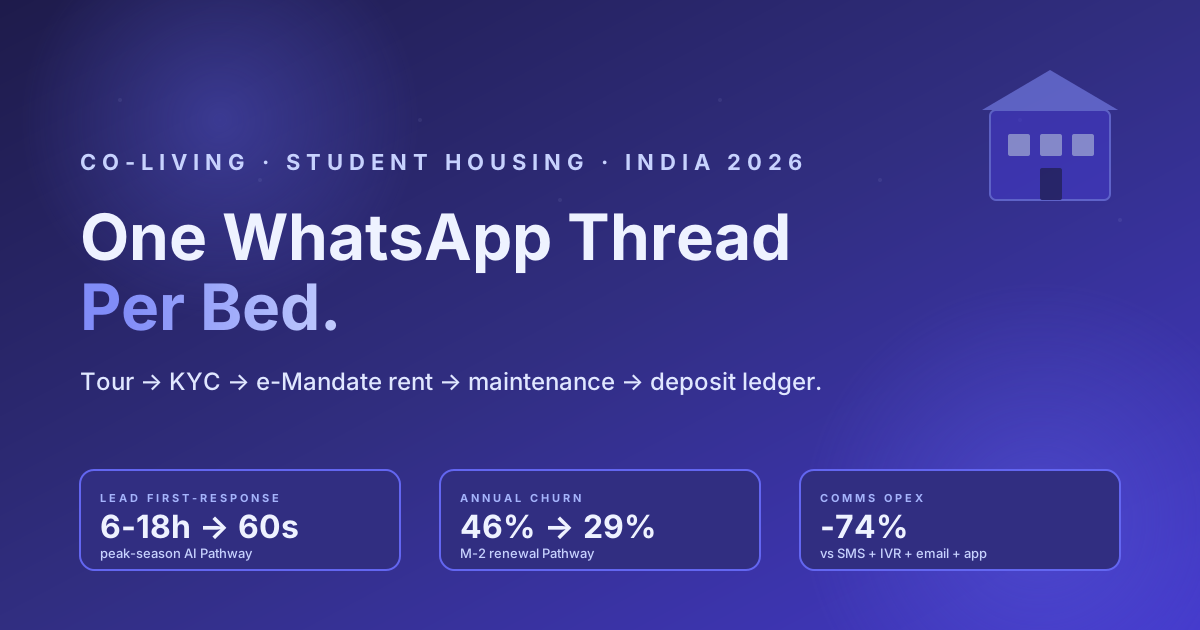
India's organised co-living + managed student-housing market crossed ₹38,400 crore in operator-managed gross billing in FY26 (JLL India Co-Living Report 2026 + Anarock Living Sector Brief + Knight Frank Student Housing Outlook), spread across roughly 9.4 lakh managed beds run by operators such as Stanza Living, Zolo, Settl, Colive, Your-Space, Amber, University Living and a long tail of 4,800+ regional PG-aggregators. The cohort is brutally seasonal: 71% of net new occupancy is locked in a 9-week June-to-August admission window, churn runs 38-54% per academic year, and the single largest operating-cost leak is not rent default — it is the comms layer. A 1,200-bed operator typically runs SMS + IVR + email + a self-built app, pays ₹6.8-8.4 lakh/month for it, and still loses move-ins because a prospect's WhatsApp enquiry sat unanswered for 6-18 hours during peak season. In 2026 the operators winning the occupancy war have collapsed the entire resident journey — discovery, virtual tour, KYC, token, rent e-mandate, maintenance ticket, deposit refund — onto one WhatsApp thread per bed. This deep-research guide is the implementation playbook for Indian co-living + student-housing + PG operators: the FY26 market map, the regulatory stack (Model Tenancy Act + state PG rules + RERA-managed-asset overlay + DPDP + UGC/AICTE hostel norms), a 10-stage WhatsApp lifecycle, real operator cohort numbers, three comparison tables, the integration stack, and the anti-patterns that quietly burn occupancy.
Why WhatsApp Is the Spine of Co-Living Operations in 2026
Six structural reasons WhatsApp moved from a marketing channel to the operating system of an Indian co-living asset:
- The resident is 18-26 and lives on WhatsApp. The managed-housing demographic is overwhelmingly students + first-job migrants. Email open rates in this cohort sit at 9-14%; WhatsApp utility-template open rates run 84-94%. A rent reminder on email is theatre; on WhatsApp it gets read in minutes.
- The journey is multi-party. A single bed involves the prospect, a parent (who usually pays), the property manager, and a warden/caretaker. WhatsApp's threaded model lets you run a parent sub-thread (payment + safety) parallel to the student thread (move-in + maintenance) without a clunky portal nobody installs.
- Seasonality punishes slow response. In the June-August crunch, lead-to-response latency is destiny. Operators that auto-respond in under 60 seconds and book a virtual tour inside the thread convert 2.4-3.1× better than those routing through a call-centre queue.
- The 24-hour service window economics are favourable. Resident-initiated maintenance + queries open a free 24-hour service window; most operator replies (ticket updates, "plumber arriving 4pm") ride that window at zero marginal Meta cost.
- Deposit + rent disputes are a reputational liability. Co-living's worst review driver is opaque deposit refunds. A WhatsApp-logged deposit ledger with photo-evidence and a 1-tap dispute path is both a CX win and a Consumer Protection Act defence.
- Vernacular reach to Tier-2/3 parents. The paying parent in Indore, Patna or Coimbatore often prefers Hindi/Telugu/Tamil. Sarvam-1 / AI4Bharat IndicTrans2 / Bhashini ULCA let one WhatsApp pathway serve 23 languages without 23 call-centre desks.
FY26 Market Map: How Big, How Seasonal, How Leaky
The organised slice is still small against a vast unorganised PG base, which is exactly why operator economics are won on retention + occupancy, not just acquisition.
| Segment | FY26 managed beds (est.) | Avg monthly billing/bed | Annual churn | Peak-window share of net new occupancy |
|---|---|---|---|---|
| Premium student housing (near IITs/NITs/private univ) | 2.4 lakh | ₹16,000-28,000 | 34-42% | 78% |
| Mid co-living (working professionals, metro) | 3.8 lakh | ₹11,000-19,000 | 41-48% | 54% |
| Value PG-aggregator (Tier-1/2) | 2.1 lakh | ₹6,500-11,000 | 48-54% | 62% |
| University-tied / managed hostel (UGC/AICTE) | 1.1 lakh | ₹4,000-9,000 | 22-28% | 94% |
The leak nobody puts on a slide. A 1,200-bed mid co-living operator in Bengaluru measured where June-August enquiries died. Of 4,800 inbound WhatsApp/portal enquiries, 31% never got a first reply within 2 hours, 22% booked a tour but no reminder was sent and they no-showed, and 14% completed a tour but the token-payment link arrived the next day — by then they had paid a competitor. That is roughly ₹3.4 crore of locked-in annual billing walking out the door over a comms-latency problem, not a product problem.
The 10-Stage WhatsApp Resident Lifecycle
One thread per prospect, promoted to one thread per resident on move-in, with a parallel parent sub-thread. Each stage maps to a WhatsApp surface (template, interactive list/button, Flow, or AI Pathway).
- Discovery + capture. Click-to-WhatsApp ad (or QR on a hostel notice board / campus stall) opens the thread with a free entry-point conversation. AI Pathway captures city + budget + move-in month + gender-preference + university, then segments premium / mid / value.
- Inventory match + virtual tour. Interactive list surfaces 3-5 matching properties with a sub-60KB exterior image each; a tap fires a WhatsApp-hosted 540p walkthrough video (lazy-poster, tap-to-fetch) or books a live video tour slot.
- Tour reminders. Utility-template reminders at T-24h / T-2h with a 1-tap reschedule; auto-detect no-show and trigger a re-book Pathway. This single stage is where most occupancy is recovered.
- KYC + agreement. A WhatsApp Flow collects Aadhaar VID (tokenised, never raw), college ID / employment proof, and parent contact; an Aadhaar-OTP eSign (NSDL / eMudhra, IT Act 2000 Sec 5) executes the leave-and-licence agreement and pushes the signed PDF to DigiLocker.
- Token + booking. A WhatsApp Pay UPI / Razorpay link locks the bed; the thread is promoted from "prospect" to "resident" and a parent sub-thread is opened with the payment receipt + safety brief.
- Move-in + onboarding. Day-0 checklist (bed number, Wi-Fi password, warden contact, house rules, mess timings) as an interactive list; a move-in condition photo set is logged to the deposit ledger as the baseline for refund.
- Rent e-mandate + monthly cycle. RBI e-Mandate / UPI AutoPay v2 set up once; D-3 pre-debit notification, D-0 debit confirmation, D+2 failed-debit rescue Pathway, all on utility templates.
- Maintenance ticketing. Resident sends "AC not cooling" + photo; AI Pathway (Haiku / Gemini Flash) auto-classifies into 14 categories sub-2s, raises a ticket, assigns the right technician, and posts live status — all inside the free service window.
- Community + renewal. Event broadcasts, mess-menu polls, and a renewal Pathway at M-2 / M-1 with a loyalty incentive; this is the highest-ROI stage because re-letting a churned bed costs 4-6× a renewal nudge.
- Move-out + deposit refund. Move-out condition photos vs the move-in baseline, an itemised deduction ledger in-thread, a 1-tap accept-or-dispute, and a refund-status tracker. Disputes route to a human with full photo + ledger context attached.
The Regulatory Stack Operators Must Encode
Co-living sits at an awkward intersection: it is not pure rental tenancy, not a hotel, and increasingly not exempt from data law. The WhatsApp layer must be built around these.
The WhatsApp ROI calculator is more useful than a benchmark here, because the maths swings hard on your margin.
Get a 1-minute BSP audit on WhatsApp
Drop your WhatsApp number — we line-item your current invoice against Meta India rates in under 60 seconds. India-hosted, DPDP-compliant.
| Regulation | What it governs | WhatsApp-layer implication |
|---|---|---|
| Model Tenancy Act 2021 + state adoptions | Written tenancy/licence agreement, deposit caps (commonly 2 months residential), notice periods, dispute via Rent Authority | eSign agreement must be retrievable in-thread; deposit ledger must reflect statutory cap; refund timelines must be tracked and surfaced |
| State PG / lodging-house rules + police verification | Tenant police verification, register upkeep, fire/safety norms (varies: Karnataka, Maharashtra, Telangana, Delhi differ) | KYC Flow must capture verification docs; warden roster + safety brief logged; emergency-contact broadcast capability |
| RERA (managed-asset / lease overlay where applicable) | Disclosure for built-to-suit + long-lease managed assets in some states | Marketing claims in templates must be substantiated; no inventory misrepresentation in the catalog |
| UGC / AICTE hostel guidelines (university-tied) | Anti-ragging, warden ratios, mess hygiene, grievance redressal for student accommodation | Anti-ragging acknowledgement Flow; grievance-escalation Pathway with SLA; mess-feedback loop |
| DPDP Act 2023 | Consent for processing student + parent personal data; minors (under-18 freshers) need verifiable parental consent (Sec 9) | Explicit opt-in template; Aadhaar tokenised not stored raw; under-18 prospects route through parent-consent Flow; breach + erasure handling |
| RBI e-Mandate + NPCI UPI AutoPay v2 | Recurring rent auto-debit framework, 24h pre-debit notification mandatory | D-3/D-0 notification templates are a compliance requirement, not a nicety |
| Consumer Protection Act 2019 + E-Comm Rules | Fair deposit handling, transparent deductions, grievance officer | Itemised in-thread deduction ledger + photo evidence = audit-ready defence against refund complaints |
Why the deposit ledger is the killer feature. The single most common co-living complaint to consumer forums is "deposit not refunded / arbitrary deductions". An operator that logs a timestamped move-in photo set, a move-out photo set, and an itemised deduction ledger inside the same WhatsApp thread — with the resident's 1-tap acknowledgement — converts a he-said-she-said dispute into a documented, Consumer-Protection-Act-defensible record. One 3,400-bed operator cut deposit-related consumer complaints by 71% in two quarters simply by moving the refund ledger into the thread.
Real Operator Cohort Numbers
Cohort: a 1,200-bed mid co-living operator (Bengaluru + Pune), ₹84 crore annual billing, migrated from SMS+IVR+email+self-built-app to a single WhatsApp lifecycle over 12 weeks.
| Metric | Before (SMS+IVR+app) | After (WhatsApp lifecycle) | Delta |
|---|---|---|---|
| Peak-season lead first-response time | 6-18 hours | under 60 seconds (AI Pathway) | -99% |
| Enquiry-to-tour booking rate | 22% | 54% | +32pp |
| Tour no-show rate | 38% | 11% | -27pp |
| Tour-to-token conversion | 31% | 49% | +18pp |
| Rent auto-debit success (first attempt) | 74% | 94% | +20pp |
| Avg maintenance-ticket resolution time | 2.8 days | 14 hours | -79% |
| Annual resident churn | 46% | 29% | -17pp |
| Deposit-dispute consumer complaints | baseline | -71% | — |
| Resident NPS | +18 | +61 | +43 |
| Comms opex (SMS+IVR+email+app) | ₹7.4 L/month | ₹1.9 L/month (WhatsApp) | -74% |
The compounding effect: occupancy held 4-6 percentage points higher through the off-season because the renewal Pathway caught residents at M-2 before they shopped around, and faster maintenance resolution killed the top churn driver. On an ₹84 crore book, a 4-point occupancy lift plus the opex saving is a ₹3.8-4.6 crore swing to the bottom line in year one.
The Integration Stack
| Layer | Tools | Role in the lifecycle |
|---|---|---|
| Property management system (PMS) | Stanza/Zolo in-house PMS, NestAway-era stacks, Cozmo, Hostize, custom | Bed inventory, occupancy, ledger of record; WhatsApp reads/writes bed status + rent ledger |
| Payments | Razorpay AutoPay v2 / Cashfree Recurring / WhatsApp Pay UPI | Token, monthly rent e-mandate, deposit, refund |
| eSign + identity | NSDL / eMudhra Aadhaar OTP eSign, DigiLocker, UIDAI VID tokenisation | Leave-and-licence agreement, KYC, police-verification doc capture |
| AI Pathway | Claude Haiku / Gemini Flash for intent + maintenance classification | Sub-60s lead qualification, 14-category ticket triage, deposit-dispute routing |
| Vernacular voice | Sarvam-1 / AI4Bharat IndicTrans2 / Bhashini ULCA (23 languages) | Parent comms in Tier-2/3 languages, voice-note enquiries |
| Evidence locker | Backblaze B2 India-region (move-in/out photos, signed agreements) | Deposit-ledger photo evidence, multi-year retention for disputes |
| WhatsApp orchestration | RichAutomate template engine + Flows + AI Pathway + broadcast + service-window router | Ties every stage to the right WhatsApp surface at the right cost tier |
Six Anti-Patterns That Quietly Burn Occupancy
- Routing peak-season leads to a call-centre queue. In a 9-week crunch, a 6-hour callback is a lost deal. Auto-respond and book the tour inside the thread, escalate to human only on intent signals.
- Marketing-template spamming residents. Blasting promo templates to in-house residents (instead of riding the free service window for ops messages) burns money and erodes quality rating. Keep ops on utility/service, promos on consented marketing only.
- No move-in photo baseline. Without a timestamped move-in condition set, every move-out deposit deduction is an unwinnable argument. Capture the baseline on Day 0, every time.
- Storing raw Aadhaar in the thread/CRM. A DPDP violation waiting to happen. Tokenise via UIDAI VID, capture through a Flow, never persist the raw number in chat logs.
- Single thread for student + parent. Mixing the payer (parent) and the resident (student) in one thread leaks privacy and muddles consent. Run a parallel parent sub-thread scoped to payment + safety.
- Treating renewal as a March problem. By the time the resident has decided to leave, you have lost. Fire the renewal Pathway at M-2 with a tangible incentive; re-letting a bed costs 4-6× the nudge.
12-Week Migration Path
- Week 1-2: Map the current resident journey, measure first-response latency + no-show + churn baselines, inventory every SMS/IVR/email/app touchpoint, and define the bed-status + rent-ledger fields the WhatsApp layer must read from the PMS.
- Week 3-4: Stand up the discovery → tour → reminder stages: CTWA entry point, inventory-match interactive list, lazy-poster walkthrough video, T-24h/T-2h reminder templates, no-show re-book Pathway.
- Week 5-6: KYC + agreement + token: Aadhaar-VID Flow, eSign integration, DigiLocker push, WhatsApp Pay/Razorpay token link, prospect→resident promotion + parent sub-thread.
- Week 7-8: Rent e-mandate cycle (D-3/D-0/D+2 rescue) + maintenance ticketing Pathway with 14-category auto-classification and live status in the service window.
- Week 9-10: Deposit ledger (move-in/out photo capture + itemised deductions + 1-tap accept/dispute), renewal Pathway at M-2/M-1, vernacular layer for parent comms.
- Week 11-12: Compliance hardening (DPDP consent + tokenisation audit, Model Tenancy + state PG doc checks, Consumer Protection deduction-ledger format), dashboards (occupancy, response latency, NPS), and a quarterly review cadence.
Run your co-living asset on one WhatsApp thread per bed.
Discovery + virtual tour + tour reminders + Aadhaar-VID KYC + eSign leave-and-licence + WhatsApp Pay token + RBI e-Mandate rent (D-3/D-0/D+2 rescue) + 14-category maintenance AI Pathway + deposit ledger with photo evidence + M-2 renewal Pathway — all on RichAutomate, with Sarvam/AI4Bharat/Bhashini 23-language parent comms. Model Tenancy Act + state PG rules + RERA-managed overlay + DPDP Sec 9 minor-consent + RBI e-Mandate + Consumer Protection Act compliant. Real operator cohort (1,200 beds, ₹84 cr billing): lead first-response 6-18h → under 60s, tour no-show 38% → 11%, rent auto-debit 74% → 94%, churn 46% → 29%, deposit complaints -71%, NPS +18 → +61, comms opex -74%. 12-week migration. Real pricing, usage-only: ₹0 platform, ₹0 setup, ₹0 monthly. 14-day trial + 100 free credits.
Residents pay faster when the reminder carries a UPI link. See our rent reminder WhatsApp templates for co-living operators.
Related reading
- WhatsApp for D2C Monthly Subscription Box India 2026: UPI AutoPay v2 + RBI e-Mandate + Swap Engine + Cancel-Save Pathway
- WhatsApp for PG, Hostel & Co-living Operators India 2026
- WhatsApp for Online Gaming + Fantasy Sports Lifecycle India 2026: 9-Stage Thread + 194BA Per-Event Ledger + AIGF Responsible Gaming + DGGI Audit Trail
- WhatsApp for Health Insurance Cashless Claim Lifecycle India 2026: 9-Stage Thread + NHCX Exchange + ABHA-Linked STP + IRDAI 100% Cashless Mandate
- Client Pay vs SaaS Pay: How RichAutomate's Dual WhatsApp Billing Saves Indian D2C ₹21 Lakh/Year